GCSE Foundation Brackets Revision Worksheets
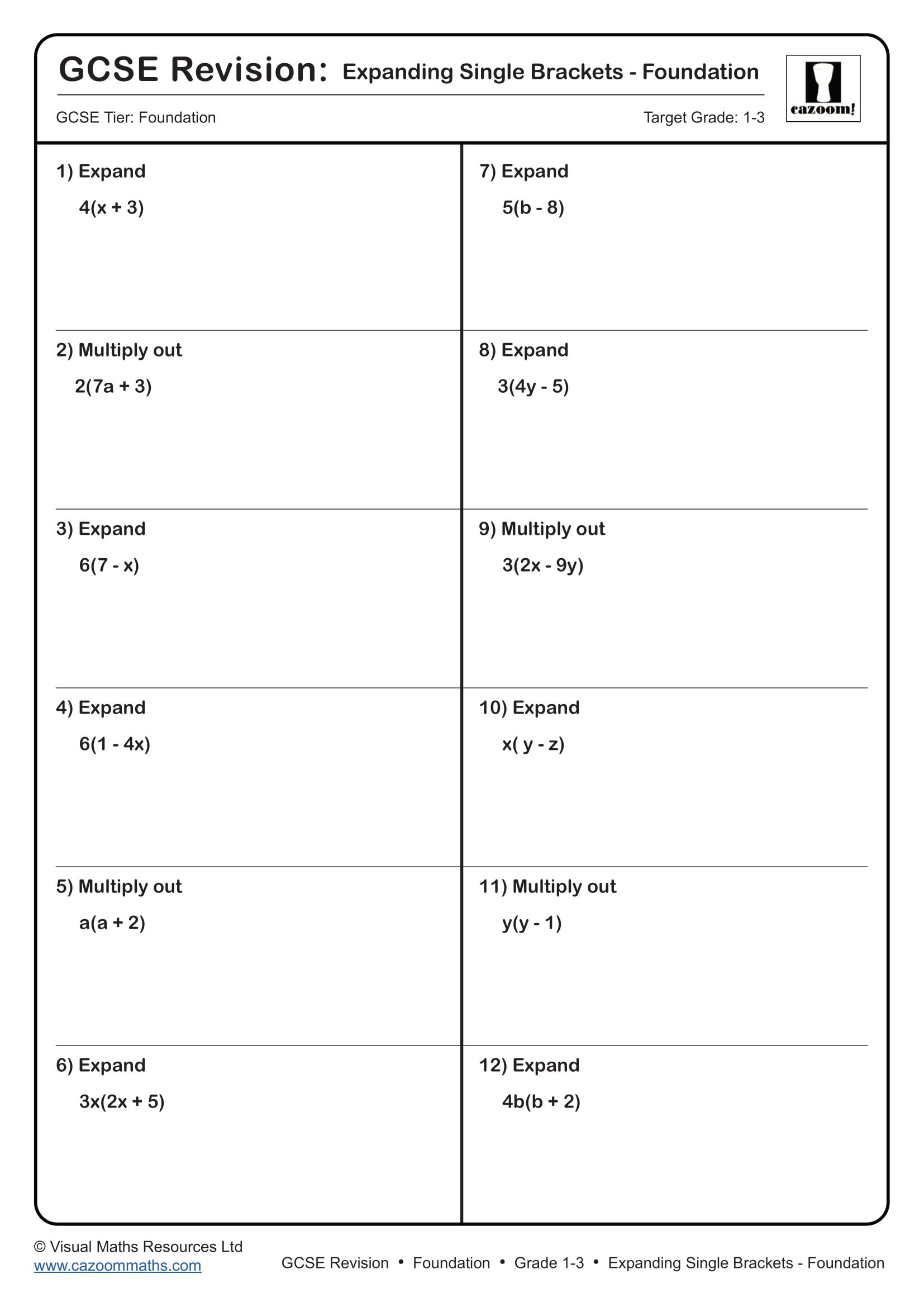
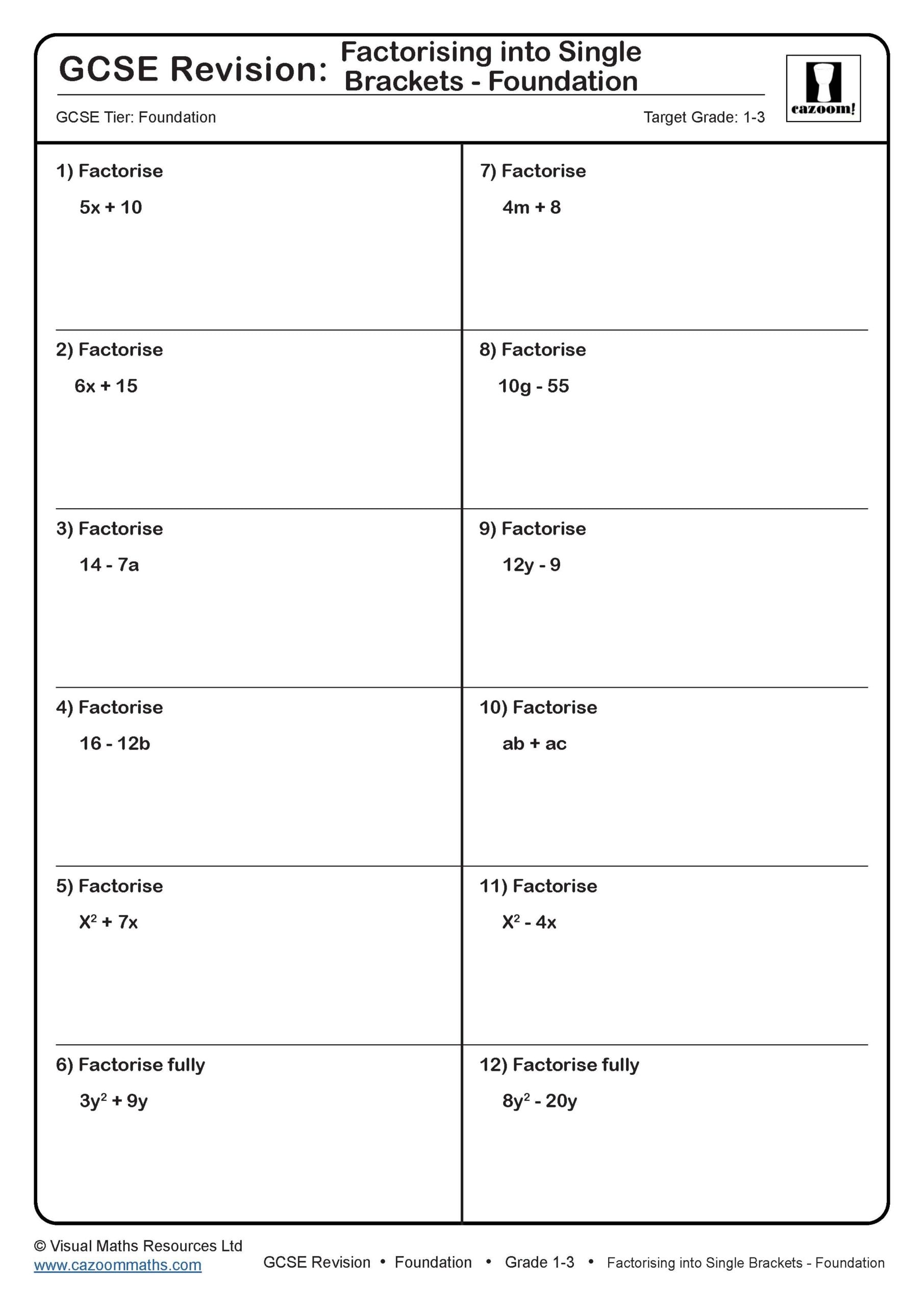
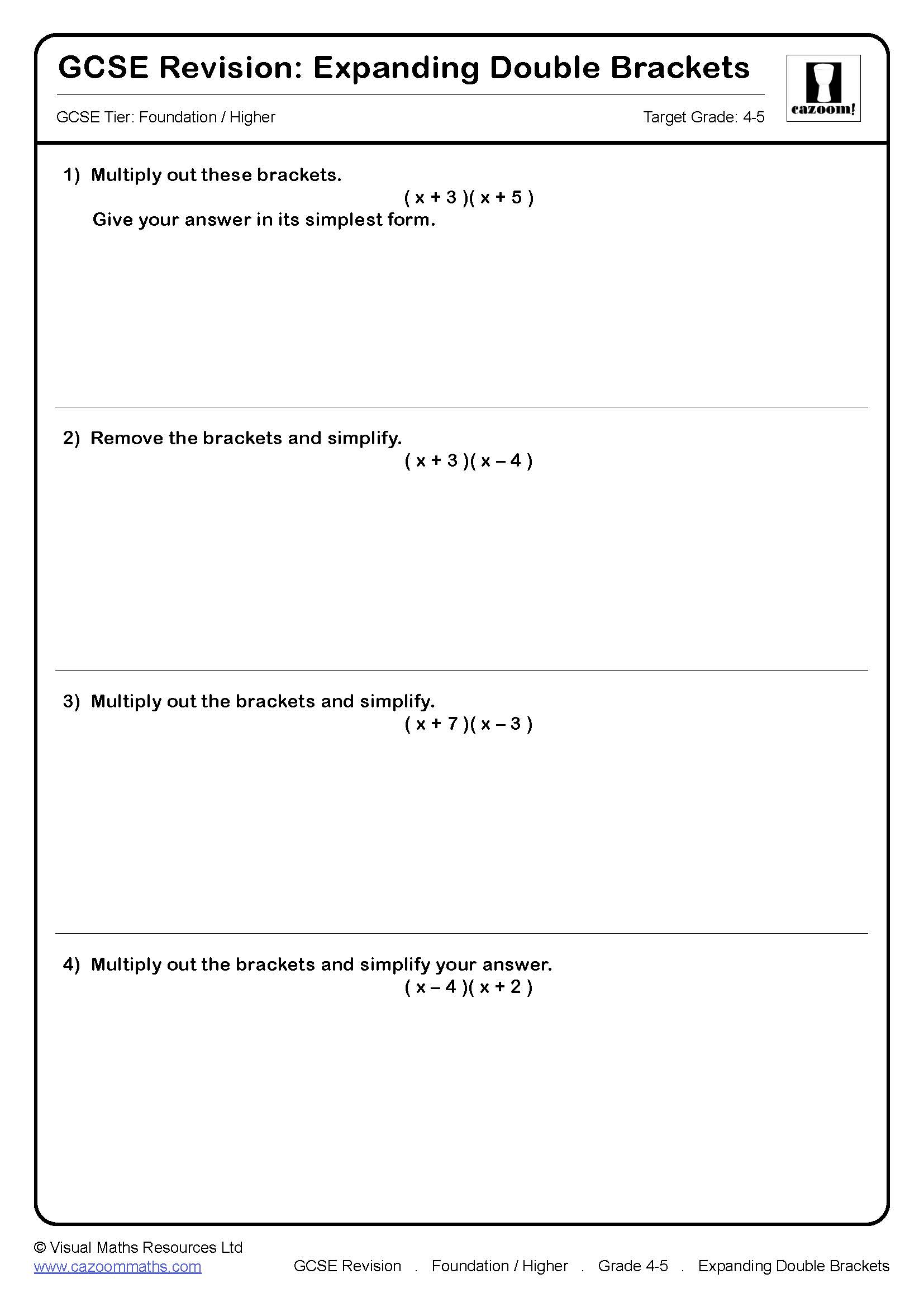
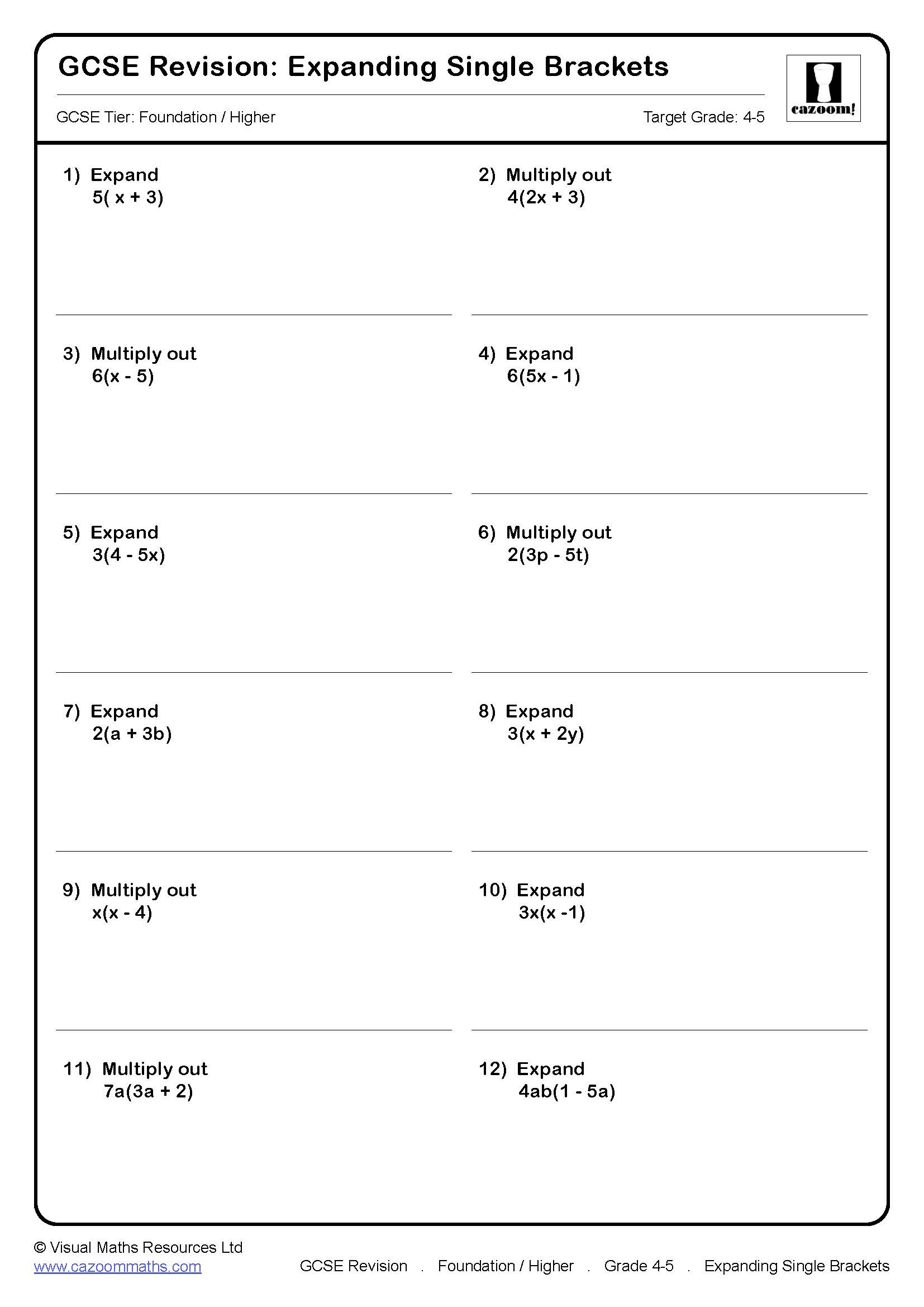
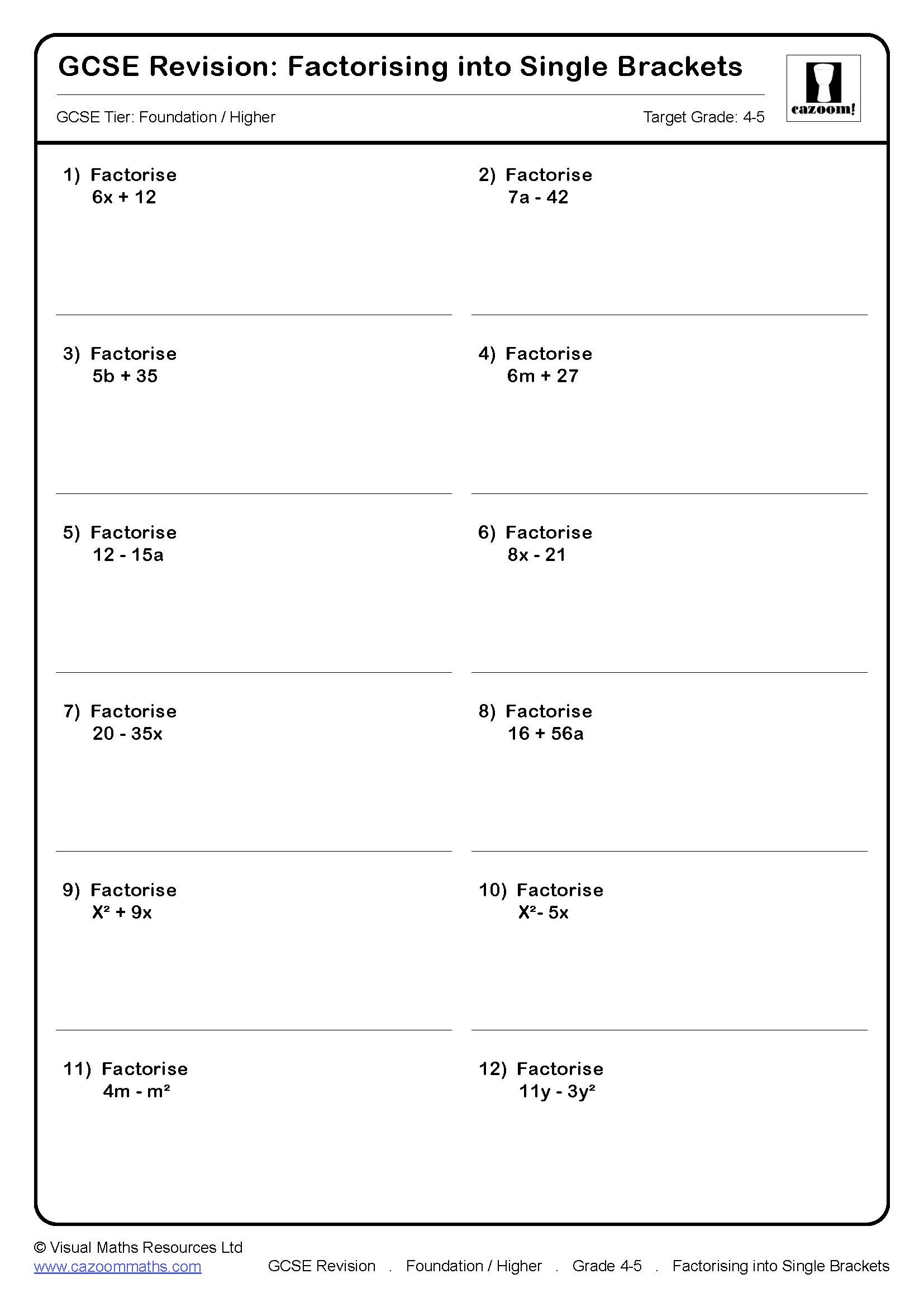
All worksheets are created by the team of experienced teachers at Cazoom Maths.
What Brackets questions appear on the GCSE Foundation paper?
Foundation papers typically include three to five marks on expanding single brackets, often within equation-solving or simplification questions. Students face tasks like expanding 5(2x + 3) or -4(x - 7), then simplifying the result. Factorising questions ask students to write expressions like 6x + 15 as 3(2x + 5), testing their understanding of common factors. These questions appear throughout both papers, not just in dedicated algebra sections.
Mark schemes penalise sign errors heavily. Students lose marks when they expand -2(x + 5) as -2x + 10 instead of -2x - 10. Teachers notice that students who write out the multiplication explicitly (showing -2 × x and -2 × 5) make fewer mistakes than those who try mental shortcuts too early.
What grade are Brackets questions on Foundation GCSE maths?
Basic expanding questions with positive numbers target grades 2-3, whilst expanding brackets containing negative terms or larger coefficients typically appears at grades 4-5. Factorising into single brackets usually sits at grade 4-5 on Foundation, particularly when the common factor isn't immediately obvious. Questions combining bracket work with equation solving or simplifying longer expressions stretch towards grade 5.
Students aiming for grade 4 should prioritise accuracy with negative numbers when expanding, as this separates secure grade 4 performance from grade 3. Those targeting grade 5 need confident factorising skills. Teachers often advise working through grade 3 questions first to build fluency before attempting the trickier grade 4-5 problems that demand more careful attention to algebraic manipulation.
How is Brackets tested differently on Foundation compared to Higher?
Foundation papers focus exclusively on single brackets, with straightforward expanding and factorising tasks. Higher tier extends to expanding double brackets, quadratic factorising, and algebraic fractions involving brackets. Foundation questions use smaller numbers and clearer structures: students might expand 4(x + 6) rather than the Higher equivalent of (2x - 5)(3x + 4). Factorising at Foundation level typically involves obvious common factors.
This Foundation approach ensures students grasp the fundamental principle: brackets represent multiplication distributed across terms. Mastering single brackets provides the foundation for GCSE success, as these skills underpin equation solving throughout the course. Students who secure bracket manipulation at Foundation level arrive at grade 4-5 overlap questions with the confidence needed to handle algebraic reasoning under exam conditions.
How should students revise Brackets for Foundation GCSE maths?
Students should begin with expanding brackets containing positive numbers only, checking each answer immediately to catch sign errors early. Once comfortable, they should progress to brackets with negative multipliers, writing out each step rather than rushing. Factorising practice works best when students first identify the highest common factor before attempting to fill the bracket. Working through 10-15 minutes of focused practice daily proves more effective than marathon revision sessions.
Teachers can use these worksheets for starters to revisit bracket skills regularly, preventing knowledge fade between topics. Setting targeted homework based on recent assessment results helps students address specific weaknesses, whether that's expanding with negatives or spotting common factors. Answer sheets allow students to self-mark and identify patterns in their errors, building the metacognitive skills needed for independent revision.