GCSE Foundation Inequalities Revision Worksheets
All worksheets are created by the team of experienced teachers at Cazoom Maths.
What Inequalities questions appear on the GCSE Foundation paper?
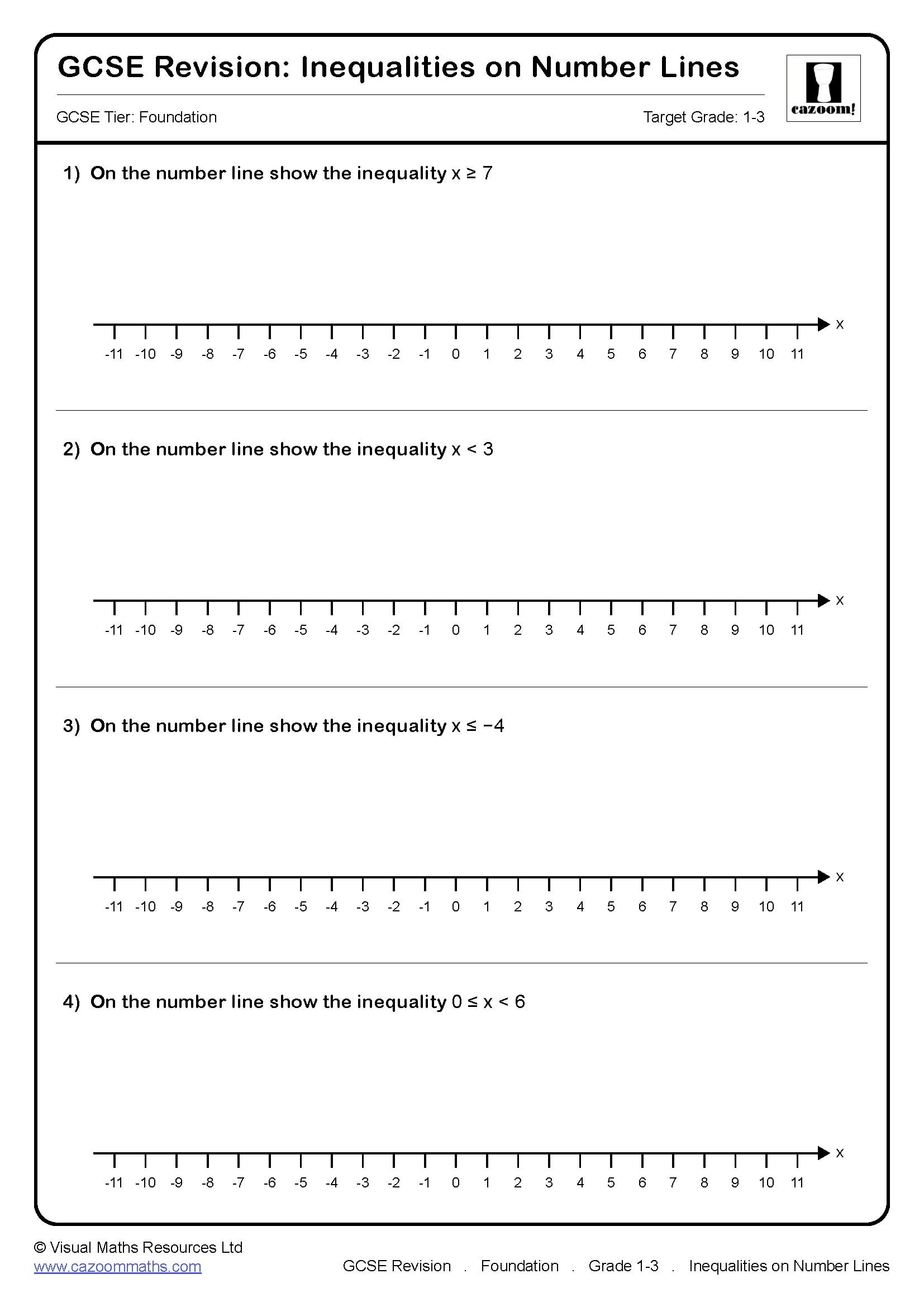
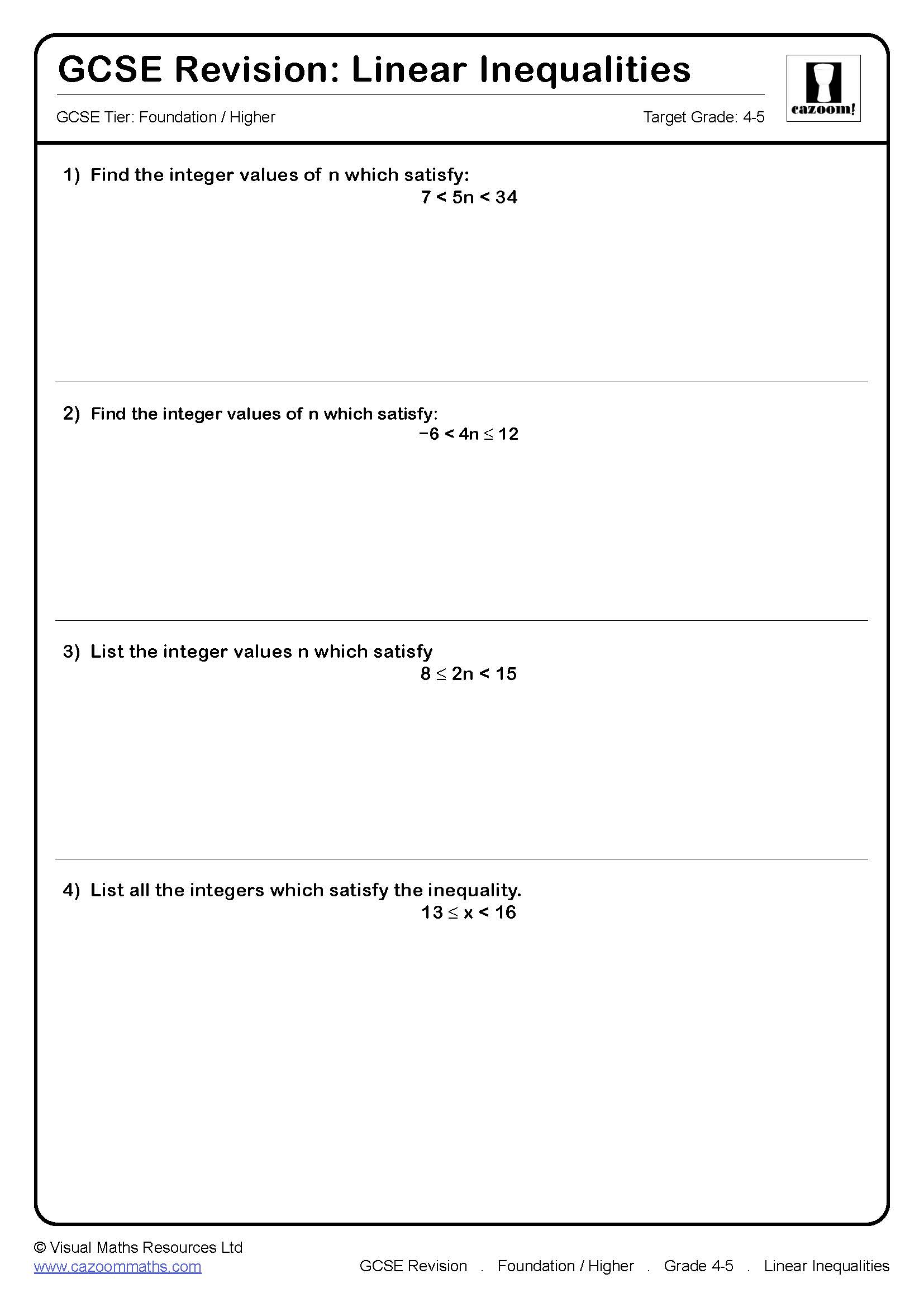
Foundation papers typically include questions on understanding inequality notation (such as x > 3 or x ≤ -2), listing integer values that satisfy an inequality, and representing inequalities on number lines. Students face approximately 6-8 marks across both papers, with questions often worth 1-2 marks each. The number line questions commonly ask students to show a given inequality or write down the inequality shown, testing whether they understand the difference between open and closed circles.
A frequent error occurs when students reverse the inequality symbol after being given a number line to interpret. Exam mark schemes expect precise notation and correctly positioned circles. Students lose marks when they write x < 4 but shade to the right, or use a closed circle when the inequality excludes the boundary value.
What grade are Inequalities questions on Foundation GCSE maths?
Inequalities questions span the full Foundation grade range. Grade 1-3 questions test basic understanding of inequality symbols and listing simple integer solutions, such as finding whole numbers where x < 5. Grade 4-5 questions require students to represent more complex inequalities on number lines, including negative values and boundaries, or solve simple linear inequalities like 2x + 1 > 7. These higher-grade questions often combine skills, asking students to show their working clearly.
Students aiming for grade 4 or 5 should prioritise mastering number line representations, as these questions separate secure from insecure understanding. Those targeting grade 3 benefit from consolidating notation and listing integer solutions first, building confidence before tackling graphical representations. Targeted practice across grade bands ensures no marks are left behind.
How is Inequalities tested differently on Foundation compared to Higher?
Foundation tier focuses on understanding inequality notation, representing single inequalities on number lines, and solving one-step or simple two-step linear inequalities. Questions remain straightforward, with clear boundaries and typically integer solutions. Higher tier extends to solving complex multi-step inequalities, quadratic inequalities, representing regions on coordinate grids, and combining multiple inequalities. The algebraic manipulation required at Higher demands much greater fluency.
The Foundation approach matters because it establishes the foundational understanding of inequality symbols and graphical representation that underpins all future work. Students at this tier need to master reading and drawing number lines accurately, understanding when to use open versus closed circles, and recognising what inequality notation actually means. These core skills secure accessible marks and build confidence for those progressing to Higher content.
How should students revise Inequalities for Foundation GCSE maths?
Students should work through worksheets systematically, starting with recognising inequality notation before progressing to number line representations. Timed practice helps replicate exam conditions, while checking answers immediately after each worksheet identifies specific misconceptions. Drawing number lines repeatedly builds the muscle memory needed to place circles correctly and shade the right direction. Students benefit from verbalising what each inequality means before representing it graphically.
Teachers can use these worksheets for starter activities, targeted intervention with students struggling on inequality notation, or homework to consolidate classwork. Setting specific worksheets based on recent assessment results allows precise gap-filling. The answer sheets enable students to self-mark during independent revision sessions, making these resources valuable for both classroom teaching and home learning when preparing for Foundation tier exams.