GCSE Foundation Proportion, Ratio Revision Worksheets
All worksheets are created by the team of experienced teachers at Cazoom Maths.
What Proportion, Ratio questions appear on the GCSE Foundation paper?
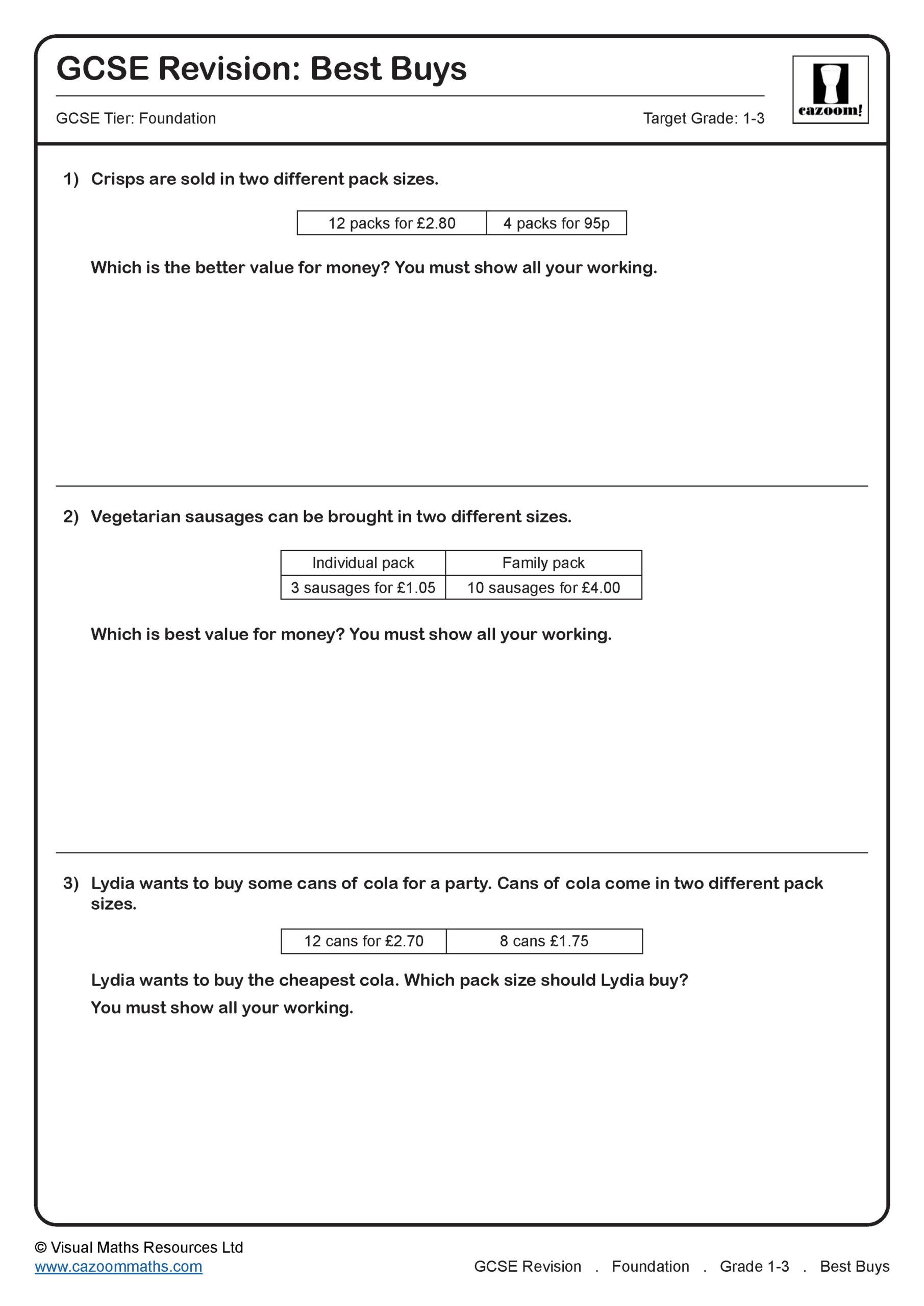
Foundation papers typically include four to six ratio and proportion questions worth around 15-20 marks in total. Students face tasks like sharing amounts in given ratios, simplifying ratios to their simplest form, using ratio notation, solving best buy problems, and working with direct proportion. Questions at grades 1-3 focus on dividing quantities into two parts, whilst grades 4-5 introduce three-part ratios, ratio expressed in the form 1:n, and problems requiring students to find total amounts when given one part.
A common error occurs when students add ratio parts incorrectly. Teachers regularly see answers where students divide by the larger number rather than the total number of parts, particularly in sharing problems involving money or sweets.
What grade are Proportion, Ratio questions on Foundation GCSE maths?
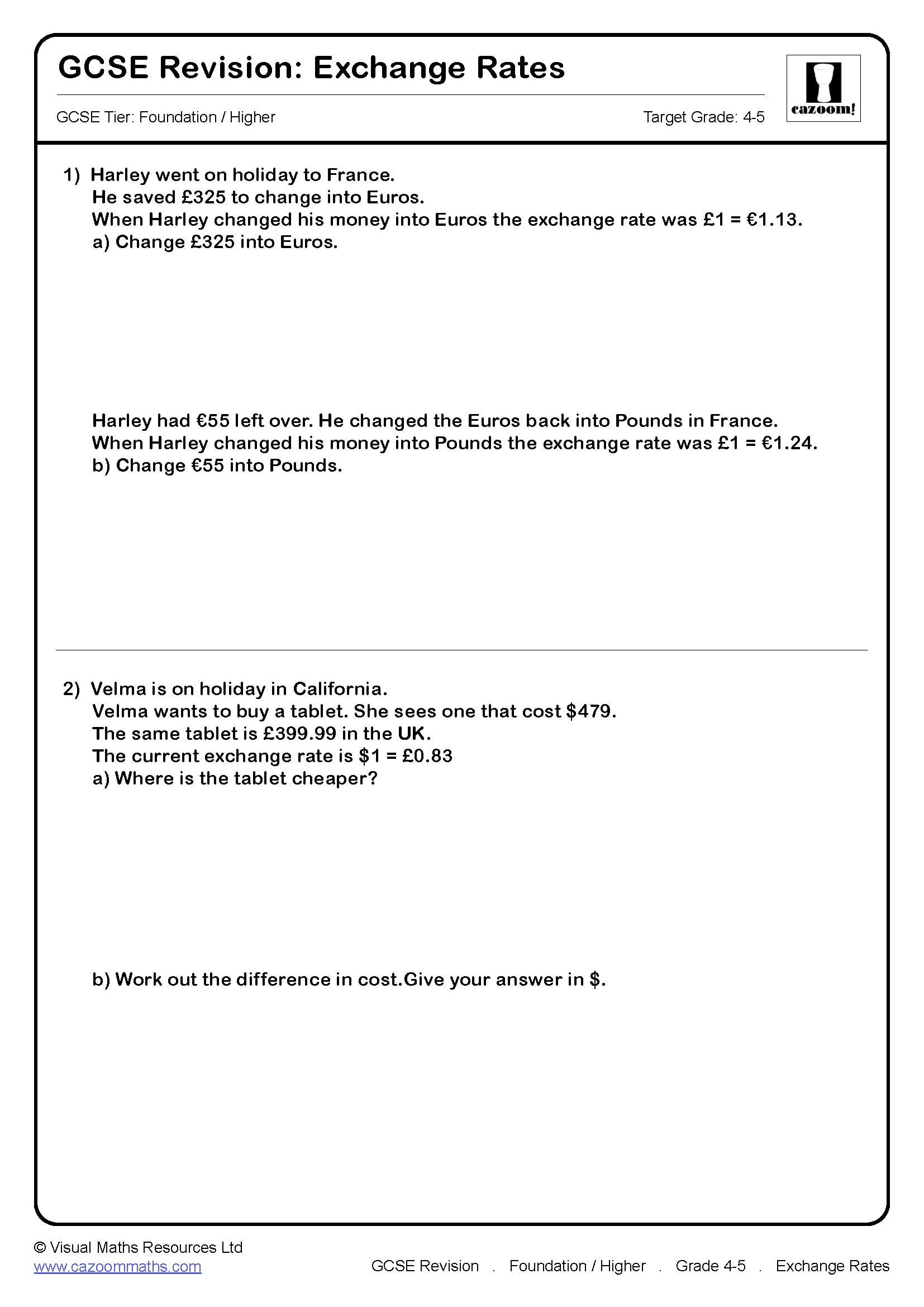
Foundation ratio questions span all five grades. Grades 1-3 questions test basic sharing in simple ratios like 1:2 or 3:1, identifying equivalent ratios, and understanding proportion through scaling recipes or measurements. Grades 4-5 questions require simplifying ratios involving decimals or different units, working backwards from one part to find totals, solving three-part ratio problems, and applying proportion to exchange rates or map scales. The mark schemes at grade 5 expect clear written methods showing ratio calculations.
Students aiming for grade 4 or 5 should ensure they're secure with grades 1-3 content first. Teachers often suggest tackling simpler two-part ratios until automatic, then progressing to more complex scenarios where ratio understanding combines with fractions or percentages.
How is Proportion, Ratio tested differently on Foundation compared to Higher?
Foundation ratio questions emphasise practical applications with whole numbers and straightforward contexts like sharing money or mixing ingredients. Students work with ratios given explicitly and use direct methods to solve problems. Higher tier introduces algebraic ratio problems, compound measures involving proportion, inverse proportion, and questions requiring proof or algebraic manipulation. Higher papers expect students to form and solve equations from ratio information independently, whilst Foundation provides more scaffolding through clearly stated parts.
Foundation students need rock-solid fluency with ratio notation, converting between forms, and recognising when to multiply or divide. Teachers notice that students who can explain their ratio method in words, not just calculate answers, handle grade 5 questions far more successfully than those relying on memorised procedures.
How should students revise Proportion, Ratio for Foundation GCSE maths?
Effective revision involves working systematically through grade bands rather than random practice. Students should start with basic two-part sharing, checking answers immediately to identify misconceptions early. Once confident, they should progress to simplifying ratios with different units, then tackle three-part problems. Timing practice under exam conditions helps build fluency. Teachers observe that students who write out ratio calculations in full, showing total parts and division steps, make fewer errors than those working mentally.
Teachers can use these worksheets for starter activities targeting specific ratio skills or set them as homework following lesson sequences. Grouping students by confidence level and assigning appropriate grade-targeted sheets allows differentiated practice. Answer sheets enable students to self-mark, identifying weak areas for further attention before assessments.