GCSE Foundation Ratio Revision Worksheets
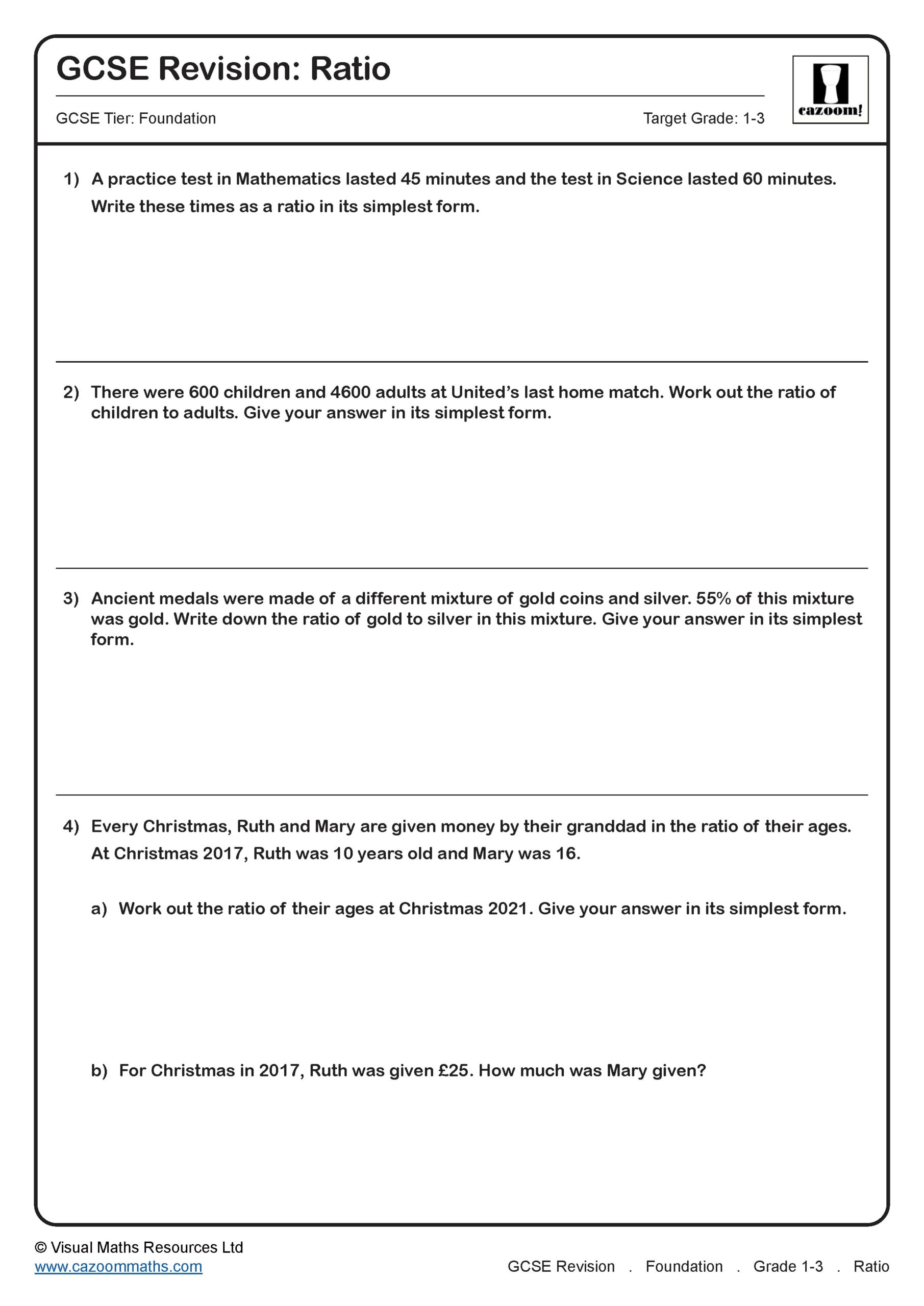
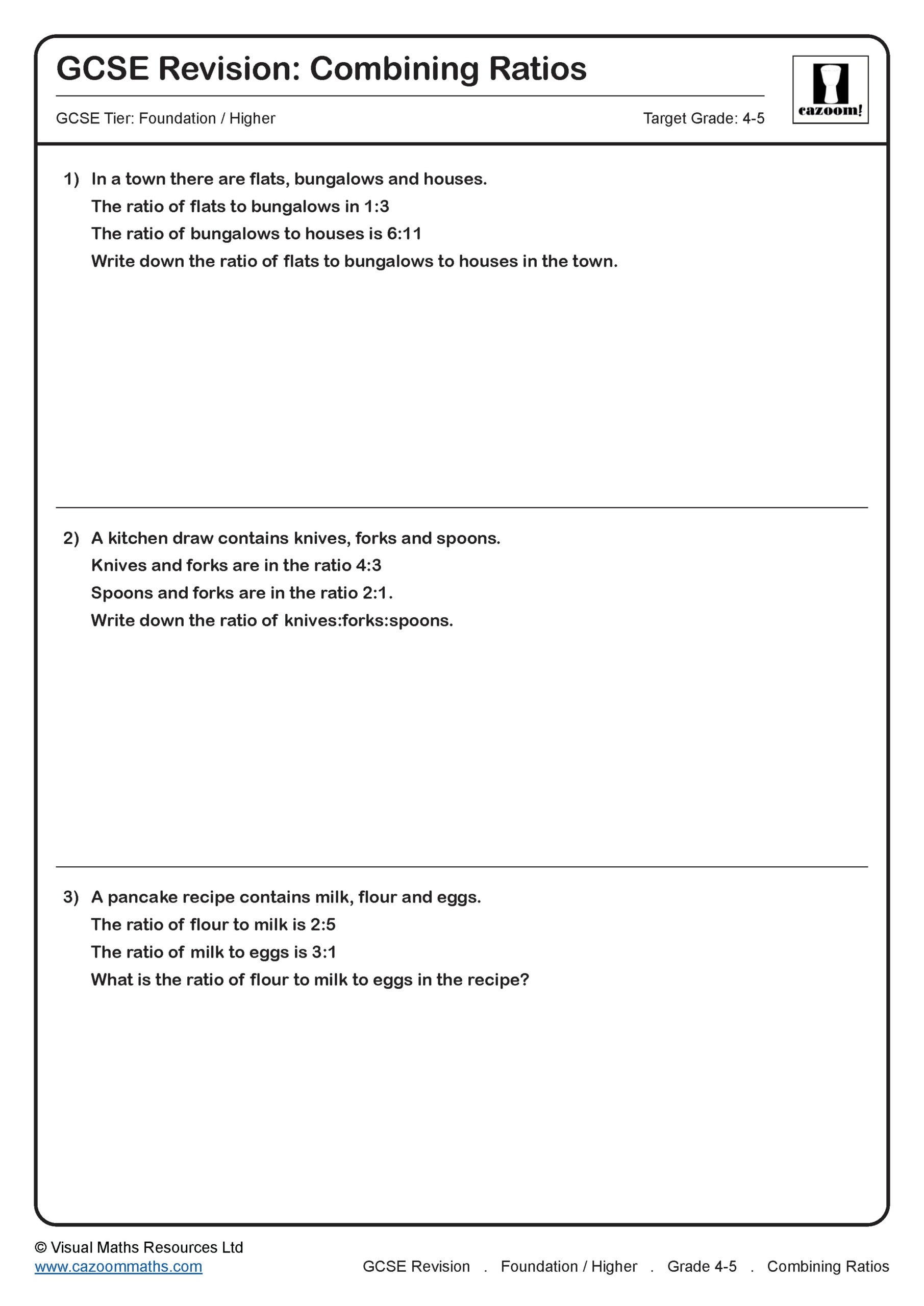
All worksheets are created by the team of experienced teachers at Cazoom Maths.
What Ratio questions appear on the GCSE Foundation paper?
Foundation papers typically include 8-12 marks worth of ratio questions, ranging from straightforward simplification to multi-step problems involving sharing amounts in given ratios. Students face questions asking them to write ratios from diagrams or word problems, reduce ratios to simplest form using common factors, share totals into two or three parts, and find missing quantities when given one part of a ratio. Grade 4-5 questions often involve calculating individual shares when only the difference between parts is known, or working with ratio and money contexts requiring clear working.
Students frequently lose marks by writing ratio answers in the wrong order or forgetting units when the question involves measurements. Exam mark schemes expect ratio notation with colons, not fractions, unless specifically asked to convert. Teachers notice that students who write down the total number of parts as their first step tend to avoid the common error of adding ratio parts incorrectly.
What grade are Ratio questions on Foundation GCSE maths?
Ratio questions span the entire Foundation grade range from 1 to 5. Grade 1-3 questions focus on writing simple ratios, identifying equivalent ratios, and sharing small amounts into two parts using clear whole numbers. Grade 4 questions introduce simplifying ratios using higher common factors, dividing quantities into three parts, and basic problem-solving where students must interpret worded contexts. Grade 5 questions, which also appear on Higher papers, demand multi-step reasoning such as finding one quantity when given another and the ratio, or combining ratio work with other topics like percentages or fractions.
Students revising for a grade 4 or 5 should prioritise mastering the problem-solving questions where the total isn't given directly, as these consistently challenge Foundation candidates. Teachers often advise starting revision with grade 2-3 simplification skills to build fluency before tackling the more demanding sharing questions that distinguish higher Foundation grades.
How is Ratio tested differently on Foundation compared to Higher?
Foundation ratio questions focus on sharing quantities and simplification using accessible numbers and clear contexts, typically involving two or three parts. Students work with ratios that simplify neatly and problems where the arithmetic remains manageable. The emphasis sits firmly on understanding what ratio means and applying it correctly to straightforward scenarios. Higher papers extend this to algebraic ratios, combining ratios, recipes requiring scaling by non-integer multipliers, and complex problem-solving involving multiple ratios simultaneously.
The Foundation approach matters because it establishes the core concept that ratio describes relative amounts, not actual quantities. Students at this tier need absolute confidence in finding total parts, dividing by that total, then multiplying to find individual shares. Teachers recognise that students who rush into calculations without identifying total parts first struggle throughout. Mastering this methodical Foundation approach creates the foundations needed for Higher tier ratio work or for tackling grade 4-5 crossover questions confidently.
How should students revise Ratio for Foundation GCSE maths?
Effective revision starts with simplifying ratios fluently using common factors, then progresses to sharing amounts systematically. Students should practise writing the total number of parts first, then work through the division and multiplication steps separately rather than attempting everything mentally. Timed practice helps build exam pace, whilst working through grade bands allows students to identify exactly where their confidence drops. Checking answers immediately after each worksheet prevents practising errors repeatedly and helps students spot patterns in their mistakes, particularly with ratio ordering or misreading questions.
Teachers can use these worksheets for targeted intervention with students hovering around grade 3 or 4, setting specific worksheets that address common weak spots identified through assessment. They work effectively as homework for independent consolidation after teaching ratio topics, or as starter activities to revisit ratio skills before tackling related content like proportion or percentages. The complete answer sheets allow students to self-assess and reattempt questions confidently during revision sessions.