GCSE Foundation Revision Mats Worksheets
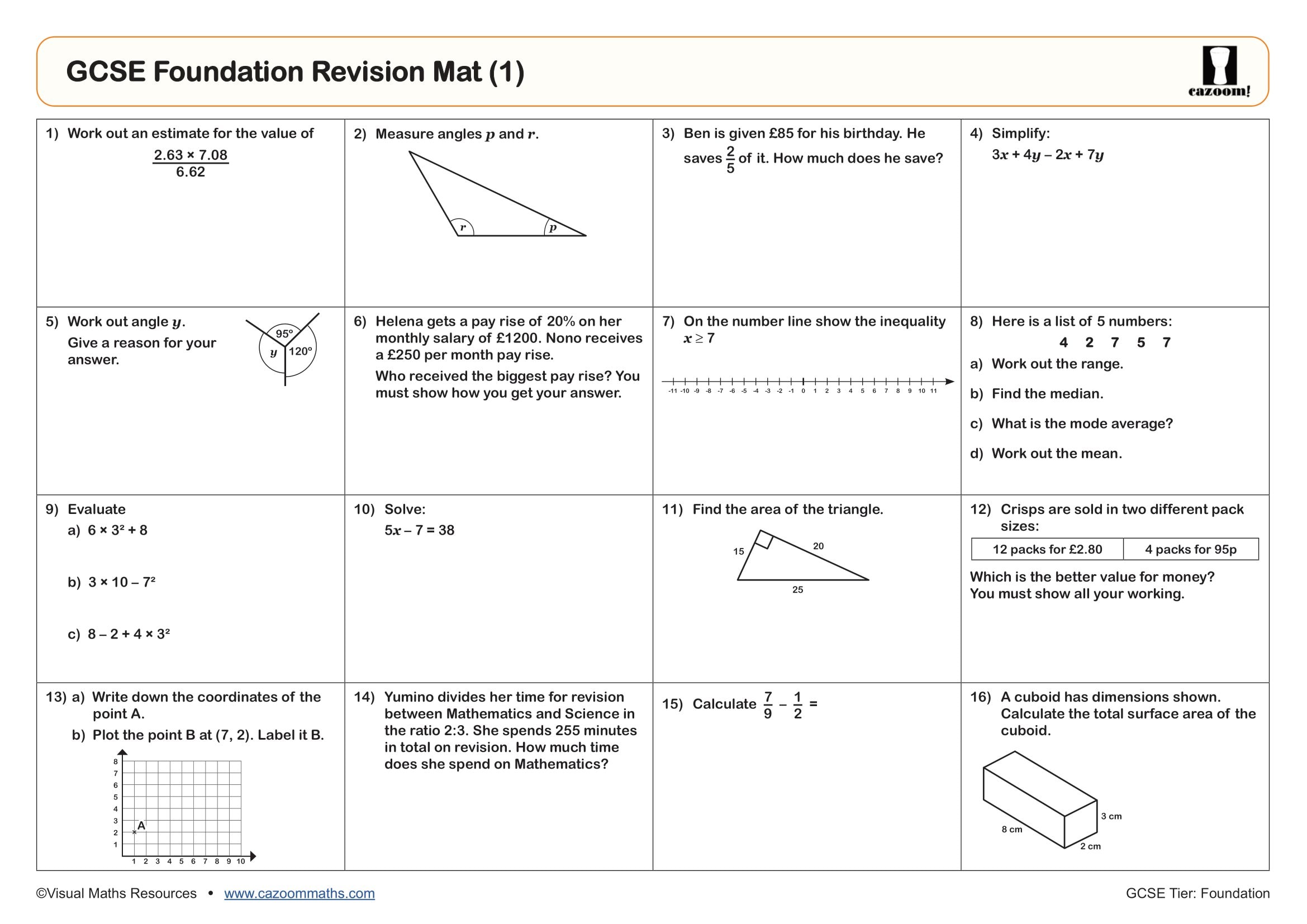
GCSE Foundation Revision Mat (1)
Target Grade: 1-3
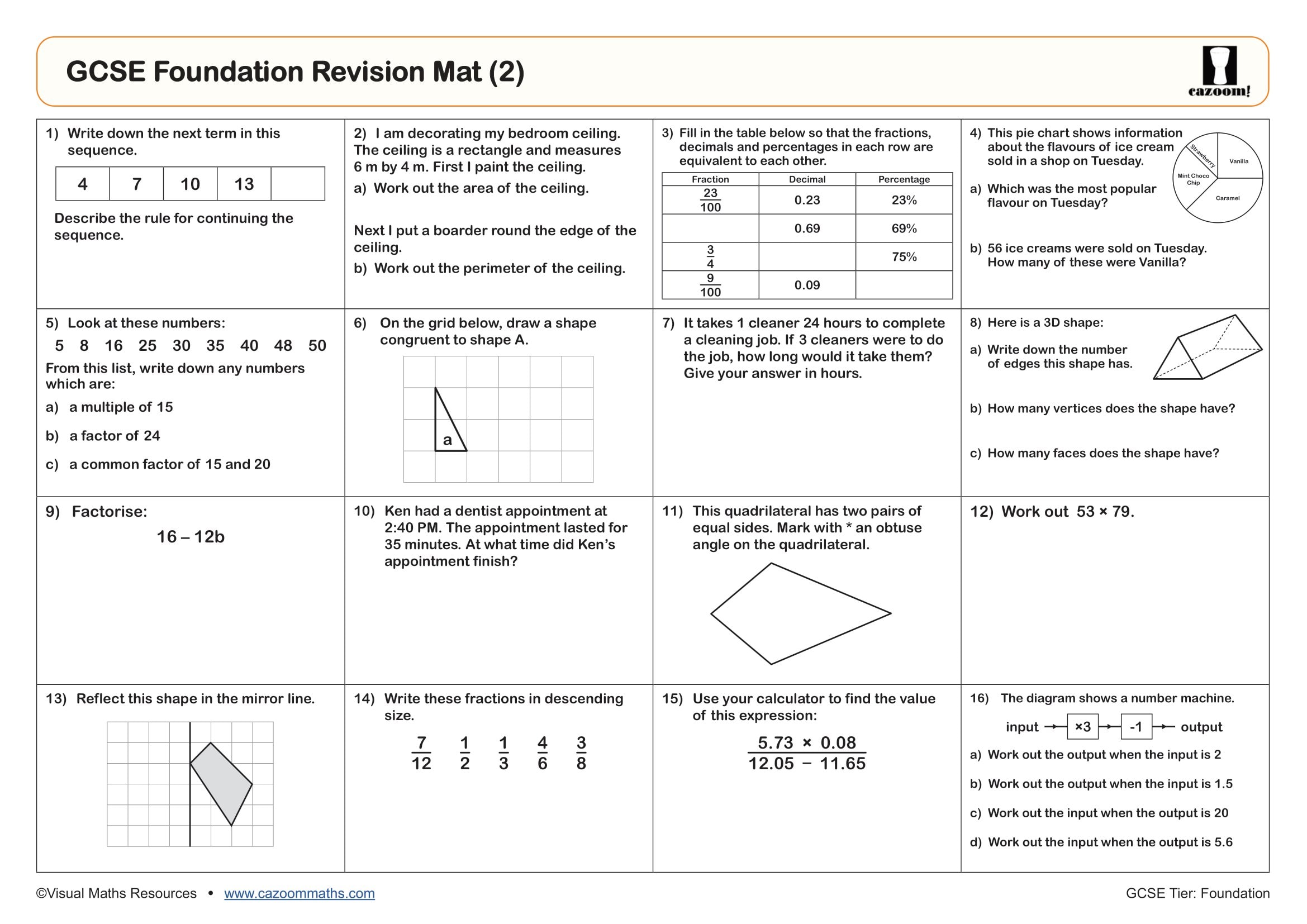
GCSE Foundation Revision Mat (2)
Target Grade: 1-3
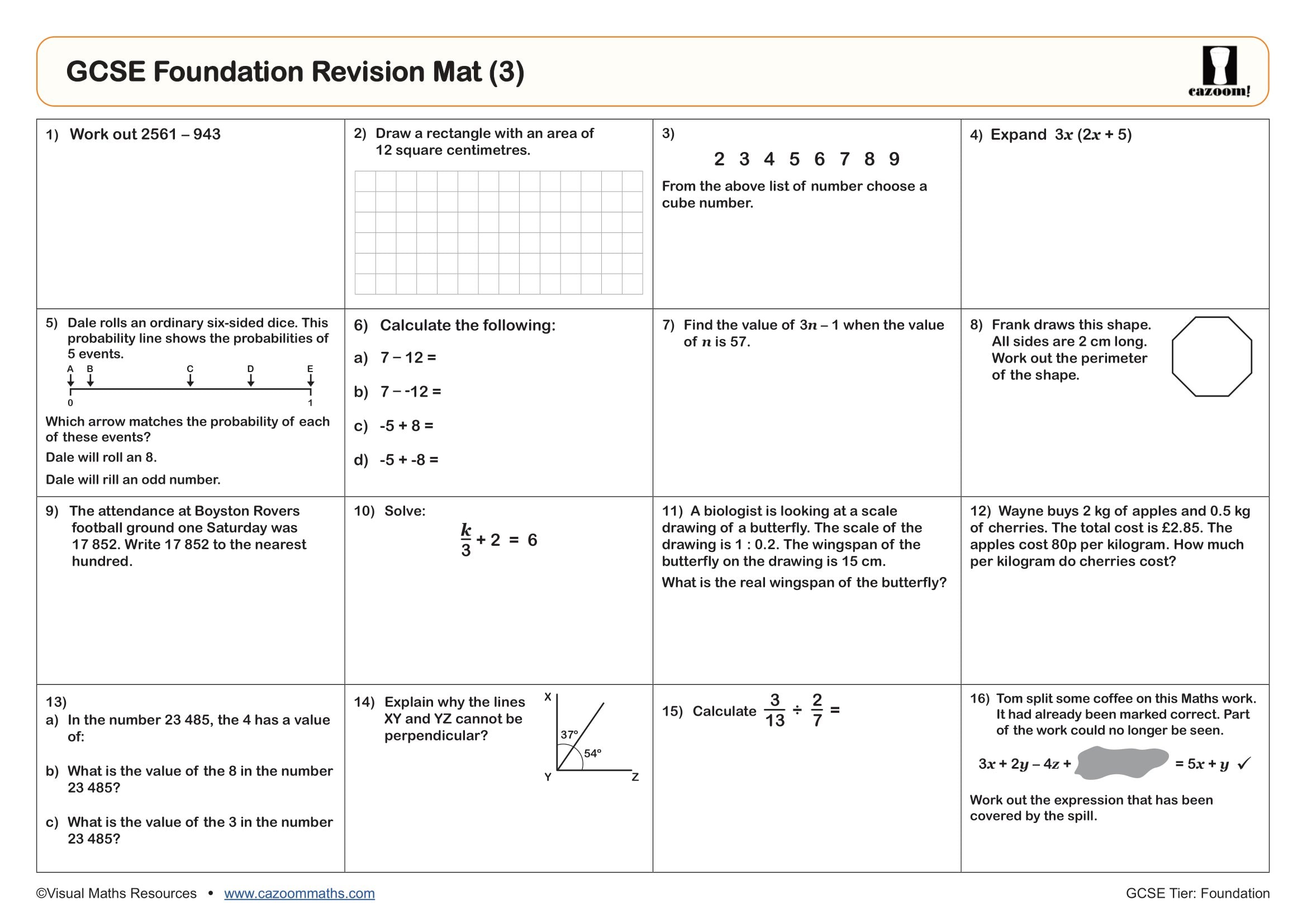
GCSE Foundation Revision Mat (3)
Target Grade: 1-3
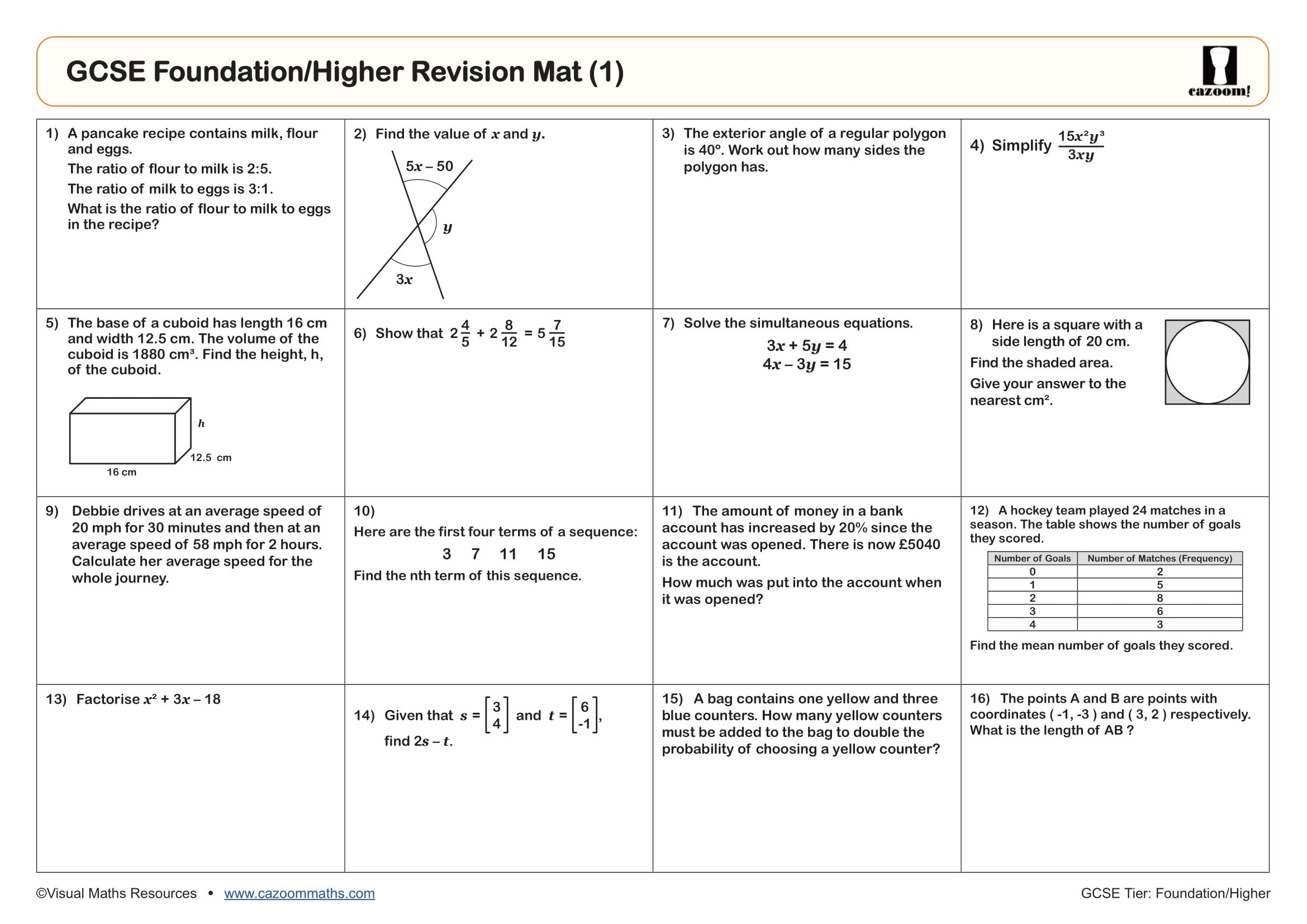
GCSE Foundation/Higher Revision Mat (1)
Target Grade: 4-5
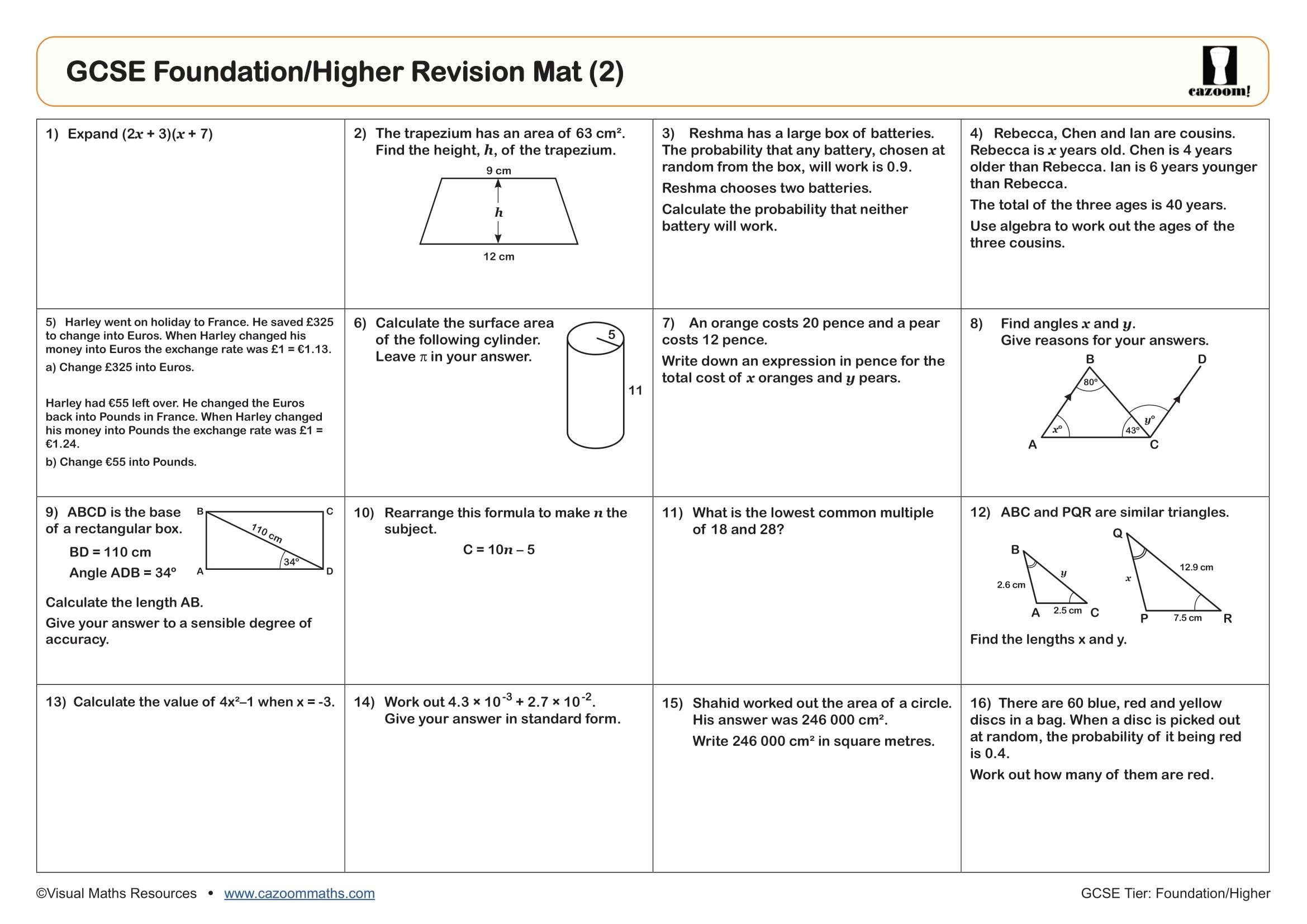
GCSE Foundation/Higher Revision Mat (2)
Target Grade: 4-5
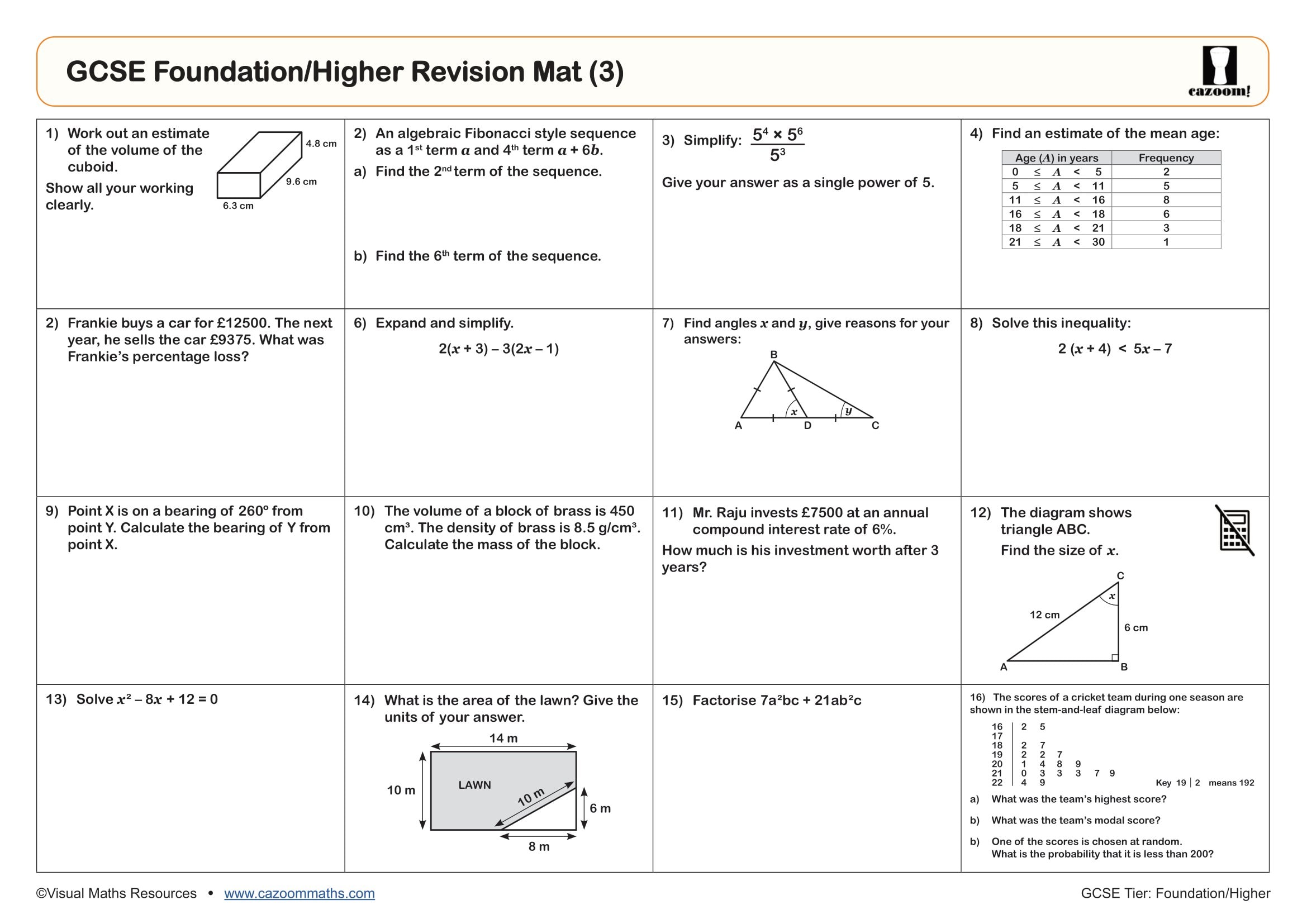
GCSE Foundation/Higher Revision Mat (3)
Target Grade: 4-5
All worksheets are created by the team of experienced teachers at Cazoom Maths.
What Revision Mats questions appear on the GCSE Foundation paper?
Foundation revision mats mirror the breadth of the actual GCSE paper, covering number skills like fraction and decimal calculations, percentages, ratio, basic algebra including solving equations and substitution, geometry topics such as area, perimeter and angles, plus probability and averages. While revision mats themselves aren't a specific exam question type, they prepare students for the mixed-topic structure of both papers, where questions jump between topics without warning. This format typically represents around 80 marks across Paper 1 and similar coverage across Papers 2 and 3.
Students lose marks when they fail to show working clearly, particularly on multi-step problems involving money or measurement. Teachers notice that Foundation candidates often know methods but make careless errors under exam pressure. Practising varied questions in revision mat format builds the mental flexibility needed to switch between topics quickly, a skill that directly improves performance on the actual papers.
What grade are Revision Mats questions on Foundation GCSE maths?
Foundation revision mats span the full grade 1-5 range, with earlier questions testing basic numeracy, simple fractions and straightforward angle facts aimed at grades 1-3. Questions targeting grades 4-5 require more sophisticated thinking, such as reverse percentage calculations, forming and solving equations, interpreting cumulative frequency graphs, or applying Pythagoras' theorem in context. The higher-grade questions on Foundation often involve multiple steps or require students to select appropriate methods without explicit prompting, which is where weaker candidates struggle.
Students should use grade indicators on revision mats strategically during revision. Those targeting grade 4 need consistent accuracy on grades 1-3 content first before attempting grade 4-5 questions. Teachers often suggest students work through a revision mat, marking each question by grade, then focusing additional practice on the grade band where errors cluster, rather than simply repeating everything.
How is Revision Mats tested differently on Foundation compared to Higher?
Foundation revision mats focus on secure understanding of core methods with straightforward contexts, whilst Higher tier mats introduce proof, algebraic manipulation of complex expressions, trigonometry beyond right-angled triangles, and questions requiring chains of reasoning across multiple topics. Foundation questions provide more scaffolding through worked examples or multiple parts that build gradually, whereas Higher questions expect students to plan multi-step solutions independently. For instance, Foundation might ask students to calculate a percentage increase step-by-step, whilst Higher would embed this within an algebraic growth problem.
This difference matters because Foundation students need absolute confidence in method application rather than mathematical creativity. Teachers observe that Foundation candidates secure higher grades by perfecting standard techniques and recognising which method each question requires. Revision mats at this tier deliberately build that pattern recognition through varied but accessible practice, ensuring students can execute fundamental skills accurately under exam conditions.
How should students revise Revision Mats for Foundation GCSE maths?
Students should work through revision mats under timed conditions, allocating roughly one minute per mark as they would in the actual exam. Checking answers immediately after completing each mat helps identify recurring errors before they become habits. Teachers recommend students keep an error log, noting which topics cause difficulty, then returning to those specific areas with focused practice from topic-specific worksheets. Foundation students particularly benefit from attempting the same revision mat again after a week, checking whether improvements stick or if further work is needed on certain skills.
Teachers can use these mats effectively as low-stakes assessments at the start or end of lessons, diagnosing class-wide weaknesses that need addressing. Setting different mats for homework across a half-term ensures students revise all topics systematically rather than concentrating only on their favourites. The answer sheets allow peer marking during lessons, encouraging discussion about methods and building students' confidence in checking their own working accurately.