GCSE Foundation Sequences Revision Worksheets
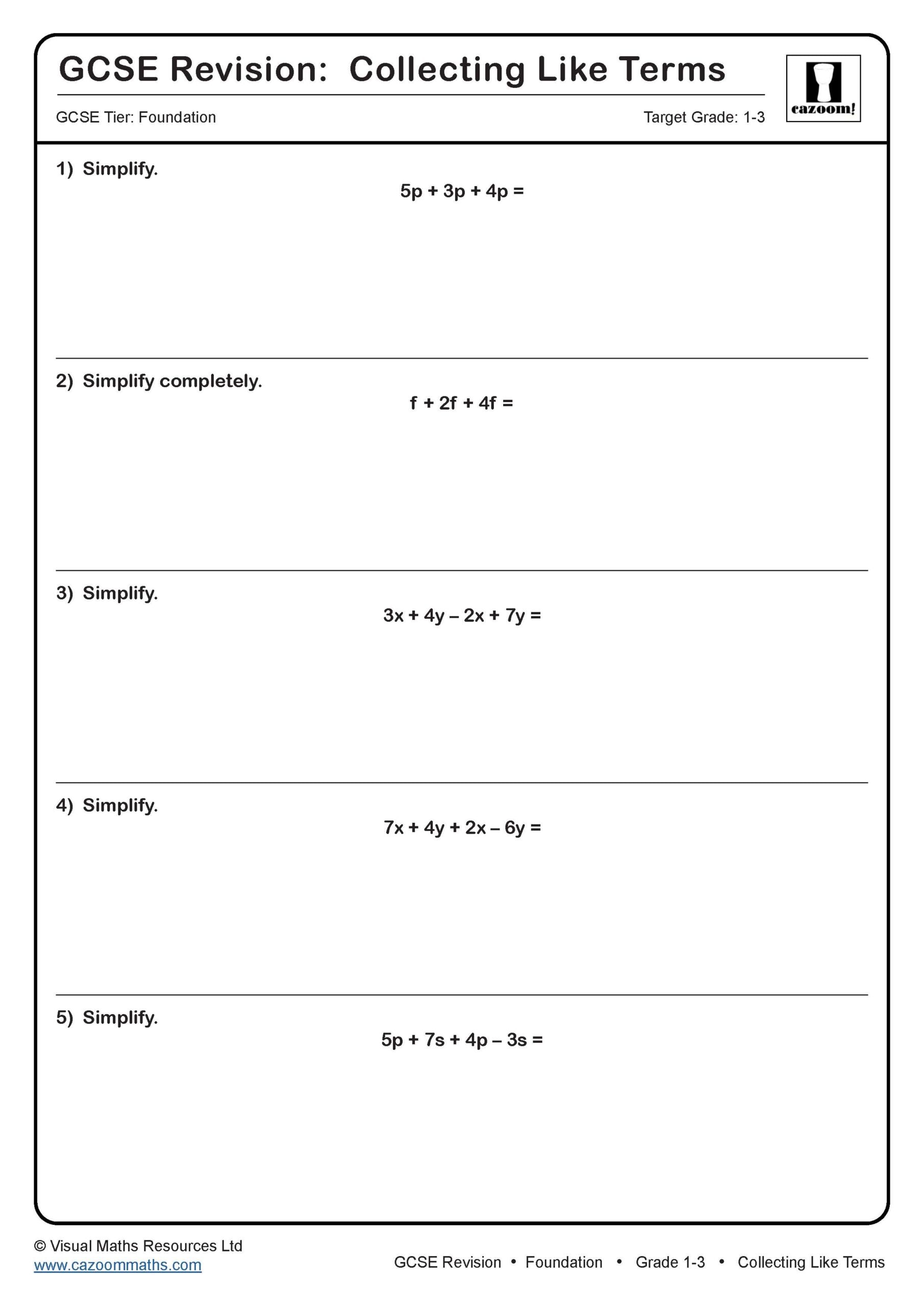
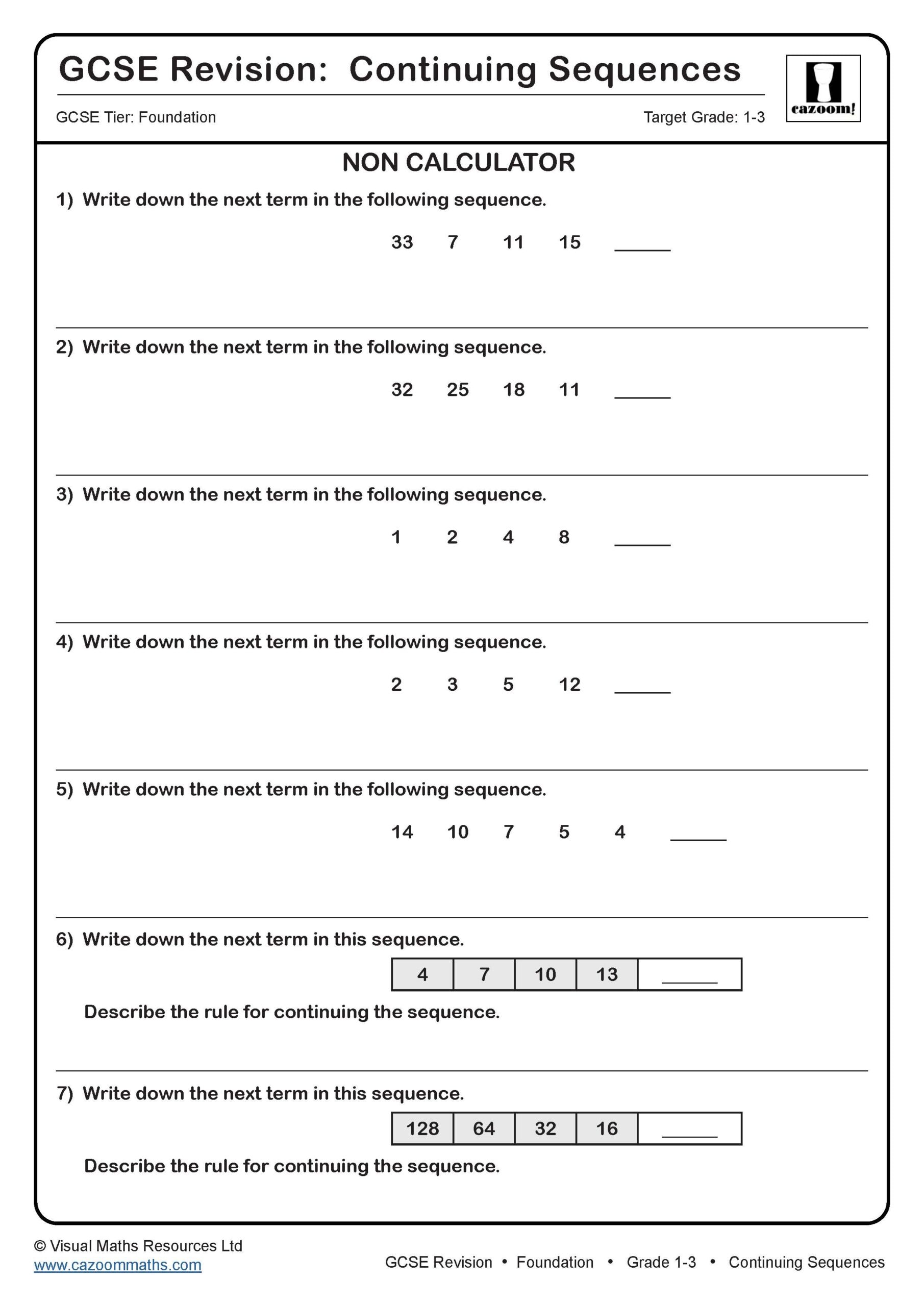
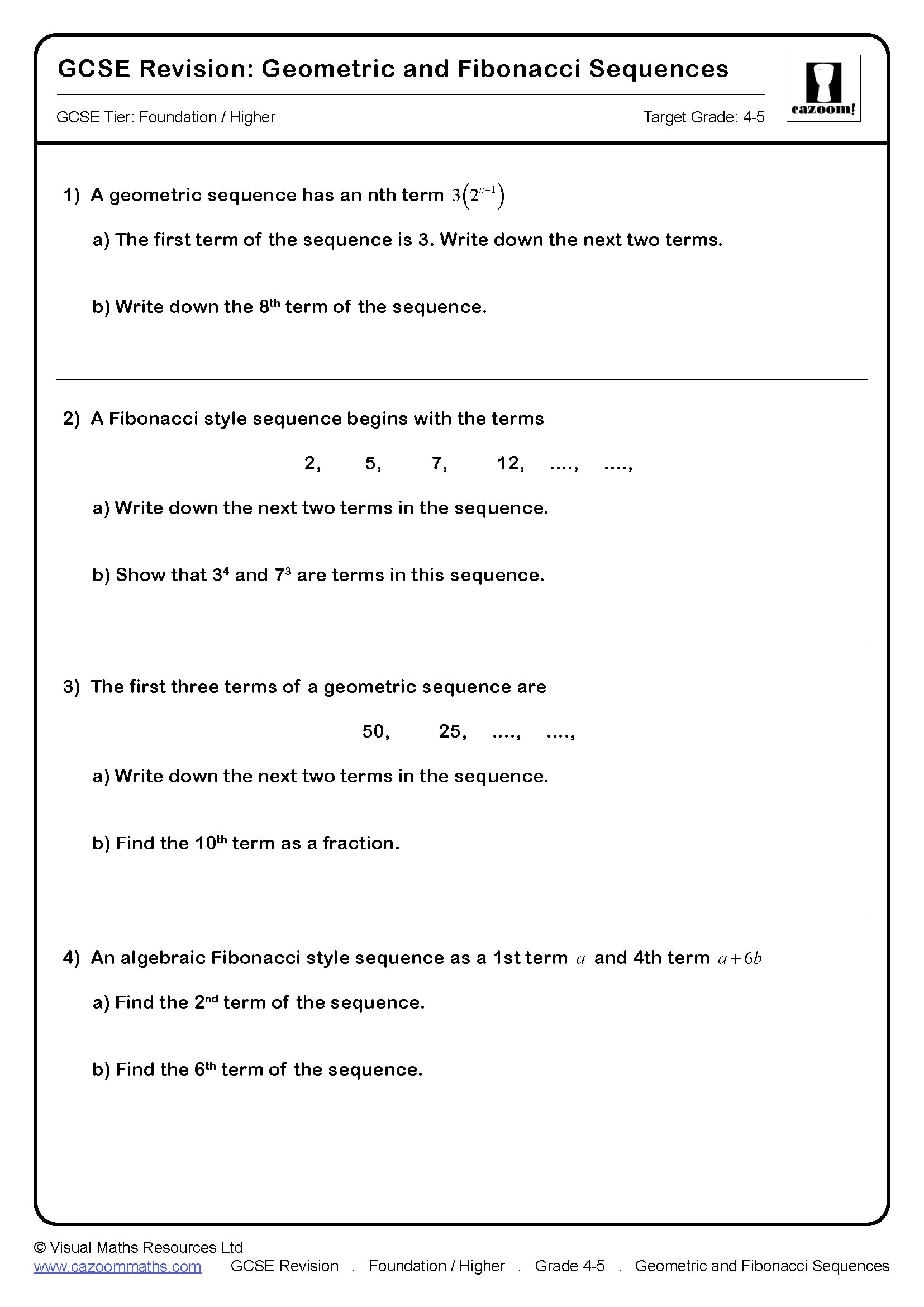
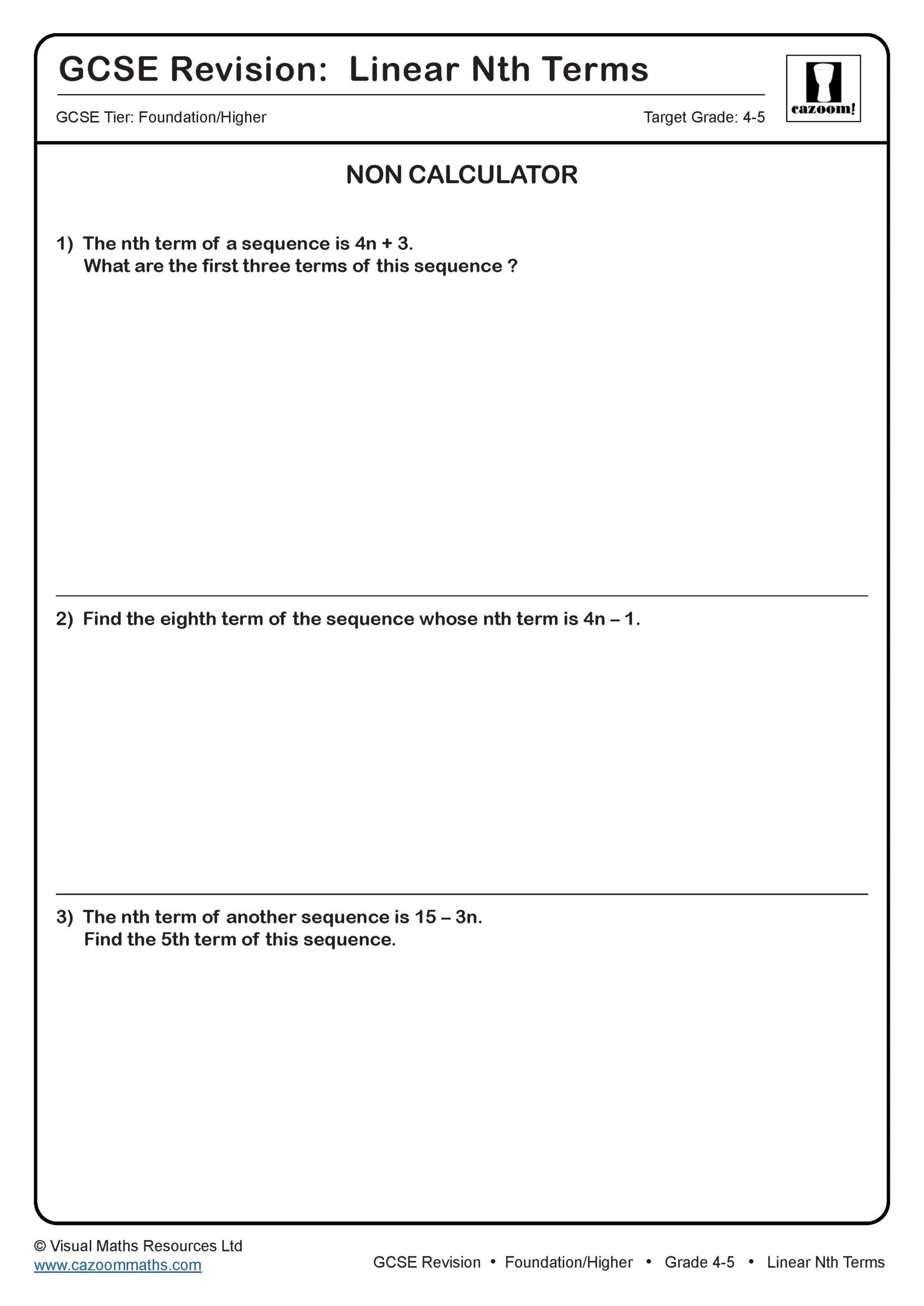
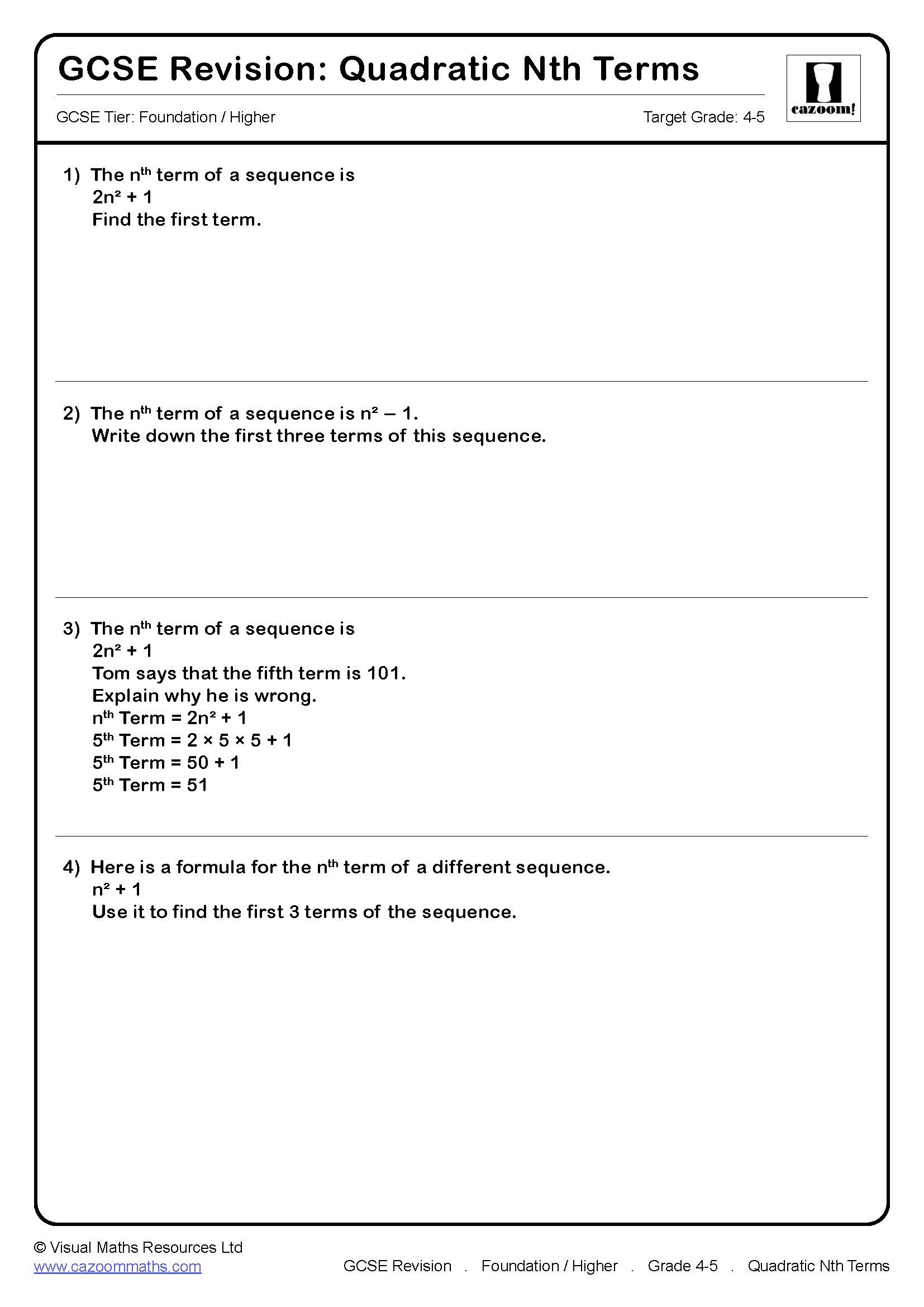
All worksheets are created by the team of experienced teachers at Cazoom Maths.
What Sequences questions appear on the GCSE Foundation paper?
Foundation papers typically include 3-5 marks on sequences across Paper 1 (non-calculator) and Paper 2 (calculator). Students face questions on continuing linear sequences, finding specific terms, identifying missing values in a pattern, and stating term-to-term rules using words like "add 3" or "subtract 2". Occasionally, simple geometric sequences appear, though linear patterns dominate. Questions worth 2-3 marks usually ask students to find two or three terms and explain the rule, or work backwards to find an earlier term.
A common error at Foundation level involves confusing the position in the sequence with the term itself. Students often write the term number instead of calculating the actual value. Mark schemes consistently penalise answers without working, so students must show each step when finding later terms or explaining rules.
What grade are Sequences questions on Foundation GCSE maths?
Sequences span grades 1-5 on Foundation papers, with basic continuation questions targeting grades 1-3 and rule-finding or backwards reasoning aiming at grades 4-5. Lower-grade questions ask students to continue simple patterns like 3, 6, 9, 12 by spotting the obvious rule. Higher-grade questions at this tier involve finding the 10th or 20th term without listing everything, or working backwards from a later term to find missing earlier values. Questions combining sequences with other topics, such as patterns in tables, often sit at grade 4-5.
Students aiming for grade 4 or 5 should focus on explaining rules clearly and showing working for multi-step problems. Teachers notice that practising grade 4-5 questions builds the reasoning skills examiners reward, whilst consolidating grades 1-3 content ensures students don't drop straightforward marks through careless errors.
How is Sequences tested differently on Foundation compared to Higher?
Foundation sequences focus on term-to-term rules ("add 5 each time") and finding specific terms through continuation or simple calculation. Higher tier introduces nth term formulae extensively, quadratic sequences, and proof questions requiring algebraic manipulation. Foundation students rarely encounter algebra within sequences beyond the simplest substitution, whereas Higher demands deriving and applying nth term expressions. The overlap at grades 4-5 means some Foundation questions mirror easier Higher questions, but Higher papers push much further into abstraction and multi-step reasoning.
The Foundation approach matters because students at this tier need concrete pattern recognition and confidence with arithmetic sequences before facing algebraic generalisation. Teachers find that mastering term-to-term rules and systematic continuation builds the number sense students need for success. Foundation sequences develop logical thinking without overwhelming students with notation they're not yet ready to handle fluently.
How should students revise Sequences for Foundation GCSE maths?
Students should work through worksheets methodically, starting with straightforward continuation before tackling backwards reasoning or rule-finding. Timed practice helps build exam confidence — allocating roughly one minute per mark reflects actual paper conditions. After completing each worksheet, students must check answers carefully, identifying where they lost marks and revisiting those question types. Common mistakes like forgetting to show working or miscounting positions need addressing immediately. Teachers notice that students who explain their rule aloud before writing it down make fewer errors.
Teachers can use these worksheets for starter activities, targeted intervention with students hovering around grade 3 or 4, or homework following classroom teaching. Setting specific worksheets based on mock results allows focused revision — students who struggled with finding missing terms benefit from repeated practice at that skill. The answer sheets make self-marking possible, encouraging independent learning whilst freeing up lesson time.