GCSE Foundation Similarity and Congruence Revision Worksheets
All worksheets are created by the team of experienced teachers at Cazoom Maths.
What Similarity and Congruence questions appear on the GCSE Foundation paper?
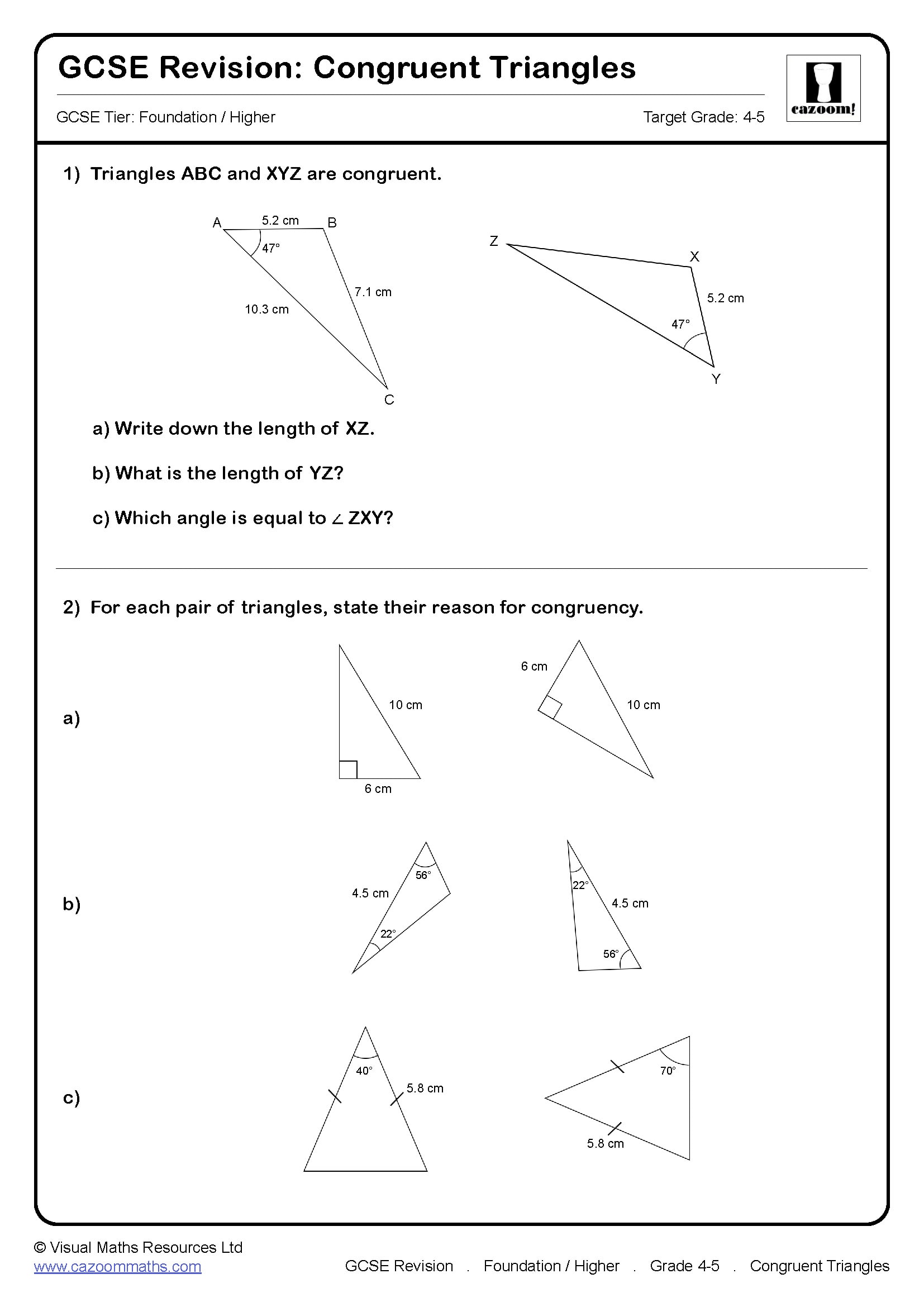
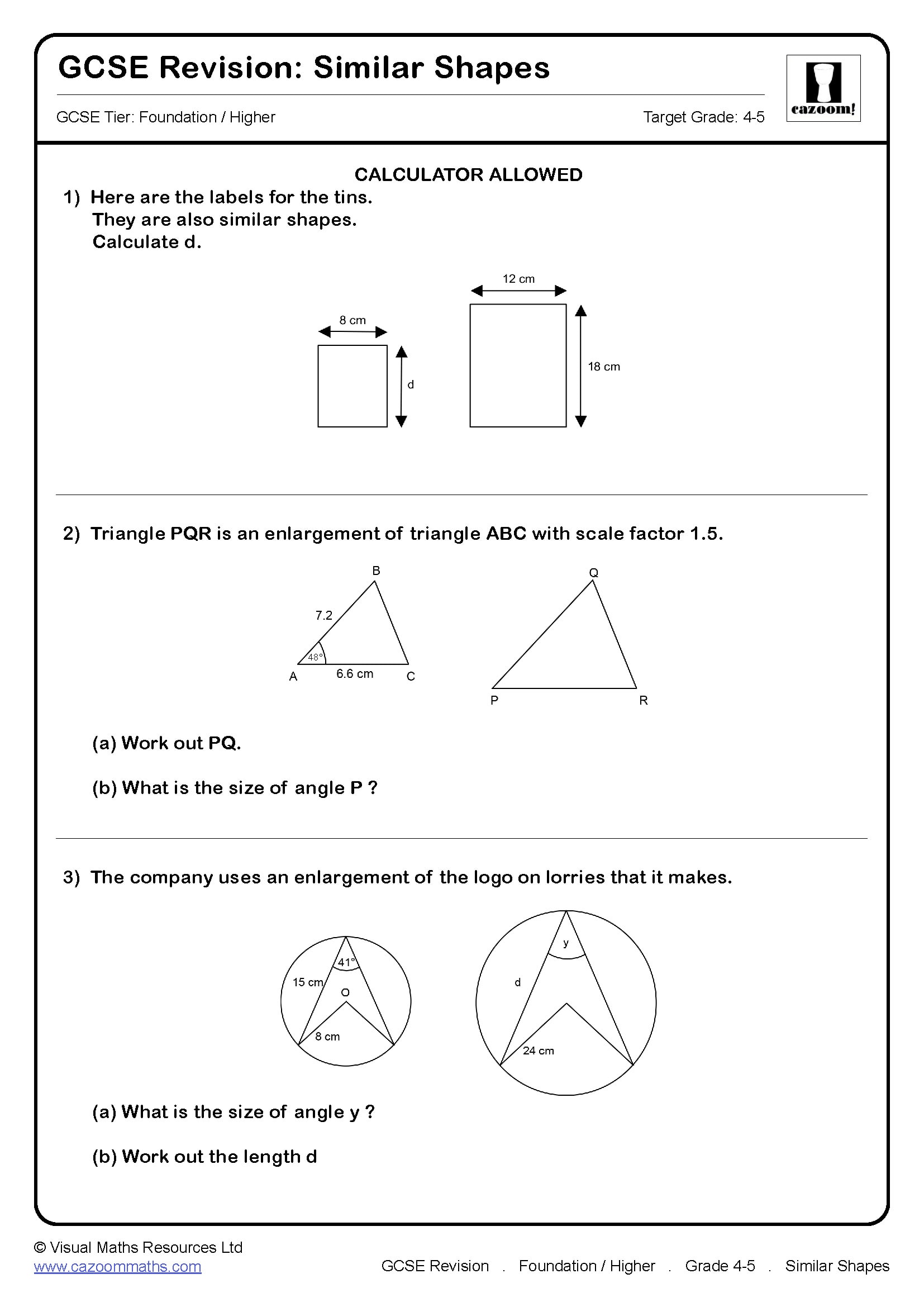
Foundation papers typically include two or three questions worth around six to eight marks in total. Students might identify congruent shapes from a set of diagrams, calculate missing side lengths using given scale factors, or determine whether two triangles are similar. Grade 3-4 questions often provide the scale factor directly, whilst grade 5 questions require students to find it themselves by dividing corresponding lengths. Map scale problems sometimes appear, asking students to convert real distances using similarity principles.
A persistent error at this tier involves students adding the scale factor instead of multiplying. When a shape enlarges by scale factor 3, students write 5cm becomes 8cm rather than 15cm. Exam mark schemes penalise this heavily, so worksheets that drill correct multiplication and division of lengths prove invaluable for securing these marks consistently.
What grade are Similarity and Congruence questions on Foundation GCSE maths?
Basic congruence recognition sits at grades 1-3, where students identify matching shapes or state whether two triangles are congruent based on given information. Grades 3-4 questions introduce scale factors for enlargement, typically providing the factor and asking for one missing length. Grade 4-5 questions require students to calculate the scale factor themselves, work backwards from an enlarged length to find the original, or solve multi-step problems involving area scale factors (though this often stretches into Higher territory).
Students aiming for grade 4 should prioritise calculating missing lengths when the scale factor is given, ensuring they multiply correctly in both directions. Those targeting grade 5 need fluency in finding scale factors from pairs of corresponding lengths, which means confident division and dealing with non-integer answers. Focusing revision on weaker grade bands builds the foundation for tackling harder questions.
How is Similarity and Congruence tested differently on Foundation compared to Higher?
Foundation focuses on recognising congruent and similar shapes, then applying given scale factors to find missing lengths. Questions remain largely numeric with clear diagrams. Higher tier expects formal congruence proofs using SSS, SAS, ASA and RHS conditions, similarity proofs involving corresponding angles and proportional sides, and complex problems where students must justify why shapes are similar before calculating. Higher also introduces area and volume scale factors, algebraic side lengths, and similarity in trigonometry contexts.
The Foundation approach matters because it establishes proportional reasoning without overwhelming students with proof. Mastering scale factor calculations at this tier provides the groundwork for ratio work elsewhere on the paper. Students who confidently identify corresponding sides and multiply accurately secure valuable marks, particularly at grades 4-5 where these questions separate middle-tier candidates from those achieving top Foundation grades.
How should students revise Similarity and Congruence for Foundation GCSE maths?
Start with congruence identification worksheets to build confidence recognising matching shapes, then progress to similarity with provided scale factors before attempting questions where students calculate the factor themselves. Timed practice helps: allow five minutes per question initially, reducing to three minutes as fluency improves. Students should annotate diagrams by labelling corresponding sides and writing the multiplication clearly (for example, 4cm × 3 = 12cm), which reduces errors. Checking answers immediately after each worksheet highlights recurring mistakes before they become ingrained.
Teachers can use these worksheets for differentiated starter activities, grouping students by target grade and assigning appropriate difficulty levels. Setting homework from grade 4-5 worksheets challenges students approaching the top of Foundation tier, whilst lower-grade sheets provide accessible practice for those building confidence. Regular low-stakes quizzing using individual questions helps students retain methods between topics, preventing the typical fade that occurs when similarity appears late in revision schedules.