GCSE Foundation Solving Equations Revision Worksheets
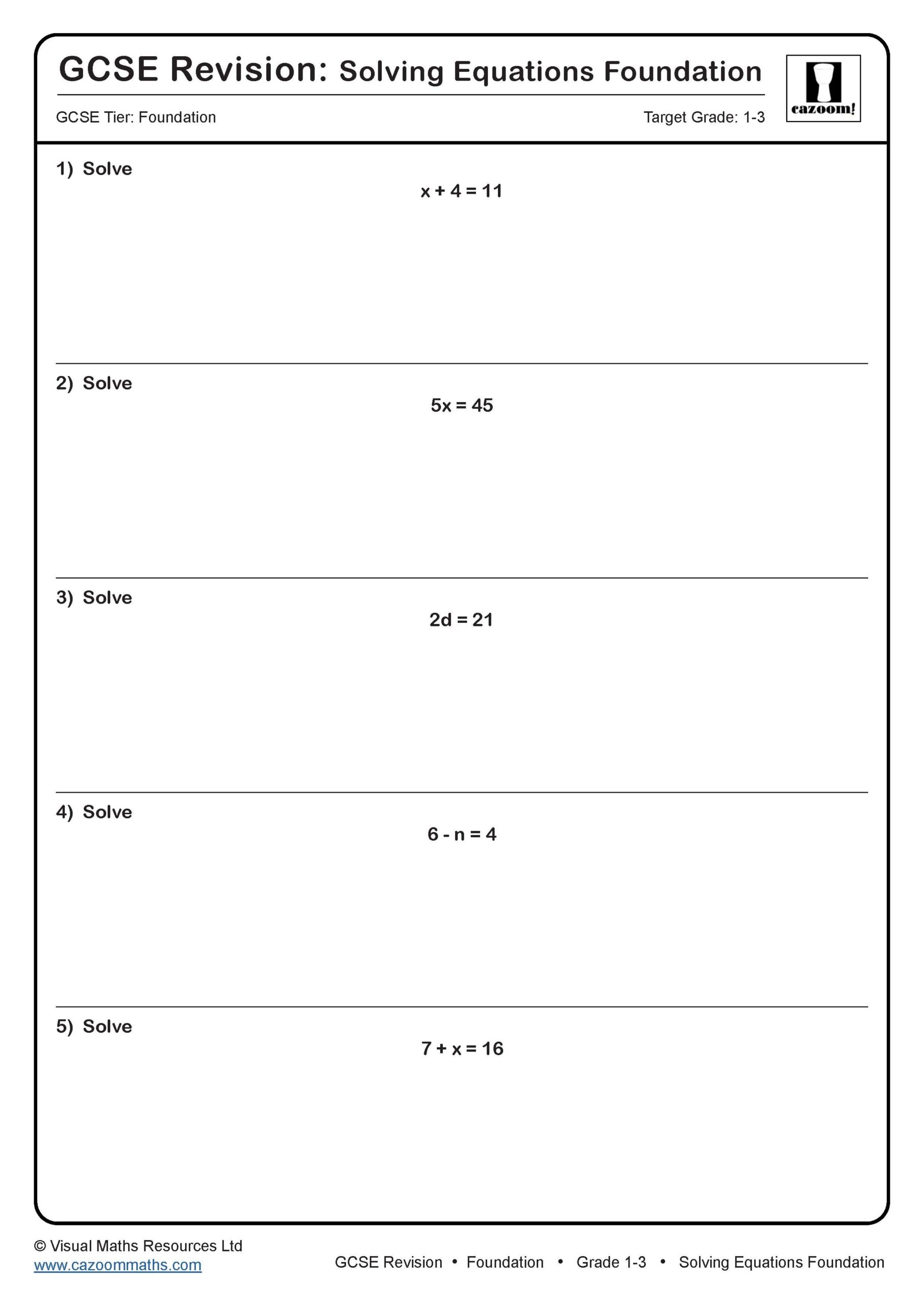
Solving Equations
Target Grade: 1-3
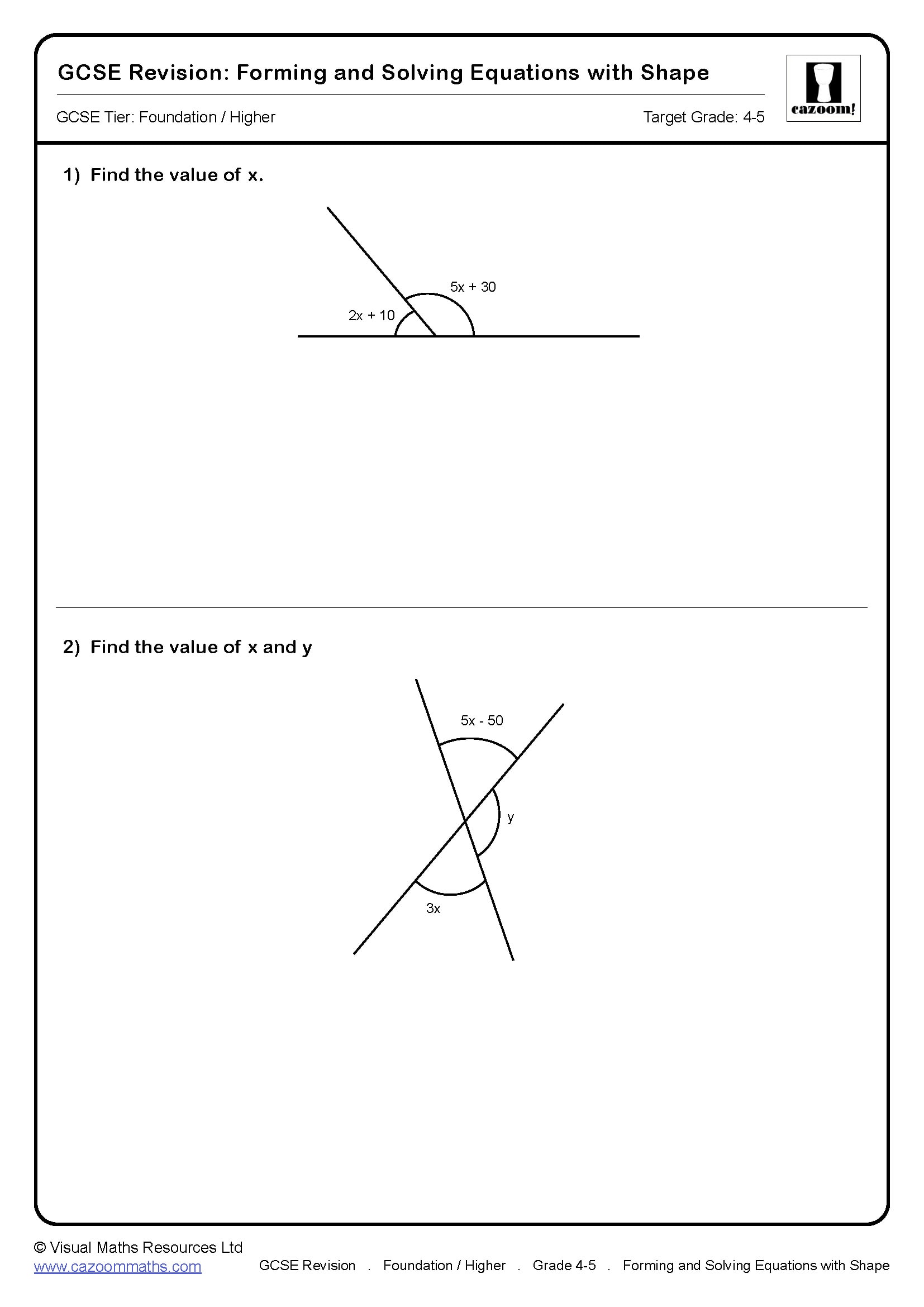
Forming and Solivng Equations with Shape
Target Grade: 4-5
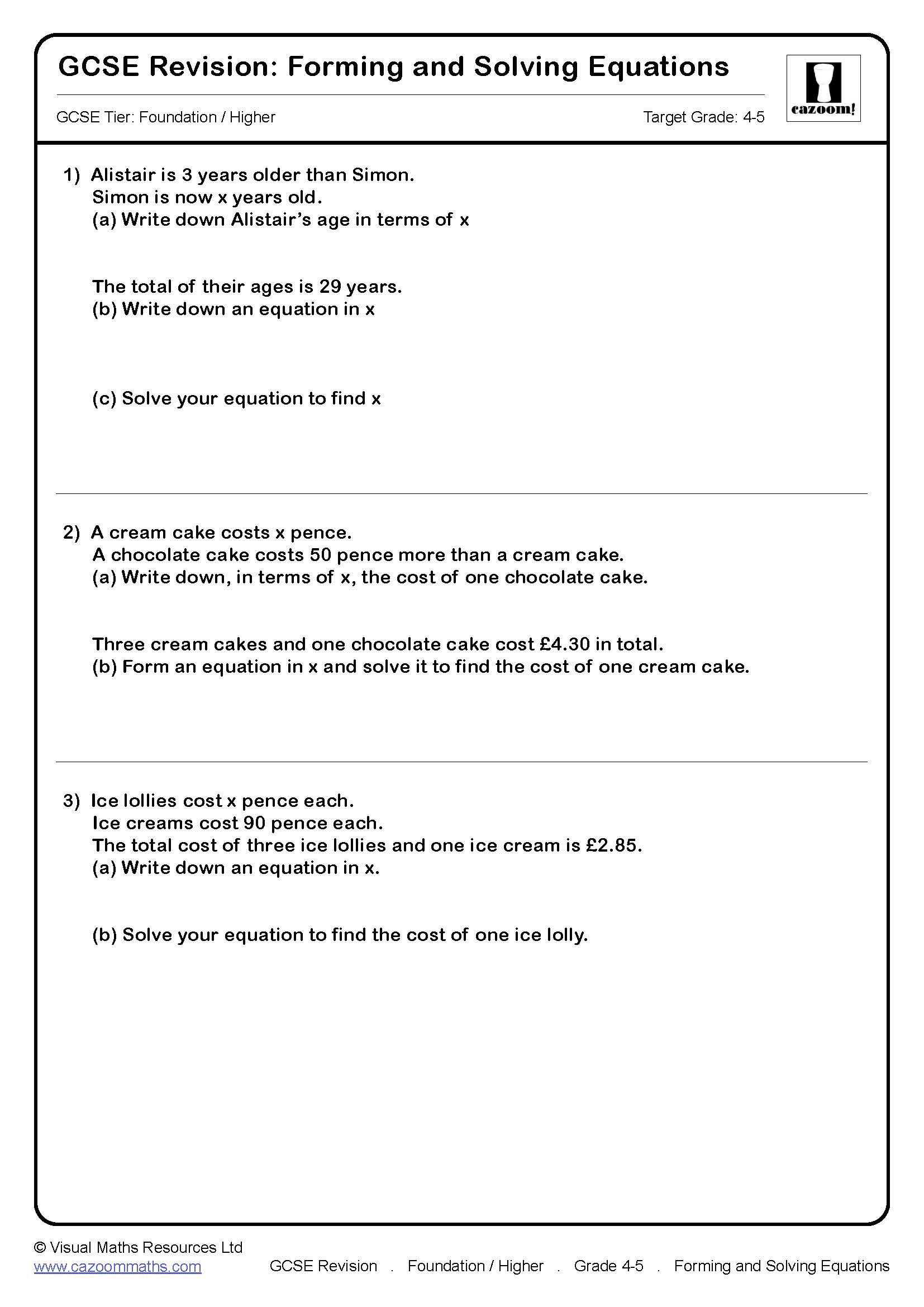
Forming and Solving Equations
Target Grade: 4-5
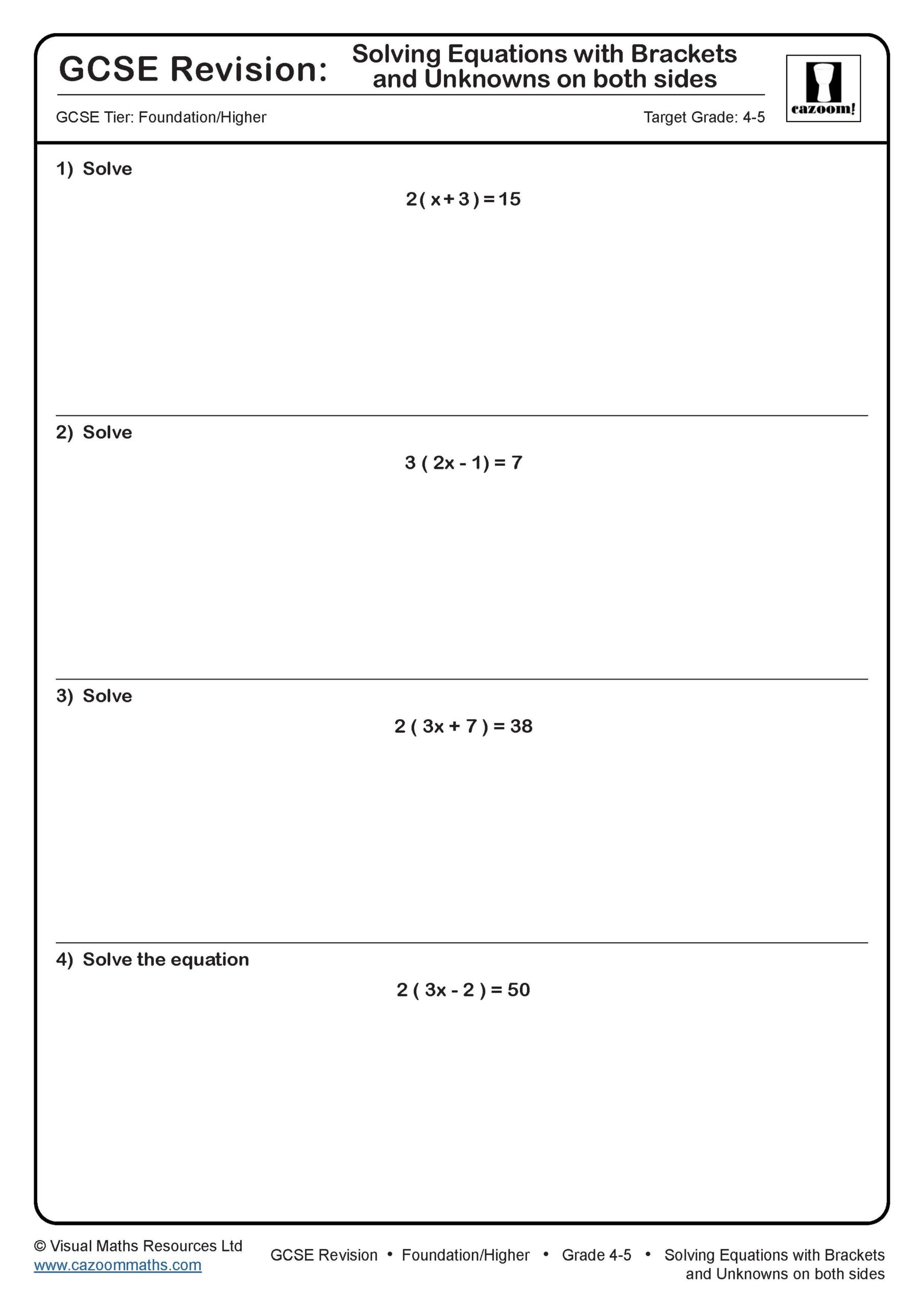
Solving Equations with Brackets and Unknowns on both sides
Target Grade: 4-5
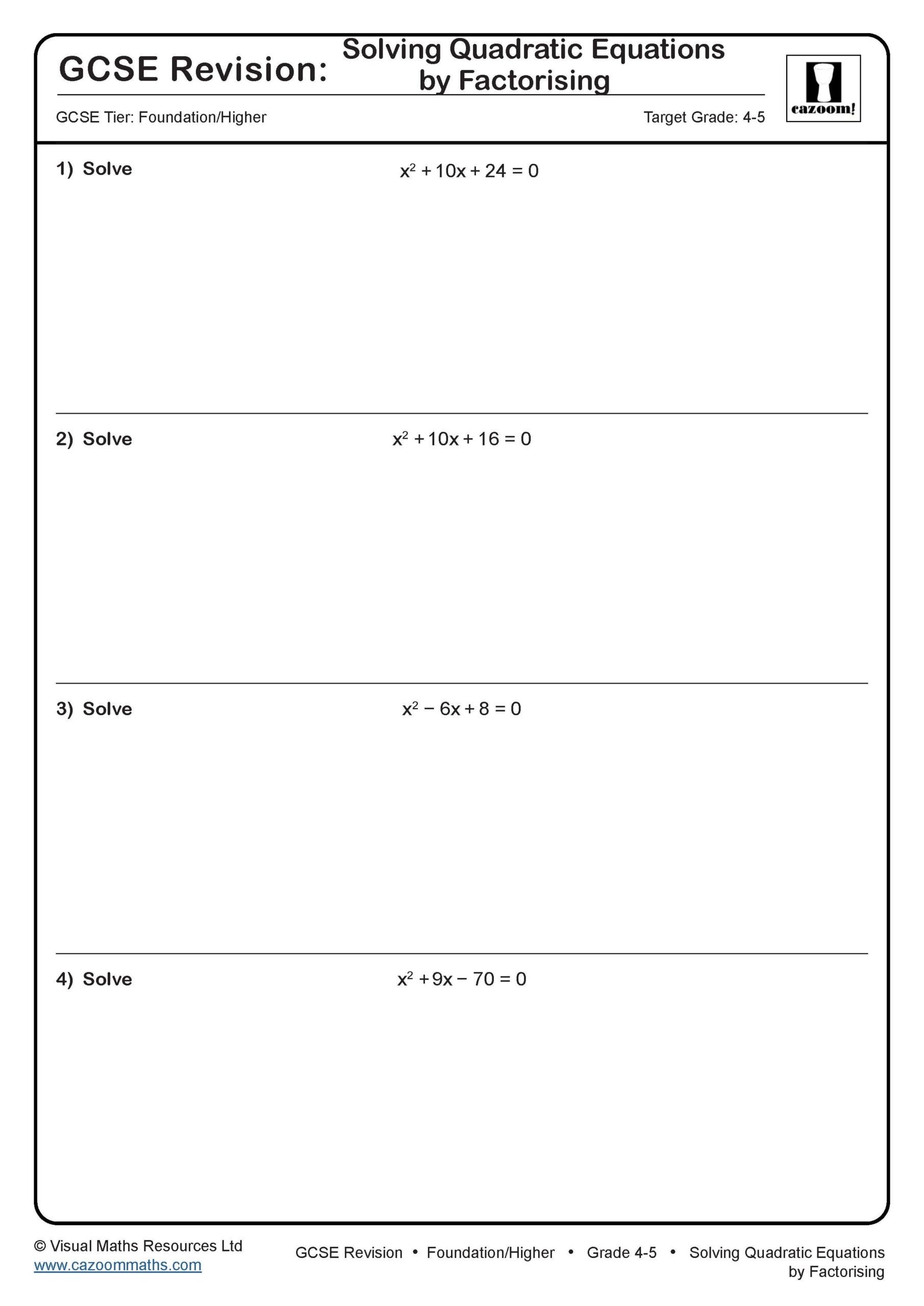
Solving Quadratic Equations by Factorising
Target Grade: 4-5
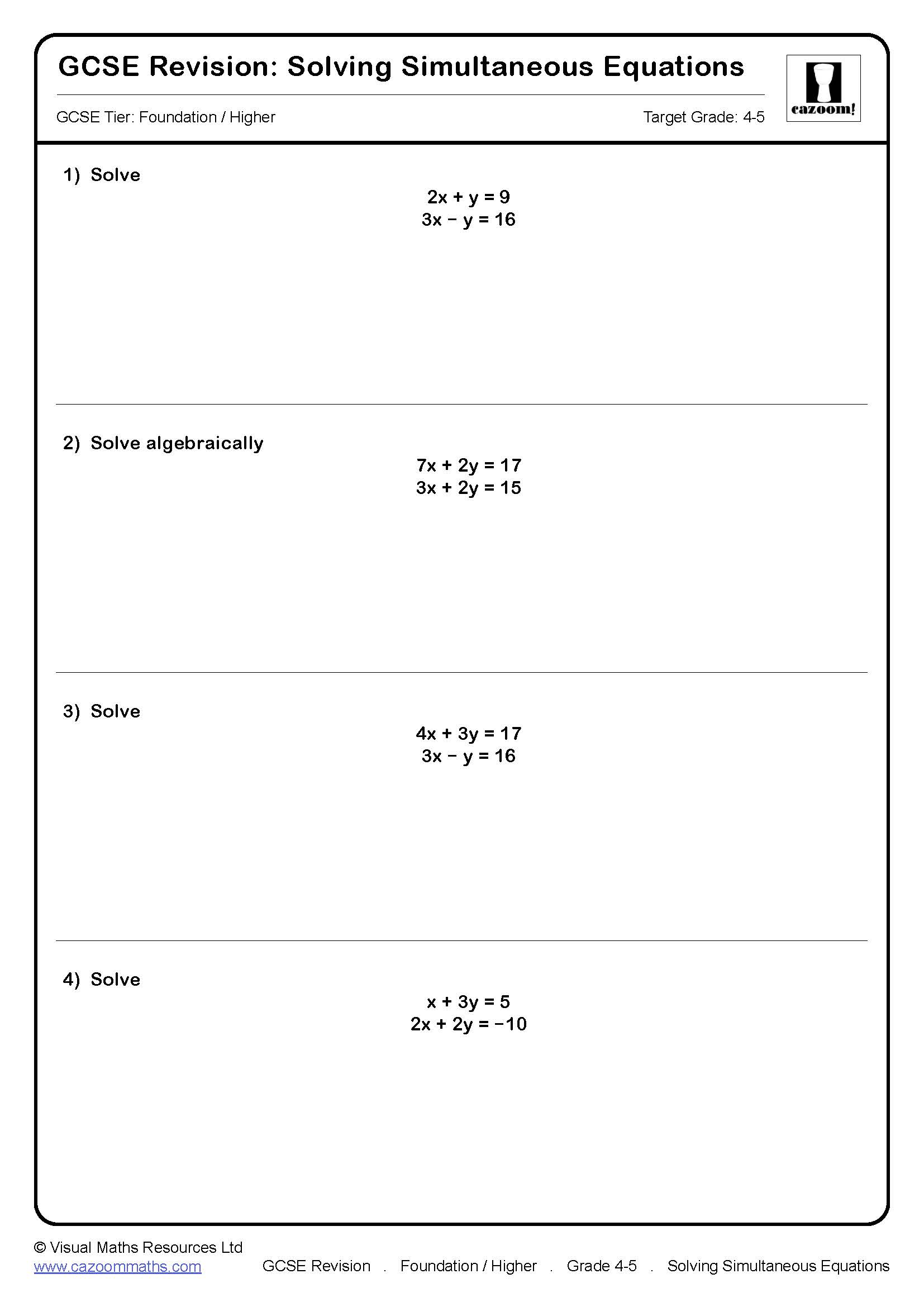
Solving Simultaneous Equations
Target Grade: 4-5
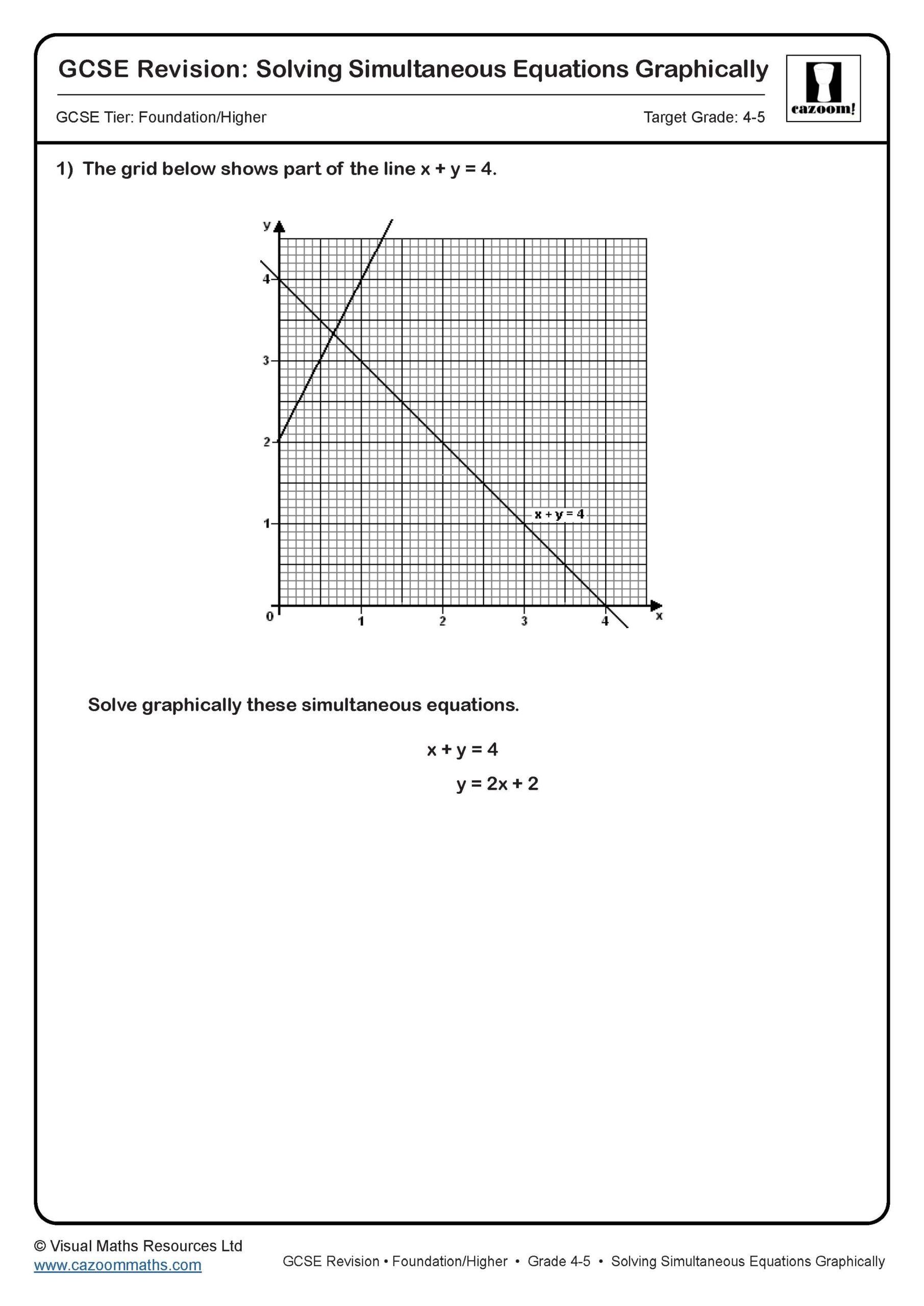
Solving Simultaneous Equations Graphically
Target Grade: 4-5
All worksheets are created by the team of experienced teachers at Cazoom Maths.
What Solving Equations questions appear on the GCSE Foundation paper?
Foundation papers typically include four to six equations worth two to three marks each, ranging from straightforward one-step problems like 3x = 15 to two-step equations such as 5x - 7 = 18. Questions involving brackets, such as 3(x + 2) = 21, appear regularly at grades 4-5. Some equations feature unknowns on both sides, though these stay accessible with small coefficients. Occasionally, a worded problem requires students to form then solve an equation, testing both algebraic translation and manipulation skills within one question.
A common error occurs when students fail to show working clearly. Exam mark schemes award method marks for correct inverse operations, so writing 'x = 12' without intermediate steps often scores zero even if correct. Students should write every operation explicitly, particularly when handling negatives or fractions, as partial credit rewards clear mathematical reasoning throughout.
What grade are Solving Equations questions on Foundation GCSE maths?
One-step and simple two-step equations typically target grades 2-3, testing whether students understand inverse operations with positive integers. Two-step equations involving negatives, fractions or decimals move into grade 4 territory. Equations with brackets or unknowns on both sides consistently appear at grades 4-5, representing the upper end of Foundation content where algebraic fluency matters most. These higher-grade questions separate students aiming for a grade 5 from those securing a grade 4, as they require multiple procedural steps without computational errors.
Students should practise grade 2-3 questions first until they can solve them reliably within 30 seconds each. Once this fluency develops, tackling grade 4-5 problems becomes manageable because the underlying method remains identical. Teachers often suggest blocking revision by grade band rather than mixing difficulties, allowing students to consolidate each skill level before progressing to more demanding equation types.
How is Solving Equations tested differently on Foundation compared to Higher?
Higher papers include equations with algebraic fractions, surds, and problems requiring rearrangement of complex formulae. Foundation focuses exclusively on linear equations where the unknown appears once or twice with integer coefficients, keeping calculations accessible. Whilst Higher expects students to manipulate equations as part of multi-step problem-solving, Foundation questions typically isolate equation-solving as a standalone skill. Fractional or negative solutions appear on Foundation, but the equations leading to them remain structurally simple compared to Higher's algebraic complexity.
This distinction matters because Foundation students need absolute confidence in the balancing method before encountering the abstract reasoning Higher demands. Mastering how to handle brackets, collect like terms and check solutions by substitution provides the algebraic foundation required for Further Maths or A-level. Teachers recognise that students who can solve any Foundation equation accurately, showing clear working, have developed transferable algebraic thinking beyond simply reaching correct answers.
How should students revise Solving Equations for Foundation GCSE maths?
Students should begin by completing worksheets under timed conditions, allowing two minutes per equation initially and reducing this as confidence builds. Working through problems in order of difficulty helps identify which equation types cause hesitation. Checking answers immediately after each worksheet reveals patterns in errors, whether from arithmetic mistakes, sign errors or incomplete working. Teachers notice that students who write out every inverse operation, rather than doing steps mentally, make fewer mistakes under exam pressure and secure method marks even when final answers contain minor slips.
In lessons, these worksheets work effectively as starter activities for retrieval practice or as differentiated tasks where students select their target grade band. Setting them as homework with answer sheets allows students to self-assess and bring specific difficulties to the next lesson. Teachers can then address common misconceptions with the whole class rather than repeating individual explanations, making revision time more efficient for everyone approaching Foundation papers.