GCSE Foundation Substitution Revision Worksheets
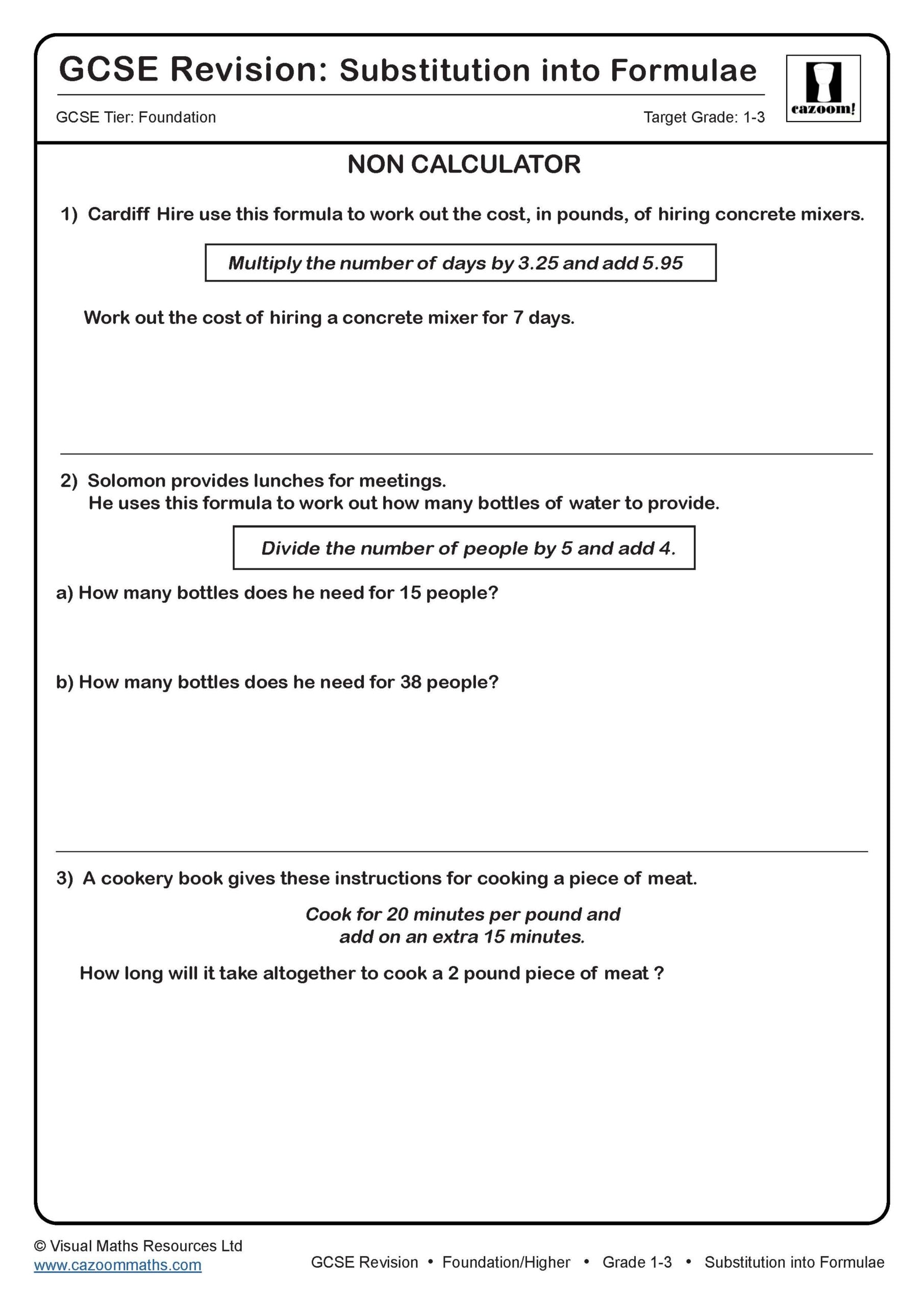
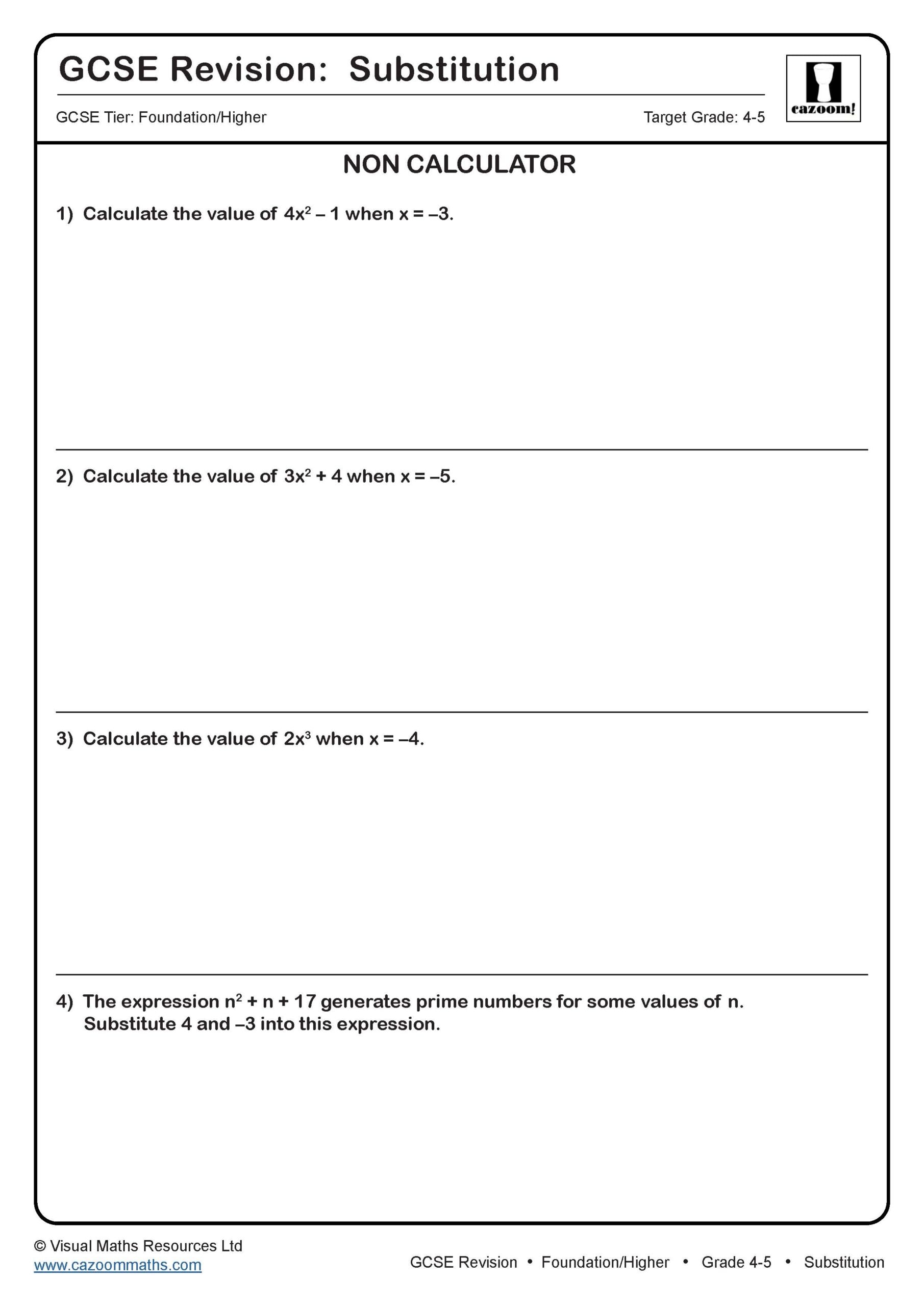
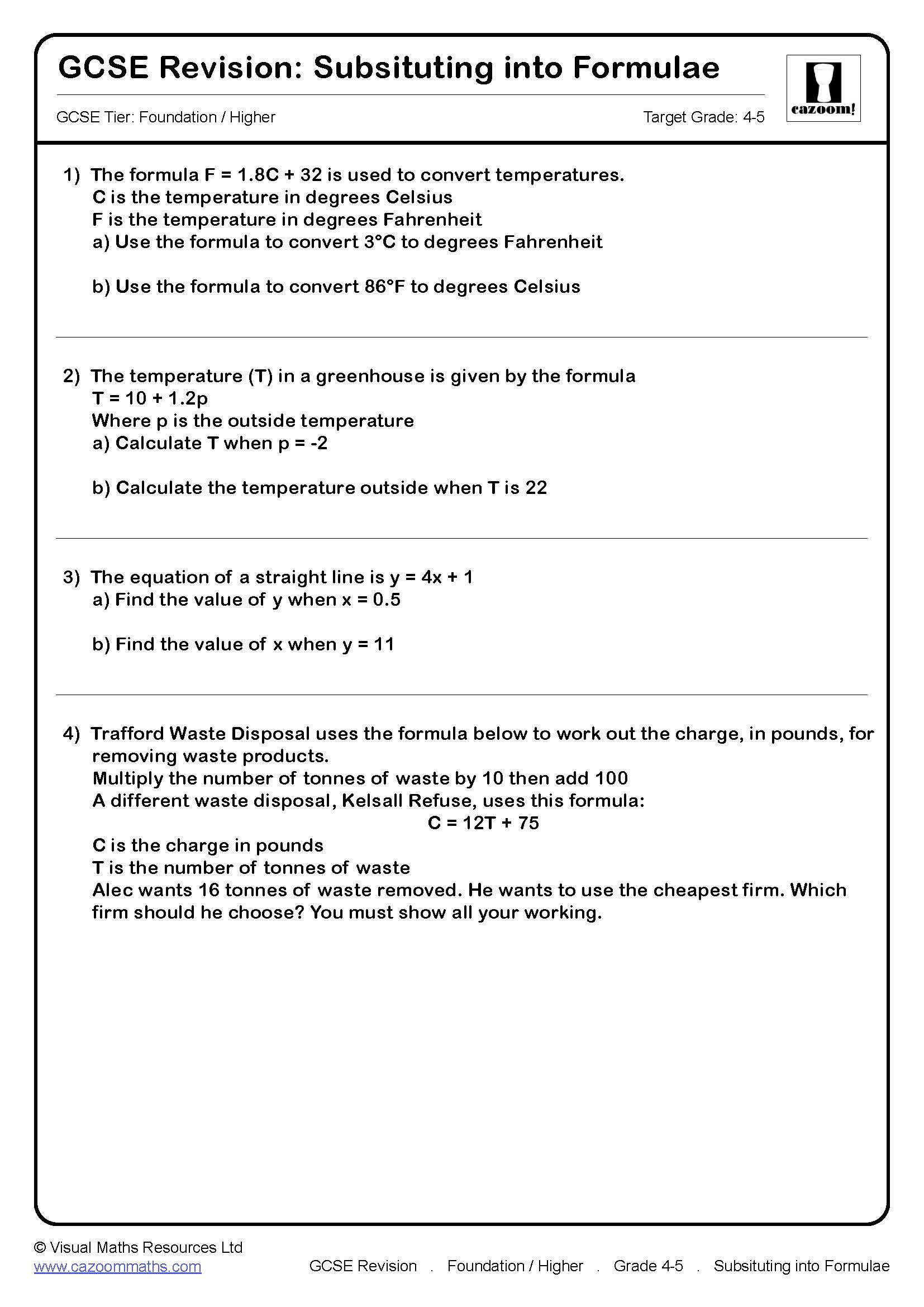
All worksheets are created by the team of experienced teachers at Cazoom Maths.
What Substitution questions appear on the GCSE Foundation paper?
Foundation papers typically include 6 to 9 marks across substitution questions, ranging from single-mark evaluations of simple expressions to three-mark problems involving formulae from real-world contexts. Students evaluate expressions like 2a + 3b when given values, substitute into formulae such as distance = speed × time, and occasionally work with algebraic fractions where the denominator remains straightforward. Questions progress from positive integer substitutions at grade 2-3 level to negative values and slightly more complex expressions at grades 4-5.
A frequent error occurs when students substitute negative numbers without brackets, writing 3 – -2 as 3 – 2 instead of recognising it becomes 3 + 2. Mark schemes consistently penalise this, even when subsequent arithmetic is correct, so reinforcing bracket notation around substituted negatives proves essential for securing marks.
What grade are Substitution questions on Foundation GCSE maths?
Substitution questions span grades 1 through 5 on Foundation papers, with clear progression in difficulty. Grades 1-3 questions involve substituting positive integers into single-operation expressions like 4x or x + 7, often worth one mark each. Grades 3-4 questions introduce two operations or simple formulae, such as evaluating 3n – 5 or finding perimeter using P = 2l + 2w. Grades 4-5 questions require substituting negative values, working with expressions containing brackets, or evaluating formulae involving three or more variables, typically carrying two to three marks.
Students aiming for grade 4 should prioritise mastering negative substitutions and bracket handling before attempting grade 5 multi-step problems. Teachers often advise working systematically through grade bands rather than attempting random questions, as confidence with simpler substitutions directly supports tackling the more demanding grade 4-5 questions where marks concentrate.
How is Substitution tested differently on Foundation compared to Higher?
Foundation papers focus on numerical substitution into expressions and formulae, keeping algebraic complexity manageable. Questions use integers and straightforward fractions, avoiding surds, complicated powers, or algebraic manipulation beyond the substitution itself. Higher tier extends to substituting expressions into other expressions, working with indices and fractional powers, and linking substitution to proof or solving equations, often within multi-step problems worth four or more marks. Foundation students face substitution as a standalone skill; Higher students encounter it embedded within broader algebraic reasoning.
This Foundation approach matters because it allows students to build substitution fluency without simultaneous demands of advanced algebra. Teachers notice that students who secure substitution accuracy at Foundation level, particularly with negatives and brackets, develop number confidence that supports all algebraic work. Mastering this tier's substitution expectations establishes foundations for potential progression to Higher content in Year 11.
How should students revise Substitution for Foundation GCSE maths?
Students benefit from working through worksheets in grade order, starting with positive integer substitutions before progressing to negatives and formulae. Practising under timed conditions helps replicate exam pressure, where substitution questions should take one to two minutes each. Using the answer sheets effectively means checking each step of working, not just the final answer. Students should identify whether errors stem from substitution mistakes or calculation slips, then rework similar problems to correct the specific weakness. Writing substituted values in brackets consistently prevents sign errors.
Teachers can deploy these worksheets as starter activities to maintain substitution fluency throughout Year 11, or set targeted homework after teaching negative numbers or formulae topics. Mixing substitution practice with other algebra work prevents students compartmentalising skills. For intervention groups, working through one worksheet together before setting independent practice builds confidence while addressing individual misconceptions immediately.