GCSE Foundation Types of Number Revision Worksheets
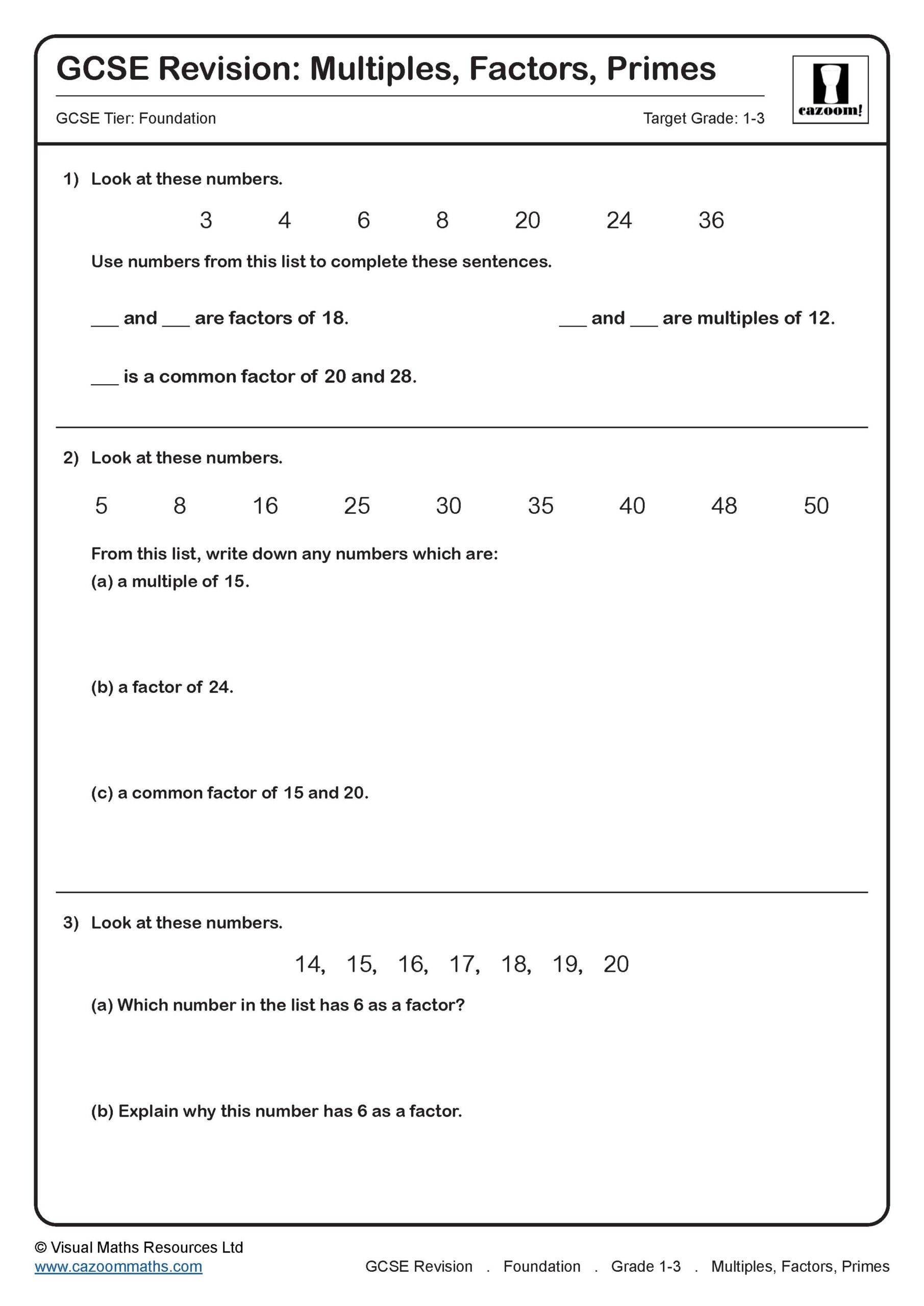
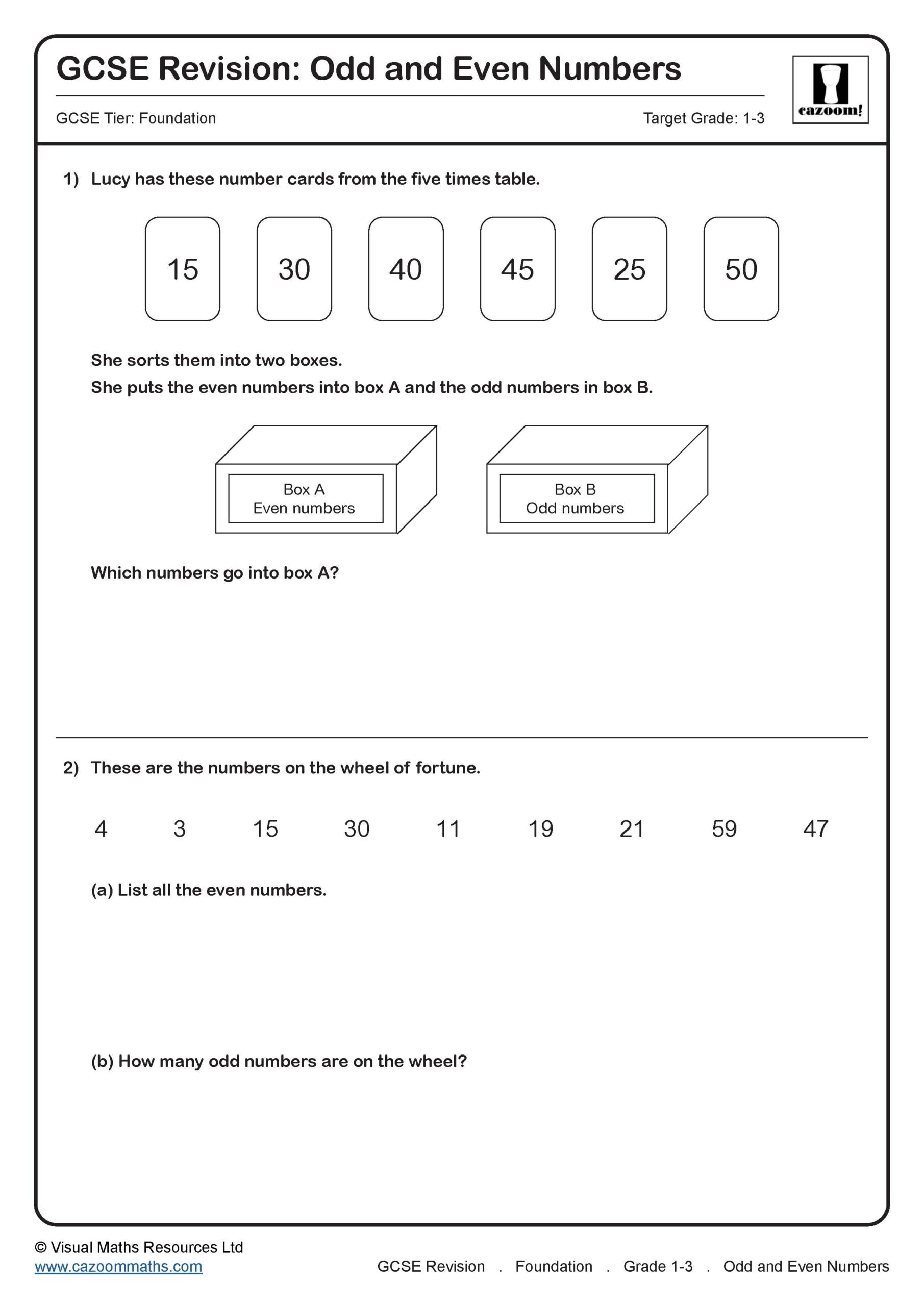
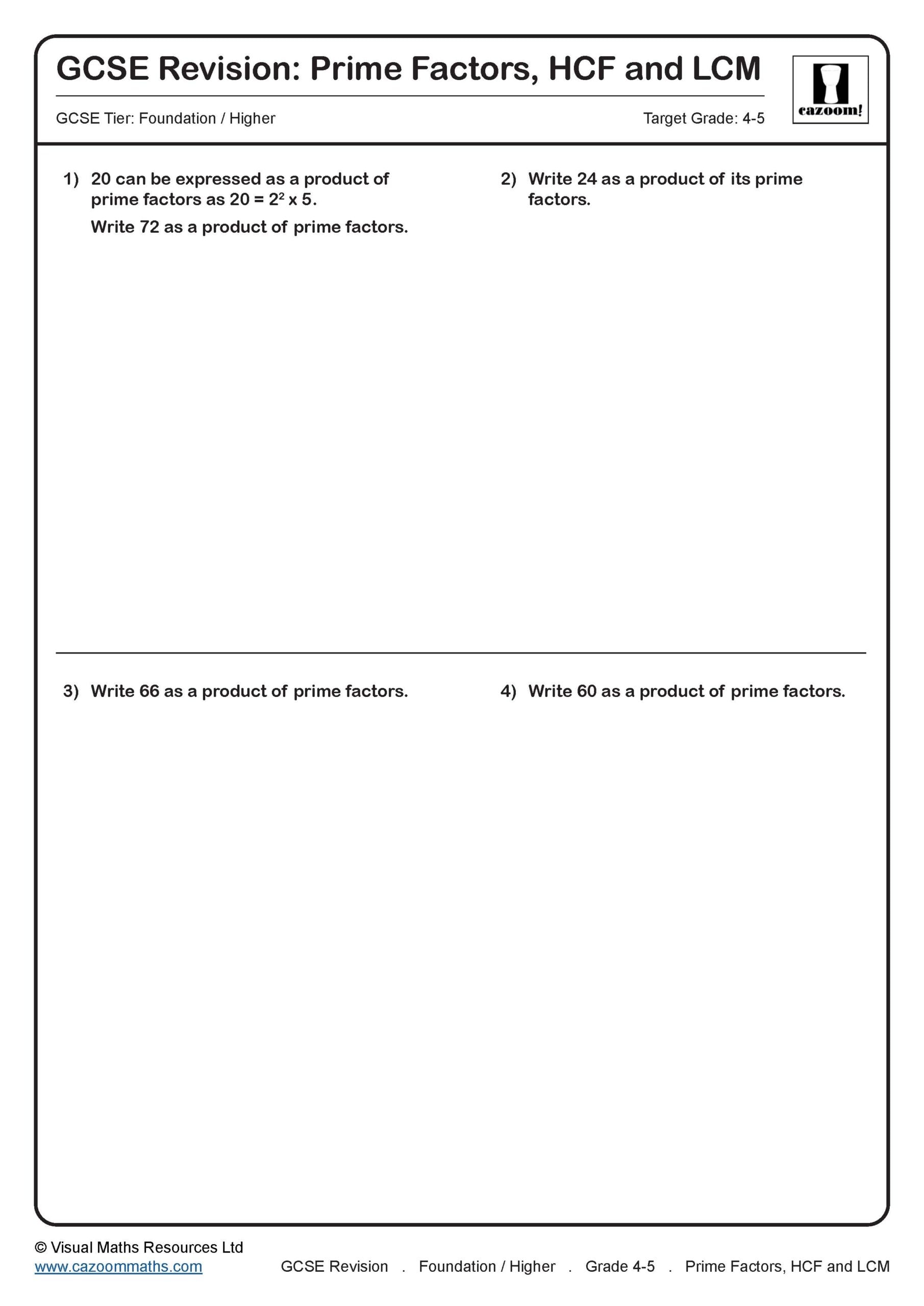
All worksheets are created by the team of experienced teachers at Cazoom Maths.
What Types of Number questions appear on the GCSE Foundation paper?
Foundation papers typically include 4-6 marks on types of number, spread across identifying primes, squares, and cubes from lists, finding factors and multiples of given numbers, and calculating HCF or LCM. Grade 1-3 questions ask students to list the first five multiples or identify whether 17 is prime. Grade 4-5 questions require finding the HCF of two numbers like 48 and 60, or using prime factorisation to find LCM. Occasionally, a worded problem involves multiples, such as working out when two events coincide.
Students lose marks by listing factors incorrectly or stopping their prime factor tree too early. Teachers notice that those who write factors in pairs (1 and 24, 2 and 12, 3 and 8, 4 and 6) make fewer errors than those listing randomly. Exam mark schemes expect all factors, so missing one costs the mark entirely.
What grade are Types of Number questions on Foundation GCSE maths?
Grades 1-3 questions test recognition and basic listing: identifying square numbers up to 100, writing the first six multiples of 7, or stating whether 29 is prime. These build confidence with number properties without calculation pressure. Grades 4-5 questions require finding HCF and LCM using methods like prime factorisation or Venn diagrams, working with larger numbers (up to three digits), and applying these skills to context, such as finding when two buses arrive together at a stop.
Students should tackle grade 1-3 content first to secure the foundational vocabulary and recognition skills. Once squares, cubes, primes, factors, and multiples are automatic, moving to HCF and LCM becomes far more manageable. Teachers often notice that students who rush to grade 5 content without mastering the basics make avoidable errors under exam conditions.
How is Types of Number tested differently on Foundation compared to Higher?
Foundation focuses on applying definitions and using systematic methods like listing or prime factorisation to find HCF and LCM. Questions are typically one or two steps, with numbers chosen to be manageable (primes under 30, two-digit factors). Higher tier expects fluency with prime factorisation using index notation, finding HCF and LCM of three numbers, and combining these skills with fractional or algebraic contexts. Proof questions, such as explaining why the product of two odd numbers is odd, appear only on Higher.
Foundation students need absolute confidence identifying number types and using structured methods for HCF and LCM. Mastering the product of prime factors in index form (such as writing 72 as 2³ × 3²) at Foundation sets students up brilliantly for the overlap grades, where this appears on both papers but with simpler numbers on Foundation.
How should students revise Types of Number for Foundation GCSE maths?
Start with recognition tasks: squares up to 15², cubes up to 5³, primes up to 30. Use worksheets to practise listing factors in pairs and multiples in sequence, checking answers immediately to catch errors. Progress to HCF and LCM questions, timing each attempt to build exam pace. Students should write out prime factor trees fully, even when the method feels repetitive, as examiners award marks for clear working. Revisit questions answered incorrectly after a few days to ensure understanding has stuck.
Teachers can assign these worksheets as starter activities to keep number skills sharp, or set targeted homework before mock exams focusing on grade 4-5 questions. Grouping students by confidence level allows tailored practice: some need repetition on basics, others need challenge through worded problems involving HCF and LCM.