GCSE Foundation Vectors Revision Worksheets
All worksheets are created by the team of experienced teachers at Cazoom Maths.
What Vectors questions appear on the GCSE Foundation paper?
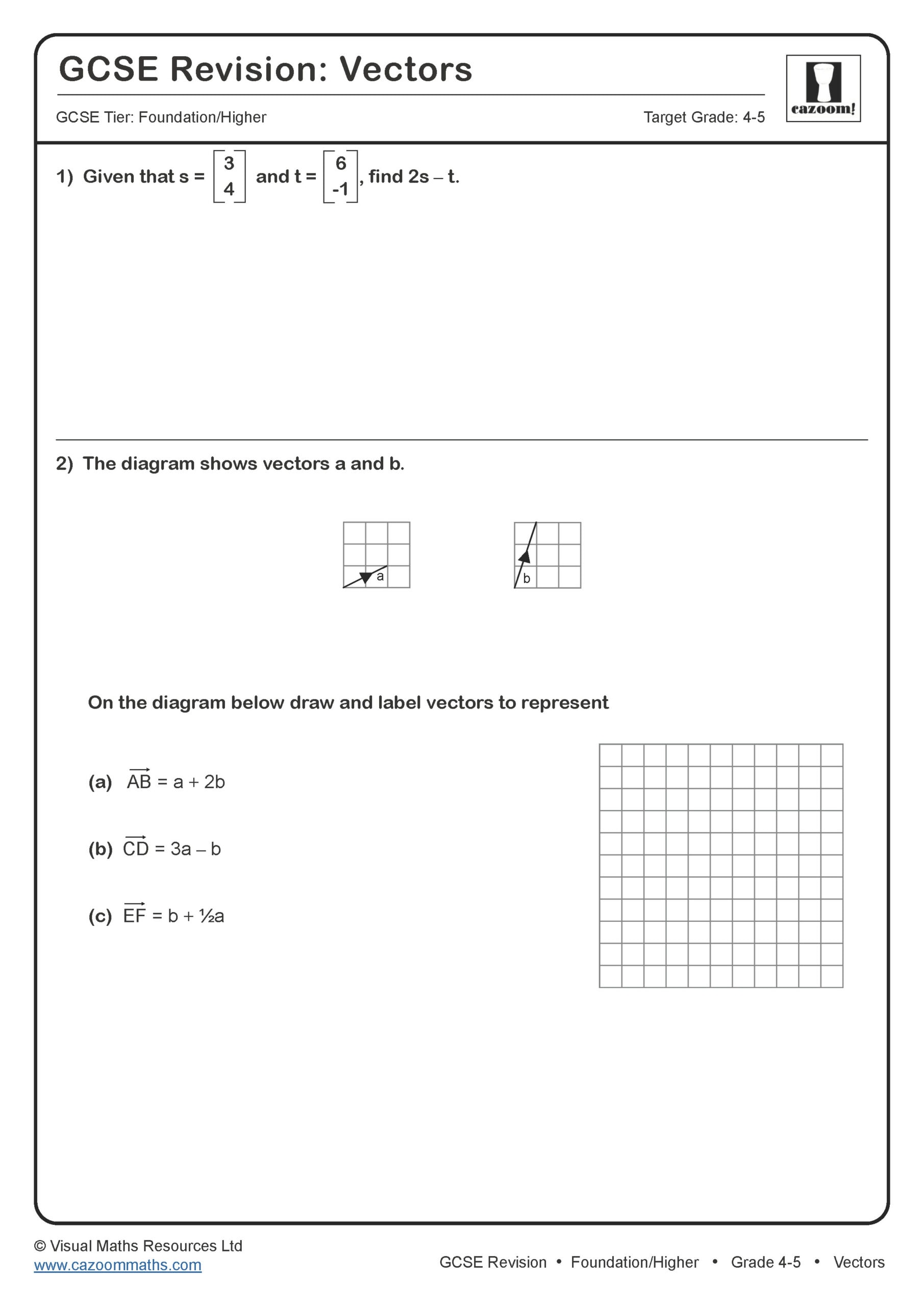
Foundation papers typically allocate 3-5 marks to vectors, usually within a single question or as part of a problem-solving context. Students face questions on describing translations using column vectors, adding two or three vectors on a grid, and finding resultant vectors. Questions often embed vectors within real-world scenarios like map journeys or movement on coordinate grids, testing whether students can translate between diagram and notation.
A common error at this tier involves sign mistakes when working with negative components. Students lose marks by treating column vectors like coordinates, forgetting that the top number represents horizontal movement and the bottom represents vertical. Exam mark schemes penalise careless errors with direction, so checking each step against the grid matters enormously for securing full marks.
What grade are Vectors questions on Foundation GCSE maths?
Lower-grade questions at grades 1-3 test basic vector recognition, writing simple translations as column vectors, and adding vectors shown clearly on grids. Mid-tier questions at grades 4-5 require students to subtract vectors, calculate resultant vectors involving three or more steps, and interpret vector notation without complete visual support. The distinction lies in how much scaffolding the question provides and whether students must work algebraically rather than purely from diagrams.
Students aiming for grade 5 should prioritise mastering algebraic vector addition and subtraction first, then tackle multi-step problems. Those targeting grade 4 benefit from securing diagram-based questions before attempting abstract notation. Focusing revision on the grade band just above current performance builds confidence whilst stretching understanding appropriately.
How is Vectors tested differently on Foundation compared to Higher?
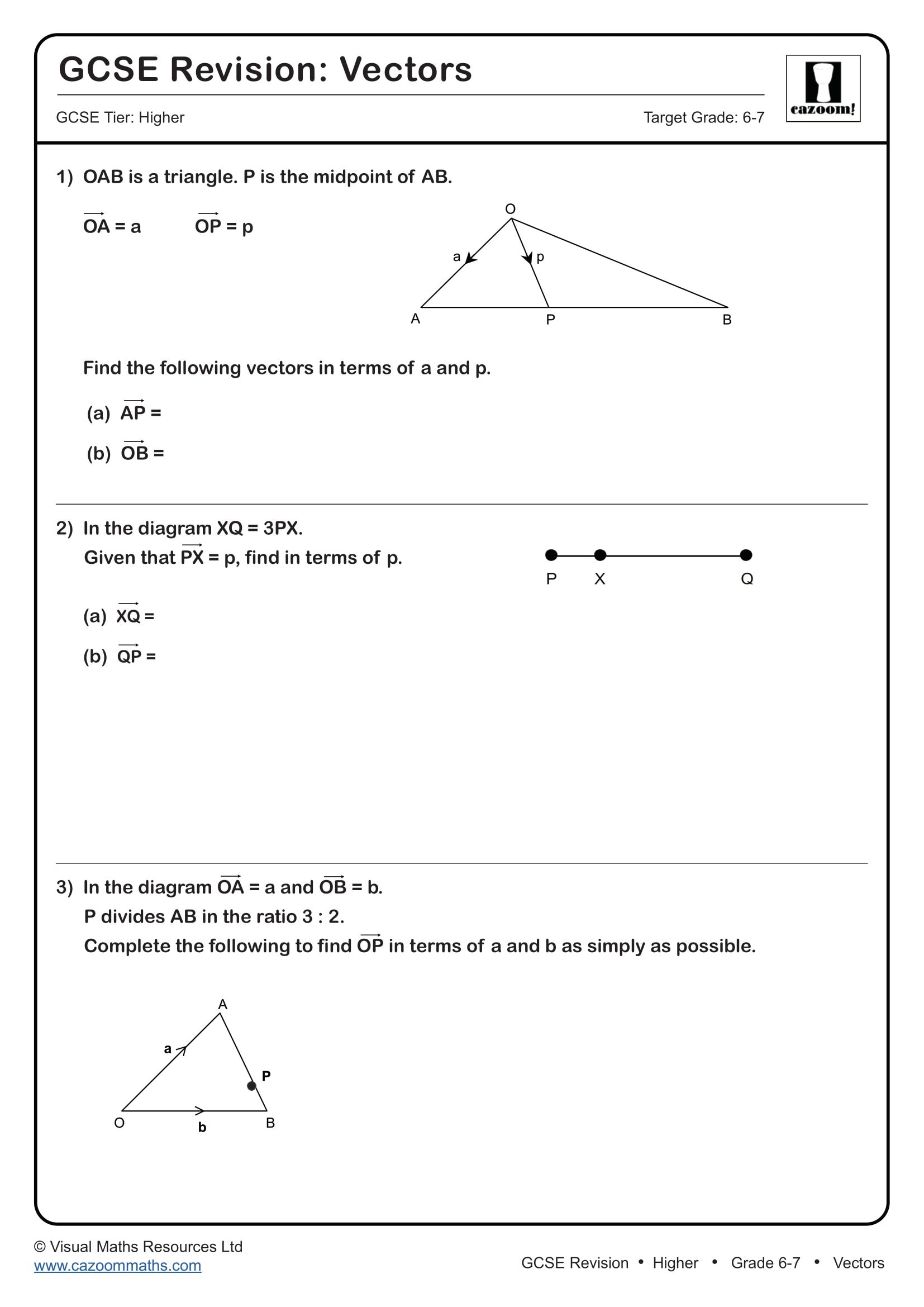
Foundation vectors focuses on concrete skills like translation, simple addition and subtraction, and resultant vectors on grids. Questions rarely exceed three vectors combined, and contexts remain accessible with clear visual support. Higher tier extends into scalar multiplication, geometric proofs using vectors, and abstract problems involving parallel vectors or ratio division along lines. The algebraic reasoning demanded at Higher far exceeds Foundation expectations.
The Foundation approach ensures students understand vectors as quantities with both magnitude and direction, building fluency with column notation before formal proof. Mastering these core skills matters because vectors underpin later topics like transformations and kinematics. Students who secure Foundation vector skills gain confidence manipulating mathematical notation beyond just numbers, developing algebraic thinking that supports progression into Higher content.
How should students revise Vectors for Foundation GCSE maths?
Students should begin with diagram-based questions, practising translations and vector addition visually before attempting algebraic calculations. Working through questions in grade order helps build confidence systematically. Timed practice using these worksheets replicates exam conditions, and checking answers immediately afterwards highlights recurring sign errors or misunderstandings about direction. Teachers notice that students benefit from verbalising what each component means before writing column vectors.
Teachers can use these worksheets for targeted intervention with students approaching grade 4 or 5, setting specific questions as homework based on recent mock performance. Pairing diagram questions with algebraic equivalents helps students connect visual and symbolic representations. Regular low-stakes quizzes using worksheet excerpts keep vector skills sharp without overwhelming students, particularly useful since vectors appears less frequently than algebra or number topics.