GCSE Higher Bearings Scale and Loci Revision Worksheets
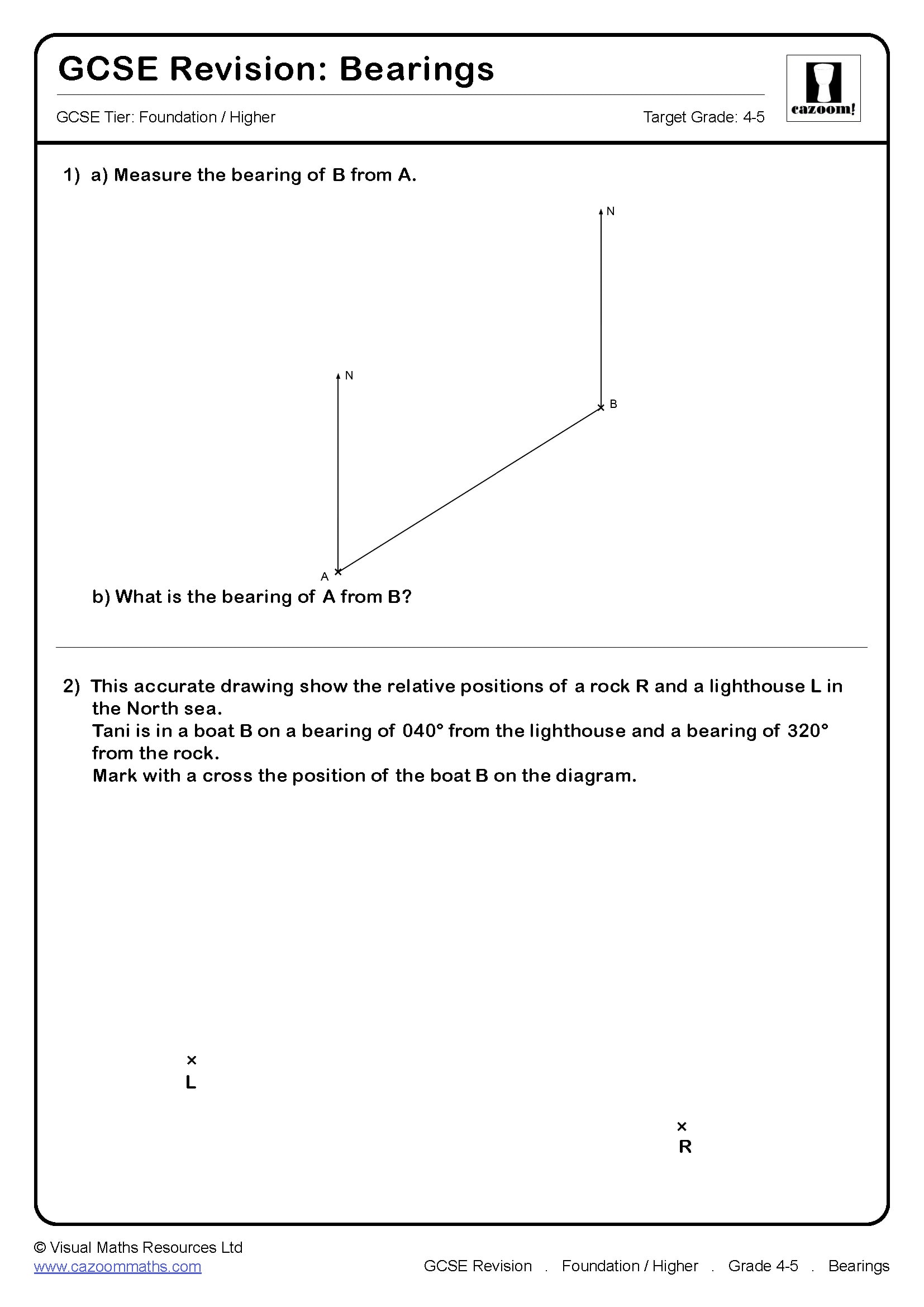
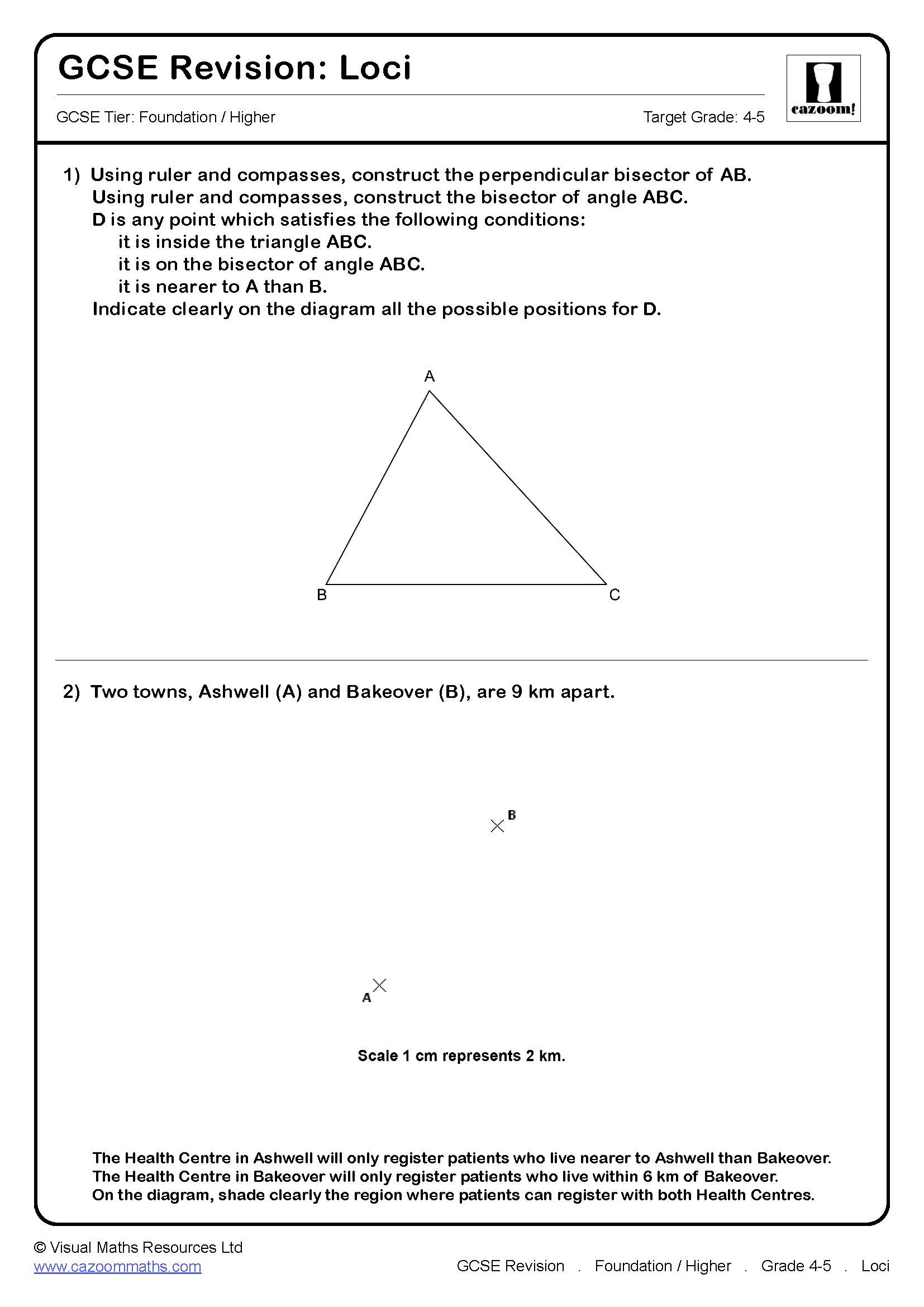
All worksheets are created by the team of experienced teachers at Cazoom Maths.
What Bearings Scale and Loci questions appear on the GCSE Higher paper?
Higher papers typically include bearings questions worth 2-4 marks involving journey problems with multiple direction changes, scale drawings requiring conversions between map and real distances, and loci constructions worth 3-5 marks. Students face compound loci problems where they must construct the intersection of two or more regions, such as finding points equidistant from two lines while maintaining a fixed distance from a point. Back bearing calculations appear frequently, often combined with trigonometry or Pythagoras for distance problems.
Exam mark schemes penalise students who measure bearings from the wrong direction or forget to draw all arcs when constructing loci. Teachers observe that students lose marks by not labelling constructions clearly or failing to shade the correct region when questions ask for 'the area satisfying all conditions'. Accurate compass work without rubbing out construction lines is essential for full method marks.
What grade are Bearings Scale and Loci questions on Higher GCSE maths?
Bearings and basic loci constructions appear from grade 4 upwards, with straightforward three-figure bearing calculations and single locus problems targeting grades 4-5. Grade 6-7 questions introduce scale drawing problems requiring multiple steps, back bearings combined with distance calculations, or loci intersections with two conditions. Grade 8-9 questions demand compound loci involving three or more constraints, bearings integrated with trigonometry, or problems requiring proof that a point satisfies geometric conditions through construction.
Students should identify their current working grade and practise questions one band above to build confidence. Teachers find that students aiming for grade 7 benefit from consolidating accurate constructions at grade 5-6 level before attempting complex compound loci, as construction errors compound quickly in multi-step problems and undermine otherwise sound reasoning.
How is Bearings Scale and Loci tested differently on Higher compared to Foundation?
Foundation papers focus on measuring given bearings, basic scale conversions, and constructing single loci like perpendicular bisectors or fixed-distance arcs with clear instructions. Higher papers expect students to interpret journey descriptions and calculate bearings independently, work with compound loci requiring multiple constructions without step-by-step prompts, and apply scale drawing to problem-solving contexts where they must decide which measurements to take. Back bearings rarely appear on Foundation but are standard at Higher.
This difference reflects Higher tier expectations for mathematical reasoning beyond following procedures. Students must recognise when to construct angle bisectors versus perpendicular bisectors from problem descriptions alone, combine constructions to find regions satisfying multiple conditions, and justify why their construction meets geometric criteria. Teachers observe that this independence separates students comfortable with grade 6 from those reaching grade 8.
How should students revise Bearings Scale and Loci for Higher GCSE maths?
Students should begin with construction accuracy, practising perpendicular and angle bisectors until they can complete them confidently within two minutes. Working through worksheets in grade order builds systematic understanding from single locus problems to compound constructions. Timed practice matters because exam pressure increases protractor and compass errors. Students benefit from checking answer sheets immediately after attempting each question, comparing their construction arcs and measurements against model solutions to identify technique weaknesses before they become habits.
Teachers can use these worksheets for targeted intervention with students approaching grade boundaries, setting specific construction types as homework before introducing compound problems in lessons. Pairing worksheet practice with past paper questions helps students recognise how loci concepts appear in different contexts. Regular low-stakes practice prevents rustiness with compass work, which deteriorates quickly without consistent reinforcement throughout the Higher tier course.