GCSE Higher Brackets Revision Worksheets
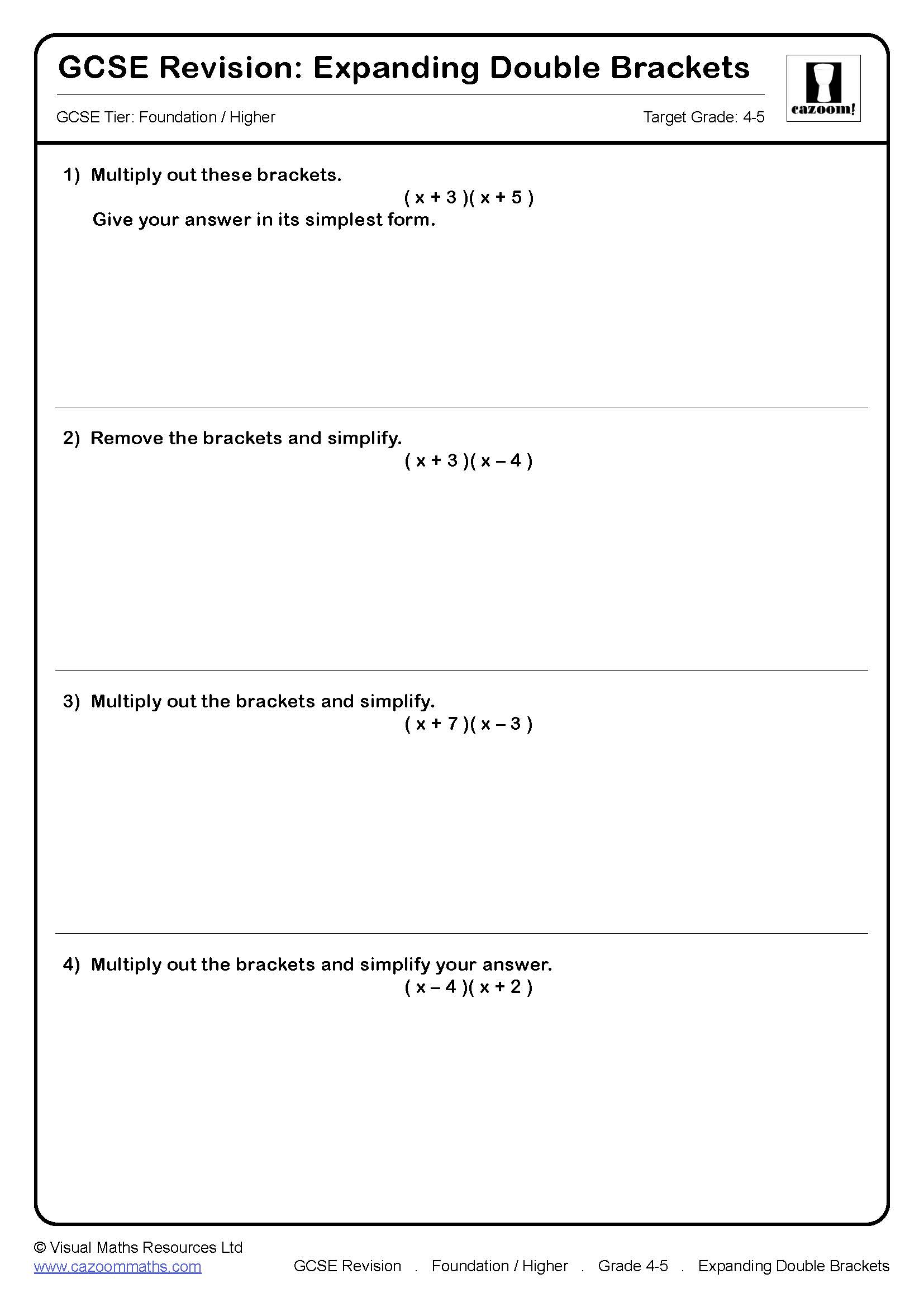
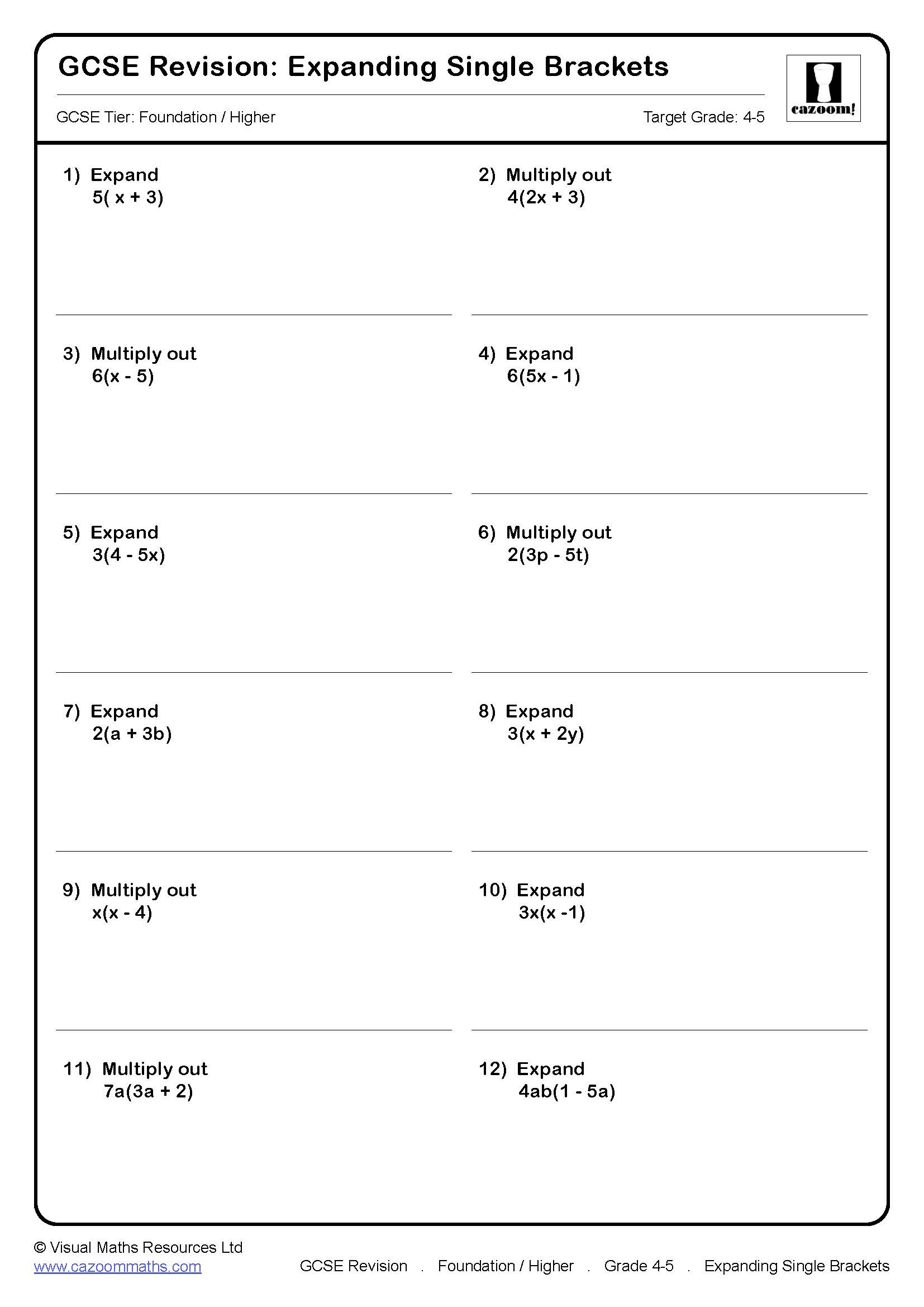
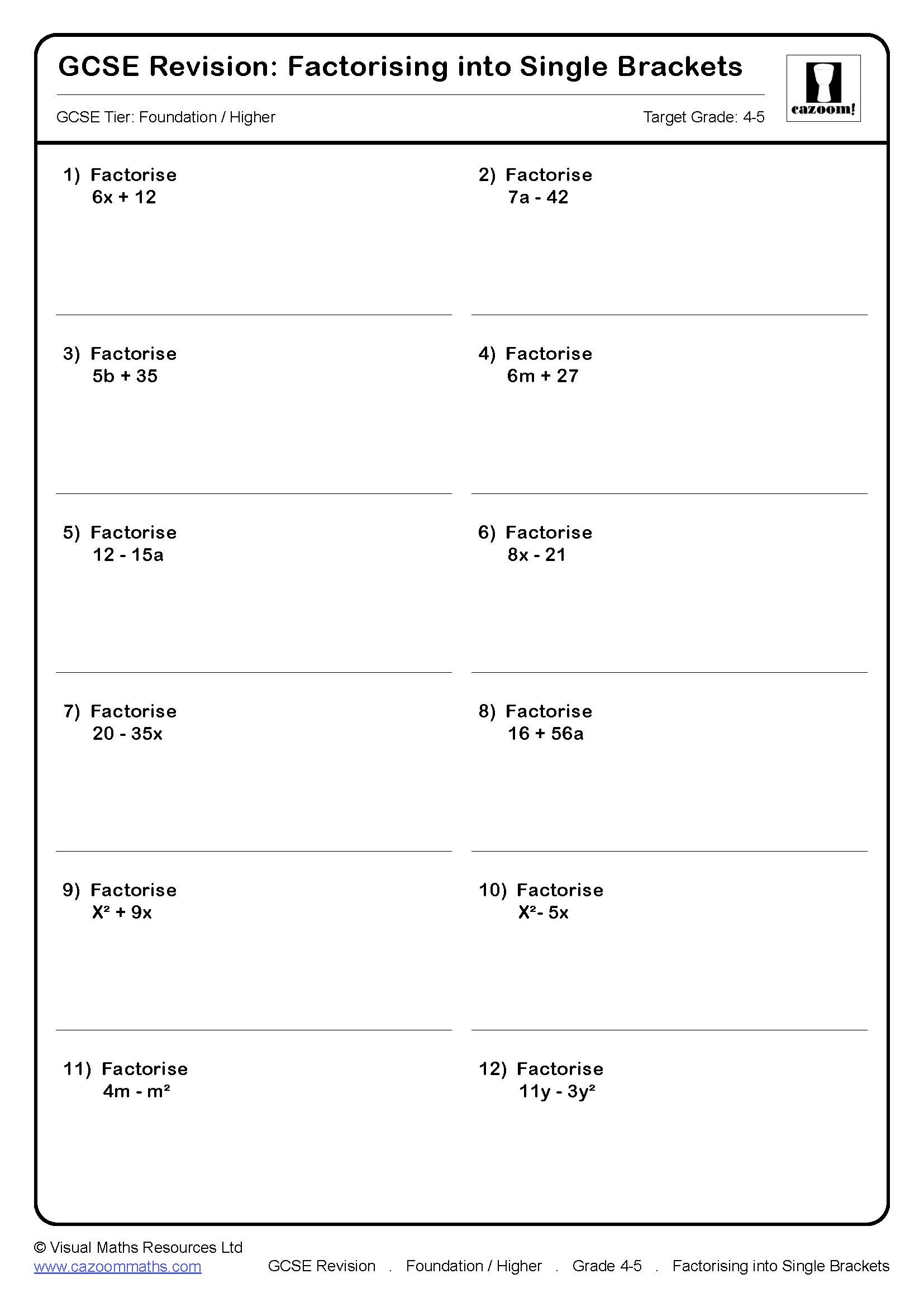
All worksheets are created by the team of experienced teachers at Cazoom Maths.
What Brackets questions appear on the GCSE Higher paper?
Higher papers typically include 8-12 marks across brackets questions, though the skill threads through other topics like factorising, solving equations, and algebraic proof. Students face double bracket expansions (including algebraic coefficients and negative terms), difference of two squares both recognising and applying it, and triple bracket expansions requiring careful organisation. Questions might combine bracket work with simplification, substitution, or forming expressions from context. The algebraic fractions questions often require expanding brackets first before simplifying.
Mark schemes penalise incomplete expansions heavily. Students who write (x + 3)(x - 5) = x² - 2x - 15 without showing intermediate steps lose method marks if their final answer contains an error. Teachers notice that showing (x + 3)(x - 5) = x² - 5x + 3x - 15 = x² - 2x - 15 protects marks, particularly in multi-step problems where bracket expansion is just the first stage.
What grade are Brackets questions on Higher GCSE maths?
Basic single and double bracket expansions with positive integer coefficients appear at grades 4-5, accessible to students working at the Foundation-Higher overlap. Questions involving negative terms, algebraic coefficients like (3x - 2)(2x + 5), or the difference of two squares typically target grades 5-6. Triple bracket expansions and problems requiring brackets within algebraic proof or forming complex expressions sit at grades 7-9, where systematic working and algebraic fluency distinguish stronger candidates. The context matters too. Expanding (x + 4)² might be grade 5, but recognising when to apply it within a proof is grade 8.
Students should identify their weakest grade band first. Those scoring grade 6 who struggle with triple brackets gain more from targeted practice there than repeating double bracket work they've already mastered. Using answer sheets to diagnose specific algebraic errors (sign mistakes, missing terms, incorrect collecting) focuses revision where it genuinely improves performance.
How is Brackets tested differently on Higher compared to Foundation?
Foundation tier focuses on single brackets and straightforward double brackets with small positive integers, like 3(x + 2) or (x + 4)(x + 3). Questions are direct and clearly signposted. Higher tier assumes fluency with these basics and moves immediately to algebraic coefficients, negatives, and mixed operations. Students face (2x - 3)(4x + 1), recognise (5x)² - 4² as difference of two squares, and expand three brackets systematically. Higher questions embed bracket work within multi-step problems rather than isolating it, expecting students to know when expansion is necessary without explicit instruction.
This shift matters because Higher candidates need strategic algebraic thinking, not just procedural recall. Knowing that (a + b)² = a² + 2ab + b², not a² + b², prevents errors across topics. Triple bracket expansion demands organisation and patience, qualities that separate grade 7 students from grade 4 students attempting the same paper. The expectation is fluency under examination pressure, not just classroom competence.
How should students revise Brackets for Higher GCSE maths?
Begin with double brackets until expansion becomes automatic, then progress to triple brackets where systematic working is essential. Students should practise expanding (x + 2)(x - 3)(x + 1) by first dealing with two brackets, then multiplying the result by the third. Checking answers immediately identifies whether errors stem from sign mistakes, missing terms, or incorrect collection of like terms. Timed practice builds the fluency needed for examinations, where bracket questions rarely appear in isolation. Working through problems that combine expansion with factorising or solving equations mirrors actual paper demands better than isolated drill.
Teachers can set these worksheets as low-stakes homework, allowing students to self-diagnose using answer sheets before addressing misconceptions in class. Alternatively, use them as starter activities targeting specific skills like difference of two squares or perfect square expansion. For intervention groups working towards grade 5, focus on accuracy with double brackets before introducing triple bracket complexity. The PDF format allows easy printing for revision sessions or cover work.