GCSE Higher Factorising Revision Worksheets
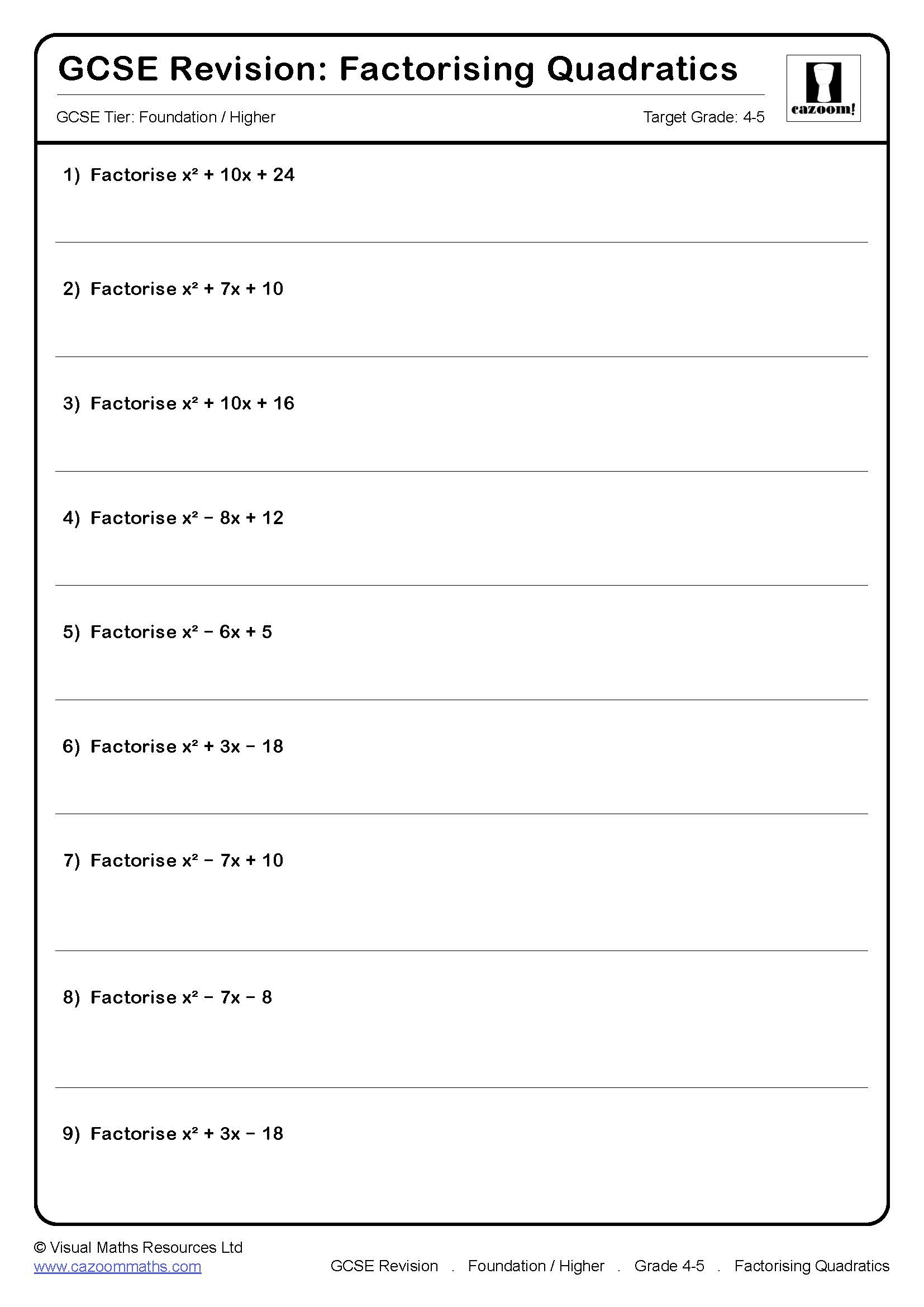
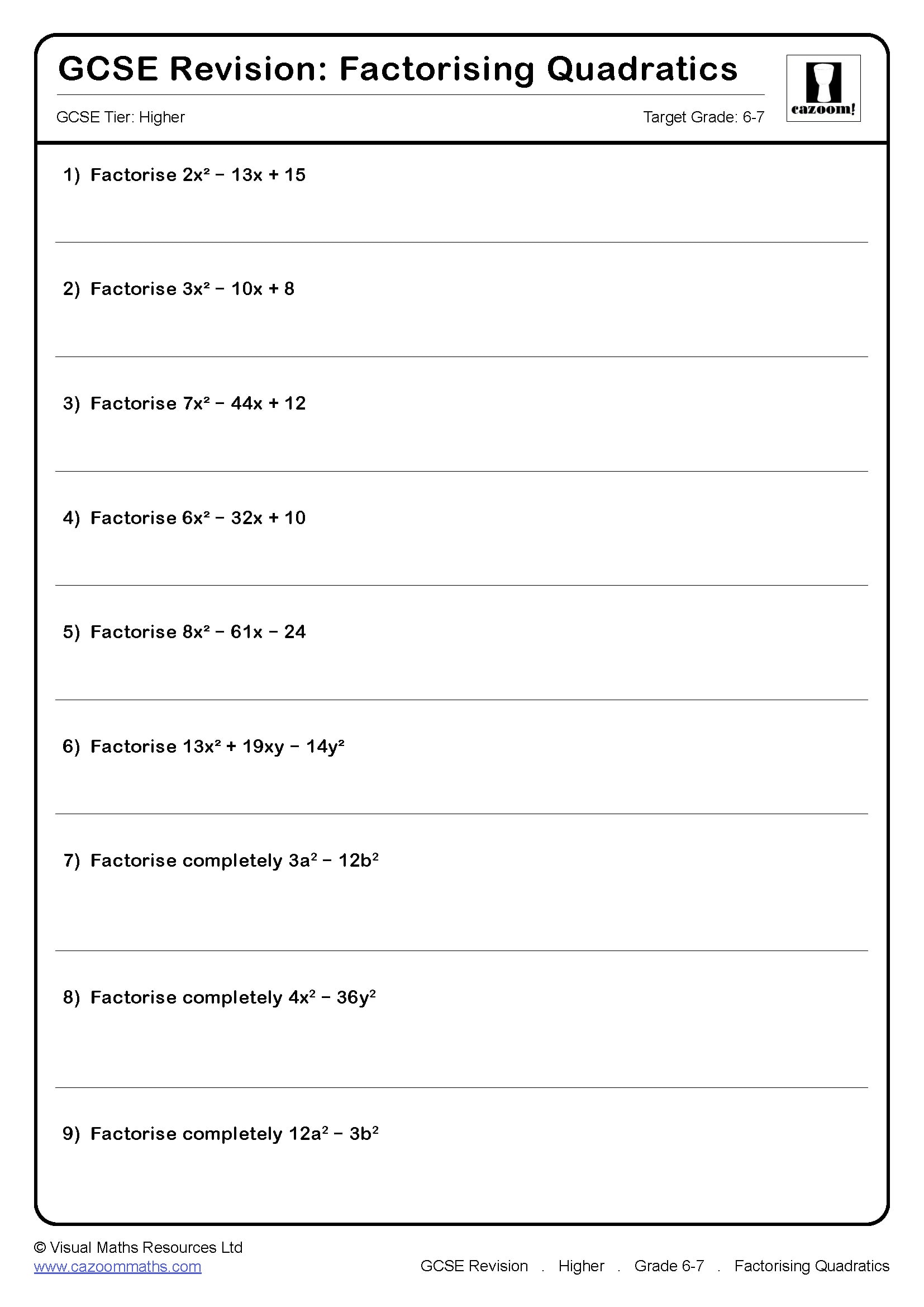
All worksheets are created by the team of experienced teachers at Cazoom Maths.
What factorising questions appear on the GCSE Higher paper?
Higher papers feature factorising quadratics where the coefficient of x² is 1 or greater, typically worth 2-3 marks per question. Students encounter factorising within equation-solving contexts, simplifying algebraic fractions, sketching quadratic graphs, and proof questions. The overlap grades 4-5 test straightforward quadratics like x² + 7x + 12, whilst grade 6-8 questions involve expressions such as 3x² - 11x - 4 or those requiring difference of two squares recognition. Factorising also appears as a step within longer problem-solving questions worth 5-6 marks.
Exam mark schemes penalise sign errors heavily, even when the factorising method is correct. Students lose marks when they factorise correctly but fail to solve the equation completely, forgetting to state both solutions. Teachers notice that writing out the factor pair check (e.g., -3 and -4 multiply to +12, add to -7) reduces careless mistakes under exam pressure.
What grade are factorising questions on Higher GCSE maths?
Factorising spans the entire Higher grade range. Grade 4-5 questions test factorising quadratics with coefficient 1, such as x² + 8x + 15 or x² - 9, worth 2 marks. Grade 6-7 questions introduce harder coefficients (2x² + 5x - 3) or require factorising within equation contexts. Grade 8-9 questions embed factorising in complex algebra, such as simplifying rational expressions, forming and solving equations from geometric problems, or algebraic proof involving quadratic identities. These higher-grade questions often carry 4-6 marks and test fluency under multi-step reasoning.
Students revising for grade 7 or above should prioritise quadratics where a ≠ 1, as these consistently appear at grade boundaries. Those targeting grade 6 benefit from securing straightforward factorising first before attempting complex coefficients. Teachers often guide students to attempt every factorising question on past papers within their target grade band to identify weak patterns.
How is factorising tested differently on Higher compared to Foundation?
Foundation papers restrict factorising to single-variable expressions with common factors (e.g., 6x + 9 = 3(2x + 3)) and occasionally simple quadratics like x² + 5x + 6, worth 1-2 marks. Higher papers expect fluency with all quadratic forms, including negative coefficients, harder factor pairs, and expressions where the coefficient of x² exceeds 1. Higher students must also factorise the difference of two squares instantly and apply factorising within proof, graph sketching, and solving equations that Foundation students would tackle using trial-and-improvement or calculator methods.
This distinction matters because Higher papers embed factorising as a tool rather than the endpoint. Students cannot access grade 7+ without automatic recall of factor pairs and confident manipulation of quadratic expressions. Exam questions assume factorising fluency, penalising students who reach for the quadratic formula when factorising is quicker and required for subsequent algebraic steps.
How should students revise factorising for Higher GCSE maths?
Students should begin with straightforward quadratics to secure method, then progress systematically to harder coefficients. Timed practice builds the speed needed for exam conditions, where factorising must become automatic rather than laboured. Working through answers carefully highlights recurring sign errors or factor pair mistakes. Teachers notice that students who write out factor pair checks consistently make fewer errors than those who factorise mentally. Practising solving equations by factorising rather than isolated factorising better reflects exam question styles, particularly at grade 7-9 where factorising appears mid-question.
Teachers can assign these worksheets as targeted homework following initial teaching, or use them for retrieval practice weeks later to combat memory decay. Setting specific grade-band worksheets allows differentiation within mixed-ability groups. In revision lessons, working through one worksheet collaboratively then setting a second for independent timed practice effectively builds confidence before mock exams.