GCSE Higher Inequalities Revision Worksheets
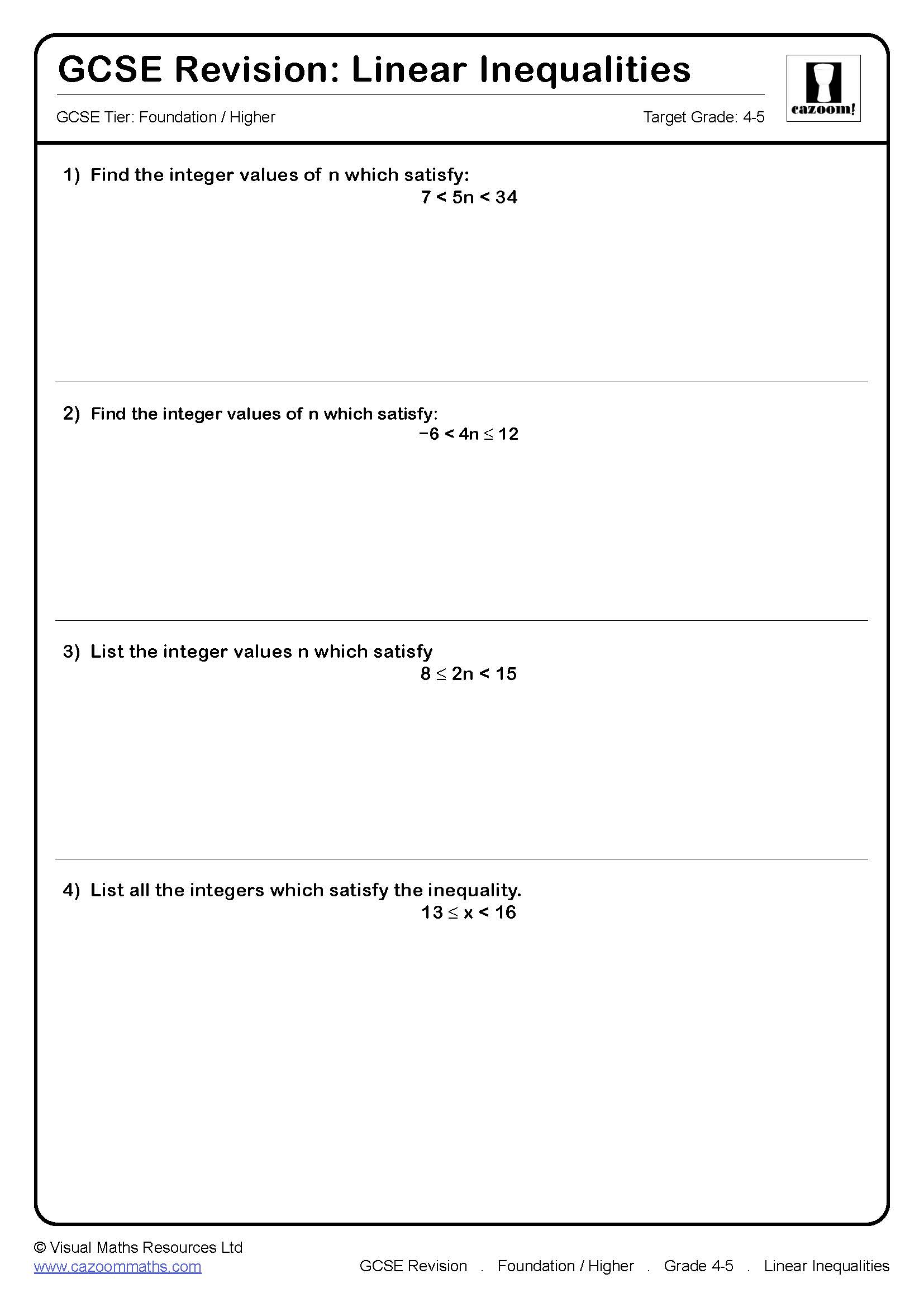
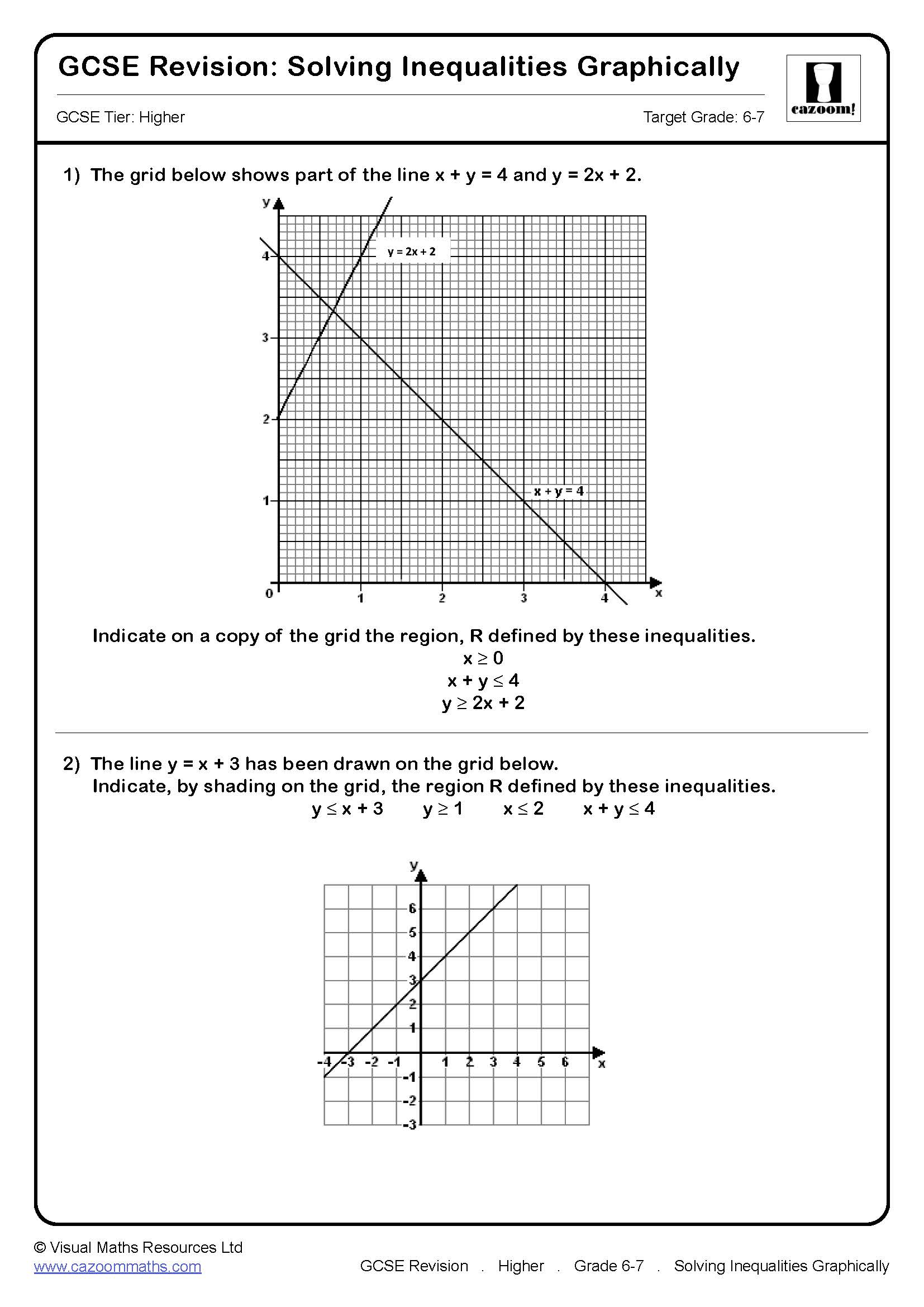
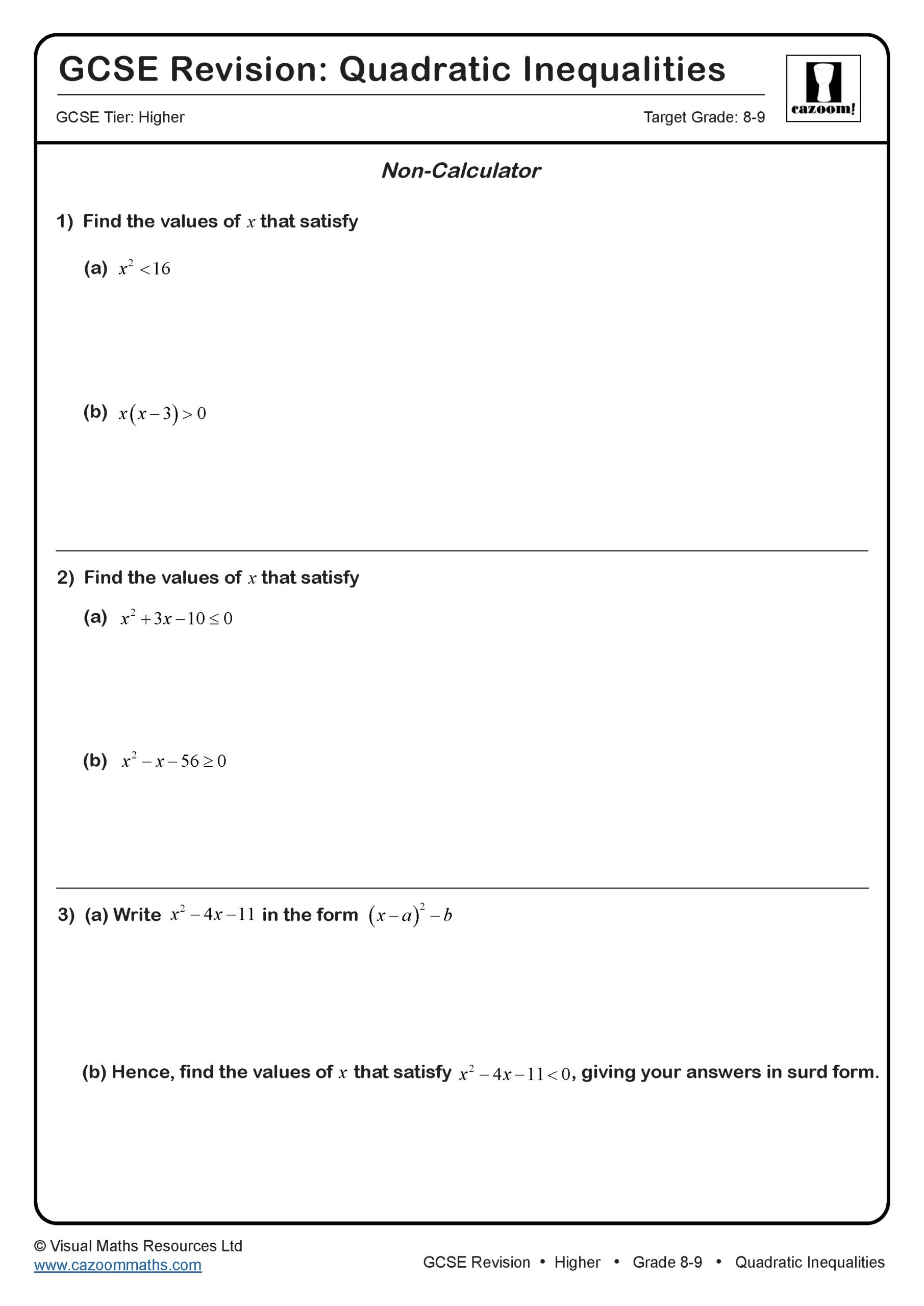
All worksheets are created by the team of experienced teachers at Cazoom Maths.
What Inequalities questions appear on the GCSE Higher paper?
Higher papers include linear inequalities with algebraic fractions (2-3 marks), regions defined by multiple inequalities on coordinate grids (4-5 marks), and quadratic inequalities requiring factorisation or graphical interpretation (3-4 marks). Students also face context-based problems where inequalities model real constraints, often embedded within problem-solving questions worth 5-6 marks. These questions assess whether candidates maintain inequality direction when multiplying or dividing by negatives, and whether they recognise solution sets as ranges rather than single values.
Exam mark schemes penalise students who write x < 3 > −2 instead of −2 < x < 3, or who shade the wrong region when presented with y ≥ 2x + 1. Teachers observe that candidates lose marks by converting inequalities to equations midway through solutions, forgetting the inequality persists throughout algebraic manipulation.
What grade are Inequalities questions on Higher GCSE maths?
Foundation-level inequality work (solving 3x + 5 > 17, representing solutions on number lines) appears as grade 4-5 questions on Higher papers, typically as opening parts worth 1-2 marks. Grade 6-7 questions require solving inequalities involving fractions or forming inequalities from written descriptions. Quadratic inequalities and graphical interpretations of simultaneous inequalities target grades 7-9, often appearing as final parts of multi-step problems where algebraic reasoning must be communicated clearly.
Students targeting grade 7 should prioritise quadratic inequalities until they can consistently identify solution ranges without errors. Those aiming for grade 9 need fluency across all inequality types, including forming and solving inequalities from unfamiliar contexts. Teachers notice that students plateau at grade 6 if they avoid quadratic cases during revision, assuming linear skills suffice.
How is Inequalities tested differently on Higher compared to Foundation?
Foundation papers restrict inequalities to linear cases with integer coefficients, often presented with number line representations already drawn. Higher papers expect students to solve quadratic inequalities algebraically, interpret solution sets from graphs without scaffolding, and handle inequalities embedded within algebraic proof or problem-solving contexts. Where Foundation asks students to shade y < x + 2 on a given grid, Higher requires identifying regions satisfying three or four simultaneous inequalities, then extracting integer coordinates within that region.
This difference matters because Higher students must treat inequalities as algebraic objects requiring manipulation, not just arithmetic comparisons. Teachers observe that students who memorise Foundation-style number line methods struggle when faced with (x − 2)(x + 5) ≤ 0, where critical value testing or sketching becomes essential for identifying −5 ≤ x ≤ 2 correctly.
How should students revise Inequalities for Higher GCSE maths?
Students should begin with linear inequalities to establish fluent manipulation, then progress to quadratic cases where factorisation and sketching determine solution ranges. Working through graphical inequality worksheets develops recognition of boundary lines (solid versus dashed) and region identification. Timed practice under exam conditions highlights whether students can complete quadratic inequality questions within 4-5 minutes, the typical allocation. Checking answers immediately after attempting each worksheet reveals persistent errors, such as reversing inequality signs when multiplying by negatives or misidentifying quadratic solution ranges.
Teachers can assign specific worksheets targeting identified weaknesses: quadratic inequalities for students comfortable with linear cases, or graphical interpretations for those struggling with region shading. Setting these as low-stakes homework allows students to attempt challenging content without exam pressure, building confidence before formal assessments.