GCSE Higher Linear Functions Revision Worksheets
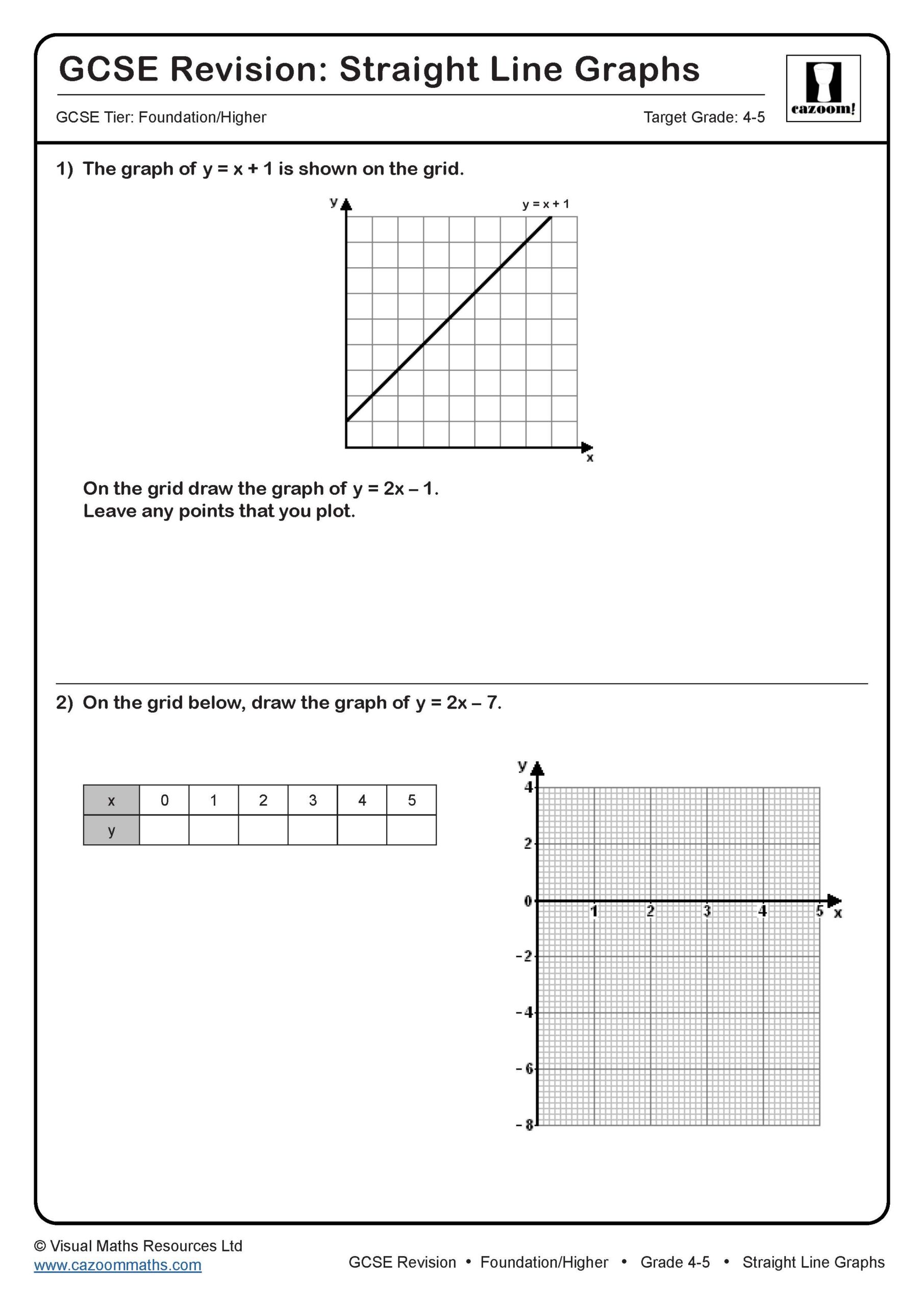
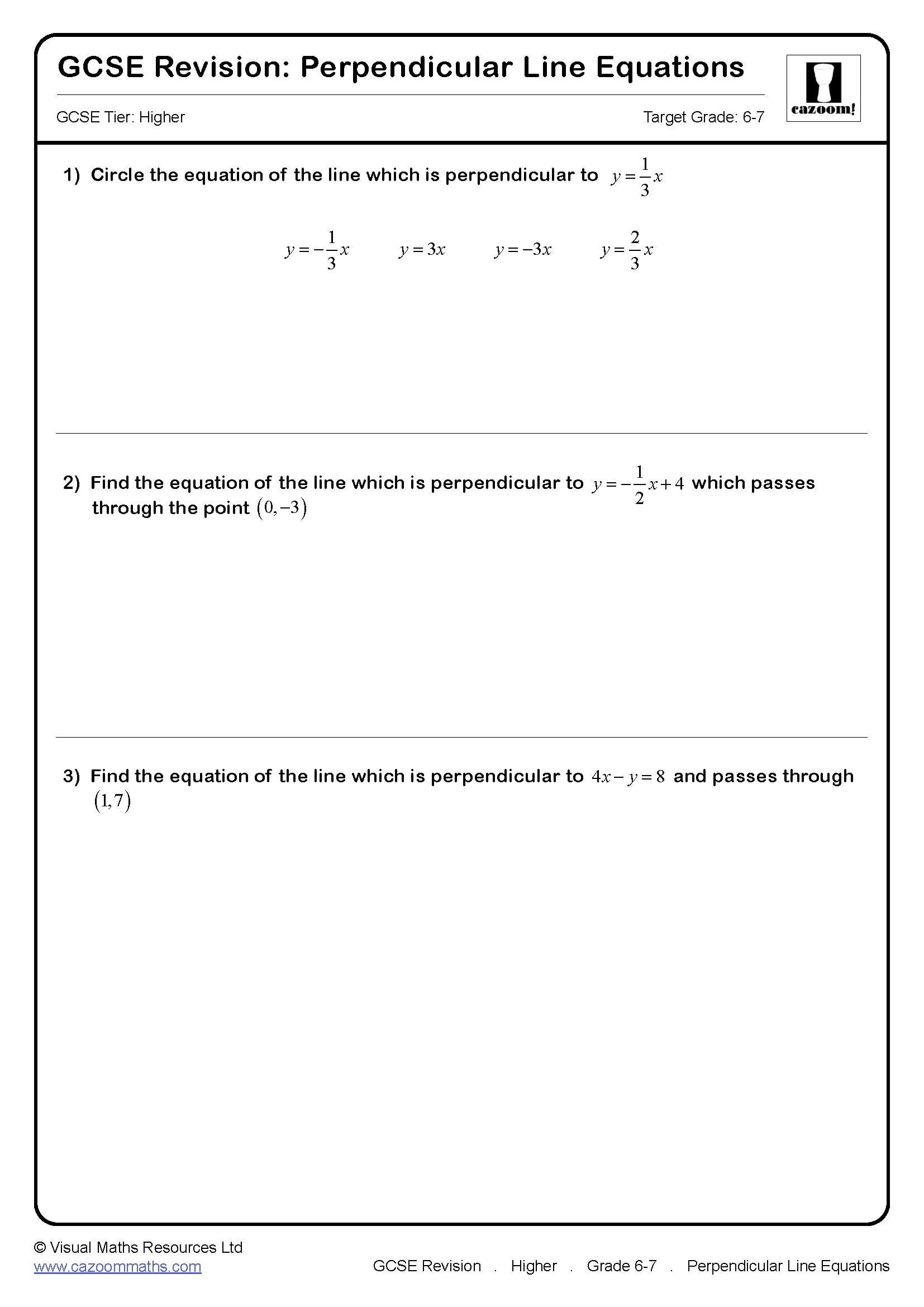
All worksheets are created by the team of experienced teachers at Cazoom Maths.
What Linear Functions questions appear on the GCSE Higher paper?
Higher papers typically include 4-6 linear function questions totalling 15-20 marks. Students face problems requiring them to find equations of lines from two points, determine where lines intersect algebraically, prove lines are parallel or perpendicular using gradient relationships, and work with transformations of graphs. Multi-step questions often combine linear functions with other topics: finding equations of tangents to circles, modelling real-life situations, or working with composite transformations. Questions worth 3-4 marks usually require showing full algebraic working.
Exam mark schemes penalise students who rely on graph paper and estimation. A question asking whether two lines are perpendicular expects m₁ × m₂ = -1 shown algebraically, not sketches. Students lose marks by finding gradients correctly but failing to state the conclusion clearly, or by rearranging equations incorrectly when converting between forms.
What grade are Linear Functions questions on Higher GCSE maths?
Linear functions span grades 4-9 on Higher papers. Grade 4-5 questions test finding gradients from coordinates, using y = mx + c to write equations, and identifying parallel lines. Grade 6-7 questions involve perpendicular gradients, finding equations from geometric conditions, and interpreting distance-time or conversion graphs algebraically. Grade 8-9 questions embed linear functions within proof, require manipulation of parametric forms, or combine multiple concepts such as finding where a linear graph intersects a quadratic.
Students aiming for grade 7 should prioritise fluency with perpendicular lines and transformations before attempting the most demanding questions. Teachers often notice students attempting grade 8-9 problems prematurely, making algebraic errors that suggest insecure foundations. Targeting grade 6-7 material first builds the manipulation skills essential for accessing the highest marks, particularly when rearranging complex equations into recognisable linear form.
How is Linear Functions tested differently on Higher compared to Foundation?
Foundation tier focuses on plotting points, reading gradients from graphs, and substituting into y = mx + c when m and c are given. Questions rarely exceed two marks and accept graphical methods. Higher tier expects algebraic reasoning throughout: deriving equations from conditions, proving relationships between gradients, and manipulating linear equations as part of multi-step problems. Higher students must recognise when lines are perpendicular without being prompted, whereas Foundation papers explicitly guide students through each step.
This algebraic emphasis matters because Higher exams assess whether students understand linear functions as mathematical objects, not just sets of coordinates. Students must rearrange ax + by = c into gradient-intercept form confidently, connect negative reciprocal gradients to perpendicularity conceptually, and apply linear reasoning within unfamiliar contexts. Teachers frequently observe that students entering Higher tier underestimate how much algebraic fluency these questions demand compared to Foundation's more procedural approach.
How should students revise Linear Functions for Higher GCSE maths?
Effective revision starts with timed practice on worksheets targeting specific grade bands. Students should work through grade 5-6 material first, checking answer sheets immediately to identify manipulation errors before they become habits. Once confident with perpendicular gradients and standard rearrangements, move to grade 7-8 questions combining linear functions with other topics. Teachers notice that students who practise writing full solutions, not just final answers, perform significantly better under exam conditions, particularly when mark schemes award method marks for correct algebraic processes.
These worksheets work well as retrieval practice starters or targeted homework after teaching graph transformations or simultaneous equations. Teachers can assign specific worksheets to address individual misconceptions revealed by assessment, or use them sequentially to build towards exam-style problem-solving. The answer sheets allow students to self-assess independently, making these particularly valuable for intervention groups or students revising grade boundaries between 6 and 8.