GCSE Higher Lines and Angles Revision Worksheets
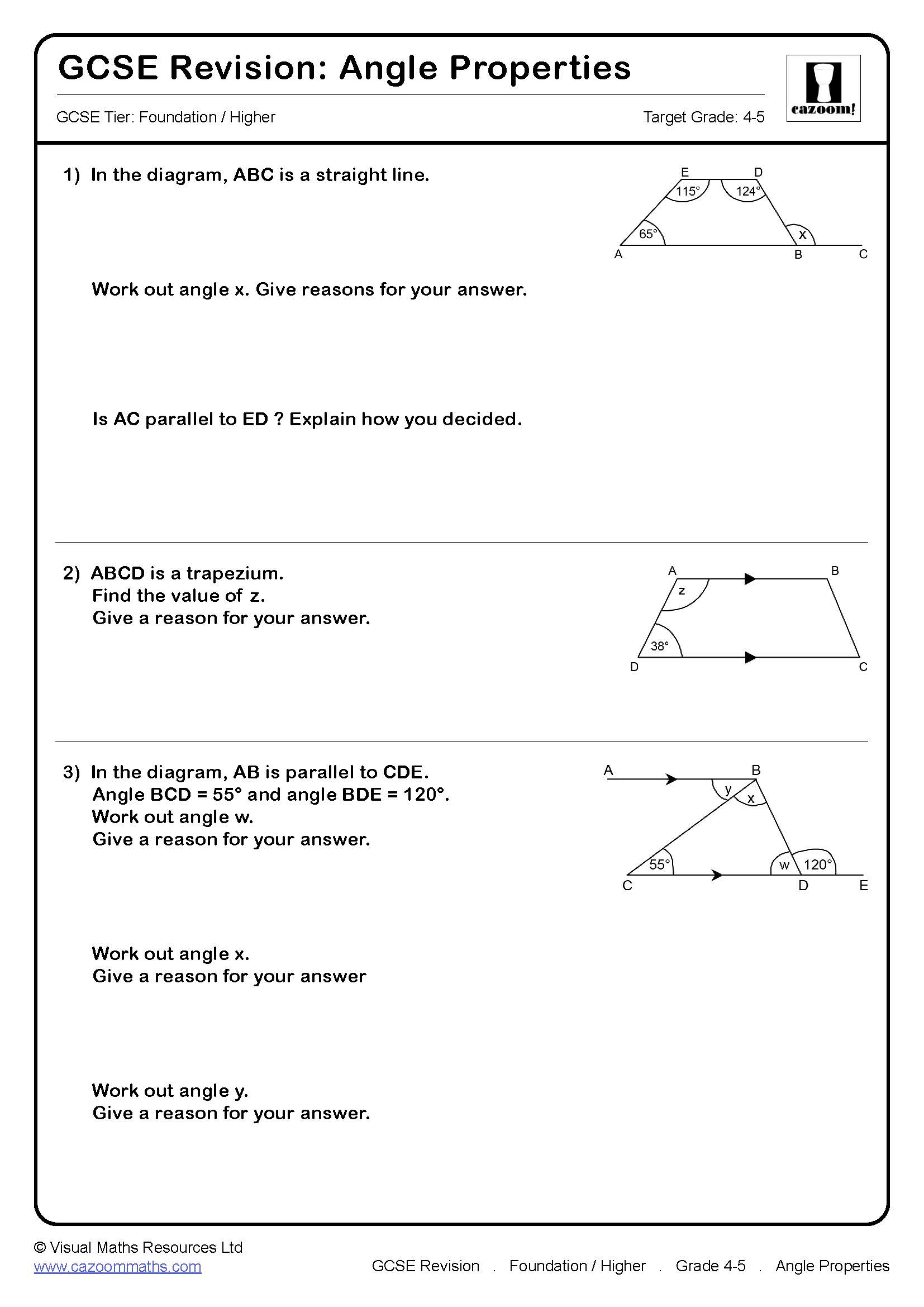
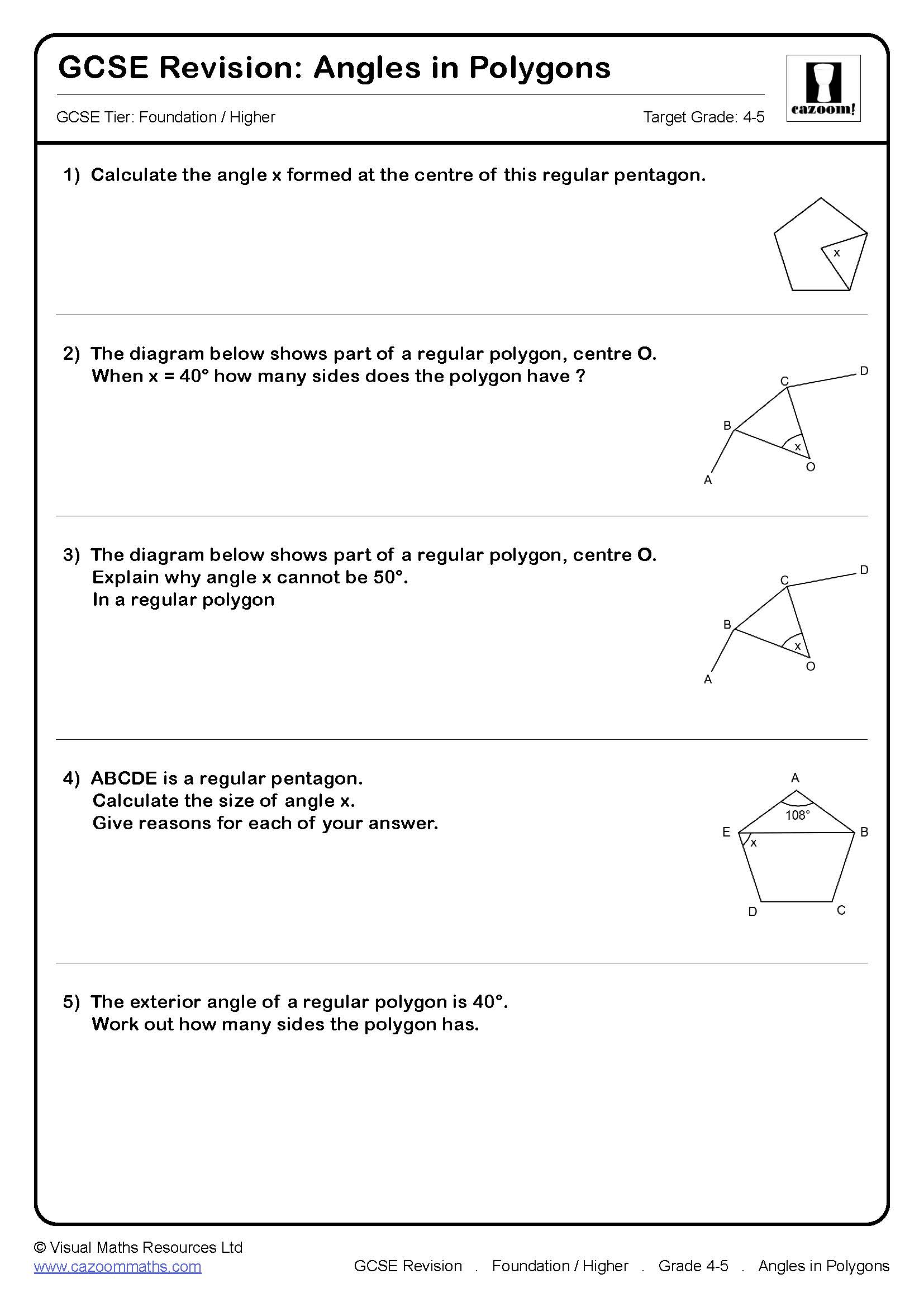
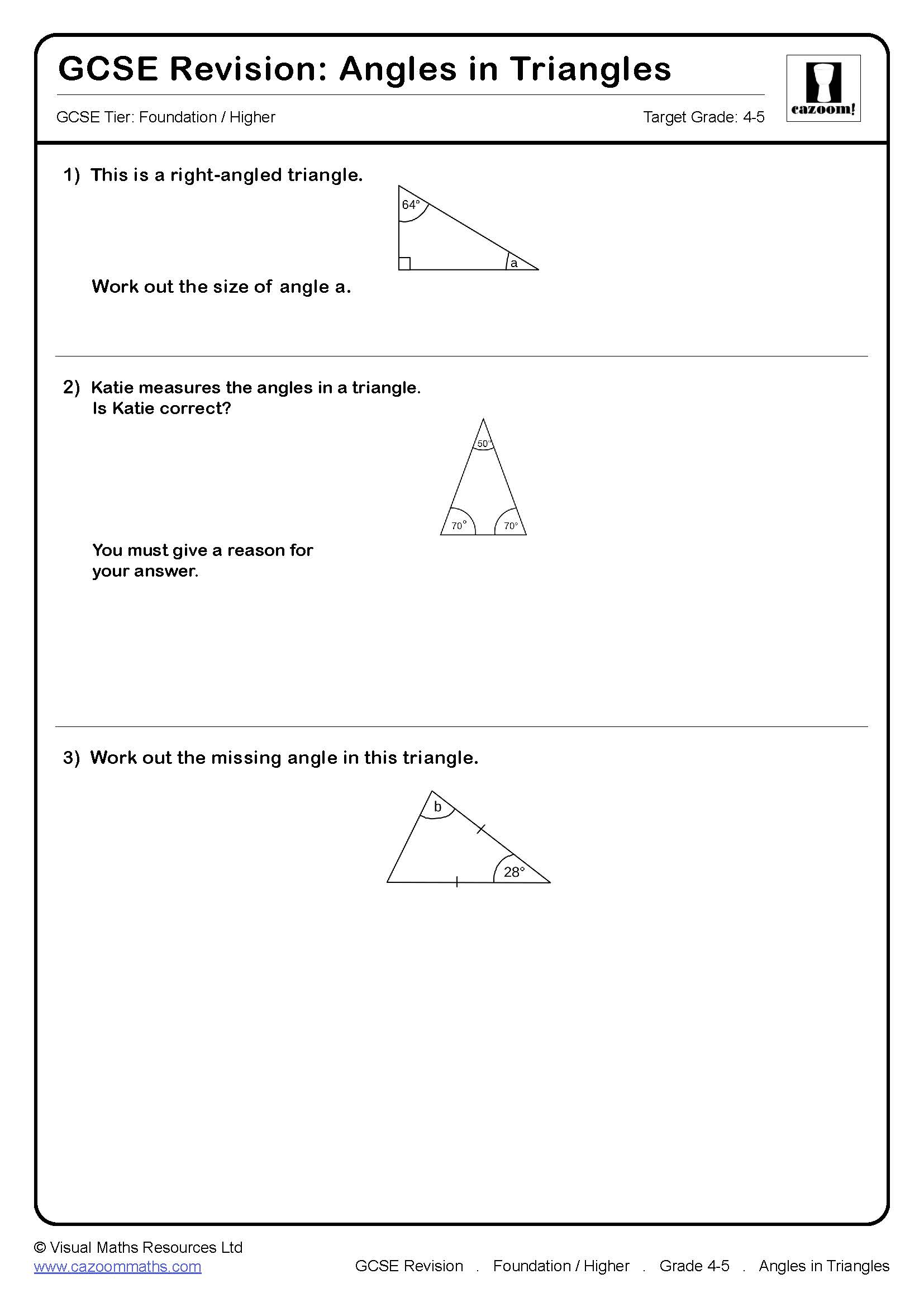
All worksheets are created by the team of experienced teachers at Cazoom Maths.
What Lines and Angles questions appear on the GCSE Higher paper?
Higher papers feature angles in parallel lines with algebraic expressions, interior and exterior angles of polygons requiring equation-solving, and problems combining multiple angle properties across complex diagrams. Typical questions carry 3-5 marks and expect clear geometric reasoning. Grade 7-9 questions often embed angles within coordinate geometry, circle theorems or vectors, testing whether students can identify which properties apply.
Exam mark schemes penalise students who jump to answers without stating angle facts. A common error at this tier involves finding an angle correctly but failing to justify using terms like 'alternate angles are equal' or 'angles in a triangle sum to 180°', losing method marks despite correct numerical answers.
What grade are Lines and Angles questions on Higher GCSE maths?
Grade 4-5 questions on Higher papers test angles in parallel lines, triangle properties and basic polygon angle sums with straightforward diagrams. Grade 6-7 questions introduce algebraic angles requiring equation-forming and solving, such as finding expressions for angles then using geometric facts to create equations. Grade 8-9 questions demand proof, asking students to justify why angle relationships must be true or combining angles with similar shapes, bearings or circle theorems across multi-part problems.
Students should attempt grade 4-5 questions first to secure foundational reasoning before tackling algebraic problems. Teachers often suggest working through worksheets by grade band, ensuring students can justify every step before progressing to proof questions that require watertight logical arguments.
How is Lines and Angles tested differently on Higher compared to Foundation?
Foundation papers focus on numeric angle calculations with clear diagrams and single-step reasoning, typically asking students to find missing angles using stated properties. Higher papers expect students to handle angles expressed algebraically, form equations from geometric constraints, and provide formal justifications for every statement. Where Foundation might ask 'find angle x', Higher asks 'prove that these lines are parallel' or embeds angle reasoning within bearings, vectors or coordinate geometry contexts.
This shift demands precision in mathematical language and the ability to construct logical arguments. Higher students must recognise which angle properties apply in complex diagrams without prompts, then communicate their reasoning clearly. Teachers notice that students who master geometric justification at this tier develop algebraic problem-solving skills that transfer across GCSE topics.
How should students revise Lines and Angles for Higher GCSE maths?
Start with grade 4-5 worksheets to secure angle facts and basic reasoning, ensuring every answer includes geometric justification like 'corresponding angles are equal'. Progress to grade 6-7 algebraic questions, practising forming equations from angle relationships before solving. Time grade 8-9 proof questions under exam conditions, then compare working against answer sheets to identify where reasoning needs tightening. Students should annotate diagrams with known angle facts before attempting calculations, building systematic approaches that prevent errors in multi-step problems.
Teachers can assign worksheets by grade band for targeted intervention, using answer sheets to model geometric reasoning during whole-class feedback. Setting timed practice replicates exam pressure, helping students develop fluency in recognising angle properties quickly whilst maintaining rigorous justification that secures full marks on Higher papers.