GCSE Higher Mean Median Mode Revision Worksheets
All worksheets are created by the team of experienced teachers at Cazoom Maths.
What Mean Median Mode questions appear on the GCSE Higher paper?
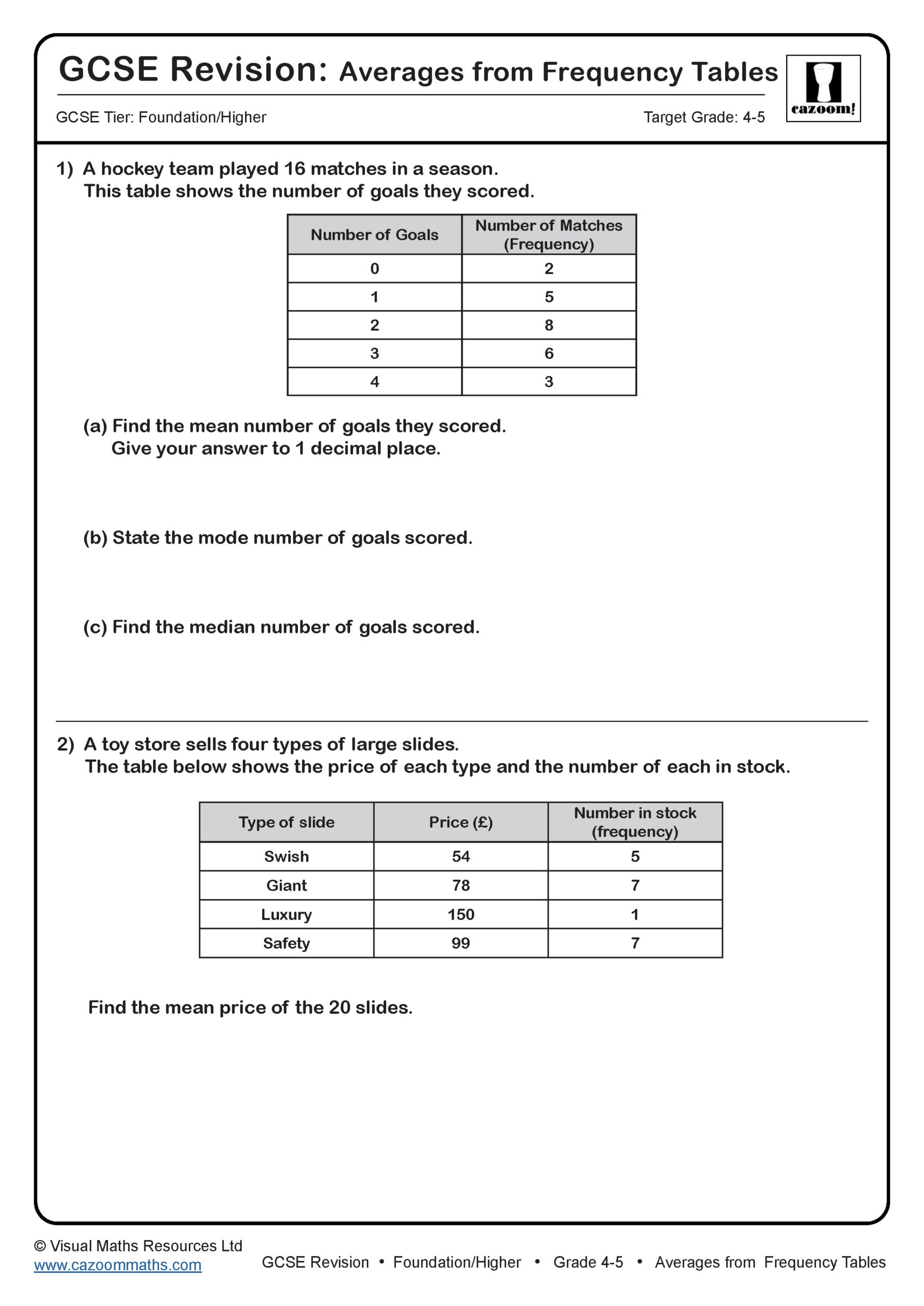
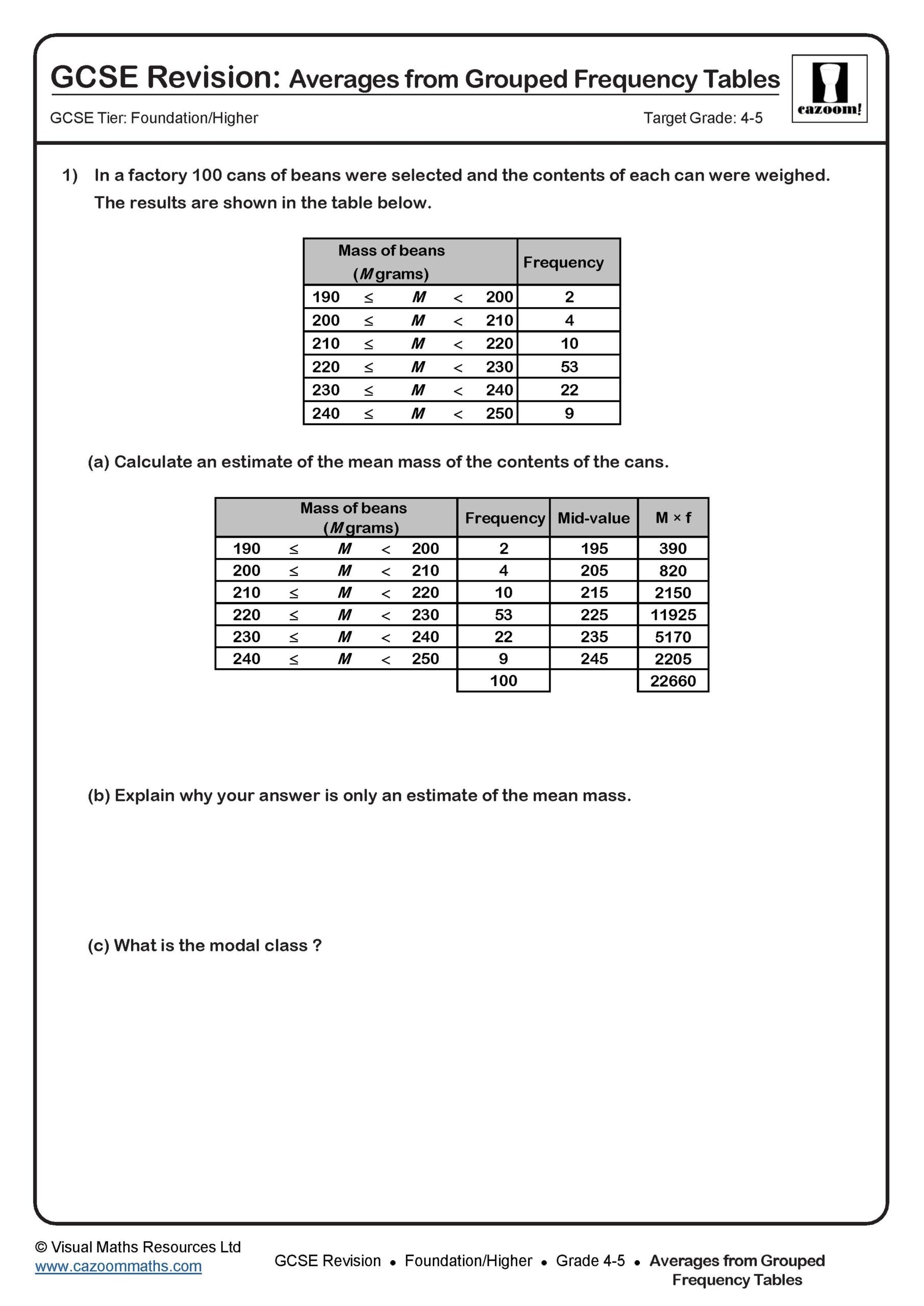
Higher papers typically feature two or three averages questions worth 2-5 marks each. Students face frequency tables requiring mean calculations using midpoints, comparing distributions using range and median together, and reverse problems where they must find missing values given the mean. Grade 7-9 questions involve proof or justification: explaining why certain statistics are impossible or determining constraints on unknown data points.
Exam mark schemes penalise incomplete working heavily in averages questions. Students lose marks when they write a correct mean but show no frequency multiplication or sum of values. Teachers observe that candidates often calculate all three averages when the question specifies one, wasting valuable exam time without gaining additional credit.
What grade are Mean Median Mode questions on Higher GCSE maths?
Grade 4-5 questions test calculating mean, median and mode from frequency tables and comparing two data sets using appropriate averages. Grade 6 questions introduce working backwards: finding a missing value when the mean is stated, or determining the range given constraints. Grade 7-9 questions demand proof that certain combinations are impossible, using algebra to express relationships between unknowns, or analysing which average best represents skewed distributions.
Students should identify their target grade band and practise those questions under timed conditions first. Teachers find that securing grade 6 technique with missing values creates a foundation for tackling grade 8-9 proof questions. Revisiting weaker grade bands prevents careless errors costing marks in accessible questions.
How is Mean Median Mode tested differently on Higher compared to Foundation?
Foundation tier focuses on finding averages from lists and simple frequency tables, with straightforward comparisons between two data sets. Higher tier expects fluency with grouped frequency tables using midpoints, reverse calculations involving algebra, and justifying why particular statistical claims cannot be valid. Higher questions embed averages within problem-solving contexts requiring multiple steps and reasoning.
This algebraic approach matters because grade 7-9 students must demonstrate mathematical reasoning, not just calculation. Teachers observe that students who rely on Foundation methods struggle when asked to prove or explain their answers. Higher tier demands understanding why formulae work and recognising when statistics mislead, skills that distinguish grade 6 from grade 8 responses.
How should students revise Mean Median Mode for Higher GCSE maths?
Students should work systematically through worksheets targeting their current grade, then attempt the next band up. Practising reverse problems where the mean is given builds algebraic confidence essential for grades 7-9. Setting a timer for exam-style questions develops accuracy under pressure. Checking full worked solutions identifies where working is incomplete, a common reason for lost method marks even with correct answers.
Teachers can assign specific worksheets matching upcoming mock exam content or use them for retrieval practice weeks after teaching the topic. Setting grade 7-9 challenge questions for homework stretches higher-attaining students while others consolidate grade 5-6 techniques. The answer sheets allow independent checking, making these suitable for remote learning or cover lessons.