GCSE Higher Quadratic and Cubic Functions Revision Worksheets
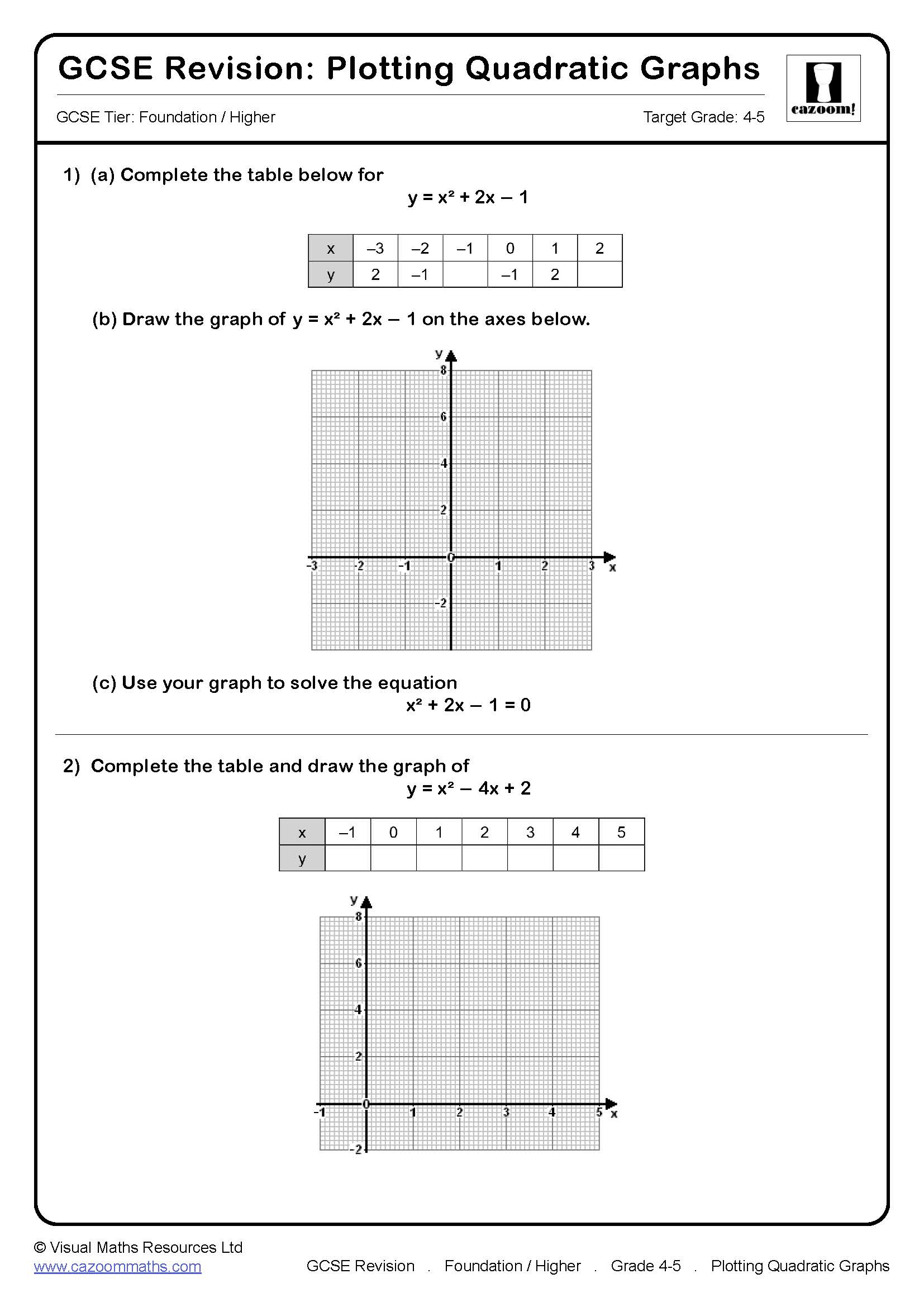
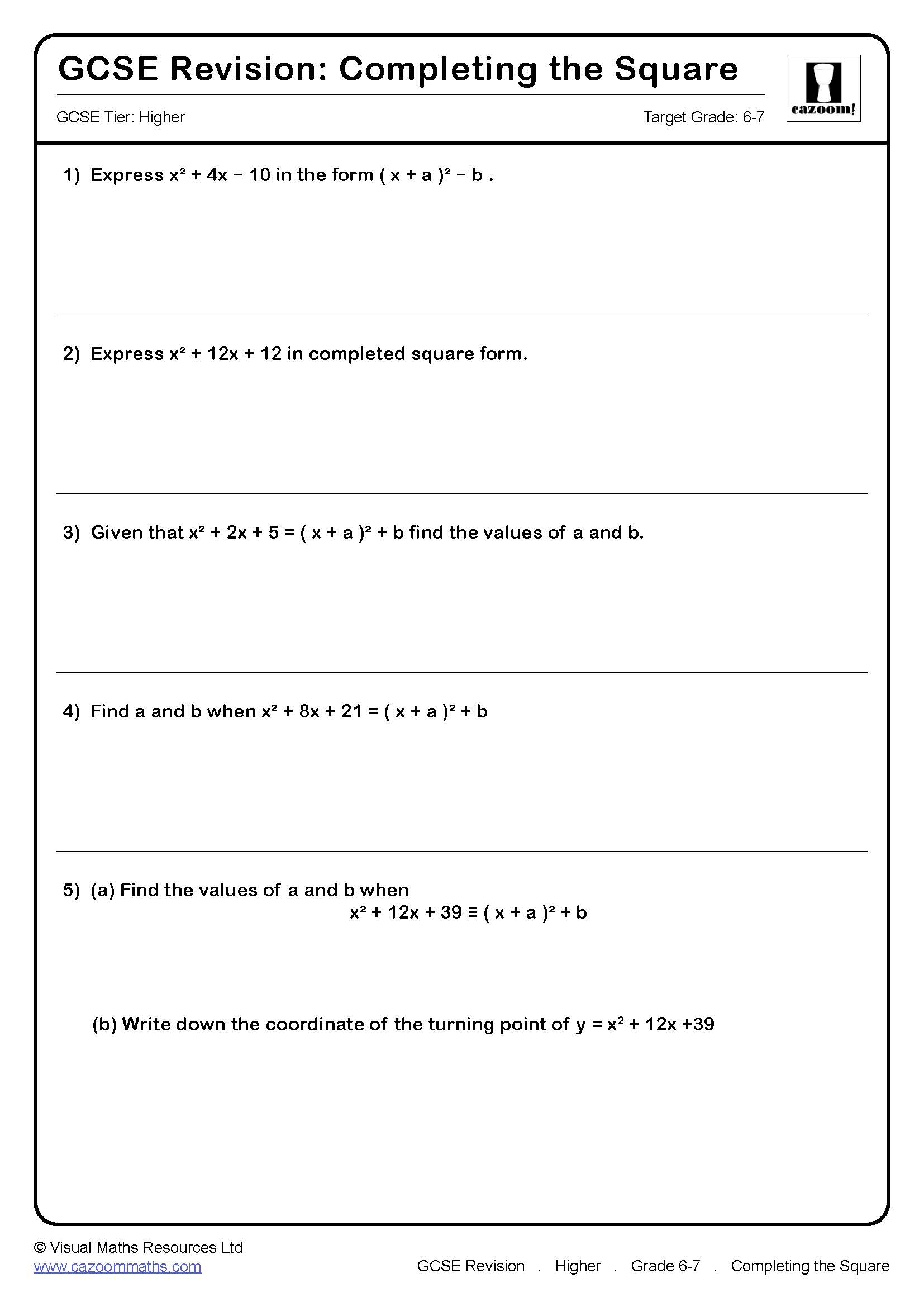
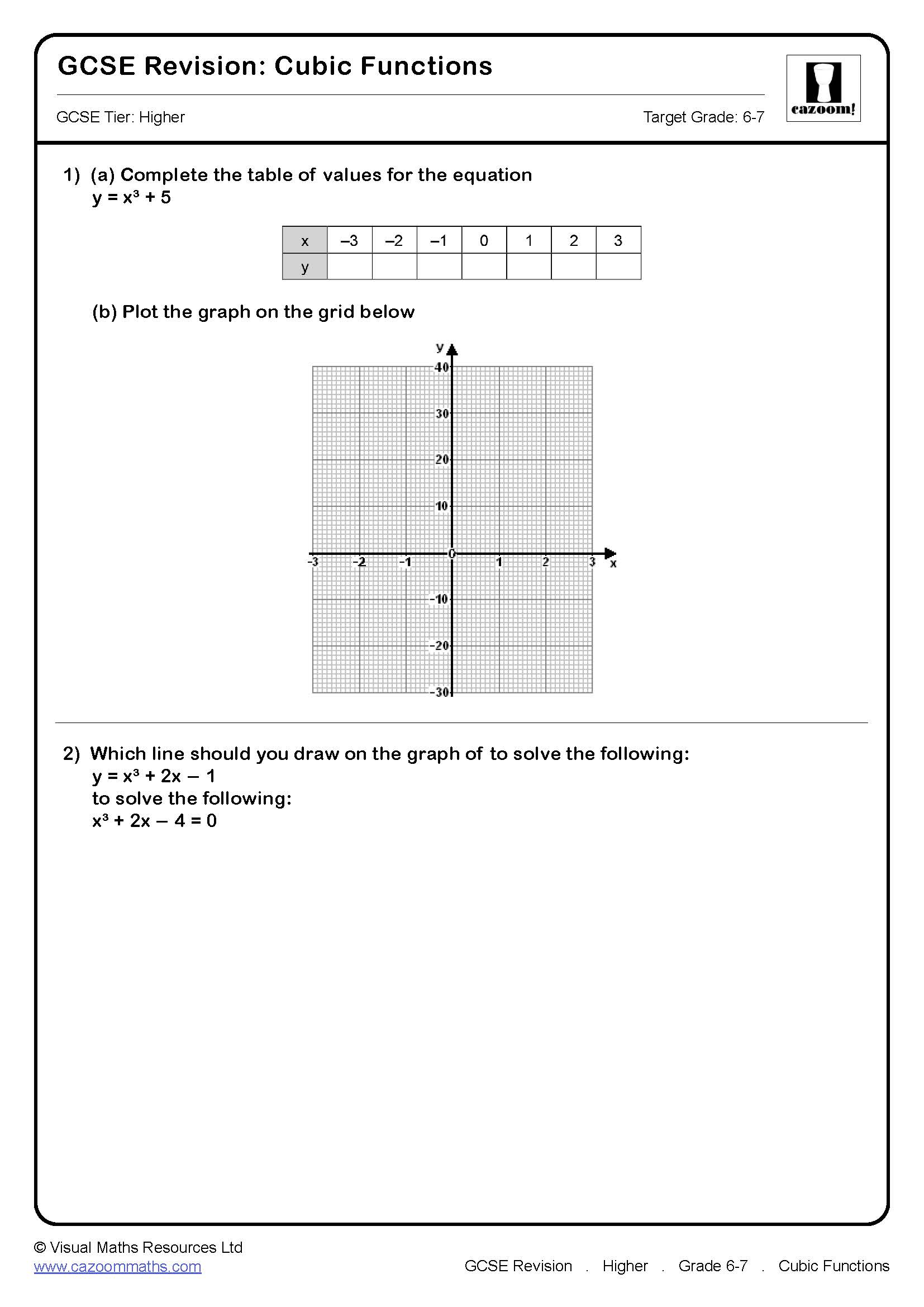
All worksheets are created by the team of experienced teachers at Cazoom Maths.
What Quadratic and Cubic Functions questions appear on the GCSE Higher paper?
Higher papers typically allocate 12-18 marks across several questions involving quadratic and cubic functions. Students face problems requiring them to solve quadratics by factorising, using the formula, or completing the square, sketch graphs showing intercepts and turning points, find equations of quadratics from given information, interpret real-life contexts modelled by quadratic functions, and identify features of cubic graphs including their general shape and number of roots. Grade 7-9 questions often combine multiple skills, such as forming and solving a quadratic inequality or using the discriminant to determine the nature of roots.
A common error is students confusing the vertex form with standard form when completing the square, particularly with the sign of the constant term. Exam mark schemes penalise incomplete sketches that omit key features like labelled intercepts or turning point coordinates, even when the general shape is correct.
What grade are Quadratic and Cubic Functions questions on Higher GCSE maths?
Grade 4-5 questions focus on solving straightforward quadratics by factorising, sketching simple parabolas with given equations, and identifying roots from graphs. Grade 6 questions introduce the quadratic formula, require students to complete the square with coefficient 1, and involve interpreting quadratic graphs in context. Grade 7-9 questions demand completing the square with coefficients other than 1, using the discriminant to determine root nature, sketching cubics with given features, finding quadratic equations from roots or graphs, and solving multi-step problems combining algebraic manipulation with graphical interpretation.
Students should identify which grade band represents their current working level and practise those questions repeatedly before attempting higher grades. Teachers often suggest consolidating grade 5-6 skills with quadratics before tackling cubic graphs, as secure quadratic knowledge underpins the more complex reasoning required at grade 8-9.
How is Quadratic and Cubic Functions tested differently on Higher compared to Foundation?
Foundation tier limits quadratic work to simple factorising, recognising parabola shapes, and reading values from given graphs. Cubic functions rarely appear beyond identifying their characteristic shape. Higher tier expects students to solve quadratics using three different methods, complete the square to find turning points algebraically, apply the discriminant, sketch graphs from equations without plotting points, work backwards from roots to equations, and handle cubics including sketching from factorised form and identifying the number of roots from different scenarios.
This depth matters because Higher questions integrate quadratic and cubic understanding into problem-solving contexts. Students might need to form a quadratic from a geometric problem, solve it, then interpret whether both solutions are valid. This algebraic fluency and reasoning distinguishes grade 6 from grade 8 performance, where conceptual understanding rather than procedural recall determines success.
How should students revise Quadratic and Cubic Functions for Higher GCSE maths?
Students should begin with grade 5-6 questions to secure core techniques like factorising and using the quadratic formula, checking their working against the answer sheets to identify exactly where errors occur. Timed practice helps replicate exam pressure, particularly for multi-step questions where students must decide which method suits each problem. Working systematically through completing the square with different coefficient values builds the algebraic manipulation skills needed for grade 7-9 questions. Students should practise sketching graphs from equations rather than relying on calculators, labelling all key features as mark schemes require.
Teachers can use these worksheets for differentiated homework, assigning specific grade-band questions based on individual target grades. During revision lessons, working through one question from each grade band helps identify gaps. Pairing weaker students with those confident in factorising encourages peer explanation, which often reveals misconceptions more effectively than teacher-led correction alone.