GCSE Higher Rearranging Equations Revision Worksheets
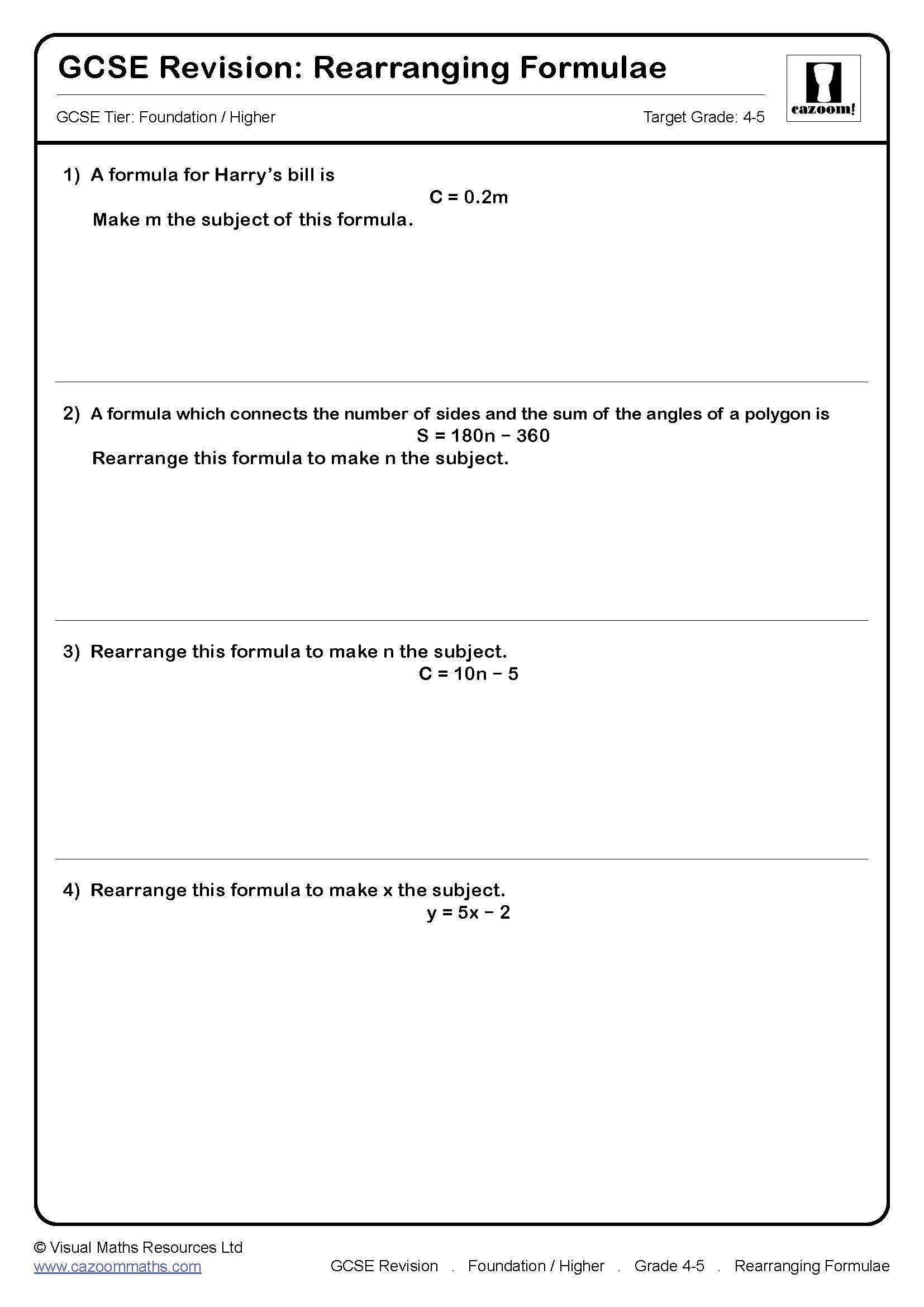
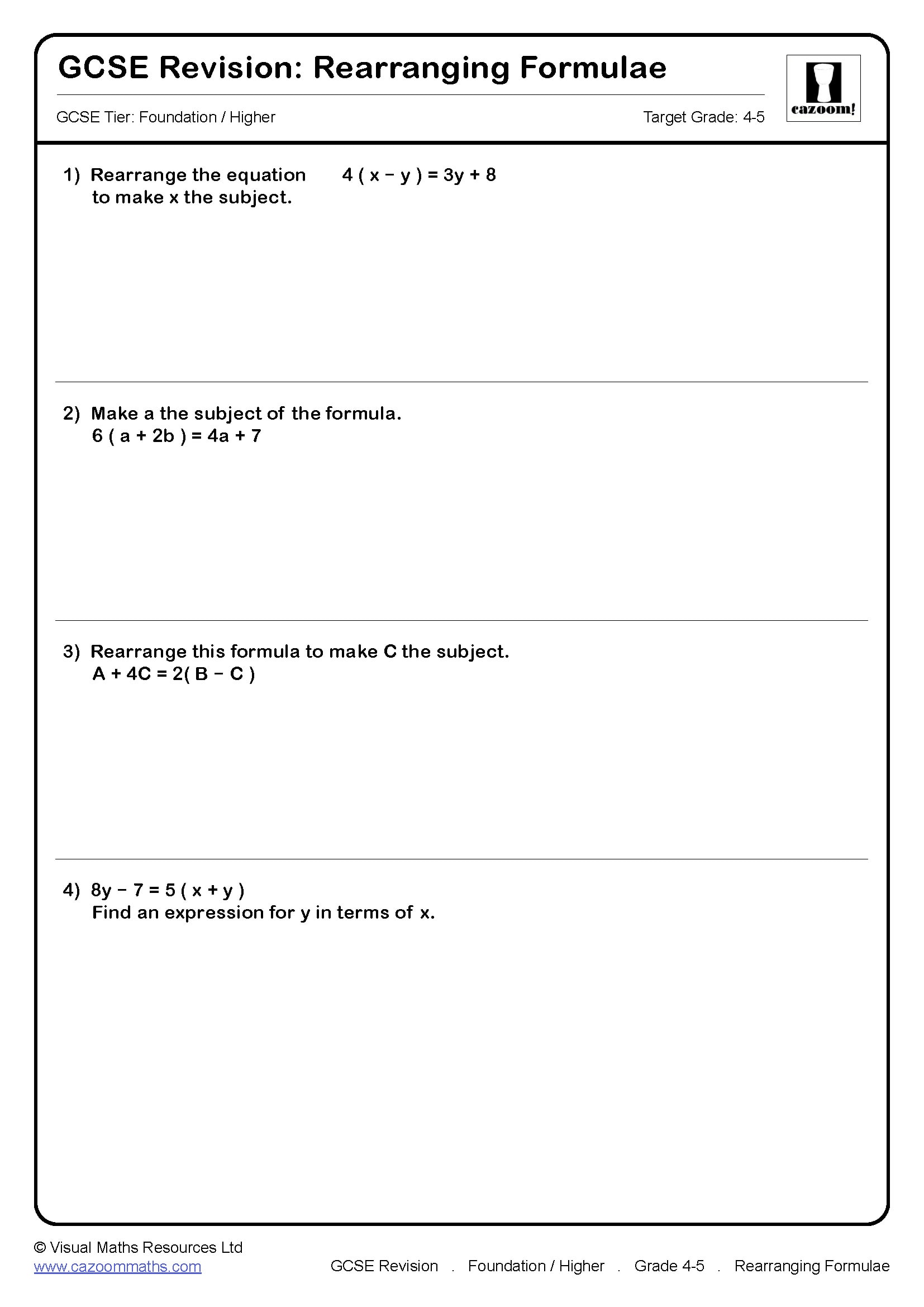
All worksheets are created by the team of experienced teachers at Cazoom Maths.
What Rearranging Equations questions appear on the GCSE Higher paper?
Higher tier papers typically feature 8-12 marks across rearranging equations, appearing both as standalone algebra questions and within problem-solving contexts. Students encounter formulae requiring two or three rearrangement steps at grades 5-6, progressing to equations where the subject appears twice (requiring factorisation) or involves powers and roots at grades 7-8. Grade 9 questions often embed rearrangement within proof or show-that problems, testing whether students recognise when algebraic manipulation is needed rather than being explicitly instructed.
A common error at this tier involves students attempting to rearrange by "doing the same to both sides" without proper understanding of operation hierarchy. Exam mark schemes penalise students who correctly perform individual steps but lose track of whether they are multiplying, dividing, or applying inverses to isolated terms versus entire expressions.
What grade are Rearranging Equations questions on Higher GCSE maths?
Foundation rearrangement at grades 4-5 typically involves making a single letter the subject from linear equations with two or three terms. Higher tier extends this: grade 5-6 questions require handling brackets and fractional coefficients; grade 6-7 problems involve rearranging to find variables within square roots or squared terms; grade 8-9 questions demand rearranging formulae where the subject appears multiple times, requiring algebraic factorisation before isolating the variable. Questions involving rearranging to derive scientific formulae or proving algebraic identities sit firmly at grade 8-9.
Students should identify their current working grade, then systematically practise rearrangement problems one grade band above. Teachers observe that students who can confidently handle grade 6 rearrangement but struggle with grade 7 material often lack fluency with inverse operations for powers and roots rather than understanding the underlying method.
How is Rearranging Equations tested differently on Higher compared to Foundation?
Foundation tier limits rearrangement to linear equations where the subject appears once, typically with integer or simple fractional coefficients. Higher tier immediately introduces greater complexity: subjects within brackets requiring expansion first, equations with the variable appearing in multiple terms, and non-linear relationships involving squares, cubes, or roots. Foundation students might rearrange a = b + c to find b; Higher students rearrange v² = u² + 2as to make u the subject, requiring understanding of inverse operations for powers.
This difference matters because Higher rearrangement connects directly to functional mathematics and science applications. Students who master complex rearrangement can manipulate kinematic equations, compound interest formulae, and trigonometric identities. Teachers notice that students comfortable with multi-step rearrangement demonstrate stronger algebraic reasoning across other Higher topics, particularly solving quadratics and working with functions.
How should students revise Rearranging Equations for Higher GCSE maths?
Effective revision starts with untimed practice across different equation types: those requiring expansion, factorisation, dealing with roots, and handling fractions. Students should work through each worksheet methodically, writing every step rather than attempting mental shortcuts. Using the answer sheets to identify exactly which operation caused errors proves more valuable than simply marking answers correct or wrong. Teachers recommend students annotate their working to show which inverse operation they are applying at each stage, making logical errors visible.
In lessons, these worksheets work effectively as starter activities to maintain algebraic fluency or as differentiated homework where students select problems matching their target grade. Teachers can set specific worksheet sections as timed practice once students demonstrate accuracy, building examination pace. Pairing weaker students with those confident in rearrangement for peer explanation often reveals misconceptions that teacher explanation alone misses.