GCSE Higher Revision Mats Worksheets
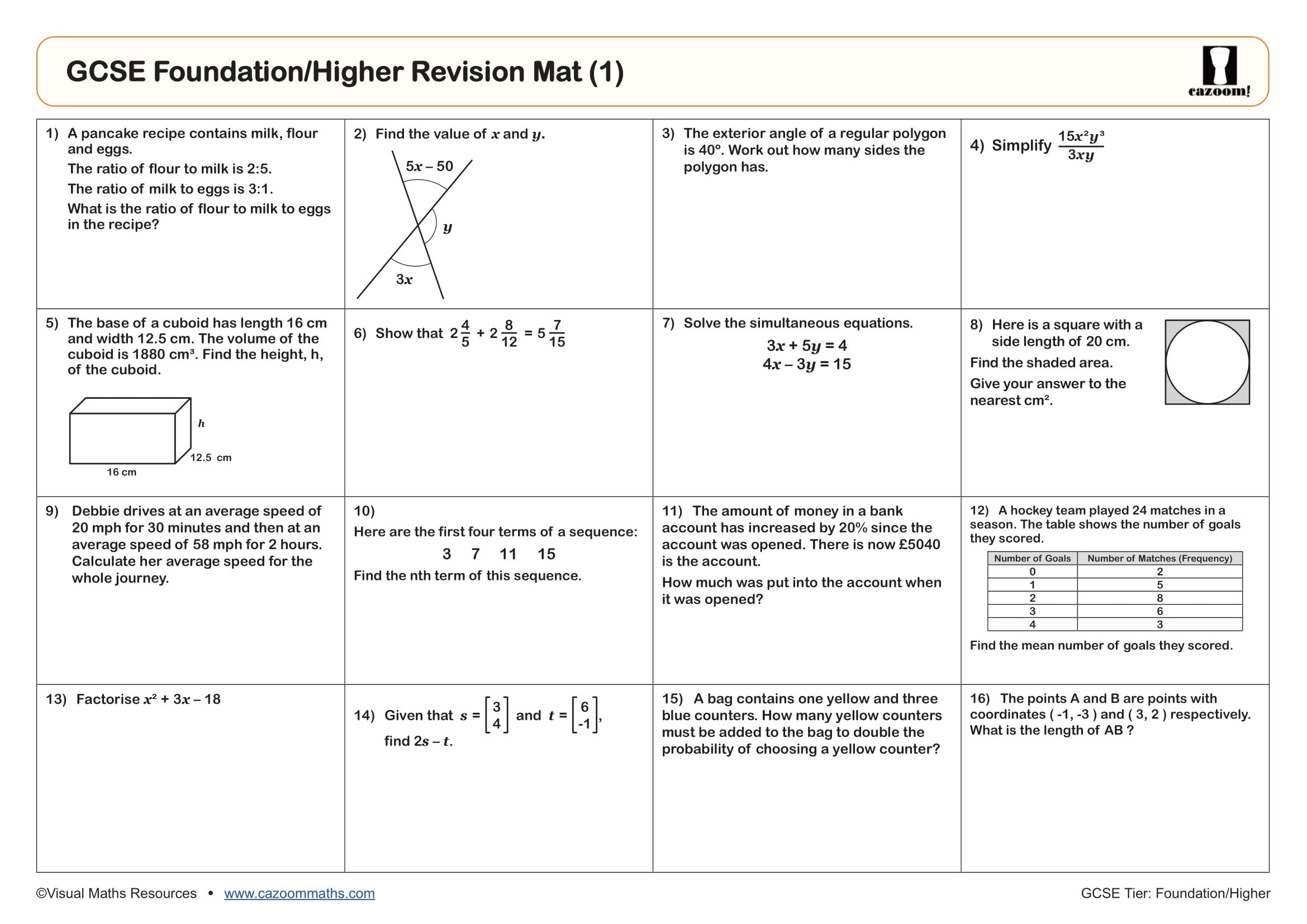
GCSE Foundation/Higher Revision Mat (1)
Target Grade: 4-5
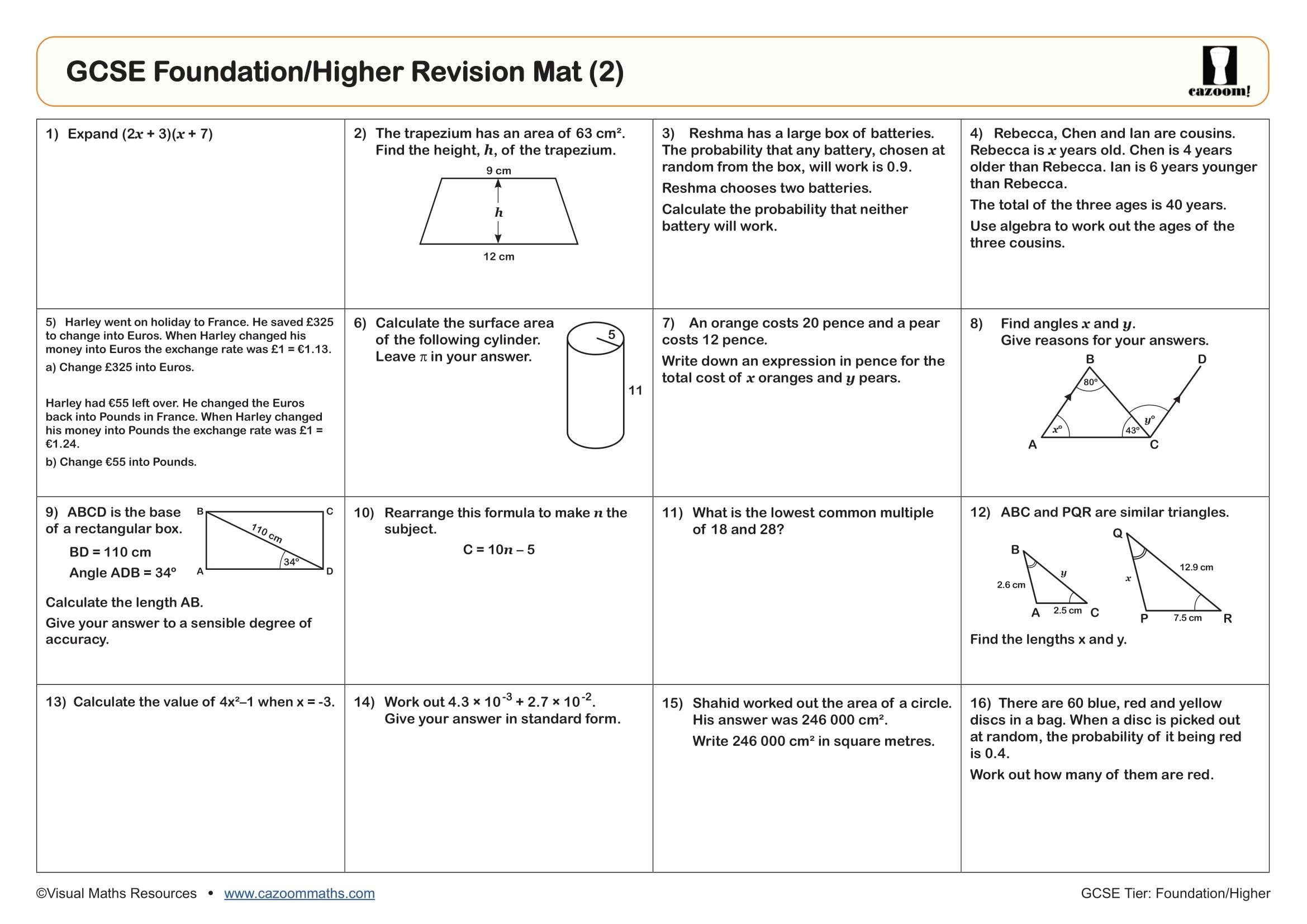
GCSE Foundation/Higher Revision Mat (2)
Target Grade: 4-5
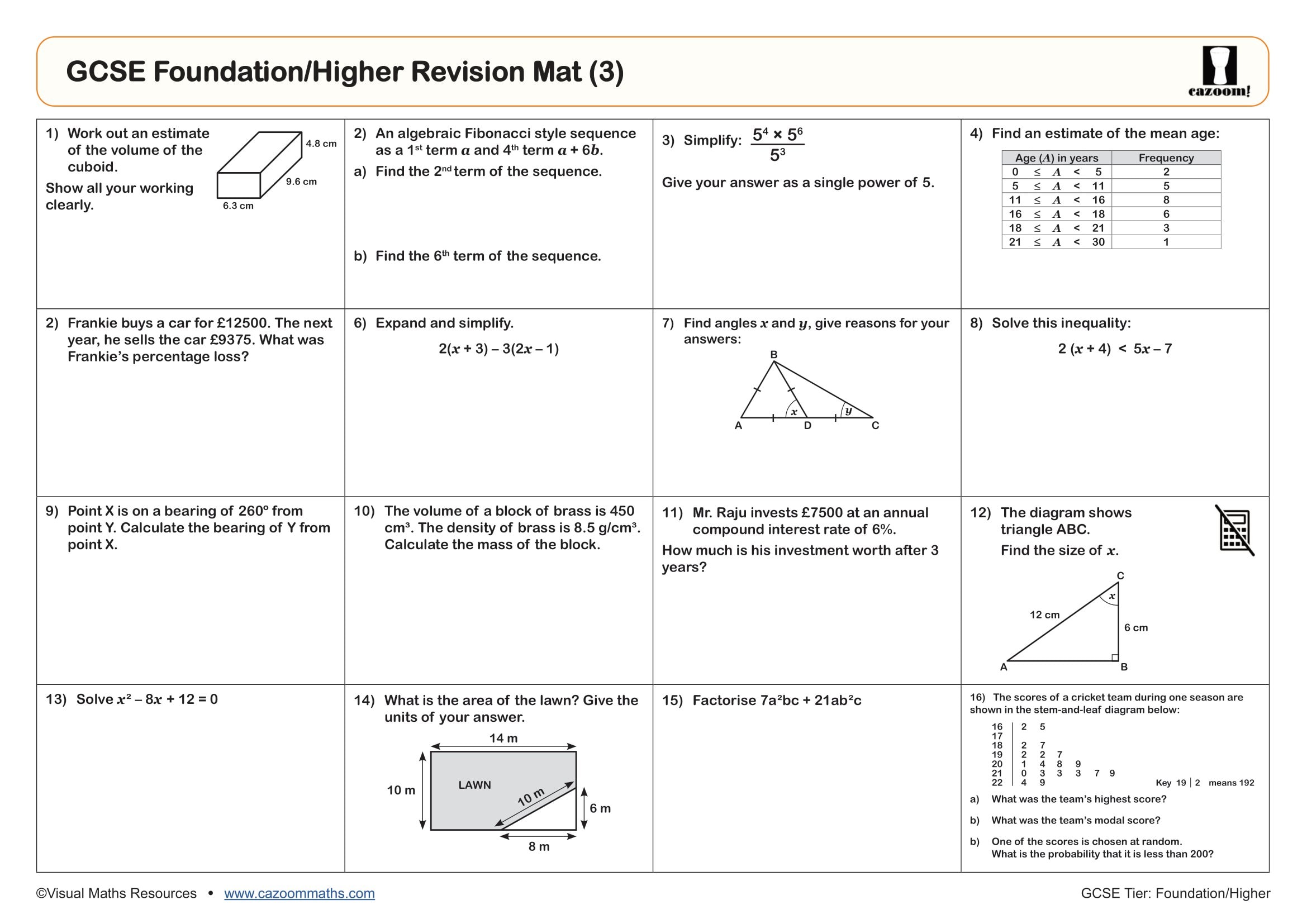
GCSE Foundation/Higher Revision Mat (3)
Target Grade: 4-5
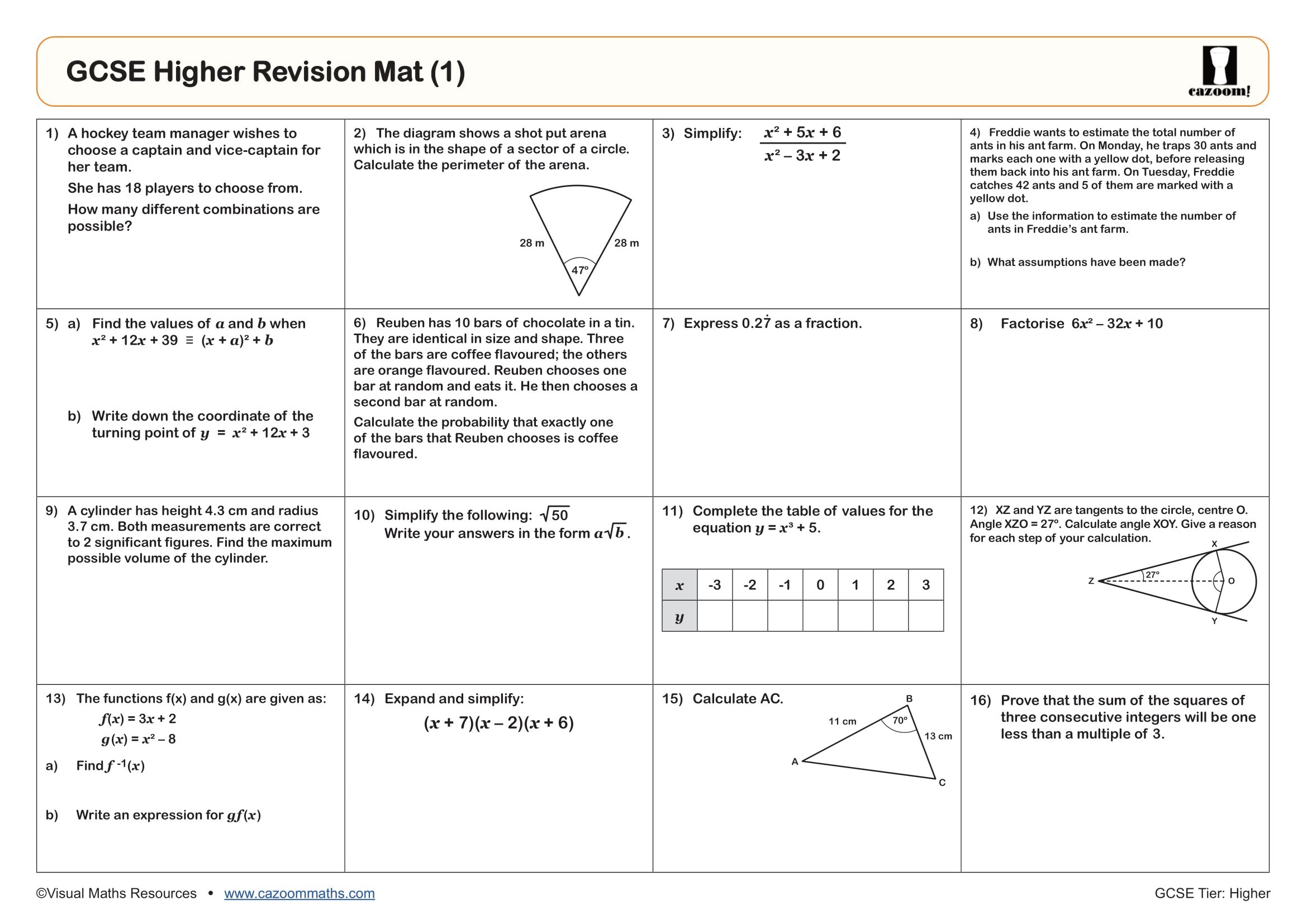
GCSE Higher Revision Mat (1)
Target Grade: 6-7
GCSE Higher Revision Mat (2)
Target Grade: 6-7
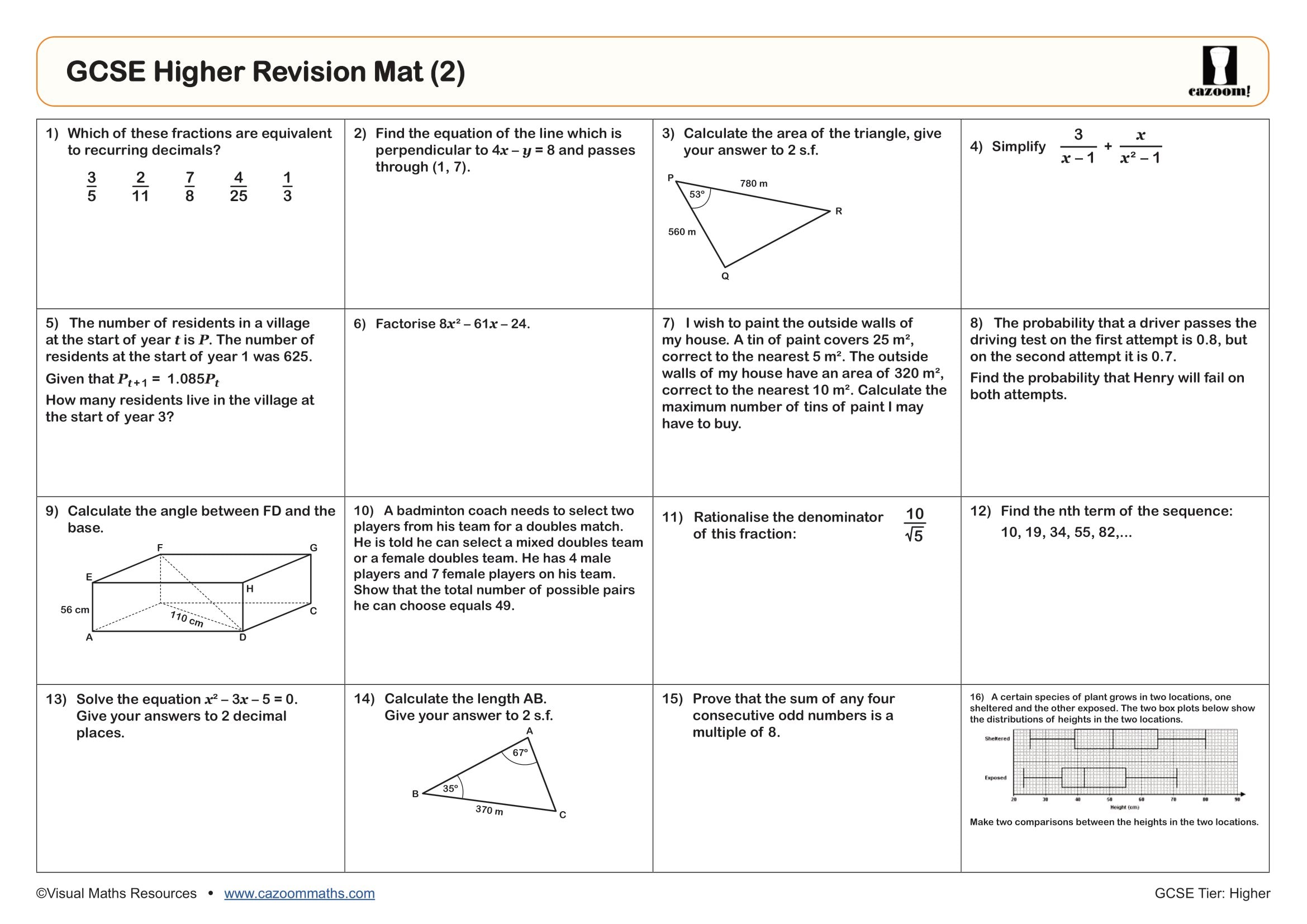
GCSE Higher Revision Mat (3)
Target Grade: 6-7
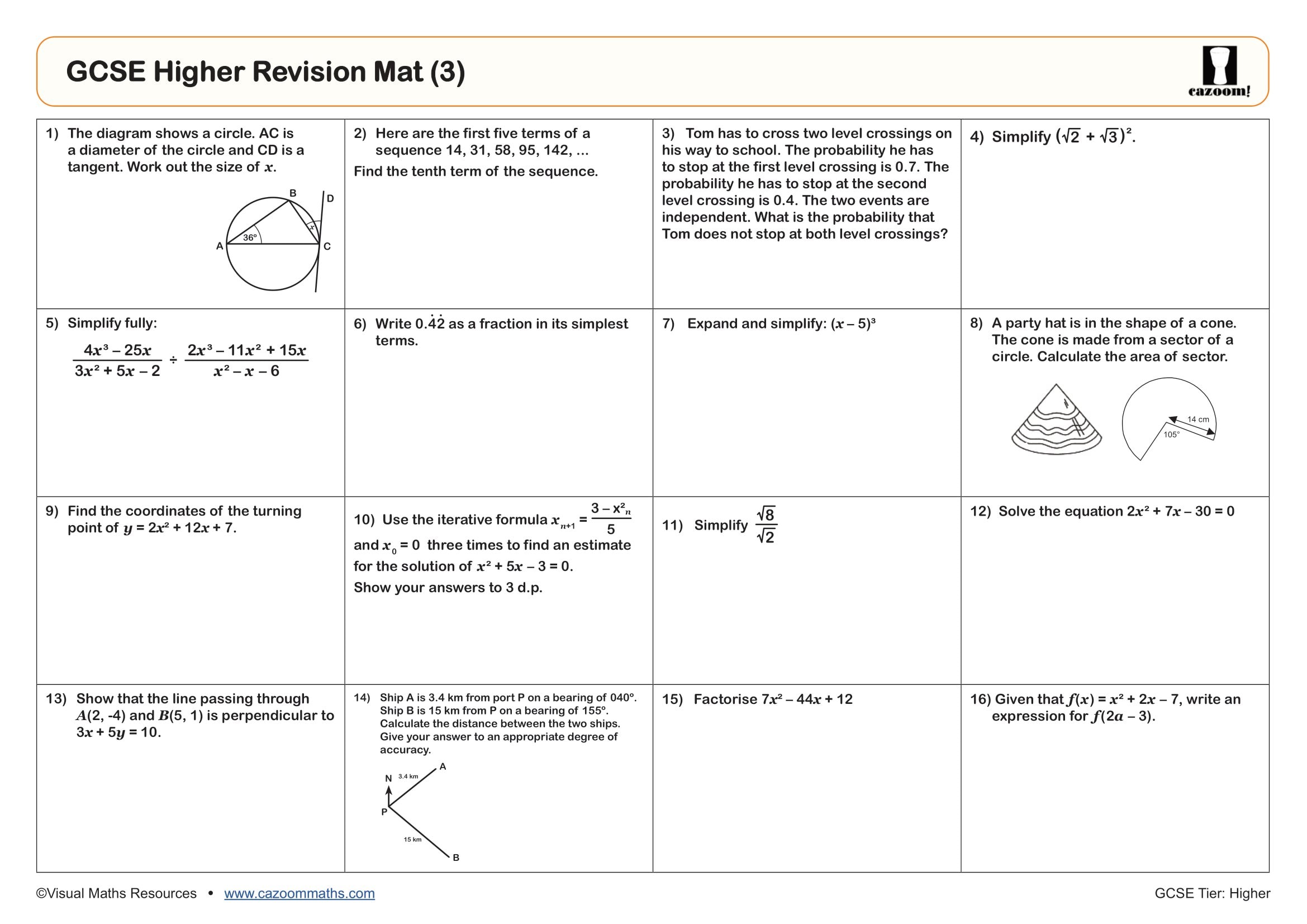
GCSE Higher Plus Revision Mat (1)
Target Grade: 8-9
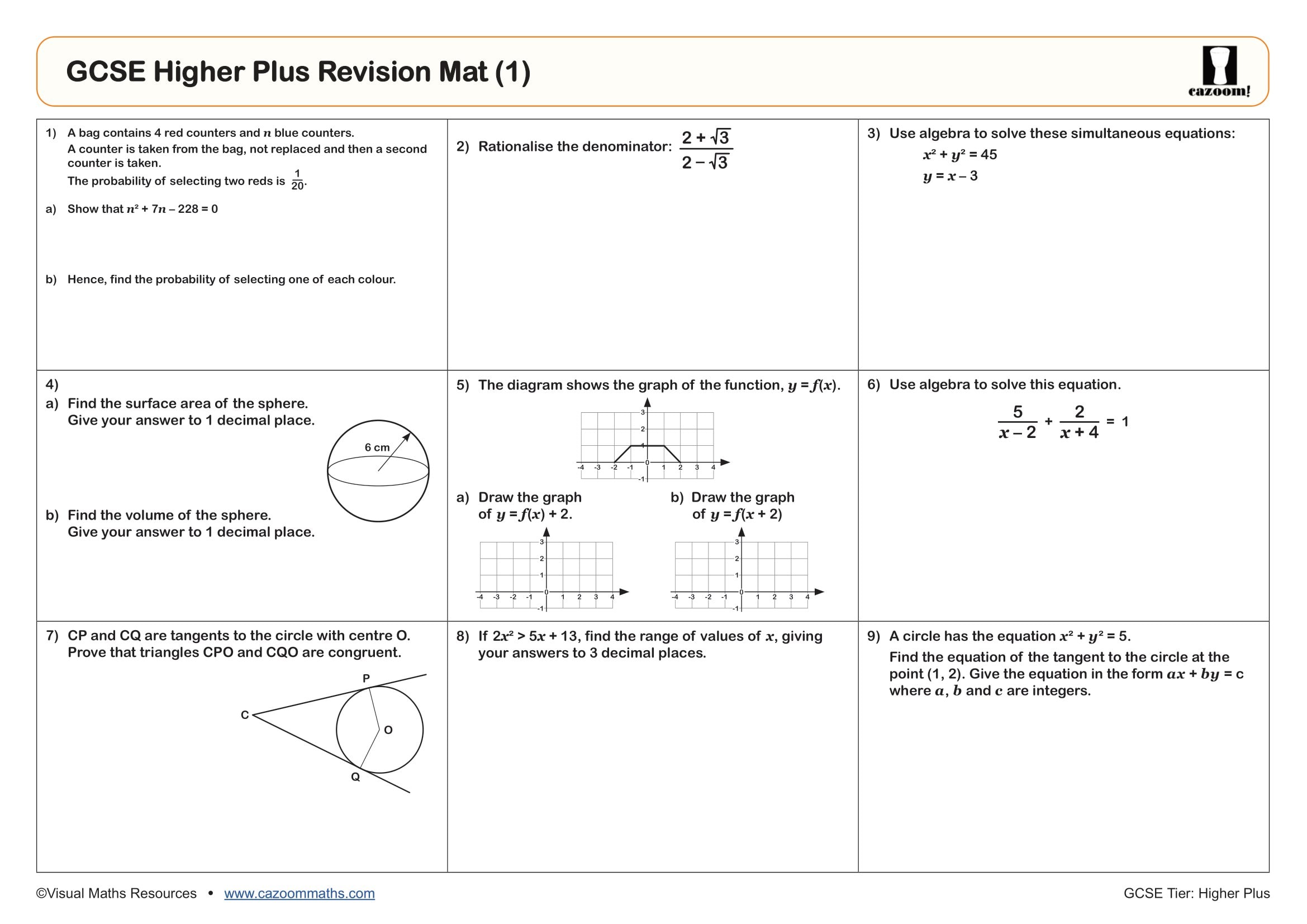
GCSE Higher Plus Revision Mat (2)
Target Grade: 8-9
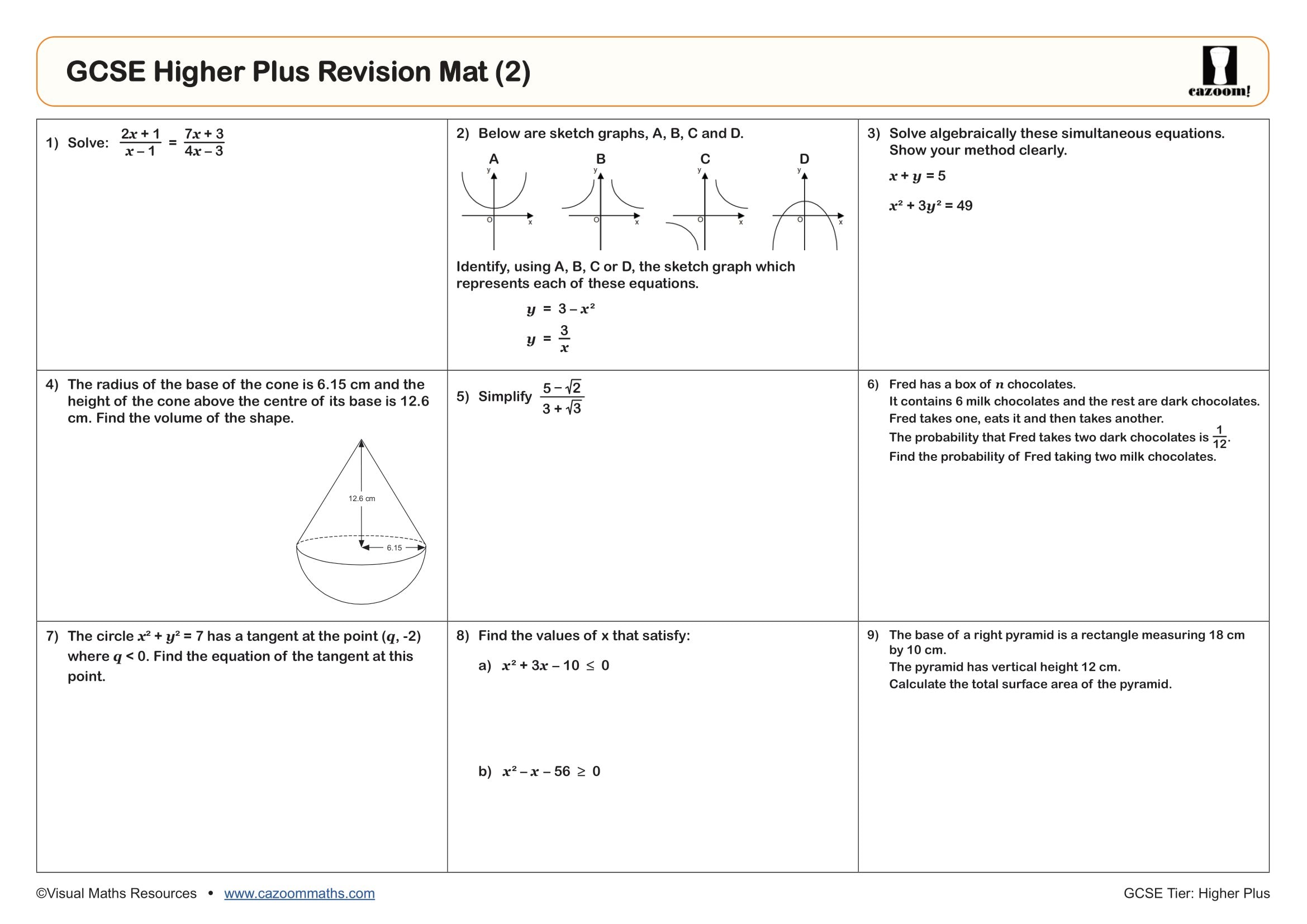
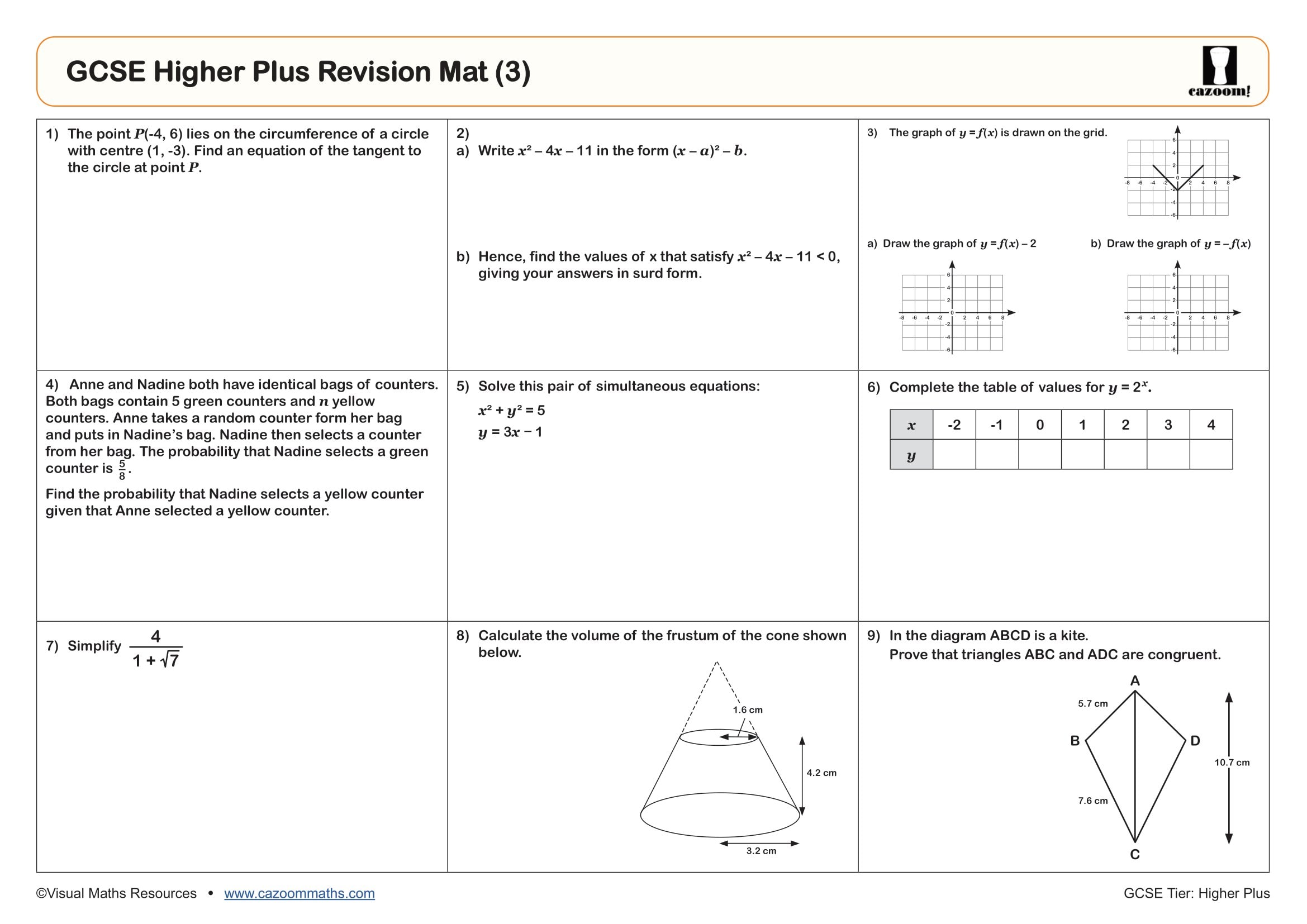
GCSE Higher Plus Revision Mat (3)
Target Grade: 8-9
All worksheets are created by the team of experienced teachers at Cazoom Maths.
What revision mat questions appear on the GCSE Higher paper?
Higher papers integrate topics rather than isolate them, so revision mat questions reflect this interleaving. Students encounter algebraic manipulation alongside geometric proof, ratio problems mixing with probability, and graph work combined with equations. Each paper typically carries 80 marks, with questions worth 1-6 marks depending on complexity. Multi-step problems dominate—students might simplify surds within a trigonometry context or apply Pythagoras within coordinate geometry, testing whether they recognise underlying structures.
A common error at this tier involves students solving individual steps correctly but failing to link them. Exam mark schemes penalise incomplete chains of reasoning—teachers notice marks lost when students don't explicitly show how one result leads to the next, particularly in questions worth 4+ marks where method marks depend on logical progression.
What grade are revision mat questions on Higher GCSE maths?
Higher tier spans grades 4-9, with revision mats typically covering the full range. Grade 4-5 questions test core skills—solving linear equations, calculating with fractions, basic trigonometry in right-angled triangles. Grade 6-7 questions demand fluency with quadratics, circle theorems, compound measures and algebraic fractions. Grade 8-9 content requires proof, iterative methods, vector reasoning and complex problem-solving where the route isn't immediately obvious.
Students should diagnose their weakest grade bands first. Teachers often recommend tackling grade 5-6 content until secure before attempting grade 8-9 material—attempting stretch questions without solid foundations wastes revision time. Using answer sheets to identify recurring errors within specific grade bands allows targeted practise, building confidence systematically rather than randomly jumping between difficulty levels.
How are revision mats tested differently on Higher compared to Foundation?
Foundation revision mats emphasise numerical accuracy and procedural fluency—substituting into formulae, calculating areas, interpreting straightforward graphs. Higher tier expects algebraic manipulation throughout, with students forming and solving equations rather than following given steps. Questions demand generalisation, proof and reasoning about why methods work, not just applying them. Where Foundation might ask for a specific angle using basic geometry facts, Higher requires multi-stage proofs combining several theorems.
This distinction matters because Higher students must think structurally about mathematics. Teachers notice that students who memorise procedures without understanding struggle when contexts shift slightly—they can't adapt methods or spot connections between topics. Revision mats at this tier develop mathematical maturity, training students to analyse unfamiliar problems by identifying familiar underlying structures, essential for accessing grade 7-9 content.
How should students revise revision mats for Higher GCSE maths?
Students should attempt revision mats under timed conditions, allocating roughly one minute per mark to simulate exam pressure. Working through grade bands systematically builds confidence—complete grade 4-5 material first, then progress to grade 6-7, finishing with grade 8-9 stretch questions. After attempting each mat, students should mark thoroughly using answer sheets, noting not just wrong answers but also inefficient methods that waste exam time, then reattempt flagged questions days later to check retention.
Teachers can deploy these worksheets strategically during lesson starters to maintain topic coverage whilst teaching new content, or set them as fortnightly homework to diagnose emerging gaps. Grouping students by target grade and assigning appropriate difficulty levels ensures everyone works at their challenge zone—grade 6 target students focus on securing grades 5-7 content rather than attempting grade 9 material prematurely.