GCSE Higher Sequences Revision Worksheets
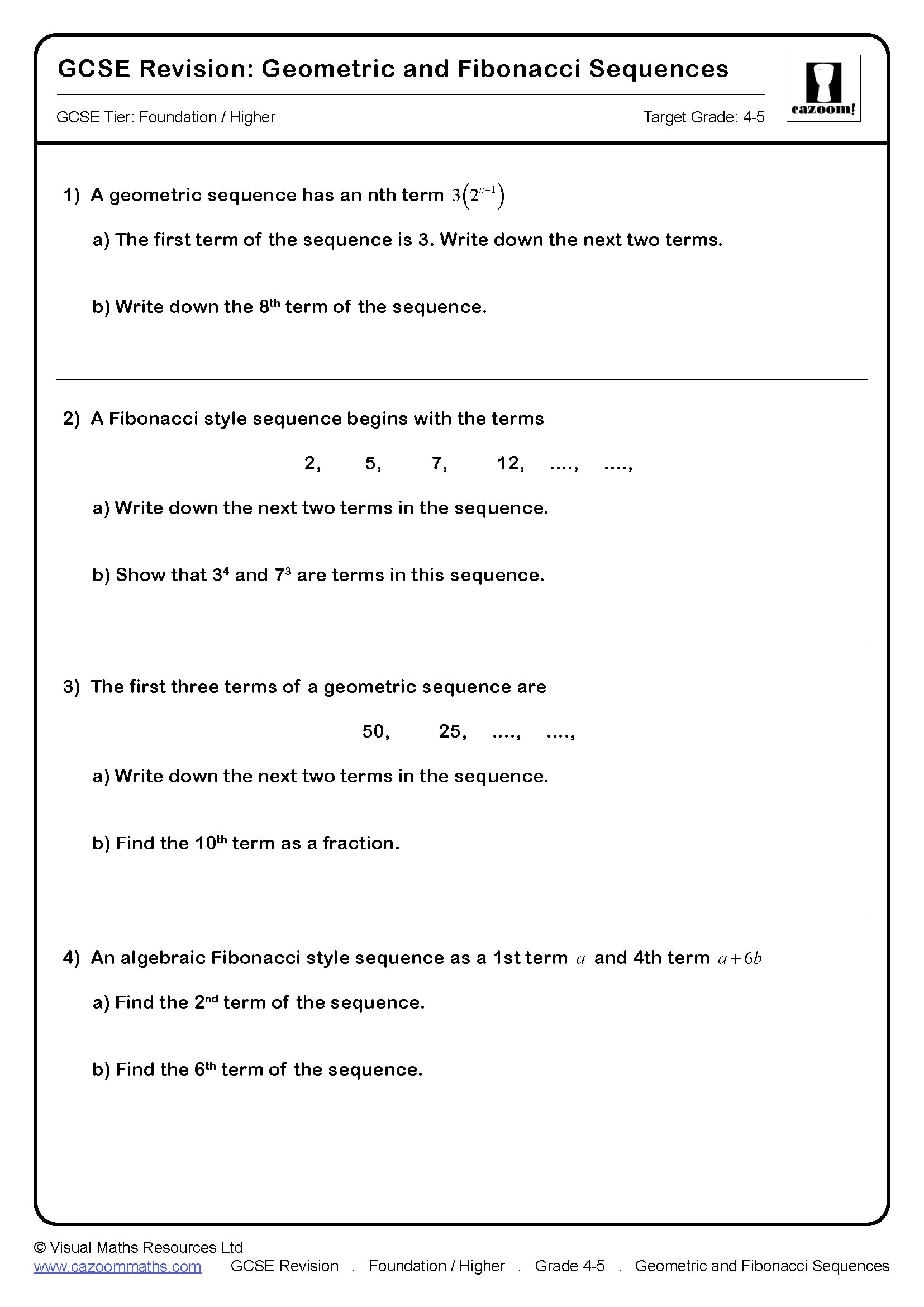
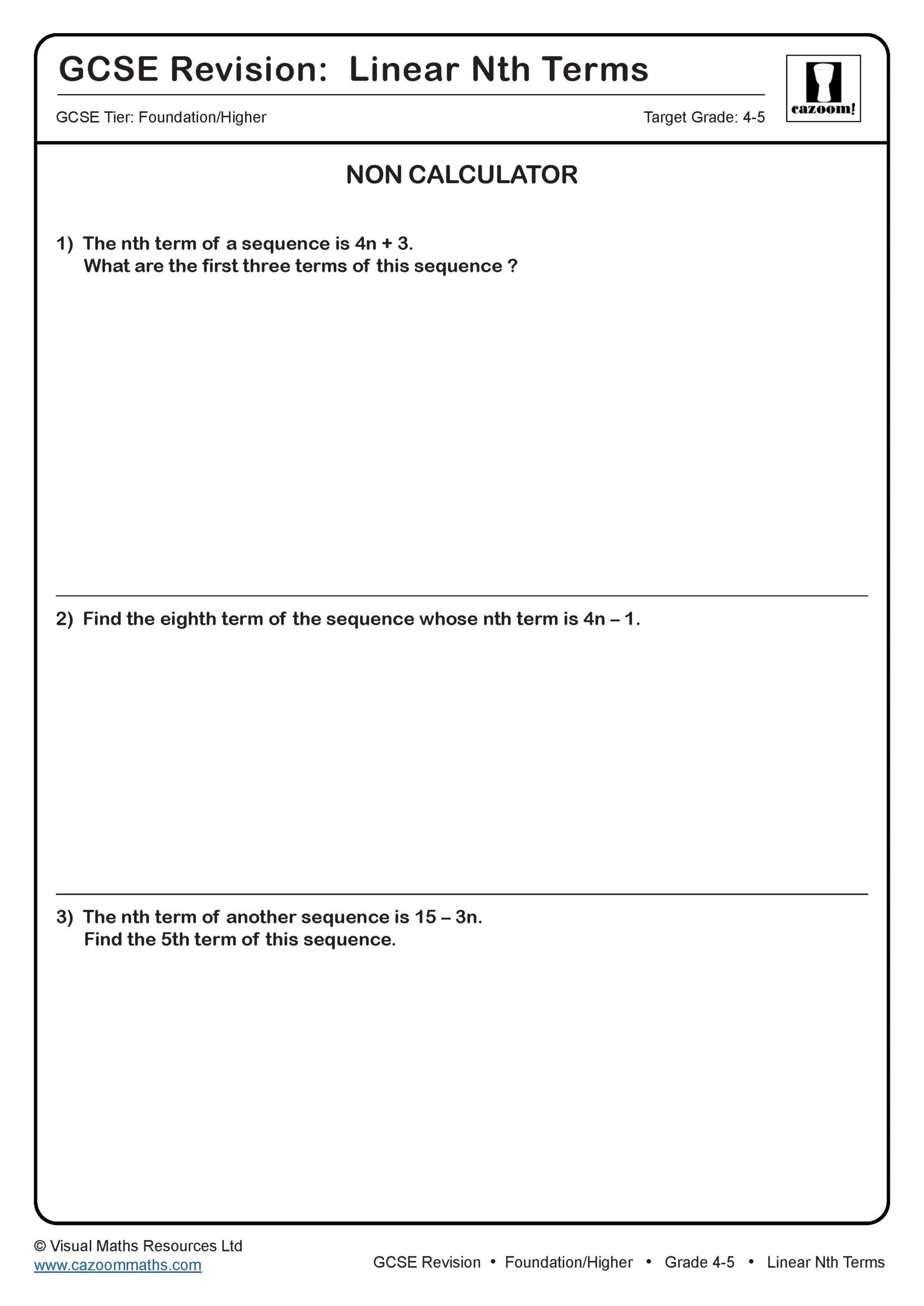
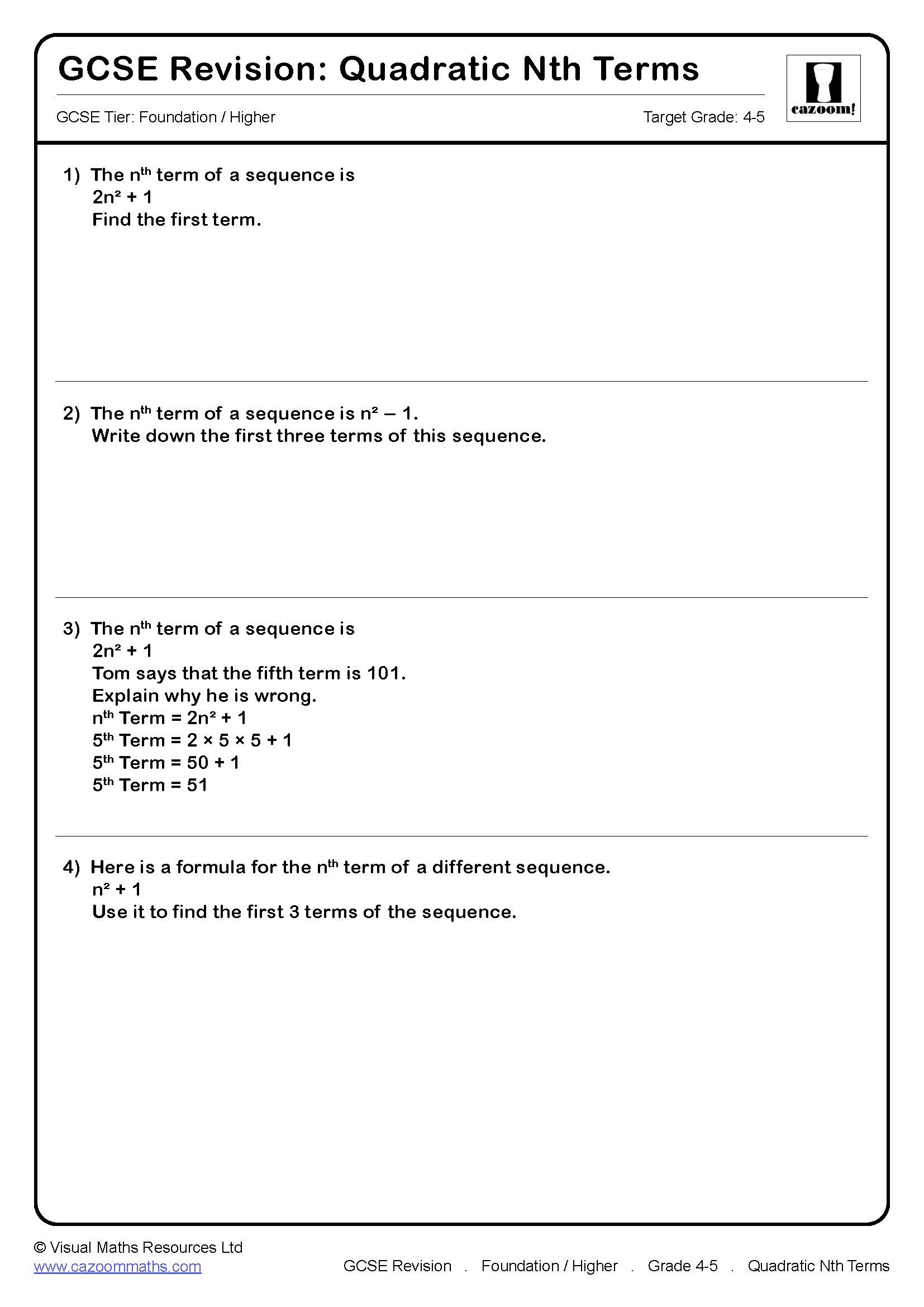
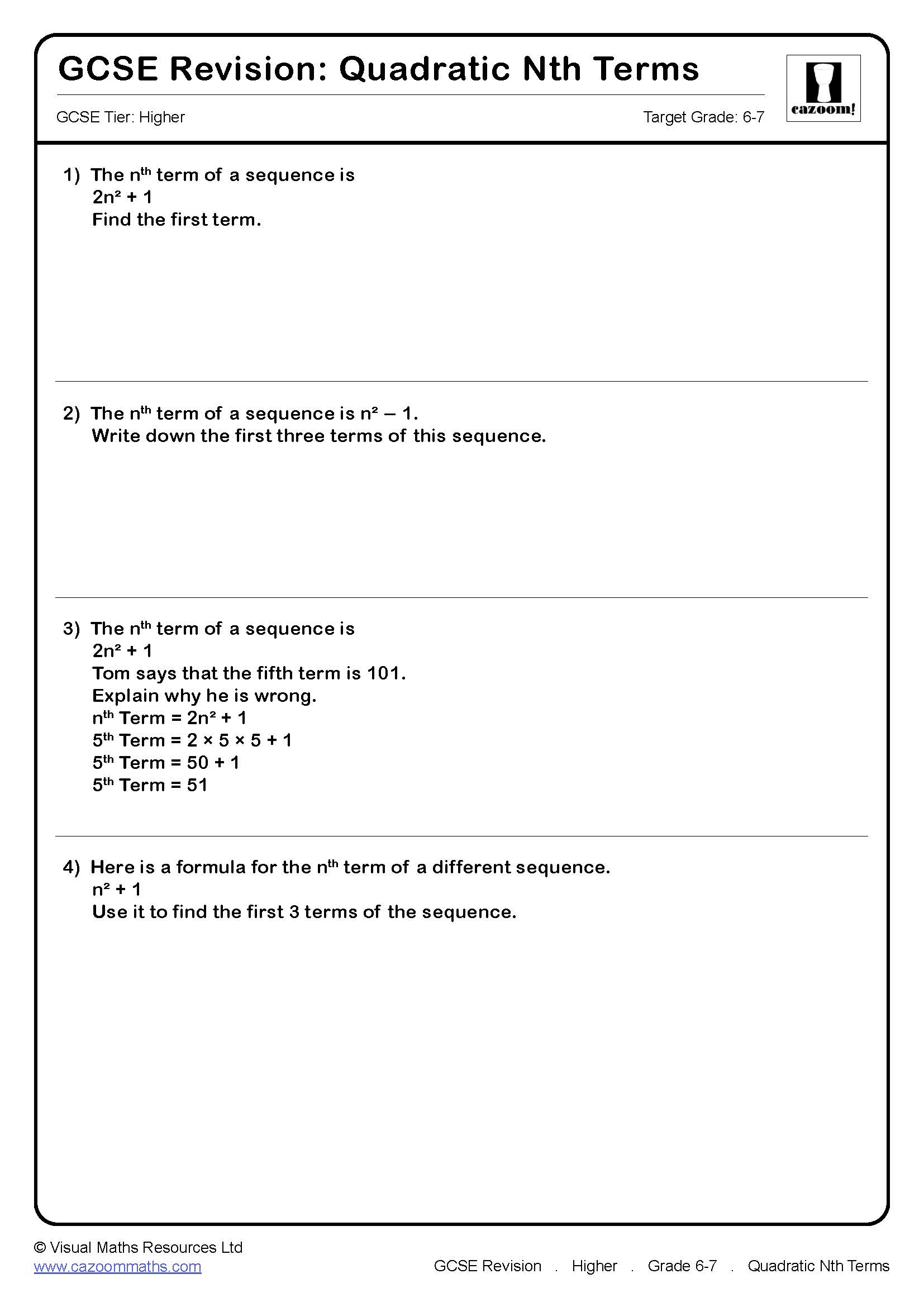
All worksheets are created by the team of experienced teachers at Cazoom Maths.
What Sequences questions appear on the GCSE Higher paper?
Higher papers typically include 6-8 marks across sequences questions, ranging from straightforward arithmetic sequences through to quadratic and geometric progressions. Students encounter nth term derivation for both linear and quadratic sequences, find specific terms in geometric sequences using position-to-term rules, and prove whether given values appear in a sequence. Multi-step questions often embed sequences within algebraic reasoning tasks, asking students to form and solve equations involving nth terms or compare two sequences algebraically.
Exam mark schemes penalise students who write incorrect nth term formulae without showing working. Teachers frequently notice marks lost when students test their nth term rule against only the first term rather than checking multiple terms, or when they confuse the coefficient of n with the common difference in quadratic sequences.
What grade are Sequences questions on Higher GCSE maths?
Grade 4-5 questions test arithmetic sequences: finding nth terms of linear sequences, generating terms from given rules, and determining whether specific values belong to sequences. Grade 6 questions introduce geometric sequences and basic quadratic sequences, requiring students to recognise pattern types and apply appropriate formulae. Grade 7-8 questions demand deriving quadratic nth terms from scratch, solving problems involving multiple sequences, or proving algebraic relationships between terms. Grade 9 questions combine sequences with other algebraic topics or require proof-based reasoning about sequence properties.
Students aiming for grade 7 or above should prioritise quadratic sequences and geometric progressions once arithmetic sequences feel secure. Teachers observe that mastering grade 4-6 content first builds the pattern recognition needed for higher-grade sequence problems, particularly when forming difference tables for quadratic sequences.
How is Sequences tested differently on Higher compared to Foundation?
Foundation sequences focus primarily on arithmetic sequences: continuing patterns, finding the nth term of linear sequences with positive coefficients, and substituting into given formulae. Higher tier expects fluency with geometric sequences (multiplying by a common ratio), quadratic sequences (second differences constant), and Fibonacci-type sequences. Questions demand algebraic manipulation beyond simple pattern-spotting, including forming equations from nth terms, working backwards from term value to position, or proving statements about sequence membership algebraically.
This depth matters because Higher exam questions test whether students recognise sequence types independently and choose appropriate methods without scaffolding. Teachers notice that students who rely on memorised rules struggle when questions require reasoning about why a sequence behaves a certain way, or when contexts disguise the underlying sequence structure within problem-solving scenarios.
How should students revise Sequences for Higher GCSE maths?
Students should work through worksheets by sequence type initially (arithmetic, then geometric, then quadratic), checking answers immediately to identify misconceptions early. Timed practice helps build exam pace, particularly for quadratic nth term questions which require systematic difference-table work under pressure. Students targeting grades 7-9 benefit from attempting questions without hints, then reviewing answer sheets to compare methods rather than just checking final answers. Mixing sequence types in later practice develops the recognition skills needed when exam questions don't specify which type appears.
Teachers can set these worksheets as retrieval practice starters, targeting specific grade boundaries based on assessment data. Setting quadratic sequence work as homework before teaching the topic identifies students who already grasp pattern extension, allowing differentiated classroom input. Answer sheets enable peer marking during lessons, prompting discussions about efficient algebraic methods.