GCSE Higher Similarity and Congruence Revision Worksheets
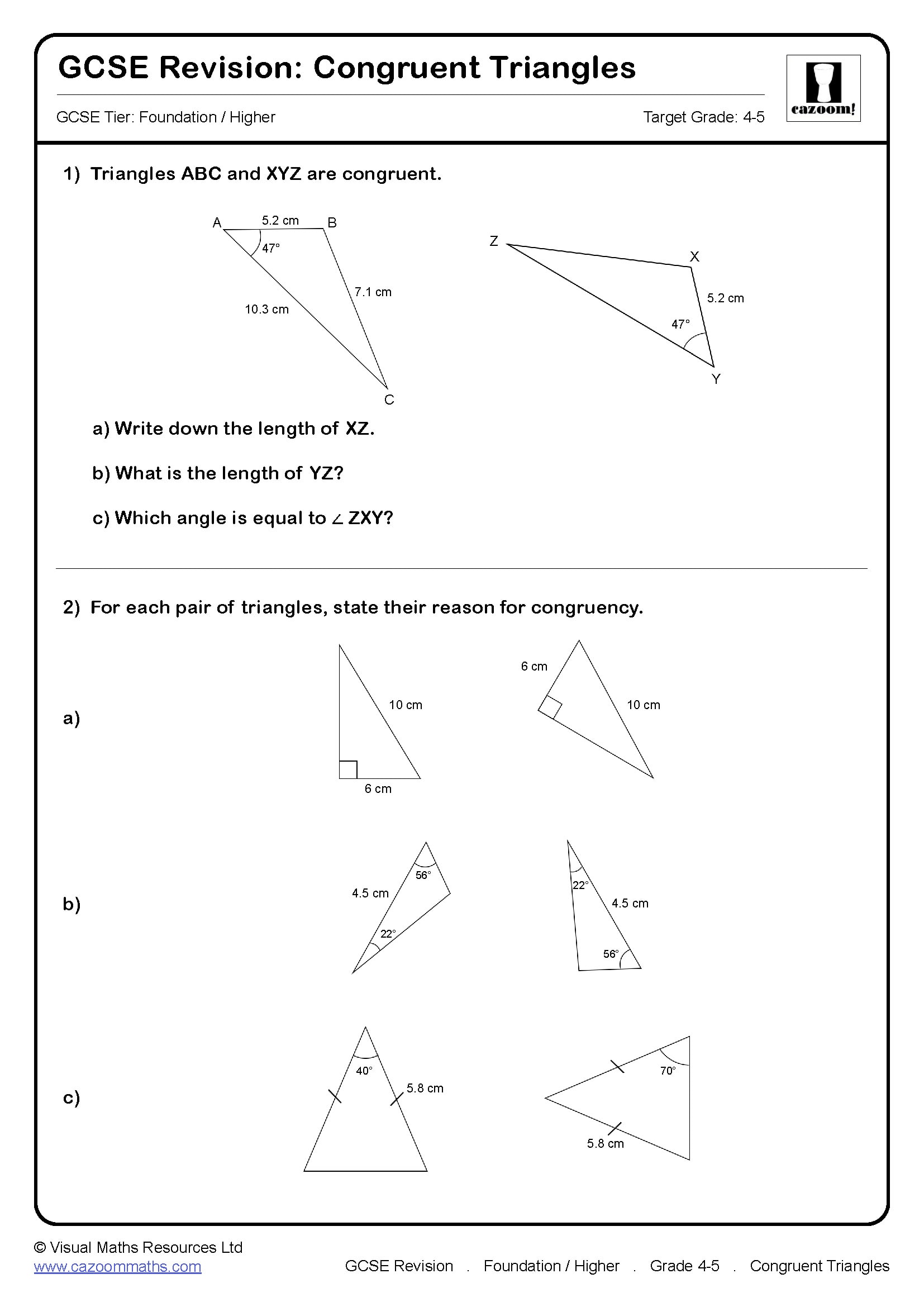
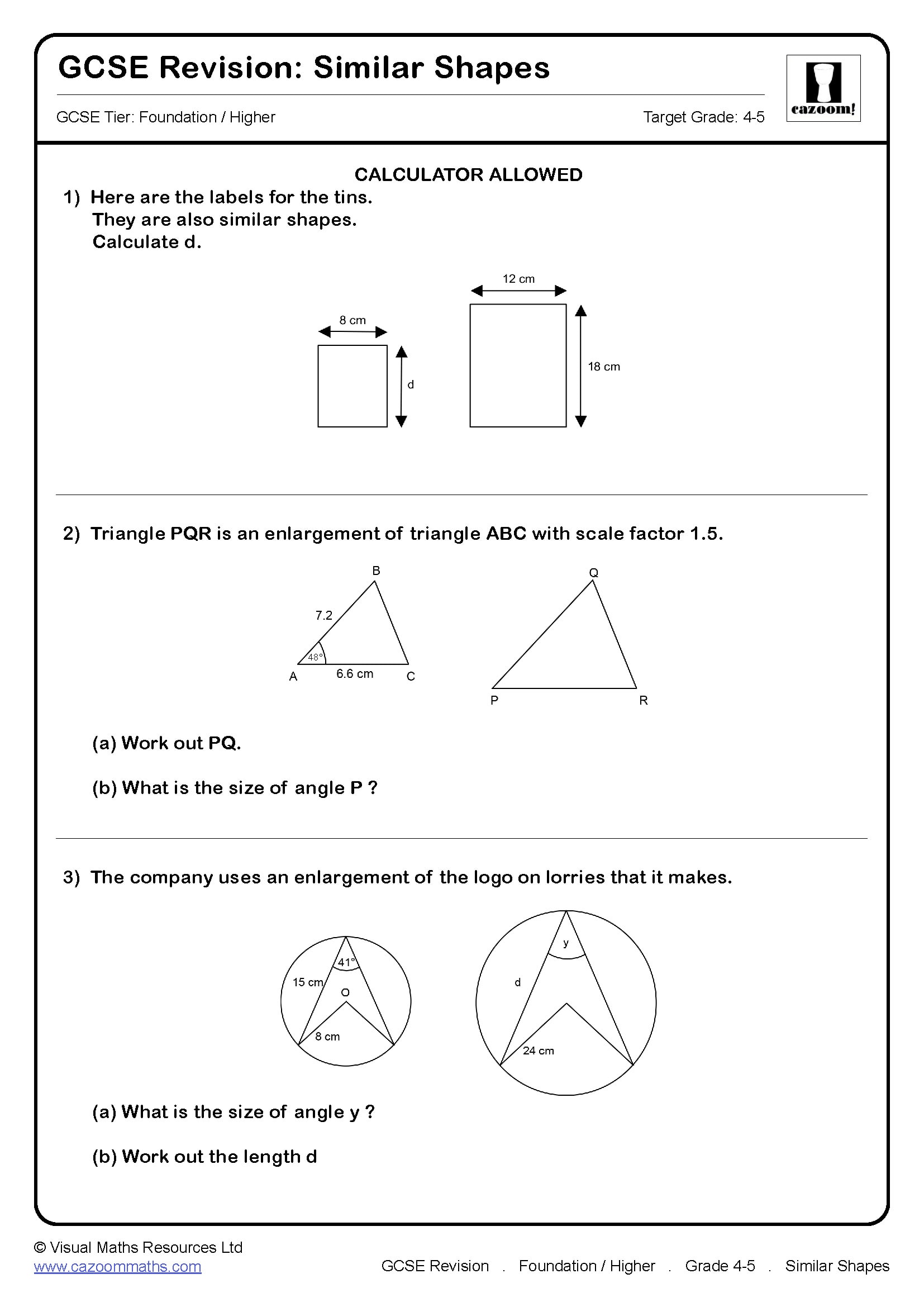
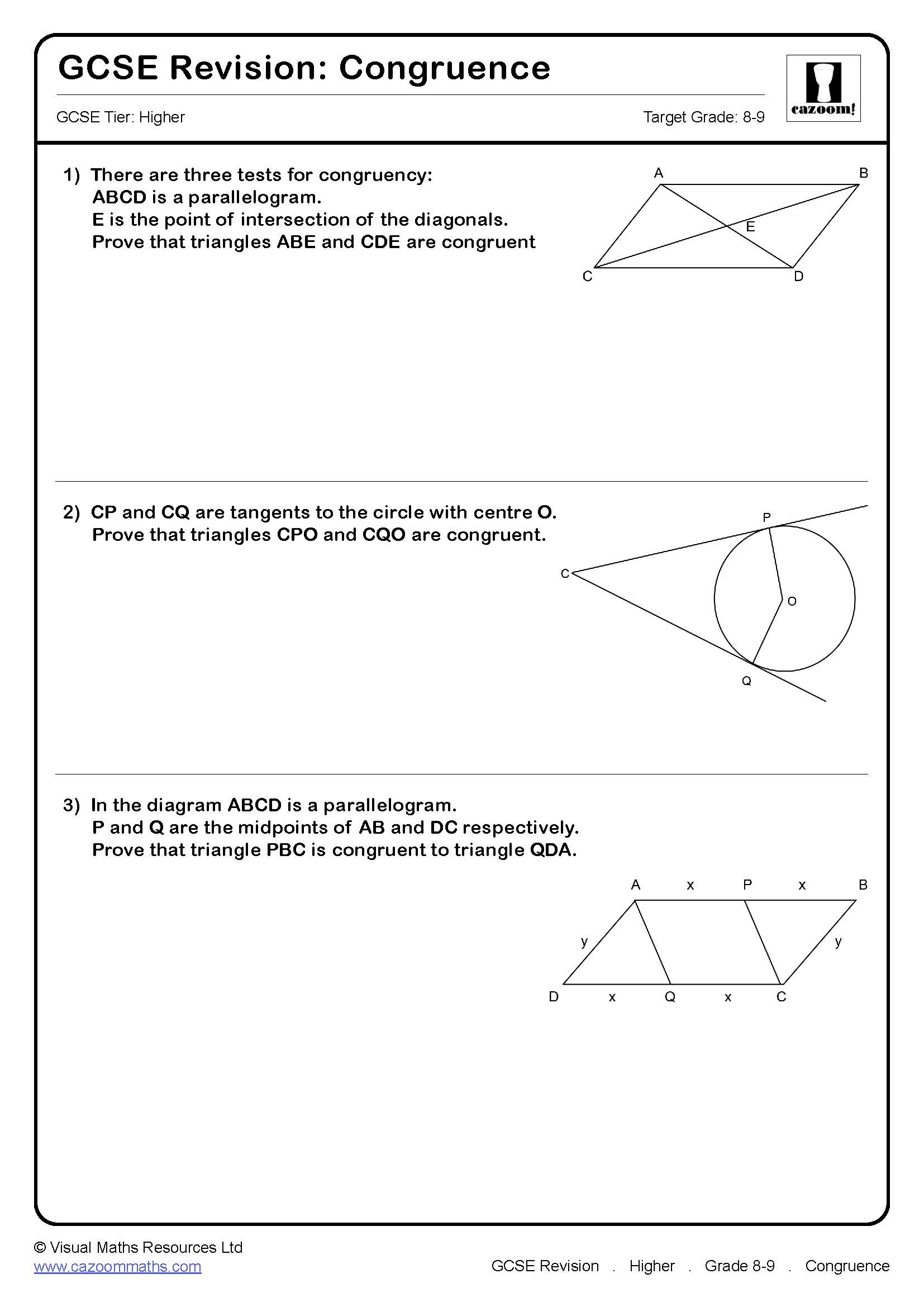
All worksheets are created by the team of experienced teachers at Cazoom Maths.
What Similarity and Congruence questions appear on the GCSE Higher paper?
Higher papers typically include three to four similarity and congruence questions worth 12-18 marks in total. Students encounter formal proofs that triangles are congruent or similar using standard conditions, calculations involving area scale factors (ratio squared) and volume scale factors (ratio cubed), and problems requiring them to find missing lengths in similar shapes using proportional reasoning. Multi-step questions often embed similarity within coordinate geometry, circle theorems or trigonometry contexts, testing whether students recognise when to apply these principles.
Exam mark schemes penalise students who state scale factors without showing how they derived them, or who confuse linear, area and volume ratios. Teachers notice that students lose marks when they don't explicitly reference SSS, SAS, ASA or RHS conditions in congruence proofs, even when their reasoning is geometrically sound.
What grade are Similarity and Congruence questions on Higher GCSE maths?
Basic similarity questions identifying scale factors or calculating missing lengths in straightforward similar triangles typically appear at grades 4-5. Questions involving area and volume scale factors, or combining similarity with other topics, usually target grades 6-7. The most demanding problems, requiring formal congruence proofs or applying similarity in unfamiliar geometric contexts, aim at grades 8-9. Students often find the algebraic manipulation within similarity problems more challenging than the geometric concepts themselves.
Students should prioritise mastering the overlap content at grades 4-5 first, ensuring they confidently identify corresponding sides and calculate linear scale factors. Once secure, they can tackle the more demanding multi-step problems and formal proofs that distinguish grade 7 from grade 9 performance. This targeted approach prevents students attempting grade 9 content before they've secured the foundational skills.
How is Similarity and Congruence tested differently on Higher compared to Foundation?
Foundation papers focus on recognising similar shapes, finding scale factors, and calculating missing lengths in straightforward contexts. Higher tier demands formal geometric proofs, requires students to justify why shapes are congruent using standard conditions, and expects fluent manipulation of area and volume scale factors. Higher questions frequently embed similarity within algebraic contexts, asking students to form and solve equations involving proportional relationships, whereas Foundation keeps these skills largely separate.
This distinction matters because Higher students must move beyond procedural calculations to demonstrate mathematical reasoning. They need to recognise when shapes are similar from given information, construct logical arguments using geometric properties, and work fluently between linear, area and volume ratios. Teachers observe that students who transfer from Foundation to Higher often struggle initially with the expectation to prove rather than simply calculate.
How should students revise Similarity and Congruence for Higher GCSE maths?
Students should work systematically through worksheets, starting with grade 4-5 content to secure scale factor calculations before attempting formal proofs or volume problems. Timed practice helps build fluency with the multi-step reasoning that Higher papers demand. After completing each worksheet, students must check their working against the answer sheets, paying particular attention to how proofs are structured and where they need to show intermediate steps. Teachers notice that students who skip checking their methods often repeat the same errors under exam conditions.
Teachers can assign specific worksheets targeting grade boundaries that students need to secure, using them for retrieval practice or as low-stakes homework. Setting a mixed selection from different grade bands helps students maintain procedural fluency whilst developing problem-solving skills. Regularly revisiting this topic throughout Year 11 prevents the common issue where students master similarity briefly, then forget the conditions for congruence by exam season.