GCSE Higher Substitution Revision Worksheets
All worksheets are created by the team of experienced teachers at Cazoom Maths.
What Substitution questions appear on the GCSE Higher paper?
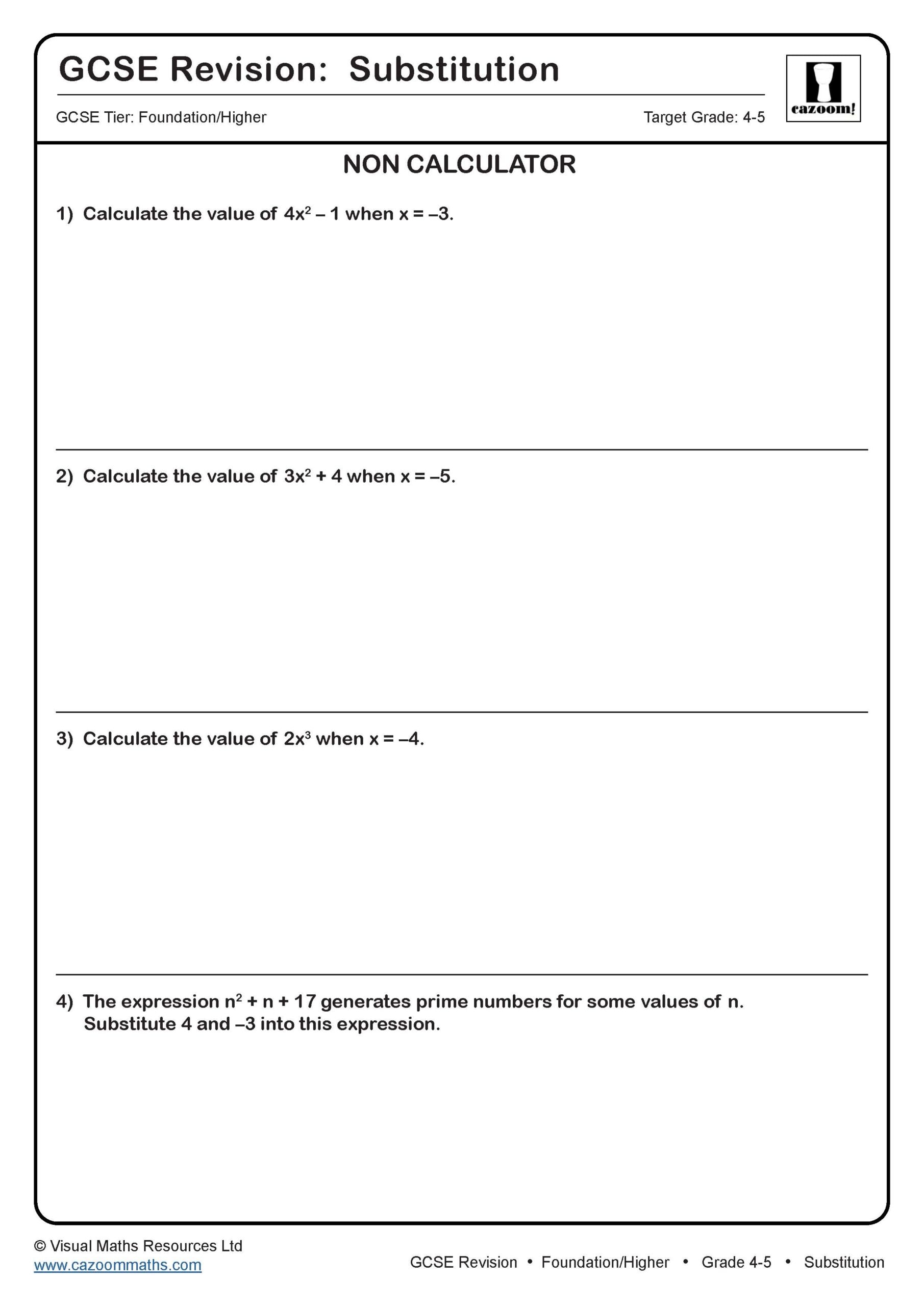
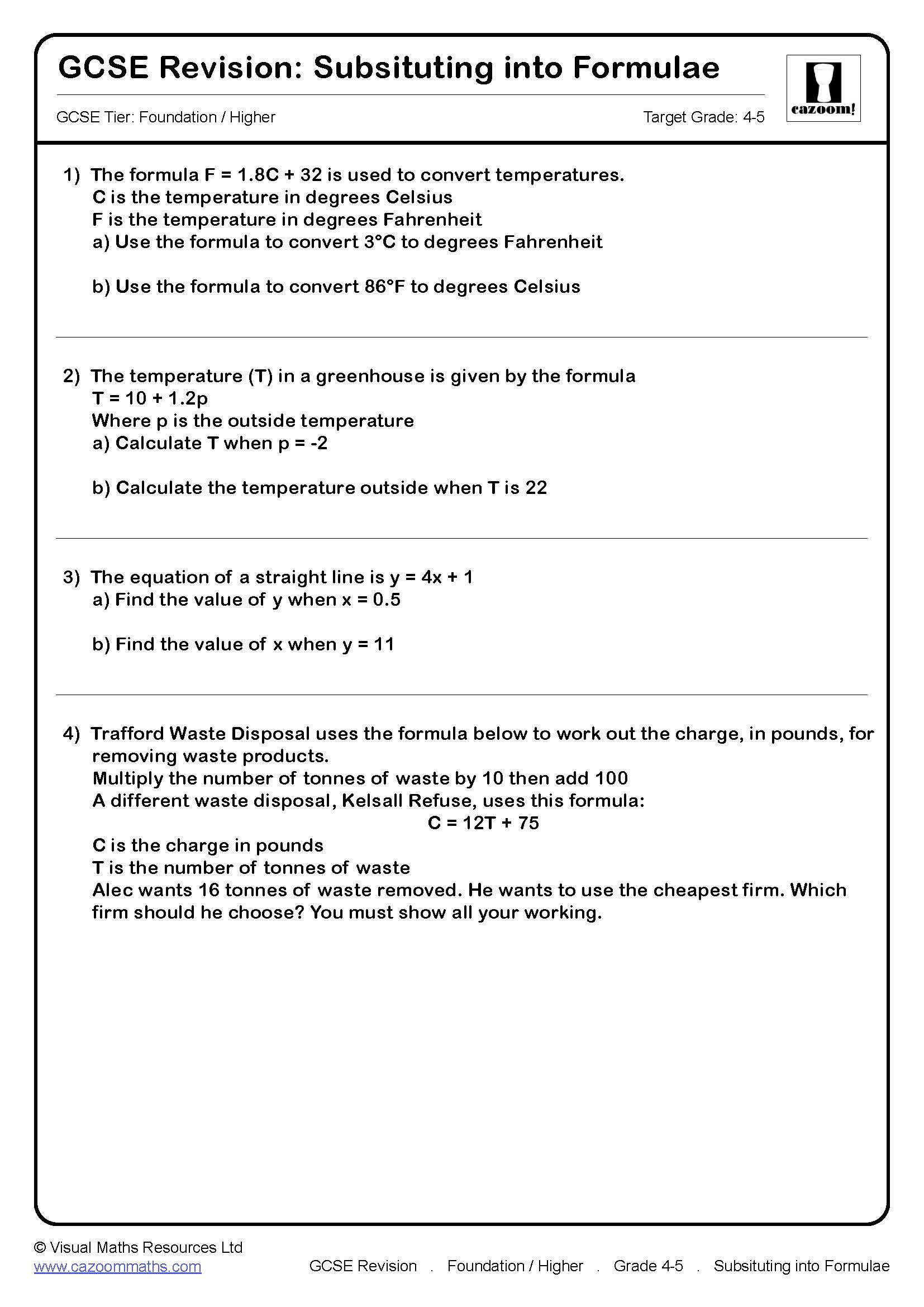
Higher papers typically include 3-5 substitution questions worth 8-12 marks total. Straightforward substitution into expressions or formulae appears early in paper 1, usually worth 1-2 marks at grade 4-5 level. More demanding questions embed substitution within proof tasks, solving quadratics, or manipulating algebraic fractions at grade 7-8. Students also meet substitution in gradient calculations, sequences, and ratio problems where recognising the need to substitute represents the challenge, not the calculation itself.
Exam mark schemes penalise missing brackets around negative substitutions heavily. A student substituting x = -3 into x² who writes -3² = -9 instead of (-3)² = 9 loses all method marks. Teachers frequently see this error even from students targeting grade 8, particularly under timed conditions when working quickly.
What grade are Substitution questions on Higher GCSE maths?
Basic substitution into single-variable expressions sits at grade 4-5, accessible to all Higher candidates. These questions test whether students can replace a letter with a number and calculate accurately using BIDMAS. Grade 6-7 questions involve substituting into expressions with brackets, negative values, or fractions, where order of operations and bracket notation become crucial. Grade 8-9 substitution appears within multi-step problems: substituting into difference of two squares, proving identities algebraically, or working with trigonometric expressions where substitution forms one step in a longer proof.
Students aiming for grade 7 should master negative number substitution completely before attempting grade 8-9 proof questions. Many teachers recommend drilling grade 5-6 substitution until automatic, as errors here undermine performance on higher-grade questions where substitution is embedded rather than explicit.
How is Substitution tested differently on Higher compared to Foundation?
Foundation tier tests substitution into straightforward formulae with positive integers or simple decimals, worth 1-2 marks per question. Higher tier assumes this fluency and tests substitution with negative numbers, fractions, and surds as standard. Questions rarely isolate substitution skills; instead, students must recognise where substitution applies within problem-solving contexts like sequences, functions, or algebraic proof. Higher papers also expect substitution into expressions containing brackets raised to powers or nested fractions.
This contextual embedding matters because Higher students cannot rely on spotting obvious substitution questions. A grade 8 geometry proof might require substituting algebraic expressions into Pythagoras' theorem, or a sequences question might need substitution to verify a general term. Students who only practise isolated substitution struggle when the skill appears within multi-step reasoning tasks.
How should students revise Substitution for Higher GCSE maths?
Start with grade 5-6 questions to establish accurate bracket notation and negative number handling, even if targeting grade 8-9. Students should write out substitutions in full initially, showing brackets explicitly before simplifying. Timed practice builds speed without sacrificing accuracy. Working through answers carefully helps identify whether errors stem from substitution mistakes or subsequent calculation slips. Many teachers recommend students mark where they substituted values in working, making checking easier.
Teachers can use these worksheets for starters targeting specific weaknesses, homework differentiated by target grade, or intervention sessions for students whose algebraic manipulation outpaces their substitution accuracy. Setting a mixture of grades 5-7 questions as low-stakes practice before assessments helps students enter exams with automatic recall of bracket rules and negative number operations under pressure.