GCSE Higher Transformations Revision Worksheets
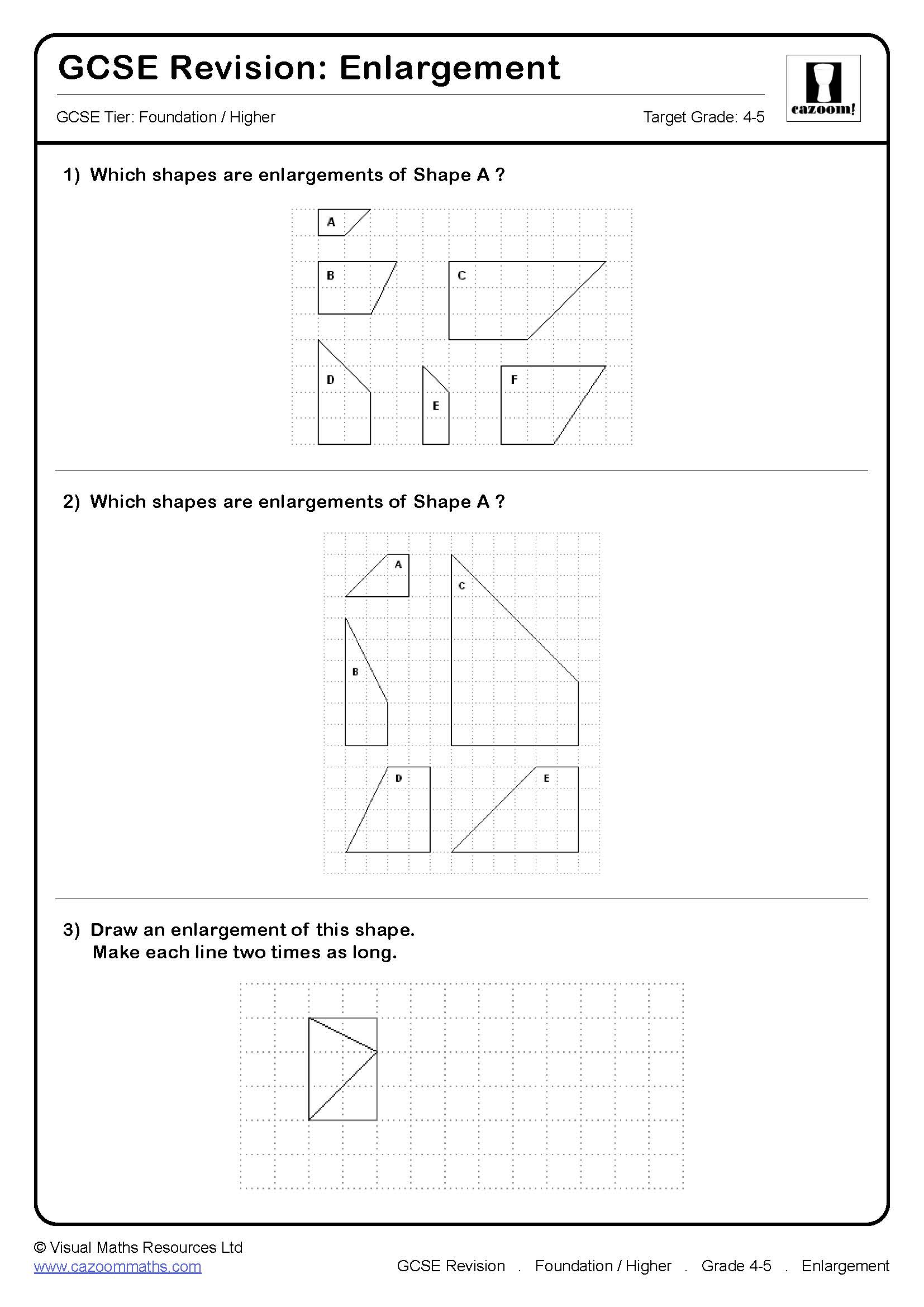
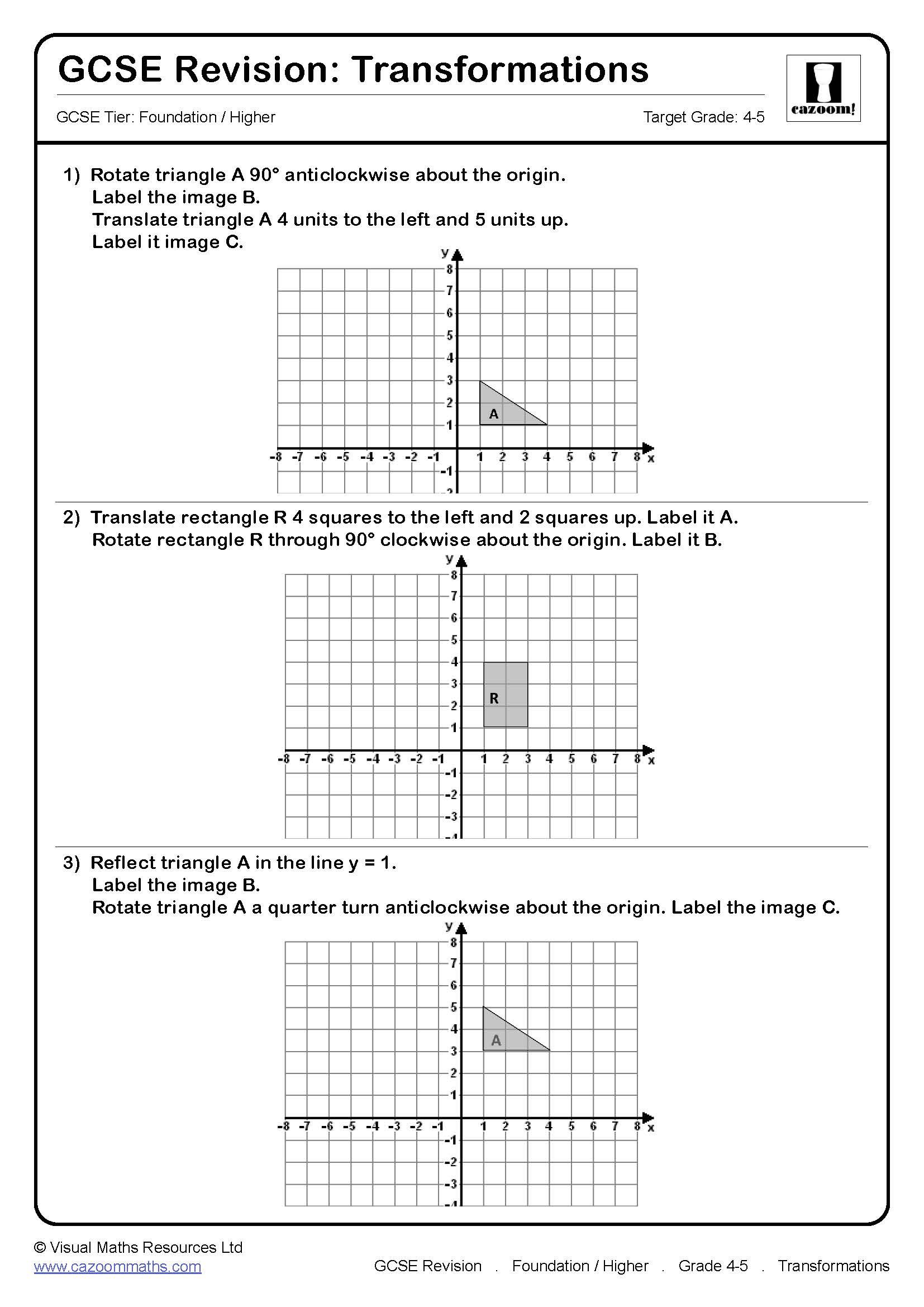
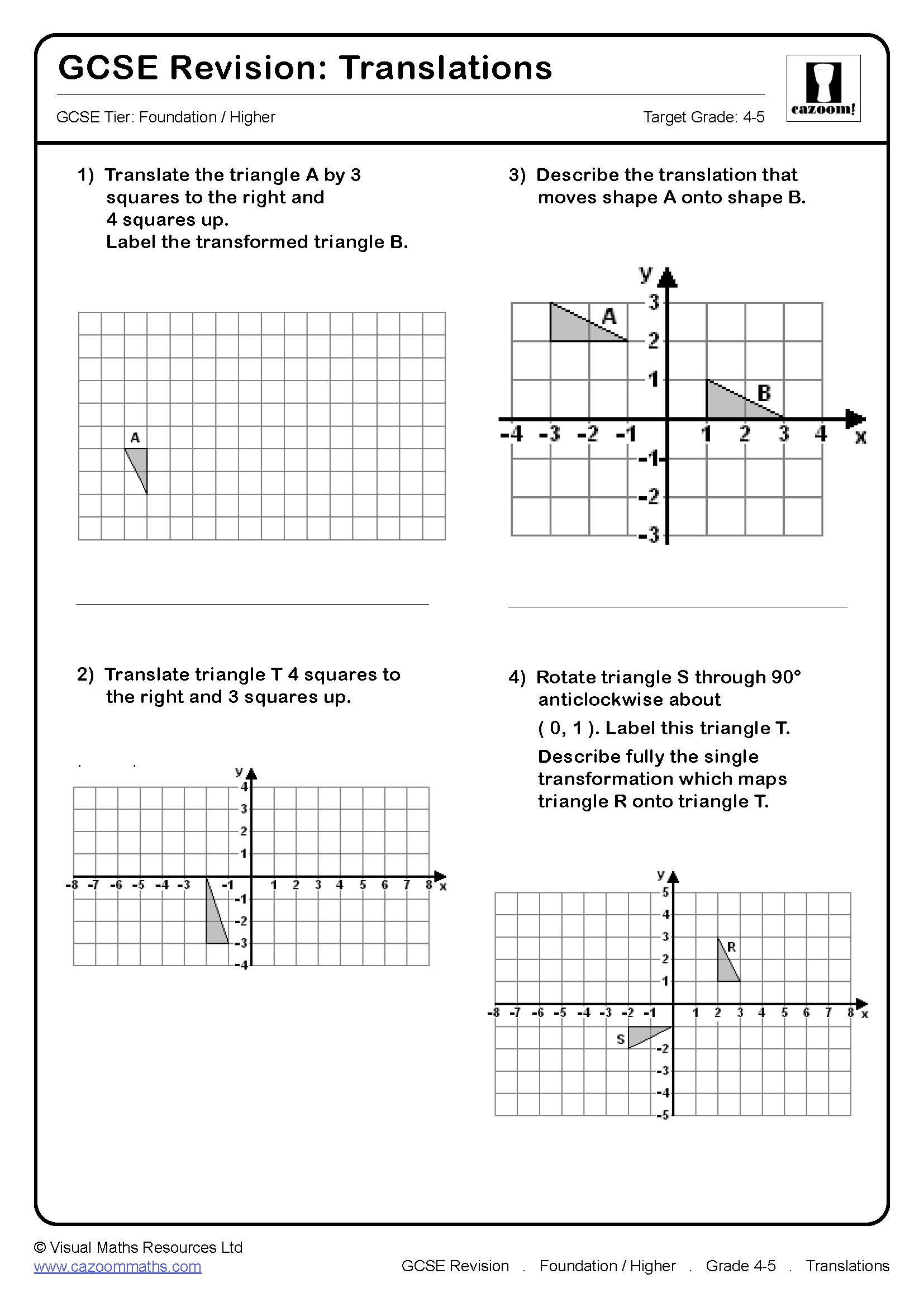
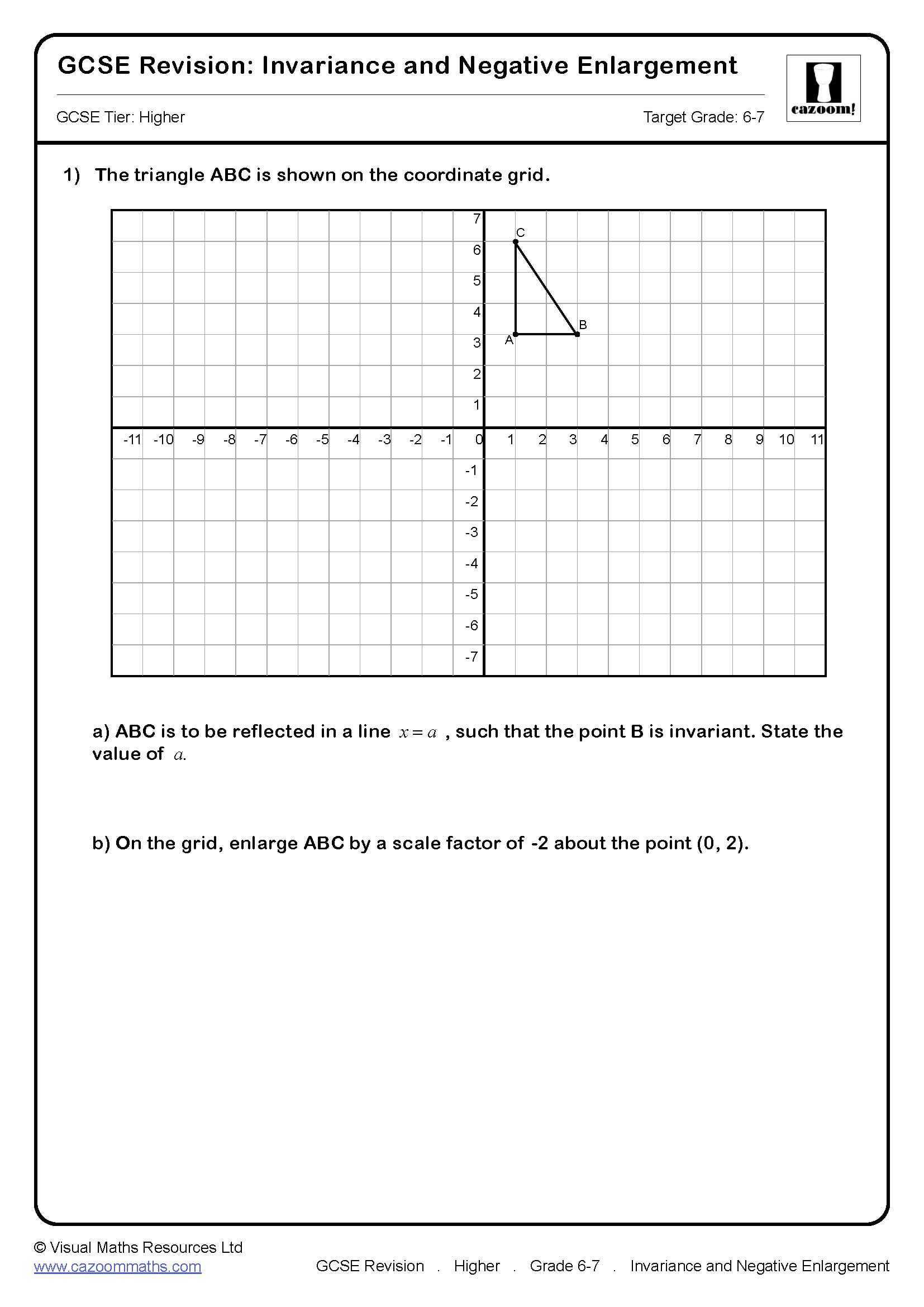
All worksheets are created by the team of experienced teachers at Cazoom Maths.
What Transformations questions appear on the GCSE Higher paper?
Higher papers typically include transformations questions worth 8-12 marks across Paper 2 and Paper 3, combining geometric and algebraic approaches. Students face single transformations requiring full descriptions, combined transformations where they must identify the single transformation equivalent to two operations, and graph transformations such as y = f(x) mapped to y = f(x + a) or y = -f(x). Enlargements with fractional or negative scale factors appear regularly, alongside reflections in lines like y = x or y = -x.
Exam mark schemes penalise incomplete descriptions heavily. A reflection without the mirror line equation, or a rotation missing centre coordinates and direction, earns zero marks regardless of correct diagram work. Teachers notice students often sketch transformations accurately but fail to write mathematically complete answers, costing them valuable marks at grades 6-8.
What grade are Transformations questions on Higher GCSE maths?
Transformations questions on Higher papers span grades 4-9, with clear differentiation in complexity. Grade 4-5 questions test single transformations with straightforward descriptions, such as rotations about the origin or reflections in coordinate axes. Grade 6-7 questions introduce combined transformations, enlargements with fractional scale factors, and transformations of graphs. Grade 8-9 questions demand identifying invariant points, describing transformations under matrices, or proving algebraic relationships between transformed coordinates.
Students aiming for grade 7 or above should focus revision on the more complex transformation types first, ensuring they can describe combined transformations and handle negative scale factors confidently. Those consolidating grades 5-6 benefit from mastering accurate notation and single transformation descriptions before progressing to multi-step questions, building systematic accuracy that prevents mark loss.
How is Transformations tested differently on Higher compared to Foundation?
Foundation papers limit transformations to positive integer scale factors, rotations about the origin in 90° multiples, and reflections in horizontal, vertical or diagonal lines. Higher papers extend this significantly, requiring fractional and negative scale factors for enlargements, rotations about any point through any angle, and reflections in any linear equation. Algebraic transformations of functions appear exclusively on Higher tier, including stretches and combinations like y = af(bx + c).
This algebraic fluency separates Higher tier performance. Students must move beyond plotting transformed shapes to understanding how coordinates change systematically under transformations. Teachers observe that grade 7+ students recognise transformation patterns algebraically rather than relying solely on graphical methods, allowing them to tackle unfamiliar contexts confidently and describe complex combined transformations that would overwhelm a purely visual approach.
How should students revise Transformations for Higher GCSE maths?
Effective revision involves working systematically through transformation types, beginning with areas of weakness identified through past paper performance. Students should practise writing complete descriptions without referring to notes, then immediately check against answer sheets to identify notation gaps. Timed practice on combined transformations builds exam stamina, whilst revisiting graph transformations alongside algebra topics strengthens the connection between geometric and functional approaches. Focusing on describing transformations precisely, including every required element, prevents the commonest mark losses.
Teachers can deploy these worksheets as targeted homework following lesson sequences on each transformation type, or as intervention materials for students approaching grade boundaries. Setting specific worksheets addressing identified weaknesses, such as rotations or combined transformations, allows differentiated revision within mixed-ability Higher groups, whilst answer sheets enable independent learning and self-correction outside classroom time.