GCSE Higher Trigonometry Revision Worksheets
All worksheets are created by the team of experienced teachers at Cazoom Maths.
What Trigonometry questions appear on the GCSE Higher paper?
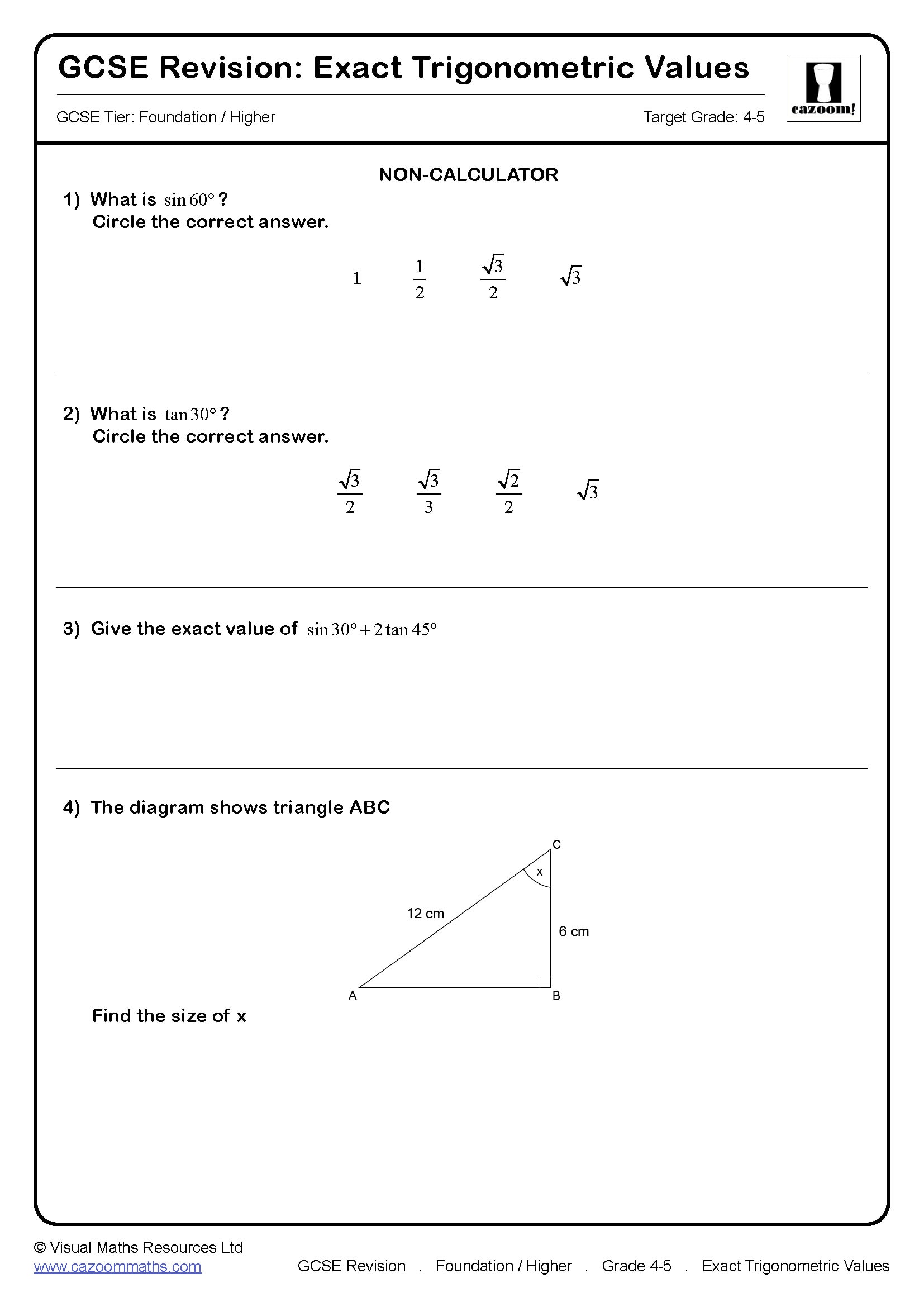
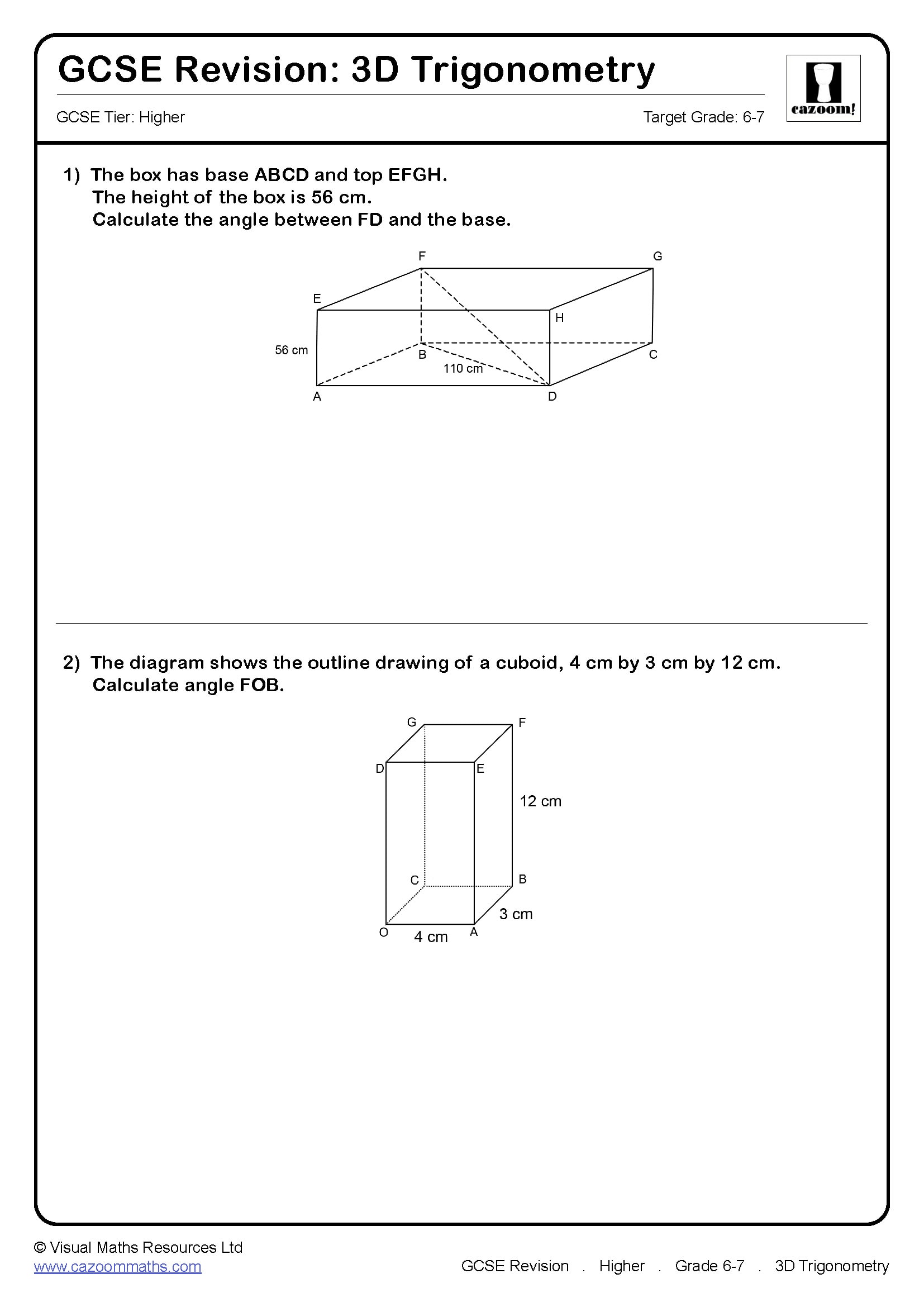
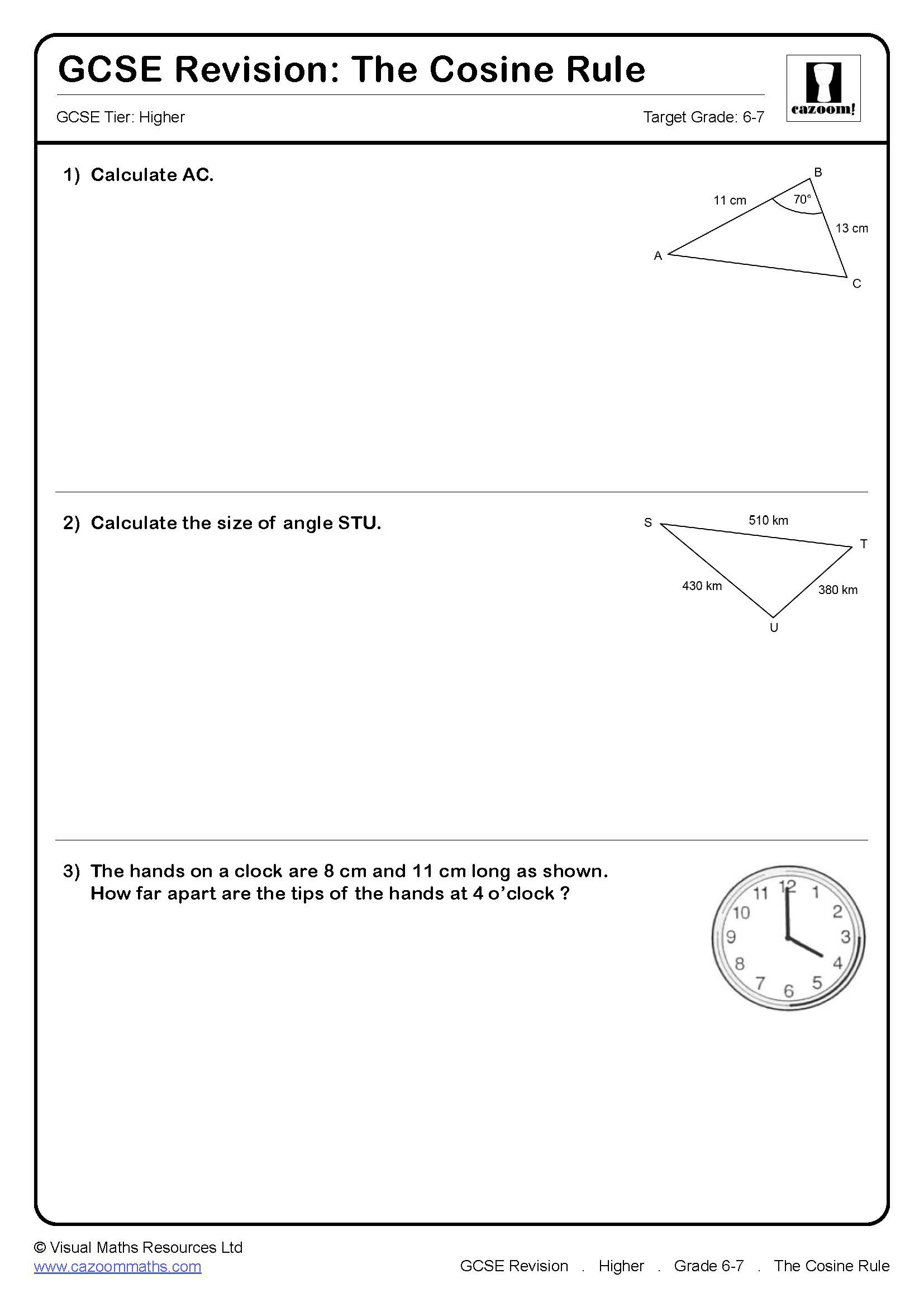
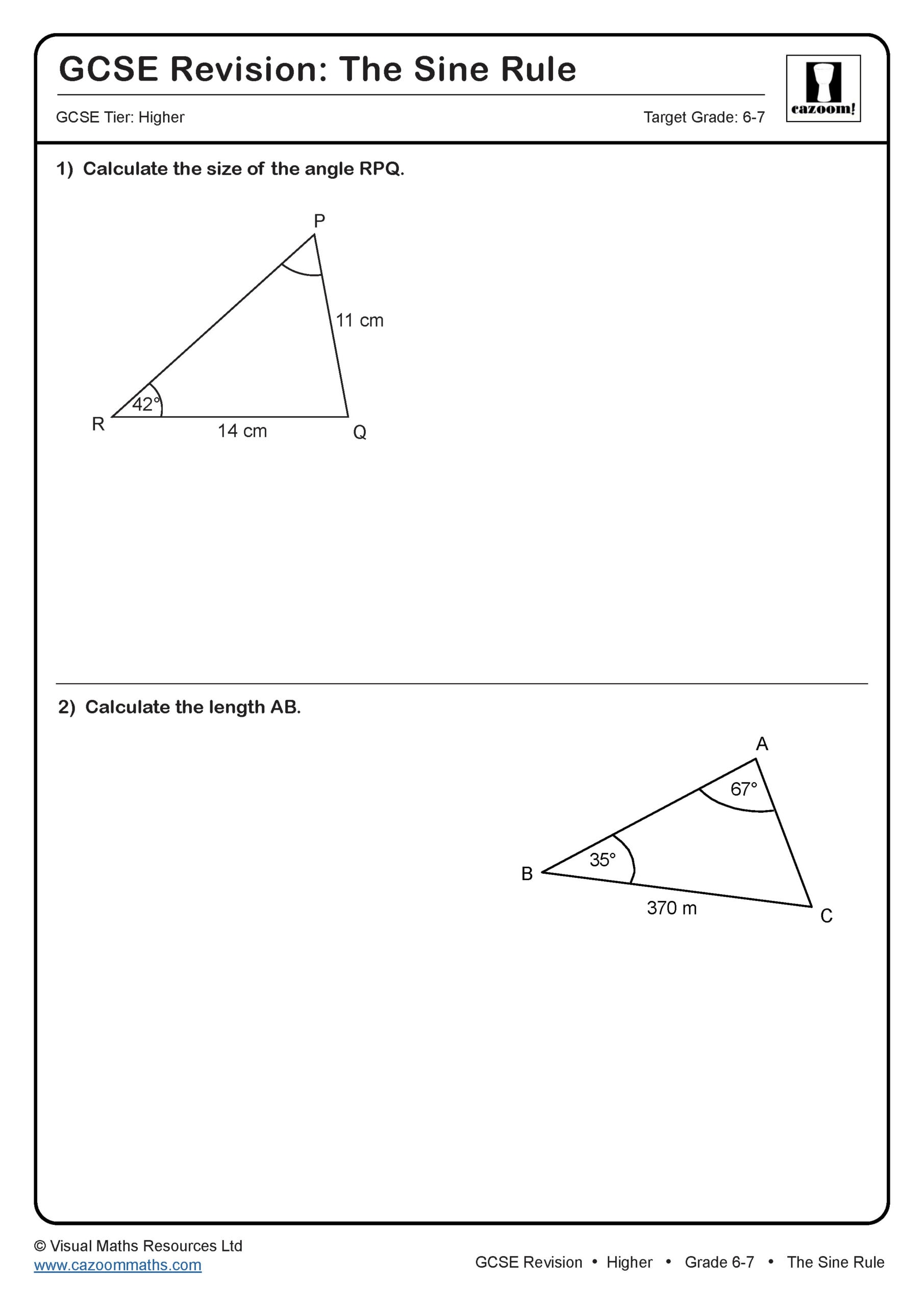
Higher papers feature trigonometry across multiple contexts, typically worth 15-20 marks. Expect questions on sine and cosine rules in non-right-angled triangles, exact trigonometric values for 0°, 30°, 45°, 60°, and 90°, trigonometric graphs including transformations, 3D problems requiring multiple calculations, and bearings combined with scale diagrams or vectors. Grade 7-9 questions often embed trigonometry within problem-solving contexts, such as calculating angles of elevation in composite shapes or proving identities.
Students lose marks when they apply the sine rule but forget to consider the ambiguous case, or when they round mid-calculation rather than at the final answer. Exam mark schemes penalise premature rounding heavily in multi-step trigonometry, so teachers should emphasise storing full calculator values throughout workings.
What grade are Trigonometry questions on Higher GCSE maths?
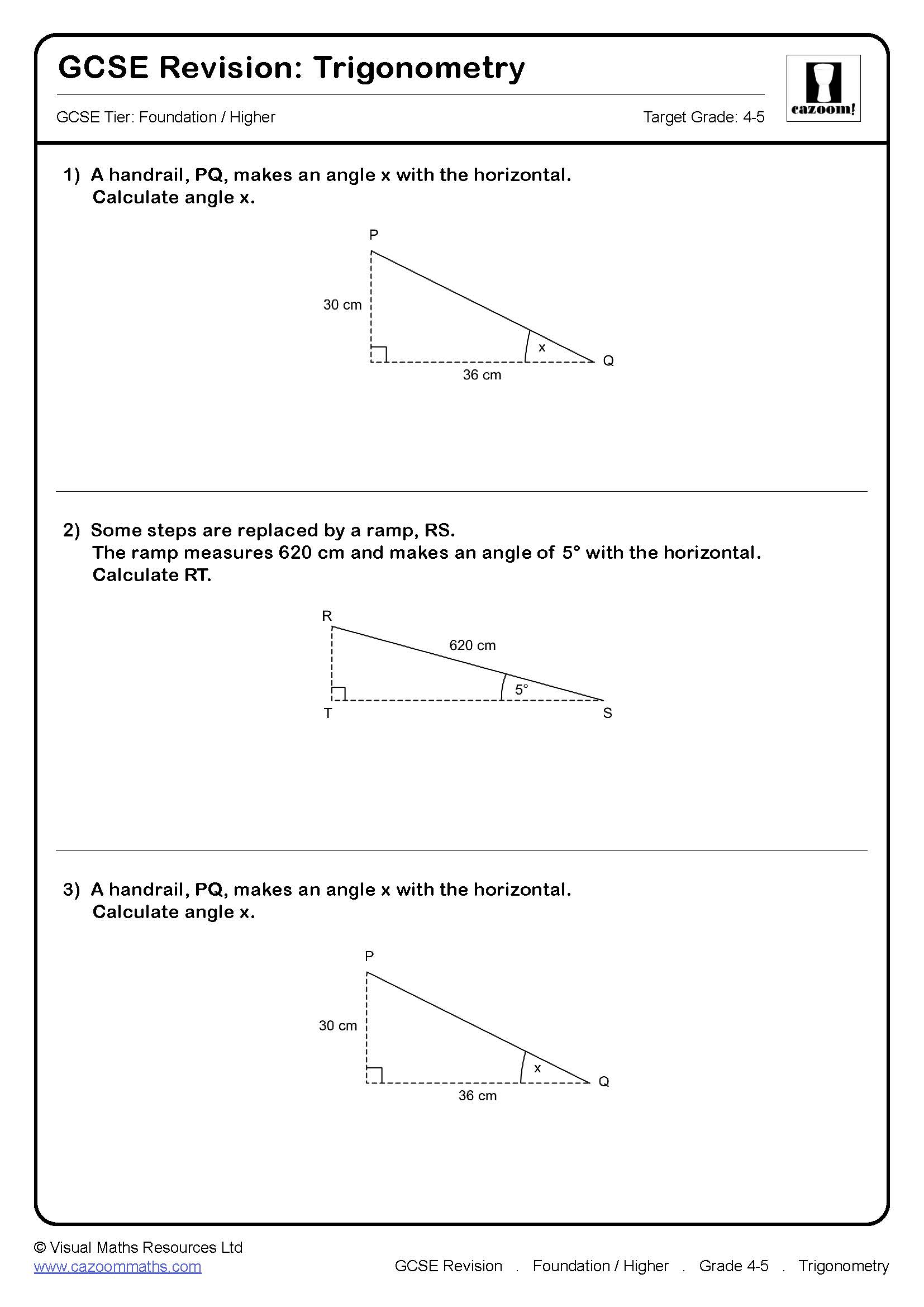
Trigonometry spans the entire Higher grade range. Grade 4-5 questions test right-angled triangle trigonometry using SOHCAHTOA, exact values for common angles, and basic sine/cosine rule applications. Grade 6-7 questions introduce 3D trigonometry, bearings with two-stage calculations, and trigonometric graphs with transformations. Grade 8-9 questions demand problem-solving across multiple steps, such as combining trigonometry with circle theorems, proving trigonometric identities, or solving equations involving compound angles. Area of a triangle using ½absinC frequently appears at grade 6-7.
Students should identify which grade band they currently secure, then systematically tackle the next level. Teachers often find that focusing on 3D visualisation lifts students from grade 6 to grade 7, whilst fluency with identities and algebraic manipulation unlocks grade 8-9 questions.
How is Trigonometry tested differently on Higher compared to Foundation?
Foundation trigonometry focuses almost entirely on right-angled triangles using SOHCAHTOA, with simple applications to finding missing sides or angles. Higher introduces sine and cosine rules for non-right-angled triangles, 3D problems requiring multiple trigonometric calculations, exact values without a calculator, trigonometric graphs with transformations, and area calculations using ½absinC. Foundation questions remain single-step or two-step; Higher embeds trigonometry within complex problem-solving, often combining it with Pythagoras, vectors, or algebraic rearrangement.
This depth matters because Higher students must select appropriate methods without prompting. Teachers notice that students who memorise formulae without understanding context struggle to decide whether a problem requires sine rule, cosine rule, or basic trigonometry. Higher demands strategic thinking alongside procedural fluency.
How should students revise Trigonometry for Higher GCSE maths?
Start by securing exact values for 0°, 30°, 45°, 60°, and 90° without a calculator, as these underpin grade 7-9 questions. Work systematically through worksheets, beginning with right-angled problems to build fluency, then progressing to sine and cosine rules, 3D trigonometry, and graph transformations. Time each worksheet to replicate exam conditions, aiming for 1-1.5 minutes per mark. Check answers immediately, focusing on where method selection or visualisation went wrong rather than just arithmetic slips.
Teachers can assign specific worksheets targeting student weaknesses identified through mock analysis. Setting 3D trigonometry as homework with answer sheets allows students to self-assess and return with precise questions. Use worksheets for low-stakes retrieval practice at lesson starts, reinforcing both procedural fluency and decision-making under time pressure.