GCSE Higher Vectors Revision Worksheets
All worksheets are created by the team of experienced teachers at Cazoom Maths.
What Vectors questions appear on the GCSE Higher paper?
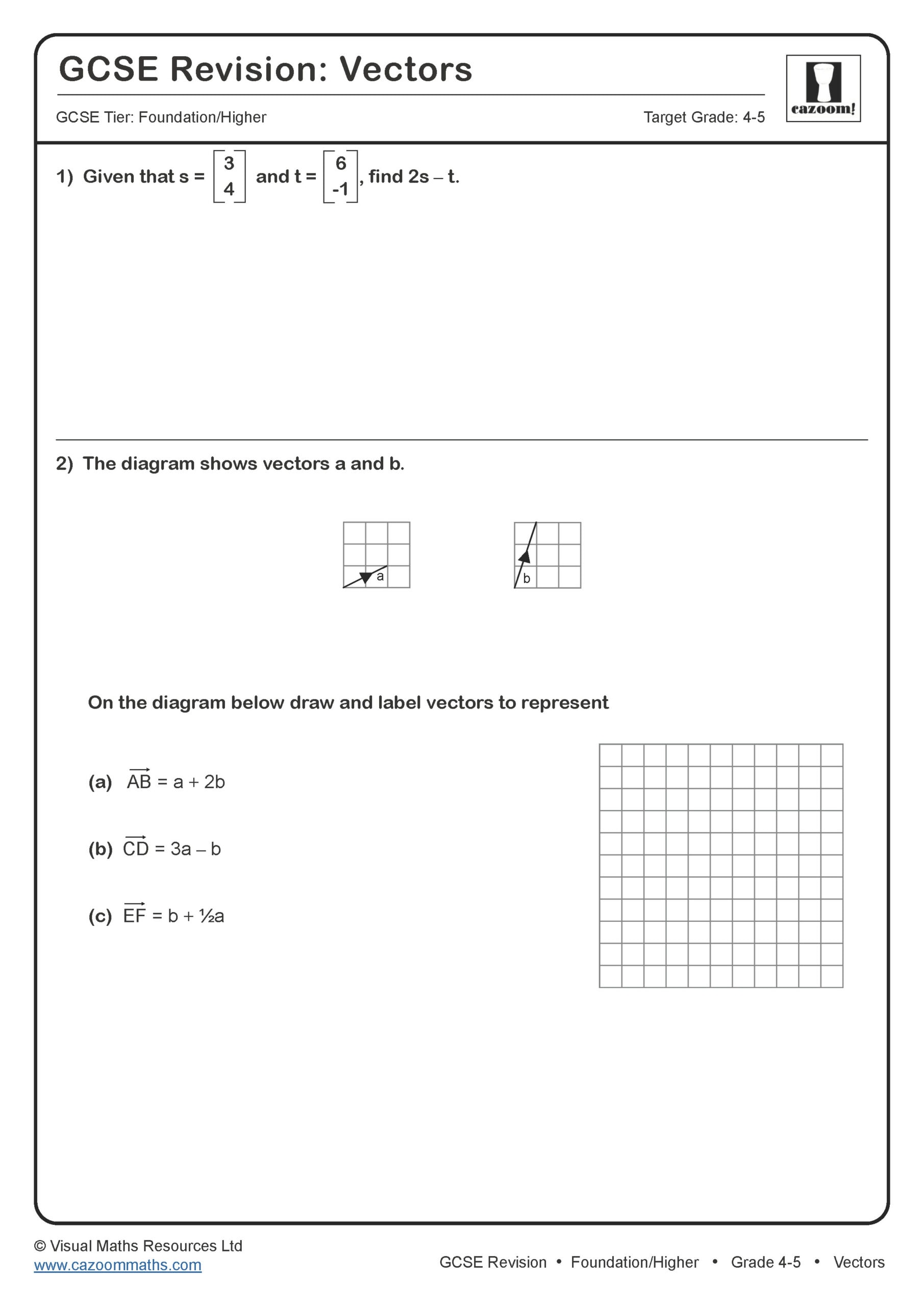
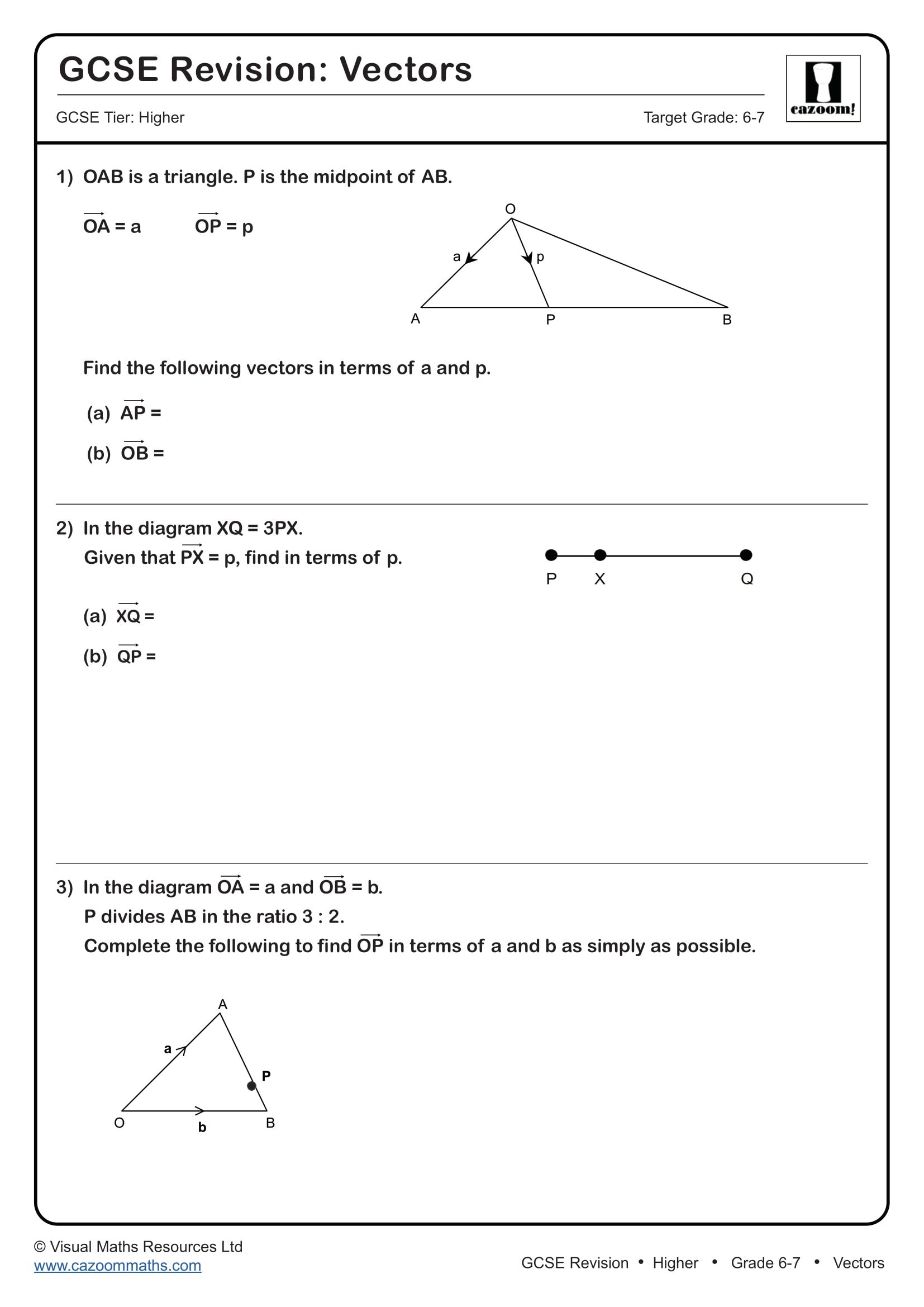
Higher papers typically include 8-12 marks across vectors, often split between a straightforward question on magnitude and direction or vector arithmetic (3-4 marks) and a more demanding proof question (5-6 marks). Students encounter column vector notation, scalar multiplication, finding resultant vectors, and calculating position vectors from diagrams. The proof questions frequently ask students to show lines are parallel using vector methods or to prove a point lies on a line by expressing position vectors in terms of ratio.
Exam mark schemes penalise students who write vectors without column notation or who fail to conclude a proof explicitly. A common error sees students correctly calculating that two vectors are scalar multiples but forgetting to state 'therefore the lines are parallel' as their final statement.
What grade are Vectors questions on Higher GCSE maths?
Basic vector questions (finding magnitude using Pythagoras, adding or subtracting column vectors, scalar multiplication) typically target grades 4-5 and appear early in the vectors question. Grade 6-7 questions require students to work backwards from a resultant vector, apply vectors to navigation problems, or combine vector arithmetic with geometric reasoning. The demanding proof questions, where students must demonstrate lines are parallel or points lie in specific ratios, aim squarely at grades 7-9 and test both algebraic manipulation and logical presentation.
Students revising strategically should consolidate grades 4-6 skills first before tackling proof questions. Teachers observe that students who rush to grade 8-9 material without securing foundational vector arithmetic waste valuable revision time and lose confidence when straightforward marks slip away on the actual paper.
How is Vectors tested differently on Higher compared to Foundation?
Foundation vectors questions focus on column notation, simple addition and subtraction, and finding single missing vectors from diagrams. The context remains straightforward, often using grids or labelled diagrams where vectors are clearly defined. Higher tier extends this substantially, requiring students to work with algebraic vectors (expressions like 3a - 2b), prove geometric properties using vector methods, and solve multi-step problems where the vector information must be extracted from complex diagrams without grid support.
This algebraic depth matters because Higher students must treat vectors as variables, not just directed line segments. Questions deliberately obscure which vectors to use, expecting students to construct their own vector expressions and justify each step. Students who memorise Foundation methods without developing this algebraic reasoning struggle significantly, particularly when proofs demand showing that vector relationships satisfy specific geometric conditions.
How should students revise Vectors for Higher GCSE maths?
Students should begin with basic vector arithmetic, timing themselves on straightforward questions to build speed and accuracy with column notation and scalar multiplication. Once confident, they should tackle proof questions systematically, writing out each step and explicitly stating geometric conclusions. Working through the answer sheets helps students see the presentation mark schemes expect, particularly how to structure a vector proof from 'let a represent...' through calculation to 'therefore the lines are parallel'. Students preparing for grades 8-9 should focus on questions combining vectors with ratio or similar triangles.
Teachers can set these worksheets as targeted homework after teaching geometric proof, or use them in revision lessons where students work through grade bands progressively. Pairing weaker students with those confident in algebraic manipulation often produces breakthroughs, as peer explanation clarifies why vector methods work geometrically, not just procedurally.