Enlargement Worksheets
Enlargement (A)
Year groups: 8, 9
-Worksheet.jpg?w=3840)
Enlargement (B)
Year groups: 8, 9
-Worksheet.jpg?w=3840)
Enlargement (C)
Year groups: 10, 11
-Worksheet.jpg?w=3840)
Enlargement with Fractional Negative Scale Factors
Year groups: 10, 11
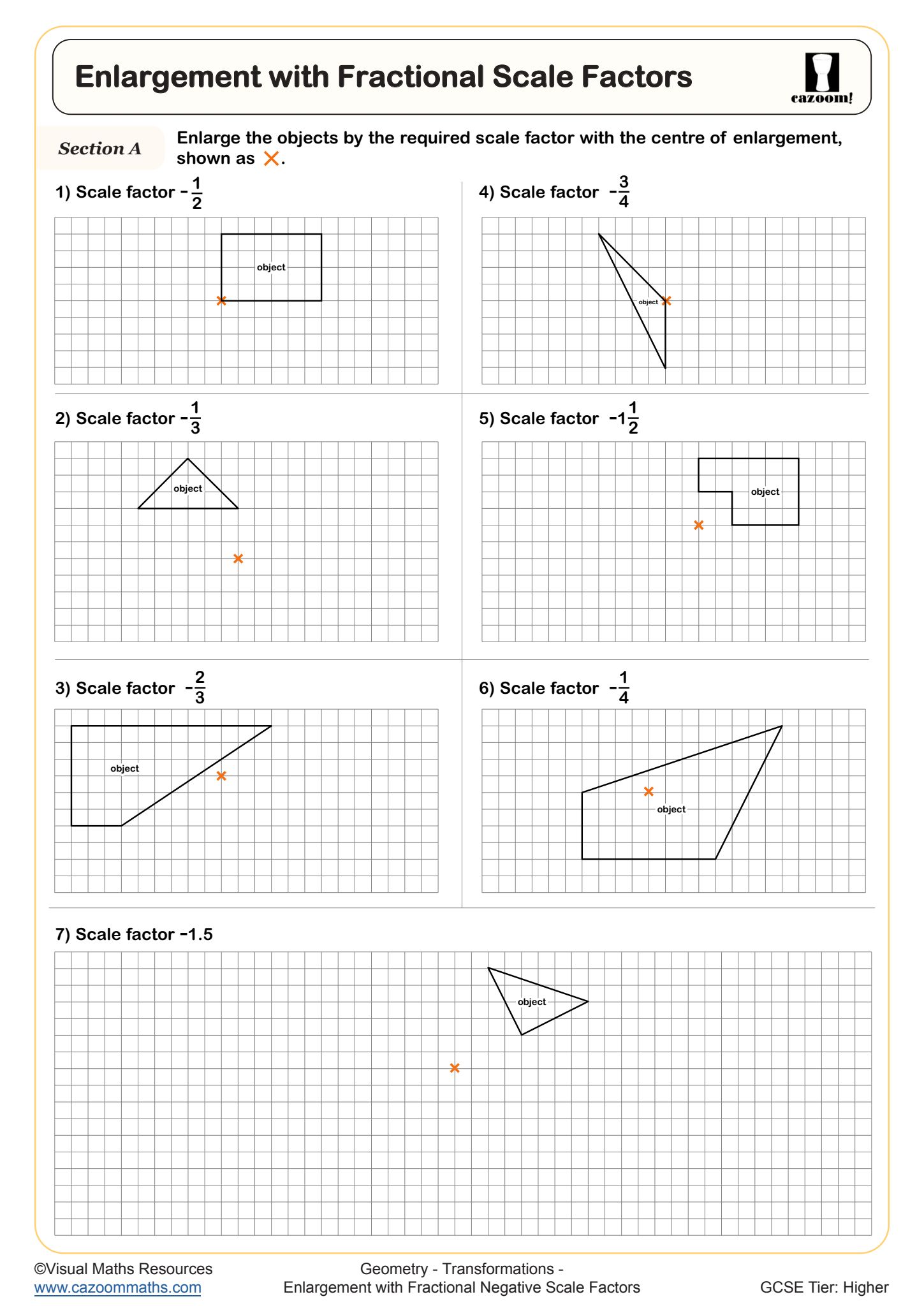
Enlargement with Fractional Scale Factors (A)
Year groups: 10, 11
-Worksheet.jpg?w=3840)
Enlargement with Fractional Scale Factors (B)
Year groups: 10, 11
-Worksheet.jpg?w=3840)
Enlargement with Negative Scale Factors
Year groups: 10, 11
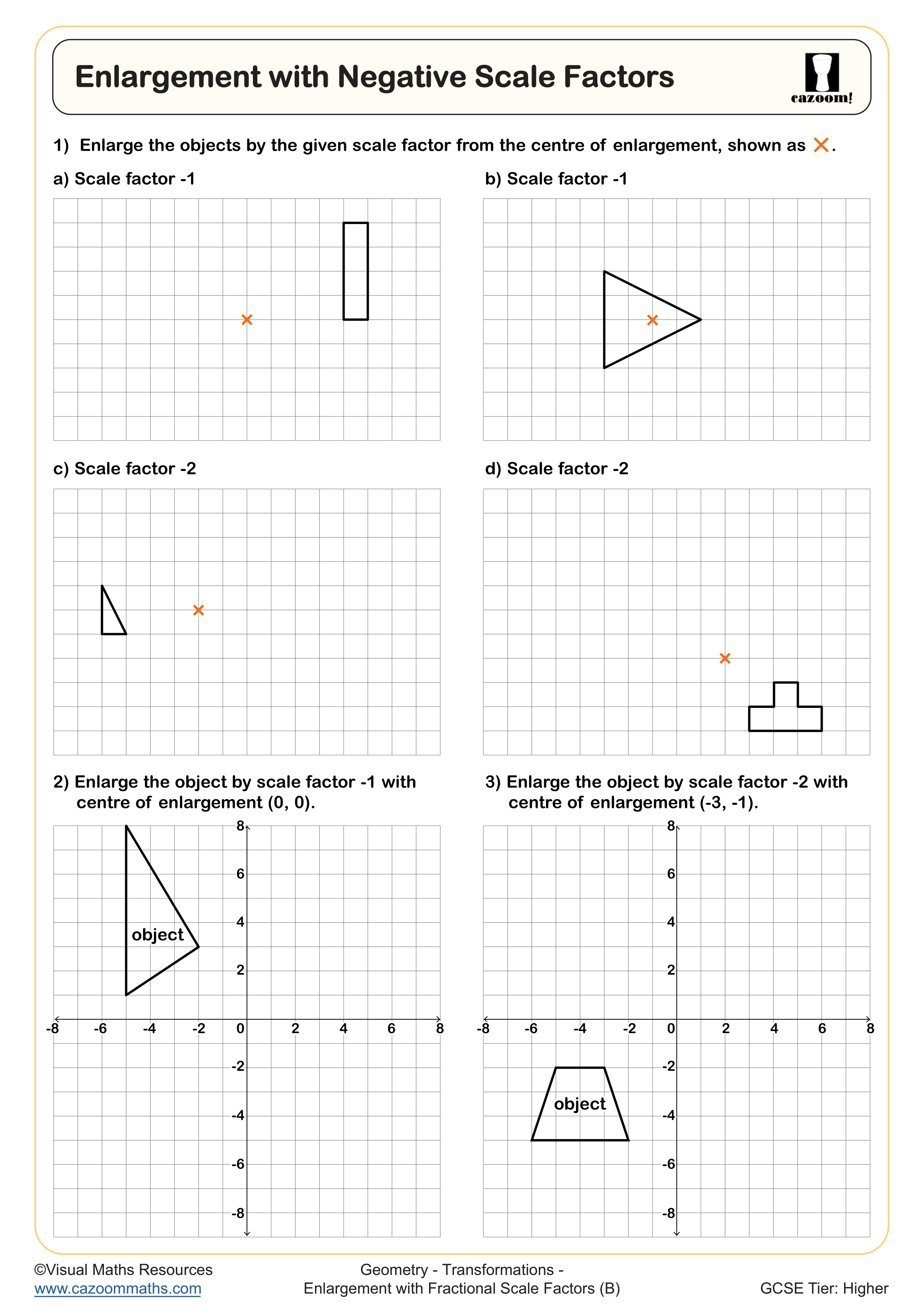
Enlargements on Axes
Year groups: 10, 11
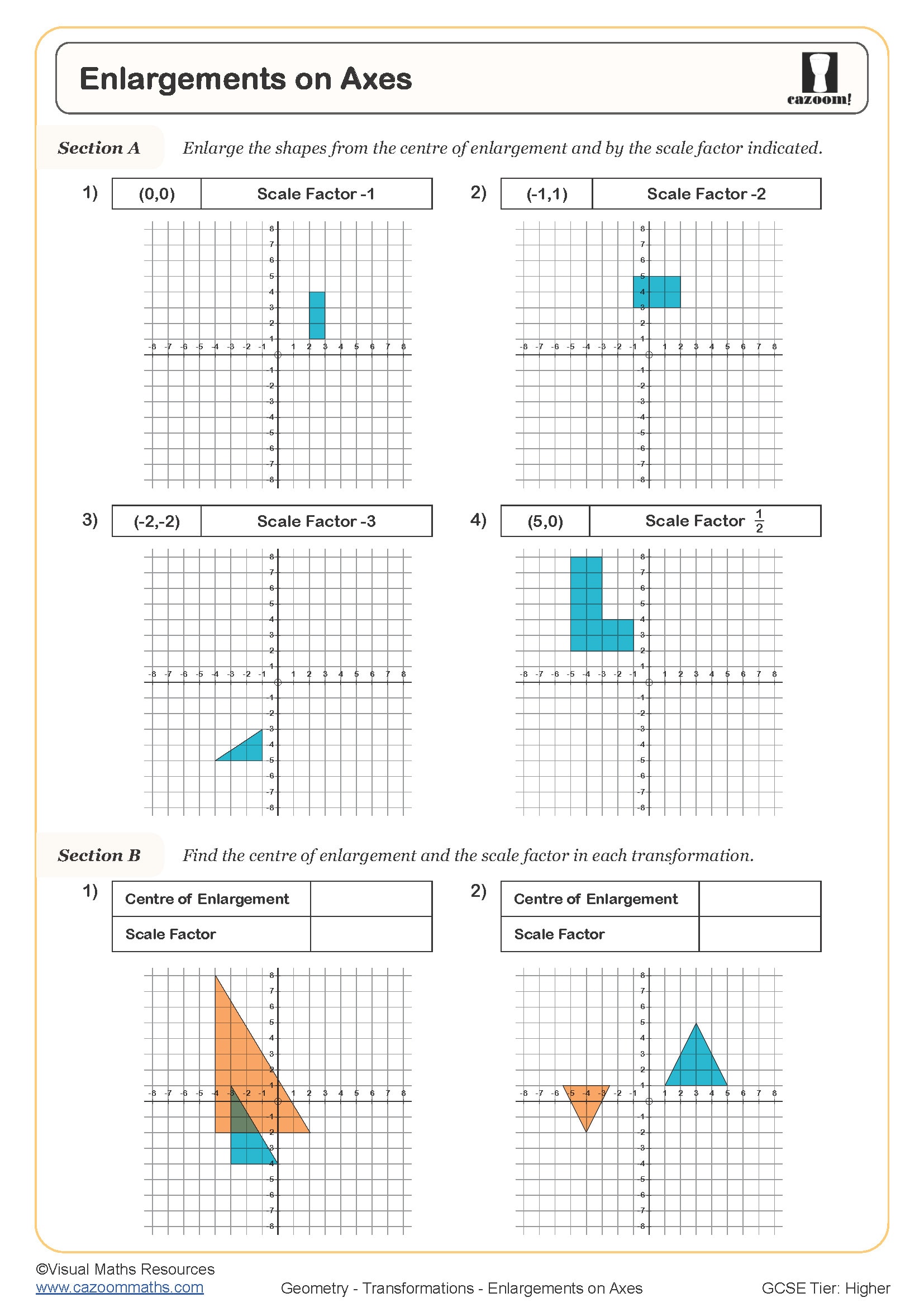
Enlargements Using Column Vectors
Year groups: 10, 11
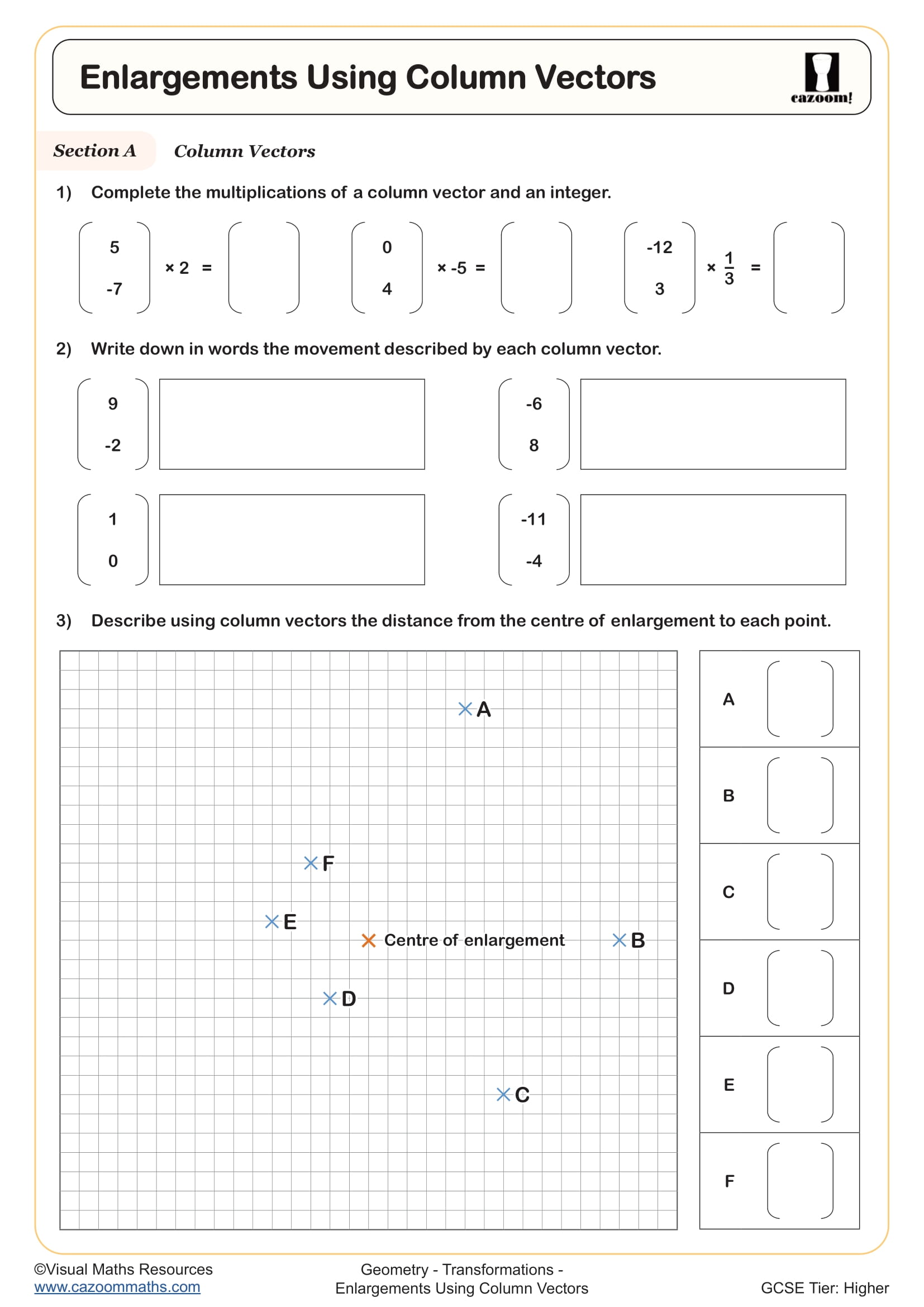
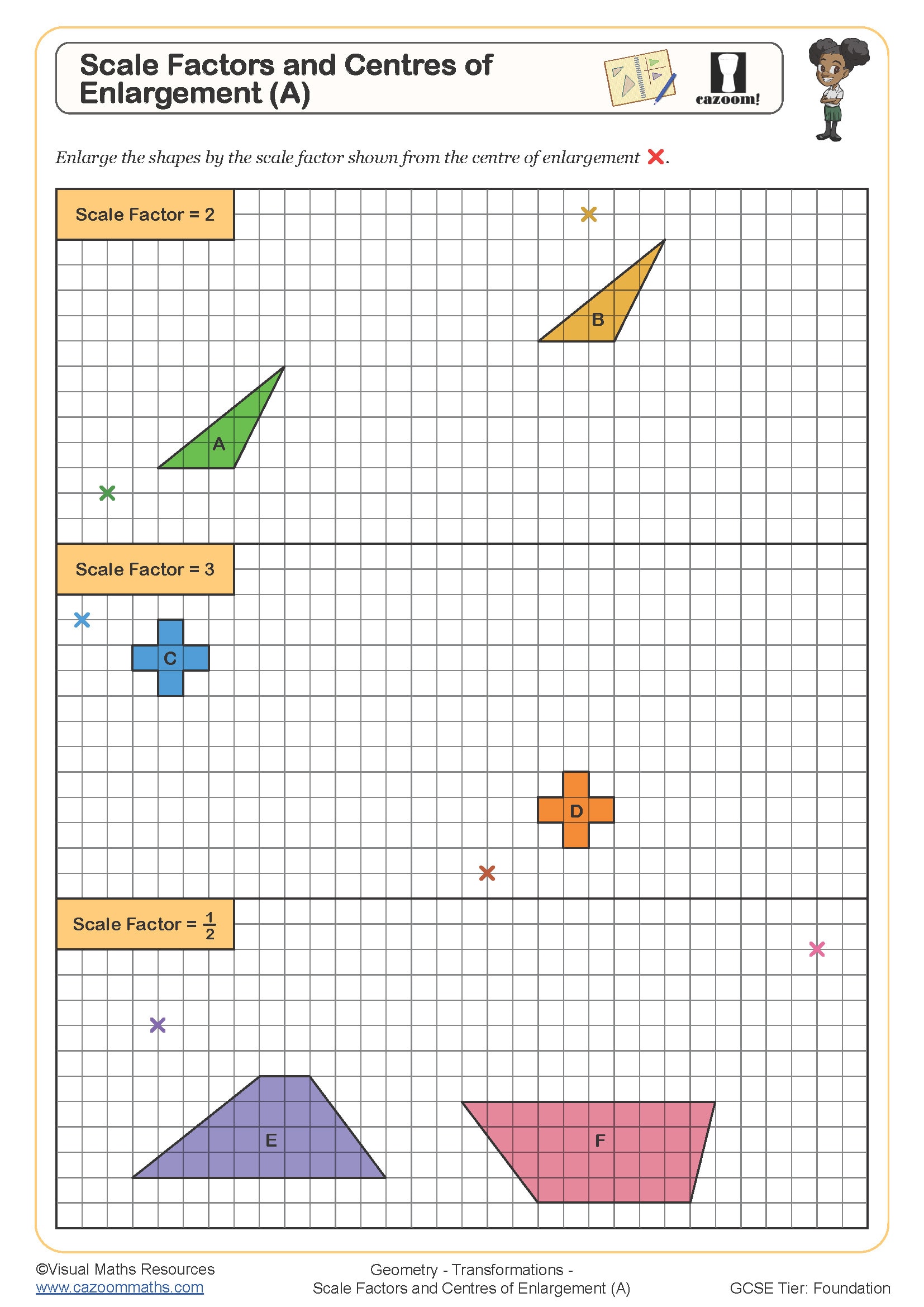
Scale Factors and Centres of Enlargement (A)
Year groups: 10, 11
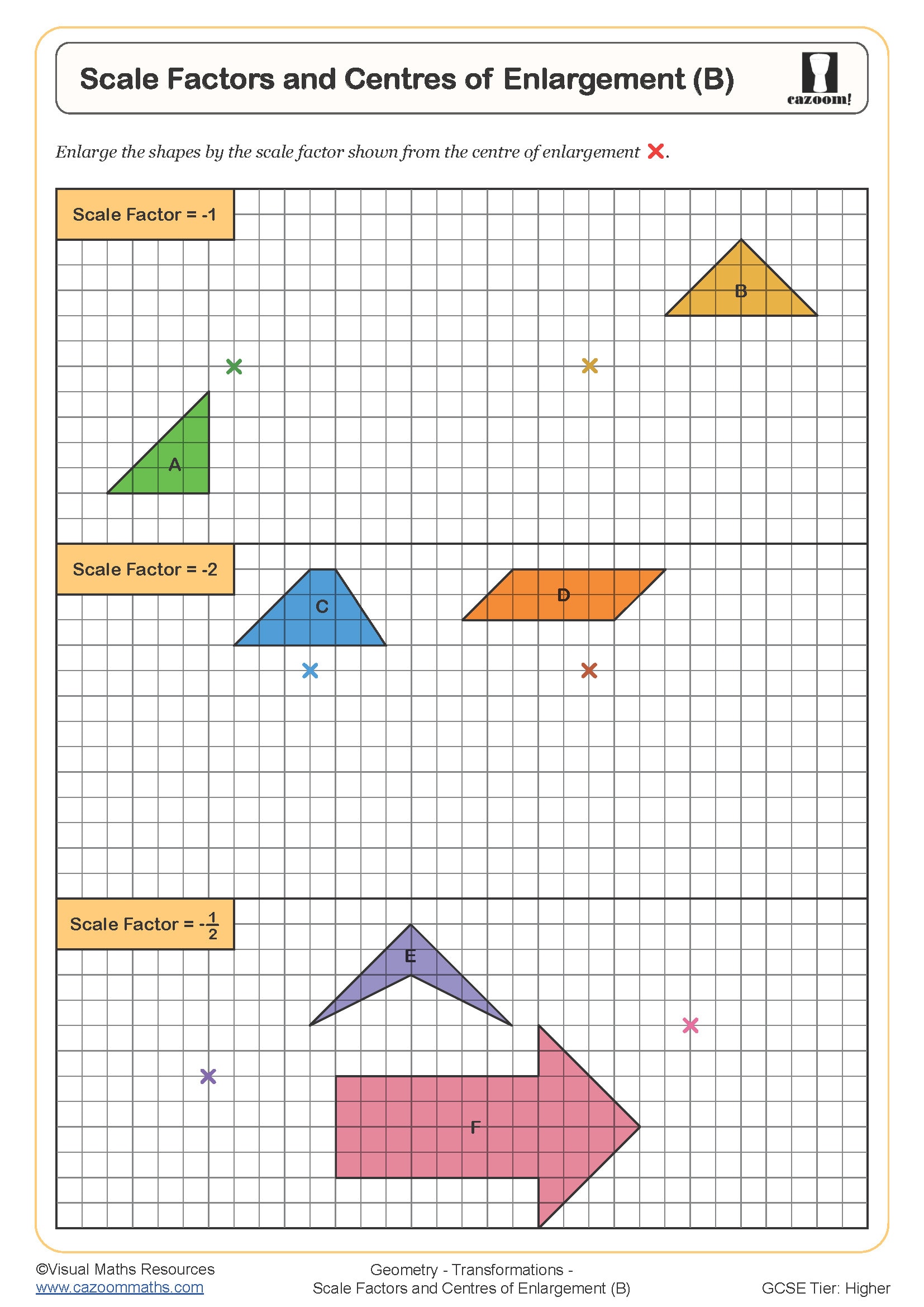
Scale Factors and Centres of Enlargement (B)
Year groups: 10, 11
All worksheets are created by the team of experienced teachers at Cazoom Maths.
What Should Students Practise with Enlargement Worksheets?
An enlargement worksheet should develop three core skills: identifying the centre of enlargement, applying scale factors accurately, and working with both positive and negative values. Students need to practise measuring distances from the centre, multiplying by the scale factor, and plotting new coordinates precisely. The worksheets progress from simple positive integer scales to fractional and negative enlargement, reflecting the National Curriculum requirement that KS4 students handle all scale factor types.
Teachers often notice students lose marks by measuring from the wrong point rather than the centre of enlargement, or by assuming negative scale factors simply flip the shape without repositioning it. Enlargement and reduction worksheets help students distinguish between scale factors greater than 1 (enlargement) and between 0 and 1 (reduction), a conceptual difference that causes confusion when students rush through transformation questions without considering what the scale factor actually means.
Which Year Groups Study Enlargement?
These worksheets cover Year 8, Year 9, Year 10, and Year 11, spanning both Key Stage 3 and Key Stage 4. Students typically meet basic enlargement with positive integer scale factors in Year 8, building foundational understanding of how shapes grow proportionally. This groundwork proves essential before tackling the more abstract concepts that follow in later years.
The progression intensifies considerably as students move through KS4. Year 9 introduces fractional scale factors (creating reductions), whilst Year 10 and Year 11 tackle negative scale factors that invert shapes through the centre of enlargement. This sequence mirrors GCSE Foundation and Higher tier demands, where negative enlargement consistently appears on Higher papers and catches students who haven't practised locating centres when the enlarged shape sits on the opposite side.
How Do Negative Scale Factors Work in Enlargement?
Negative enlargement combines two transformations: the shape enlarges by the absolute value of the scale factor, then inverts through the centre of enlargement to the opposite side. With a scale factor of -2, for example, each point moves twice as far from the centre but in the opposite direction. Students must measure the distance from centre to original vertex, multiply by the negative scale factor, and plot in the opposite direction along the same ray from the centre.
This concept connects directly to optics and image formation in physics. When light passes through a convex lens, the image forms inverted and magnified on the opposite side of the lens, behaving exactly like negative enlargement. Camera lenses, projectors, and the human eye all demonstrate this principle, where the lens centre acts as the centre of enlargement. Understanding negative scale factors helps students grasp why photographs appear upside down on camera sensors before digital processing corrects the orientation.
How Can Teachers Use These Enlargement Worksheets Effectively?
The worksheets scaffold learning by starting with clearly marked centres and positive integer scales before removing supports. Early questions often show ray lines from the centre to guide students, whilst later problems require them to locate the centre themselves by working backwards from an original and enlarged shape. This structure helps students build confidence with the method before tackling the spatial reasoning that GCSE questions demand, particularly when centres sit outside the shapes or on awkward coordinates.
Many teachers use enlargement transformation worksheet tasks for paired work, where one student describes the transformation whilst their partner attempts to recreate it. The complete answer sheets work well for self-assessment during intervention sessions, allowing students to identify whether errors stem from incorrect centre identification, scale factor application, or plotting accuracy. The PDF format makes these resources suitable for homework, particularly when preparing for assessments where transformation questions combine multiple skills within a single mark scheme.