Money Problems Worksheets
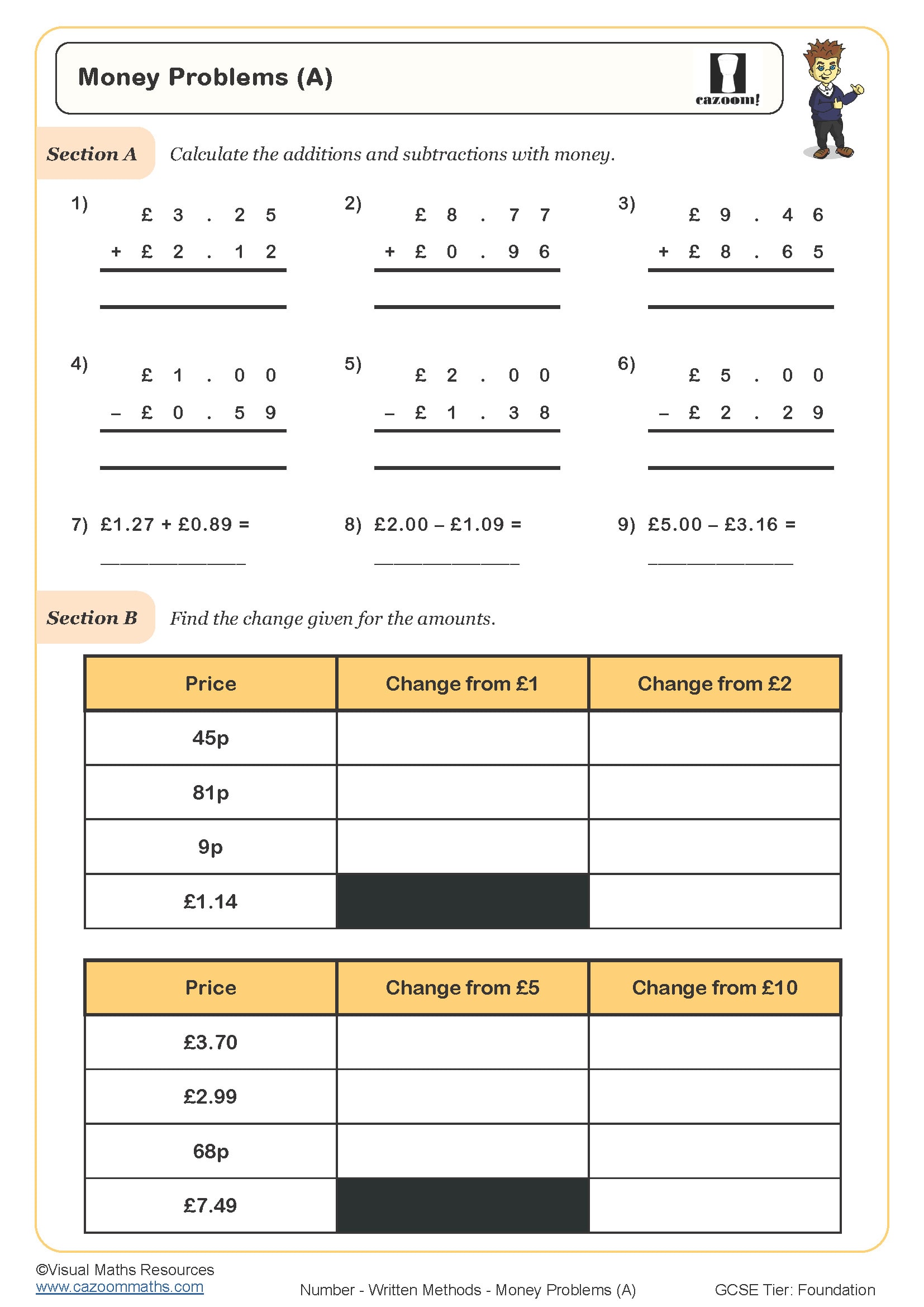
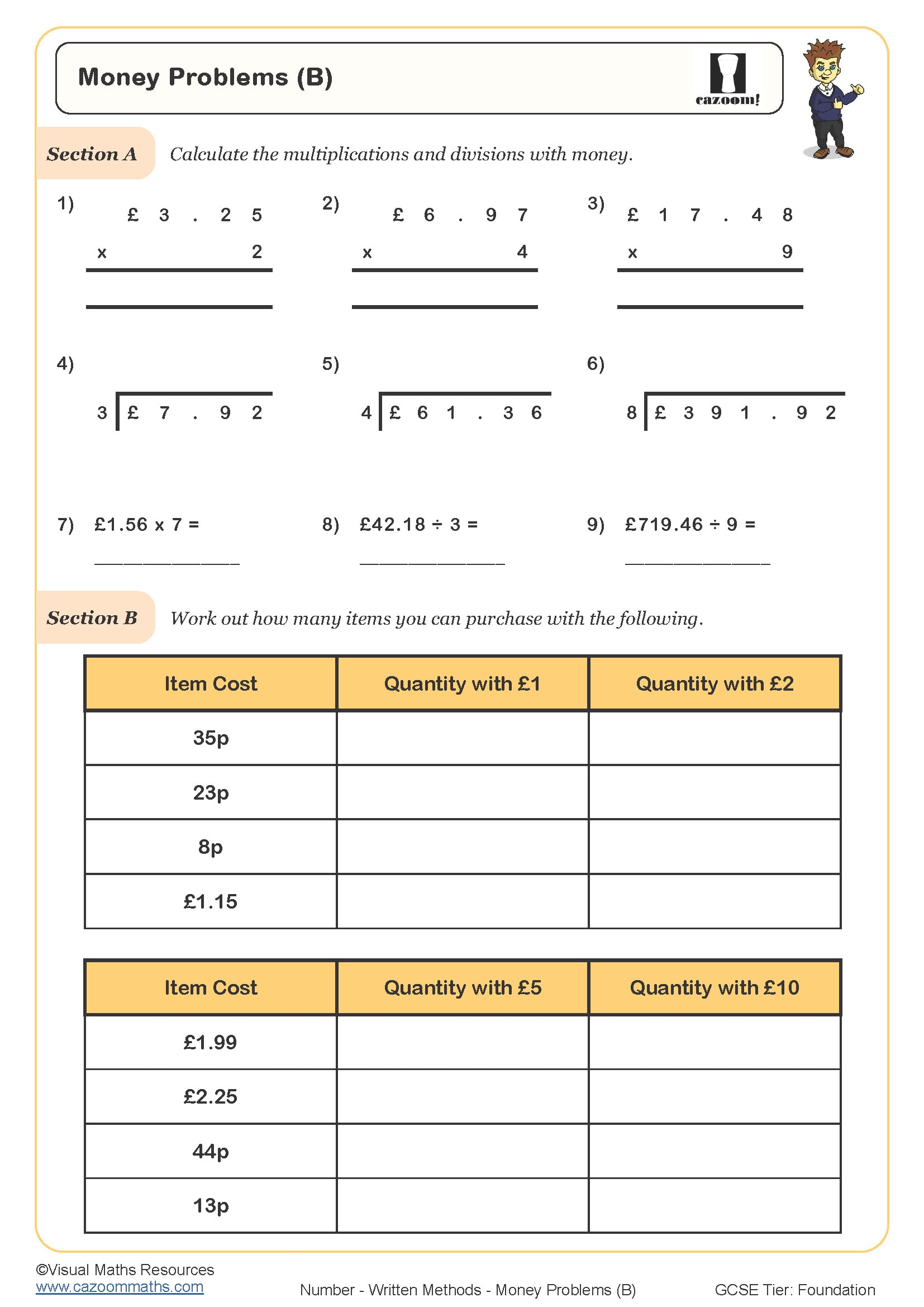
All worksheets are created by the team of experienced teachers at Cazoom Maths.
What skills do students practise with money problems?
Money problems worksheets focus on applying the four operations to decimal numbers in practical contexts, helping students understand place value and rounding in real-world situations. Students practise calculating change, working out discounts and percentage increases, comparing prices, and solving multi-step problems that require them to plan which calculations to perform in sequence. Many teachers find this topic particularly valuable for Key Stage 3 because it bridges the gap between abstract number work and functional mathematics.
A common error occurs when students attempt to add £3.50 and 75p without converting to the same unit first, writing £3.125 instead of £4.25. Worksheets that include mixed units within the same problem help students recognise when conversion is necessary and develop the habit of checking whether amounts are expressed in pounds or pence before calculating.
Which year groups use money problems worksheets?
These money problems worksheets are designed for Year 7 and Year 8 students studying the KS3 curriculum. At this stage, students are expected to apply their understanding of decimals, fractions, and percentages to financial contexts, moving beyond the basic money skills covered in primary school. The National Curriculum requires students to solve problems involving proportion and ratio in contexts including money, which these worksheets directly address.
Progression between Year 7 and Year 8 typically involves increasing the number of steps required to reach a solution and introducing more sophisticated concepts. Year 7 problems might focus on calculating sale prices after a percentage discount, whilst Year 8 questions often combine multiple percentage changes, require students to work backwards from a final price, or involve comparing different pricing structures to determine which represents better value.
How do money problems connect to percentage calculations?
Calculating percentages in money contexts helps students understand concepts like discounts, VAT, interest, and profit margins. Students learn to find a percentage of an amount when working out sale prices, calculate percentage increases for scenarios involving tax or price rises, and determine the original price when given a final amount after a percentage change. This topic requires students to choose the appropriate method, whether multiplying by a decimal equivalent or using the formal percentage calculation, and to interpret their answers in context.
These skills directly apply to financial literacy, helping students make informed decisions about purchases, understand credit card interest, and compare deals when shopping. In STEM careers, percentage calculations with money appear constantly in business analysis, economics, engineering project budgets, and scientific research funding applications. Understanding how to manipulate percentages accurately with decimal amounts forms the foundation for more advanced work with compound interest and exponential growth.
How can teachers use these money problems worksheets effectively?
The worksheets provide structured practice that builds from simpler calculations to more complex problem-solving scenarios, with complete answer sheets enabling students to check their methods independently. Teachers can use the progression within each worksheet to identify precisely where students' understanding breaks down, whether it's the initial calculation, converting between units, or interpreting what the question actually asks for. The worked solutions allow students to compare their approach with a correct method, making these sheets particularly effective for self-marking.
Many teachers find money problems work well for mixed-ability groupwork, where students tackle the same scenario but different difficulty levels. The worksheets suit intervention sessions for students who struggle with decimal place value, provide focused revision before assessments on ratio and proportion, or serve as homework that parents can easily support because the context feels familiar. Questions involving real shopping scenarios or budgeting situations often engage reluctant mathematicians more effectively than abstract number problems.