One Number as a Fraction of Another Worksheets
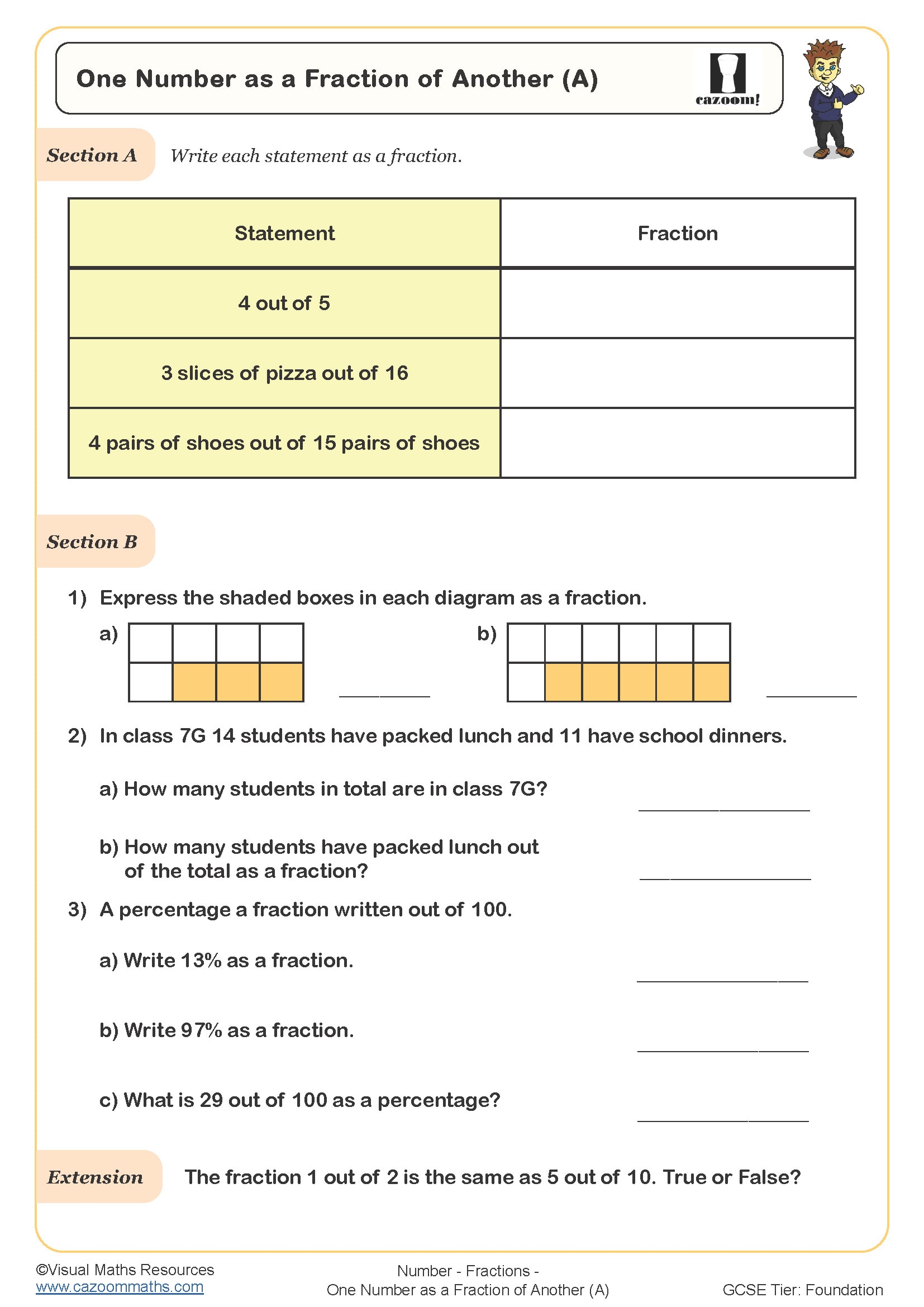

All worksheets are created by the team of experienced teachers at Cazoom Maths.
What Does One Number as a Fraction of Another Mean?
Expressing one number as a fraction of another means writing the first quantity as the numerator and the second as the denominator, then simplifying. For example, "15 out of 25" becomes 15/25, which simplifies to 3/5. This concept appears throughout KS3 maths and forms the foundation for converting between fractions, decimals, and percentages in GCSE examinations.
A common error teachers observe is students reversing the fraction, writing 25/15 instead of 15/25. Students often confuse which number should be on top, particularly when questions use phrases like "what fraction of 40 is 16?" rather than the more straightforward "16 out of 40". Emphasising that the number being described goes in the numerator helps students avoid this misconception and build confidence with more complex ratio problems later.
Which Year Groups Cover One Number as a Fraction of Another?
These worksheets target Year 7 and Year 8 students within Key Stage 3. The National Curriculum introduces this skill as students develop their understanding of fractions beyond basic operations, connecting fractional thinking to proportional reasoning. Year 7 students encounter this when working with fractions of amounts and simple ratio problems, whilst it becomes increasingly important for GCSE foundation topics.
Progression across these year groups involves moving from straightforward whole number examples where simplification is obvious to more complex scenarios involving larger numbers, multiple-step problems, or contextual situations. Year 8 work often incorporates algebraic representations or connects this skill to percentage calculations, preparing students for the ratio and proportion strand that features heavily in GCSE exams where questions regularly ask students to express relationships between quantities.
How Do You Simplify Fractions When Finding One Number as a Fraction of Another?
Simplifying involves dividing both numerator and denominator by their highest common factor (HCF). After writing the initial fraction, students identify common factors and reduce to lowest terms. For instance, 18/24 simplifies to 3/4 by dividing both parts by 6. Teachers notice that students who don't simplify fully often identify an obvious common factor like 2 but miss that further simplification is possible, writing 9/12 as their final answer.
This skill has direct applications in data analysis and scientific contexts. When lab technicians express that 45 out of 180 samples showed a particular result, they simplify this to 1/4 to communicate findings clearly. Understanding fraction simplification helps students interpret statistical data, experimental results, and survey findings across STEM subjects, where expressing proportions accurately is fundamental to drawing valid conclusions from evidence.
How Can These Worksheets Support Learning in the Classroom?
The worksheets provide systematic practice starting with identifying which number forms the numerator, then finding common factors, and finally simplifying completely. Answer sheets enable students to self-assess during independent work, identifying exactly where errors occur in their method. This immediate feedback helps students correct misconceptions about fraction positioning or simplification before these errors become embedded.
Many teachers use these resources for targeted intervention with students who struggle with proportional reasoning, as mastering this skill prevents difficulties with ratio and percentage topics later. The worksheets work well as homework following initial teaching, or as starter activities to refresh understanding before moving to ratio work. Paired work where one student completes a question while their partner checks against the answer sheet encourages mathematical discussion about methods and helps students articulate why fractions need simplifying.