Pictograms Worksheets
All worksheets are created by the team of experienced teachers at Cazoom Maths.
What Are Pictograms in Maths?
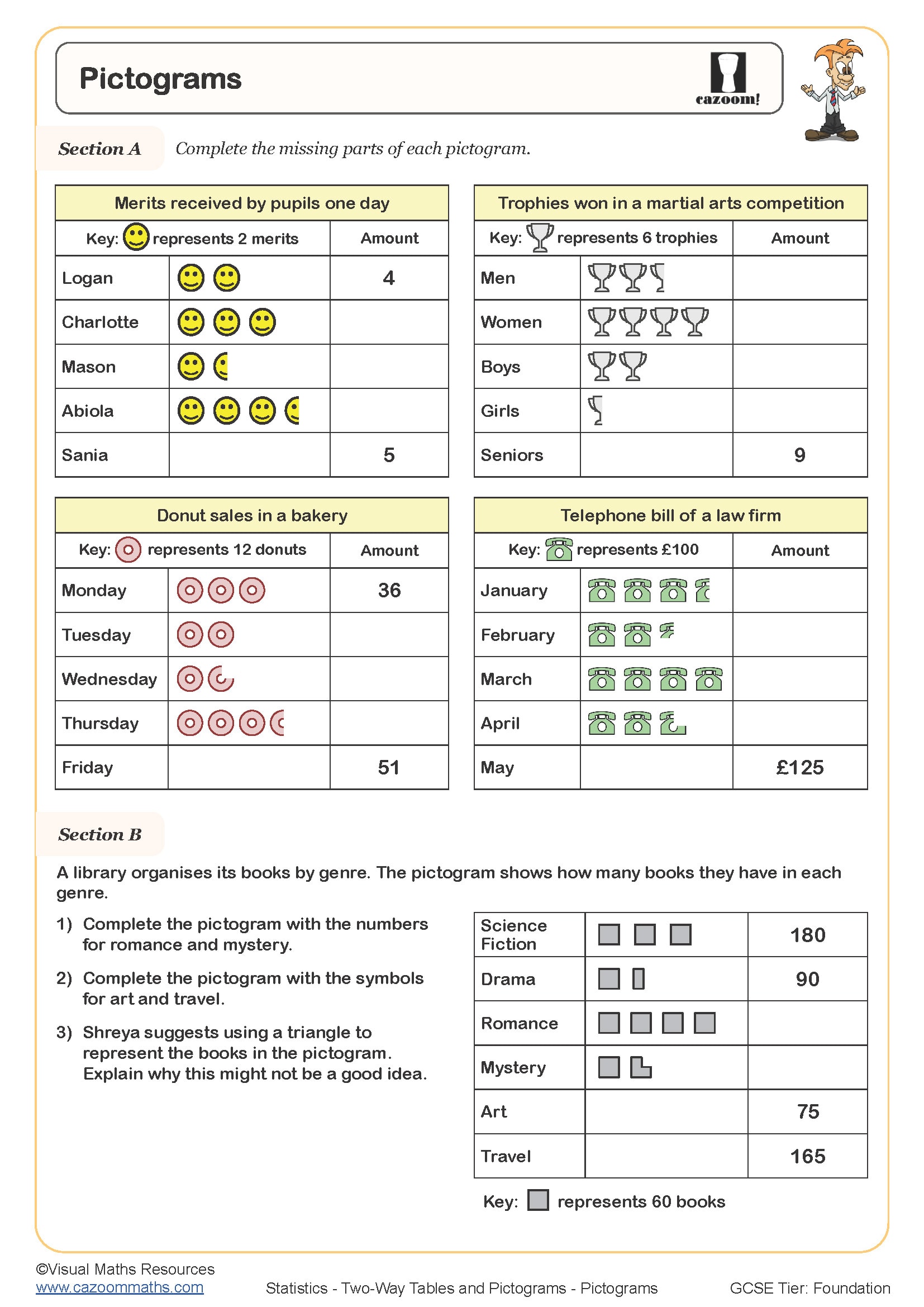
A pictogram is a statistical diagram that uses pictures or symbols to represent data, where each symbol stands for a specific number of items according to a key. In KS3 maths, students encounter pictograms with scales where one symbol might represent 2, 5, 10, or more units, requiring them to multiply rather than simply count symbols. The key is the most critical element of any pictogram, and students must refer to it before attempting to interpret or draw the diagram.
Teachers frequently notice that students make errors when half symbols or quarter symbols appear in pictograms. For instance, if one symbol represents 10 items, students sometimes interpret half a symbol as 5.5 rather than 5. Exam mark schemes penalise careless reading of the key, particularly when students assume a one-to-one relationship without checking. Drawing pictograms also requires precision, as symbols must be sized consistently and aligned properly to communicate data clearly.
Which Year Groups Study Pictograms?
These worksheets cover pictograms for Year 7 and Year 8 students within Key Stage 3 of the National Curriculum. At this stage, students move beyond simple pictograms encountered in primary school and work with more sophisticated scales and larger datasets. The focus shifts from basic reading to analysing data, making comparisons, and constructing pictograms with appropriate scales for given contexts.
Progression between Year 7 and Year 8 typically involves increasing the complexity of the scale and the calculations required. Year 7 students consolidate understanding of pictograms with scales of 5 or 10, whilst Year 8 work may introduce more challenging scales or datasets that require students to choose appropriate symbols and scales independently. Students also develop critical thinking about when pictograms are suitable compared to other statistical diagrams like bar charts or pie charts.
Why Do Pictograms Use Scales of 5 and 10?
Scales of 5 and 10 in pictograms make data easier to read and reduce the number of symbols needed when representing larger quantities. If a pictogram showed 50 items with a one-to-one scale, it would require 50 symbols, making the diagram cluttered and difficult to interpret. Using a scale where one symbol represents 5 or 10 units creates a clearer visual representation whilst maintaining accuracy, especially when fractional symbols represent intermediate values.
This skill connects directly to real-world data presentation in newspapers, reports, and infographics, where visual clarity determines whether information is understood quickly. In STEM contexts, scientists and engineers use scaled visual representations to communicate complex datasets to non-specialist audiences. Students who understand how scales work in pictograms develop transferable skills for interpreting graphs, charts, and technical diagrams across subjects, from geography's population pyramids to science's results tables presented visually.
How Should Teachers Use These Pictogram Worksheets?
The worksheets provide structured practice that builds from reading and interpreting pictograms to constructing them with given scales. Questions guide students through extracting information, performing calculations based on the key, and drawing accurate diagrams with appropriate symbols. The answer sheets allow students to identify mistakes immediately, which is particularly valuable when learning to apply scales correctly and check their symbol counts.
Many teachers use these worksheets during statistics units as targeted practice after introducing pictograms through class examples. They work well for homework when students need independent consolidation, or as intervention material for students who struggled with pictograms in end-of-topic assessments. Paired work can be effective, with one student reading data from a completed pictogram whilst their partner verifies calculations. The worksheets also serve as quick revision before assessments, helping students refresh the method for interpreting keys and calculating totals from fractional symbols.