Year 7 Fraction Wall Worksheets
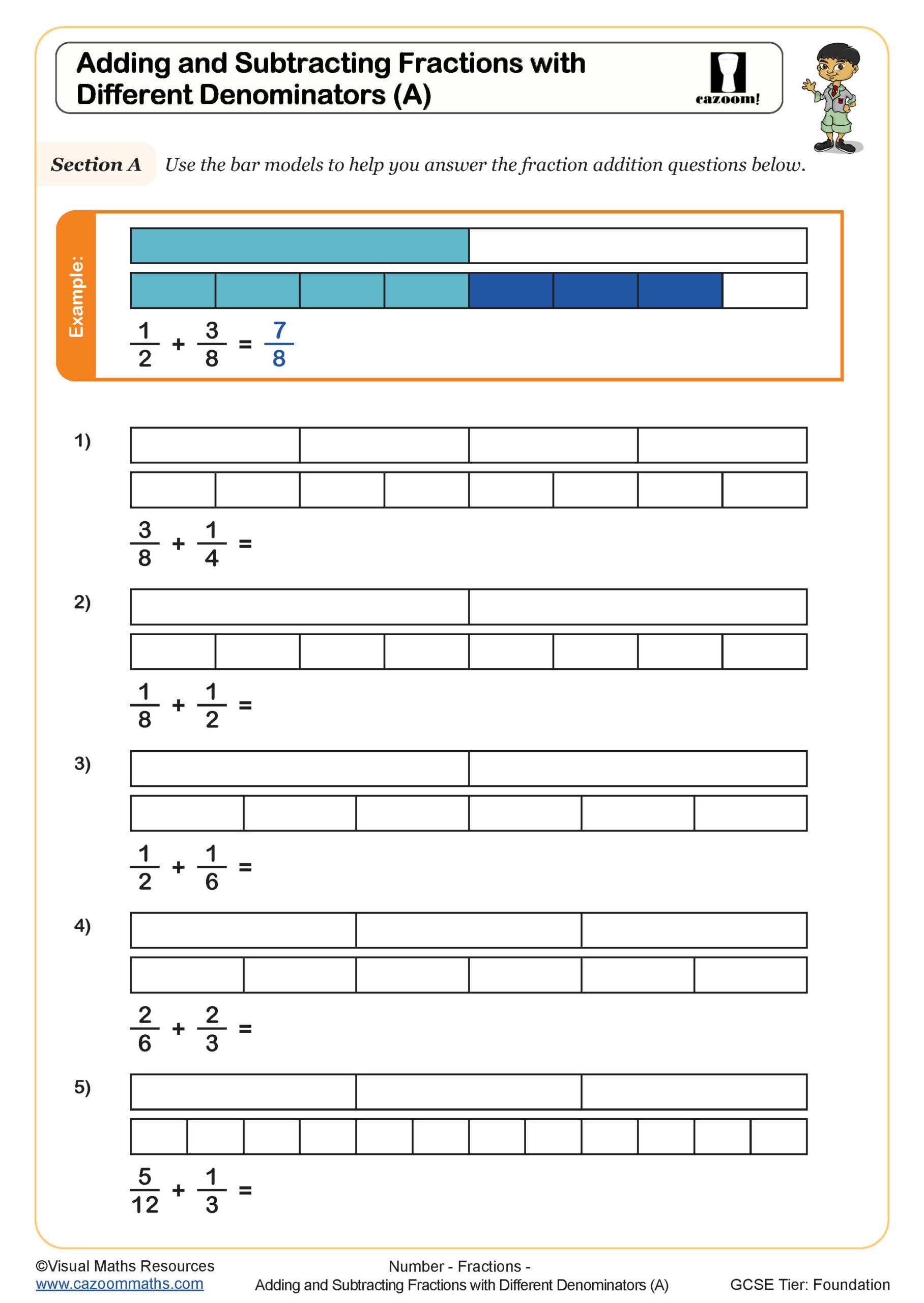
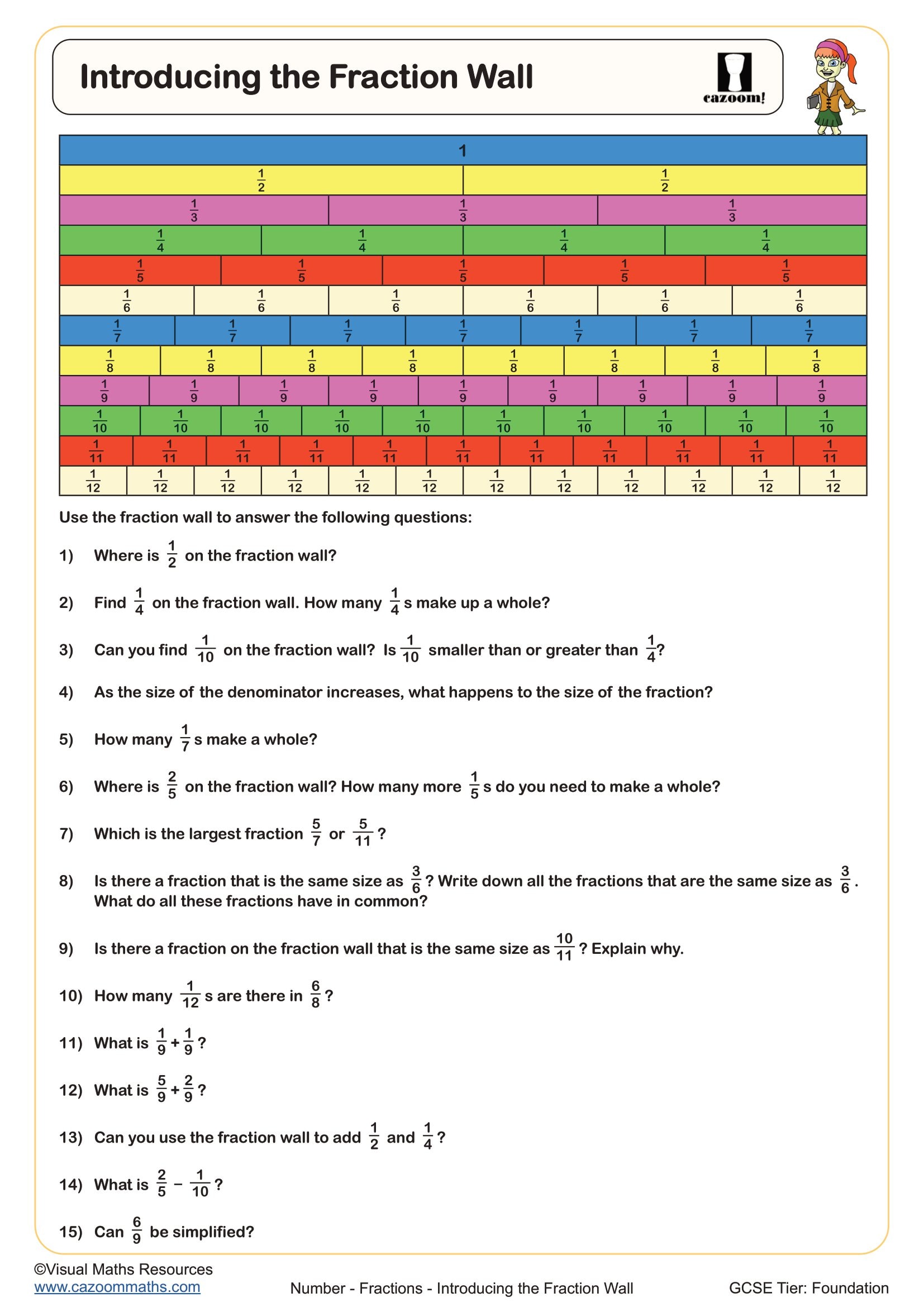
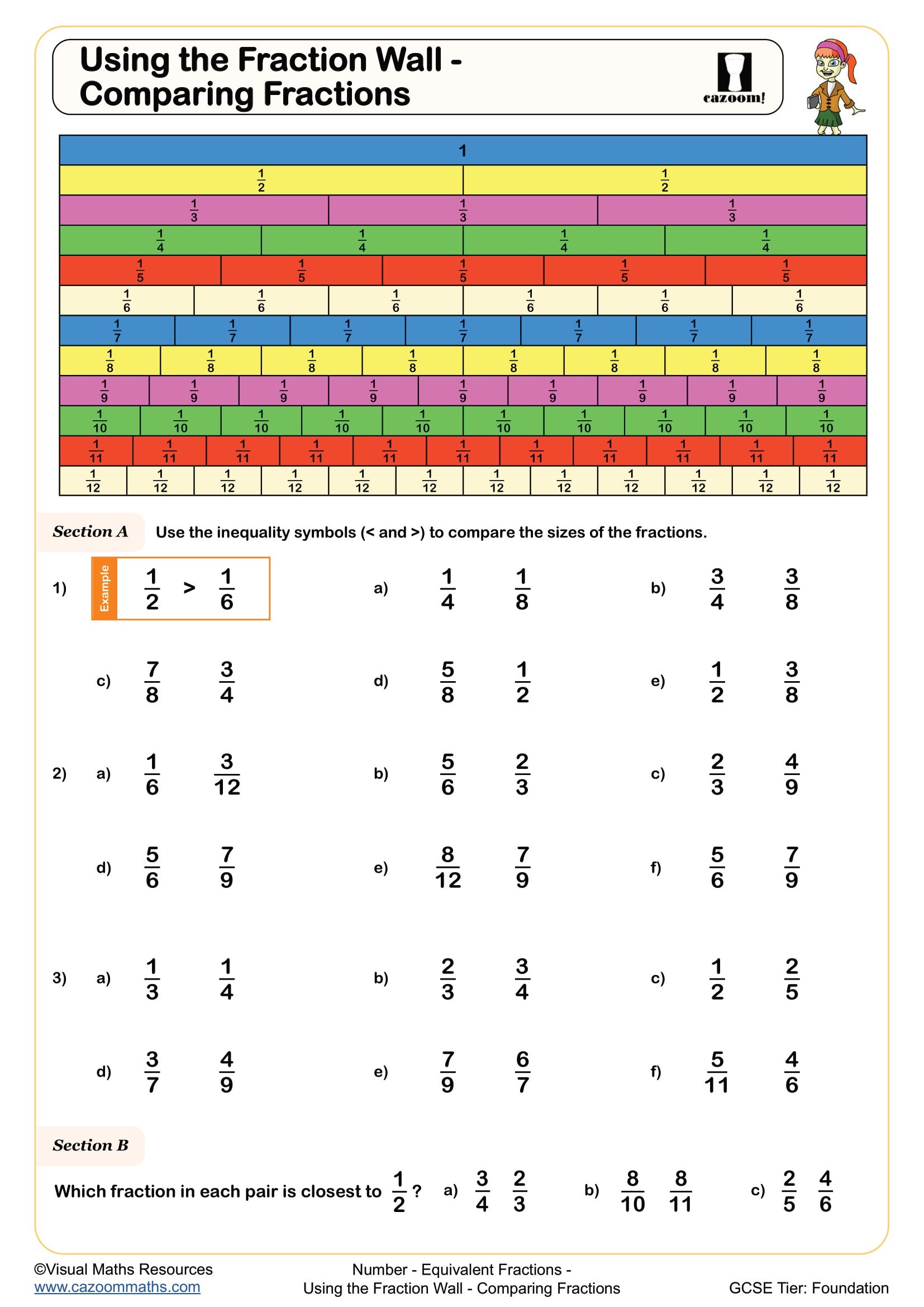
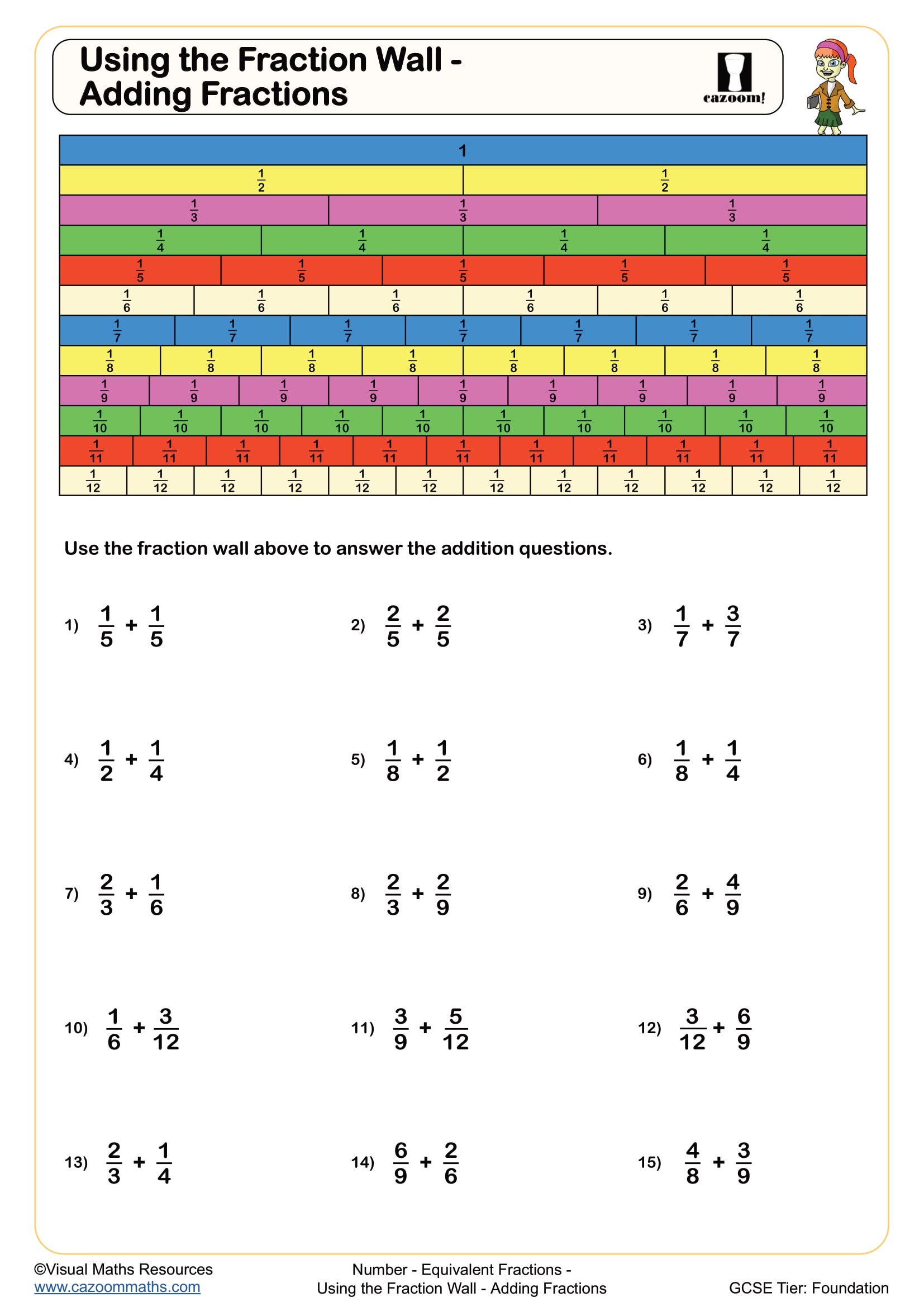
All worksheets are created by the team of experienced teachers at Cazoom Maths.
What is a fraction wall and how does it help with learning fractions?
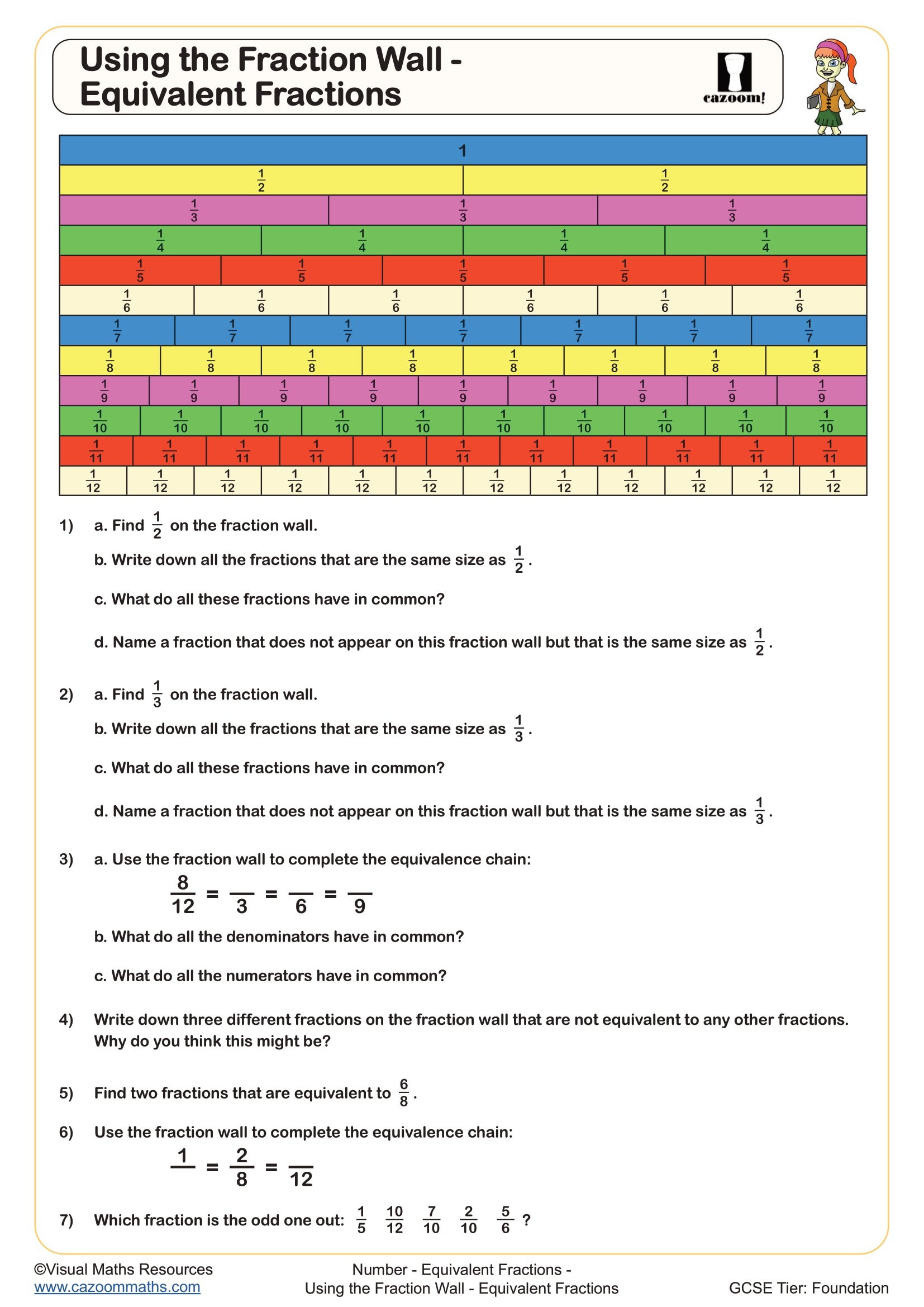
A fraction wall is a visual representation that divides a whole into equal parts, showing how different fractions relate to each other. It displays unit fractions (halves, thirds, quarters, fifths, and so on) stacked vertically, allowing students to see at a glance that 2/4 occupies the same space as 1/2, or that 3/6 is equivalent to 1/2. This visual model is particularly valuable for students transitioning from primary to secondary mathematics, where fraction work becomes more abstract.
Students often memorise rules for finding equivalent fractions without understanding why they work. The fraction wall addresses this by making relationships visible—when students see that two quarters physically match one half, the rule of multiplying numerator and denominator by the same number becomes meaningful rather than procedural. Teachers find this visual approach particularly effective for students who struggle with abstract fraction manipulation, as it provides a concrete reference point they can return to when uncertain.
Which year groups use fraction wall worksheets?
These fraction wall worksheets are designed for Year 7 students at Key Stage 3, though the visual approach is introduced earlier in primary school. At KS3, the National Curriculum expects students to calculate with fractions, understand equivalence, and order fractions confidently. The fraction wall serves as a bridge between concrete primary methods and the more formal algebraic approaches required for GCSE.
Whilst primary students use fraction walls to establish basic equivalence, Year 7 students apply this tool to more complex problems involving unlike denominators and mixed operations. The worksheets progress from identifying equivalent fractions using the wall, to comparing fractions with different denominators, to using the visual model to support addition where common denominators must be found. This scaffolded approach ensures students develop both conceptual understanding and procedural fluency before moving to purely abstract fraction work in later KS3 years.
How do fraction walls help with adding fractions?
Fraction walls make adding fractions with different denominators visual rather than purely procedural. When adding 1/3 and 1/4, students can use the wall to see that they need a common denominator—twelfths—by looking for a row where both thirds and quarters align. This visual approach helps students understand why finding a common denominator is necessary, rather than simply following memorised steps that they may misapply under exam pressure.
This skill has direct applications in construction and design technology, where measurements must often be combined from different fractional units. Carpenters routinely add fractional measurements (3/8 inch and 1/4 inch, for instance), and architects work with scaled drawings that require precise fraction calculations. Understanding the underlying concept through fraction walls gives students the mathematical confidence to tackle these real-world applications, where estimation isn't sufficient and accuracy matters for structural integrity or component fitting.
How can teachers use these fraction wall worksheets effectively?
The worksheets provide structured progression from visual identification to practical calculation, with each sheet building on previous understanding. Early questions ask students to use the fraction wall to identify equivalent fractions, whilst later questions require them to compare fractions and justify their reasoning using the visual model. Complete answer sheets allow students to check their own work or enable teachers to quickly mark responses during lessons, making these resources suitable for both guided practice and independent consolidation.
Many teachers use these worksheets during intervention sessions with students who struggle with abstract fraction concepts, as the visual approach often unlocks understanding where algorithmic teaching hasn't succeeded. They're equally effective as homework after introducing fraction operations, allowing students to practise with the visual support before attempting purely numerical problems. Some teachers also find them valuable for paired work, where students explain their reasoning to a partner using the fraction wall as a shared reference point, developing both mathematical vocabulary and conceptual understanding simultaneously.