Factorising Using the Area Model WORKSHEET
Factorising Using the Area Model WORKSHEET DESCRIPTION
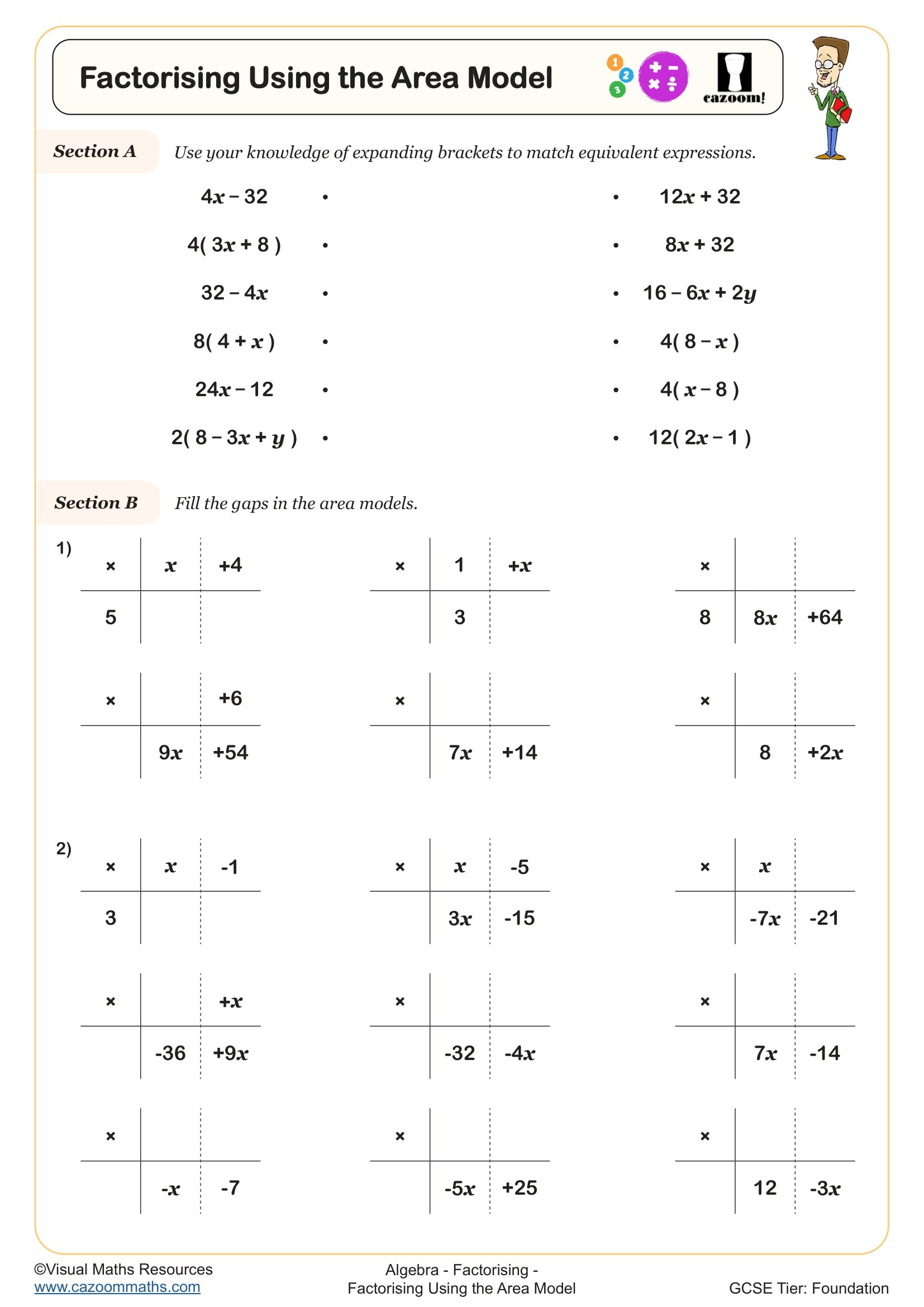
Using the area model serves as an introduction to factorising two term linear expressions throughout this worksheet.
Students will begin by matching equivalent expressions in section A, using their knowledge of expanding a single bracket.
Section B, gradually introduces pupils to the concept of factorising as they fill gaps in area models over 4 different questions. In question 1, all terms are positive with negatives introduced in question 2. In both these questions the highest common factor is the coefficient of x in the expanded expression. In questions 3 and 4, expressions such as 27x + 45 will be factorised.
To finish, section C poses some problem solving questions that will see learners articulating what's wrong with a factorisation and explaining why expressions cannot be factorised.
All worksheets are created by the team of experienced teachers at Cazoom Maths.
RELATED TO Factorising Using the Area Model WORKSHEET
Frequently Asked Questions
This worksheet is designed for Year 8 and Year 9 students who are developing their algebraic manipulation skills. The area model approach provides a visual foundation that helps pupils at this level understand the relationship between expanding and factorising expressions. Students should already be comfortable with taking out common factors before attempting these activities.