KS4 Expanding Brackets Worksheets
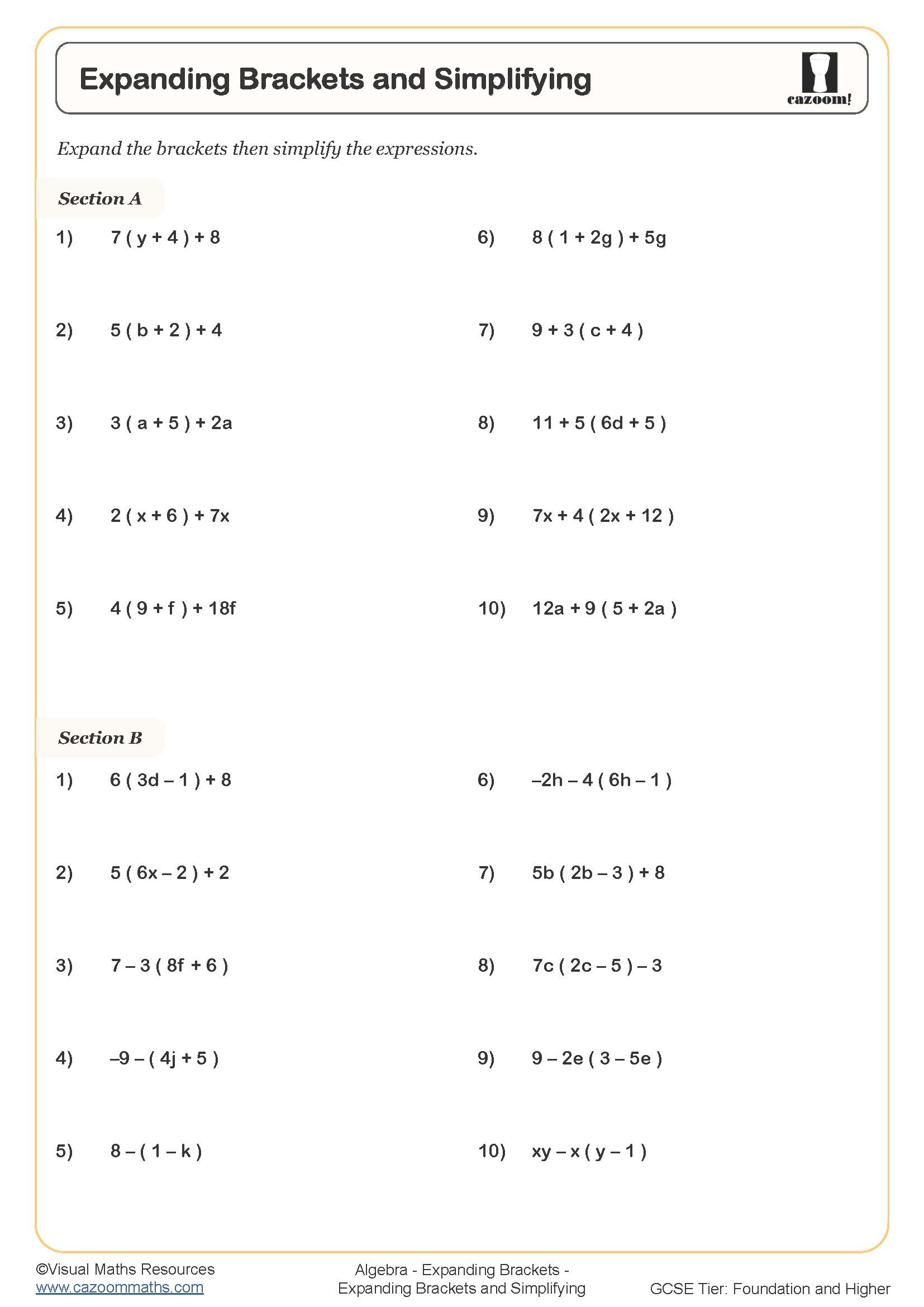
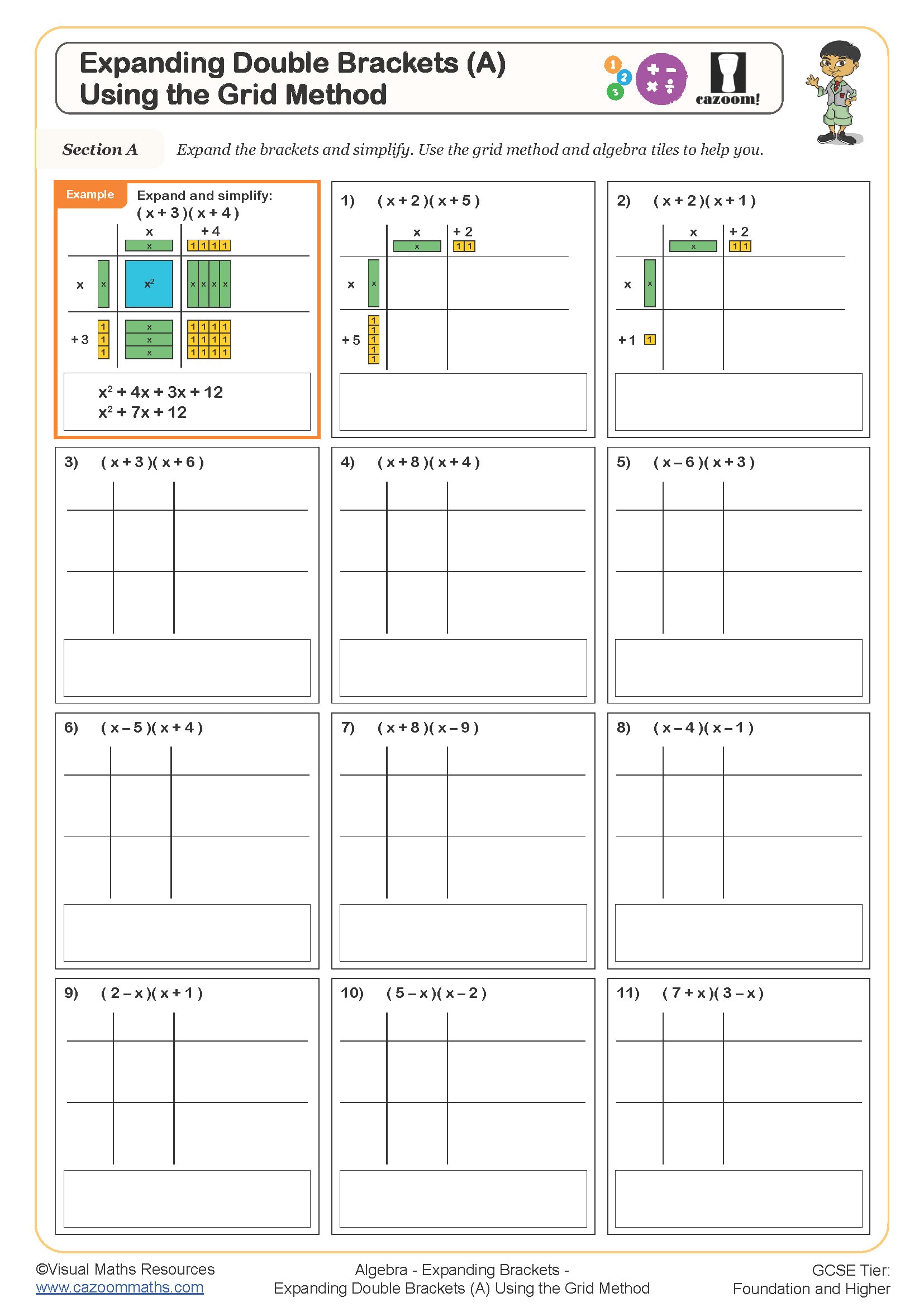
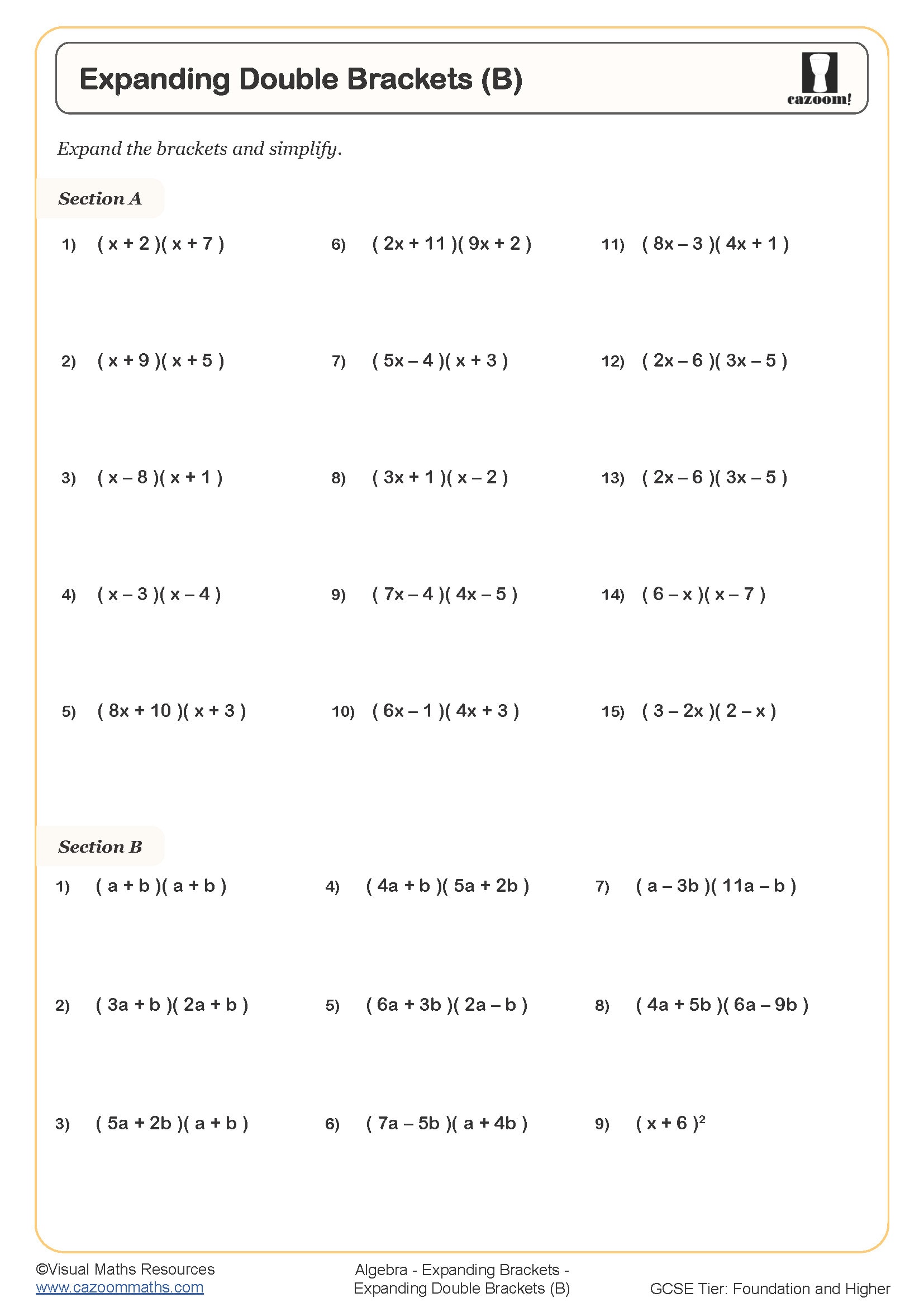
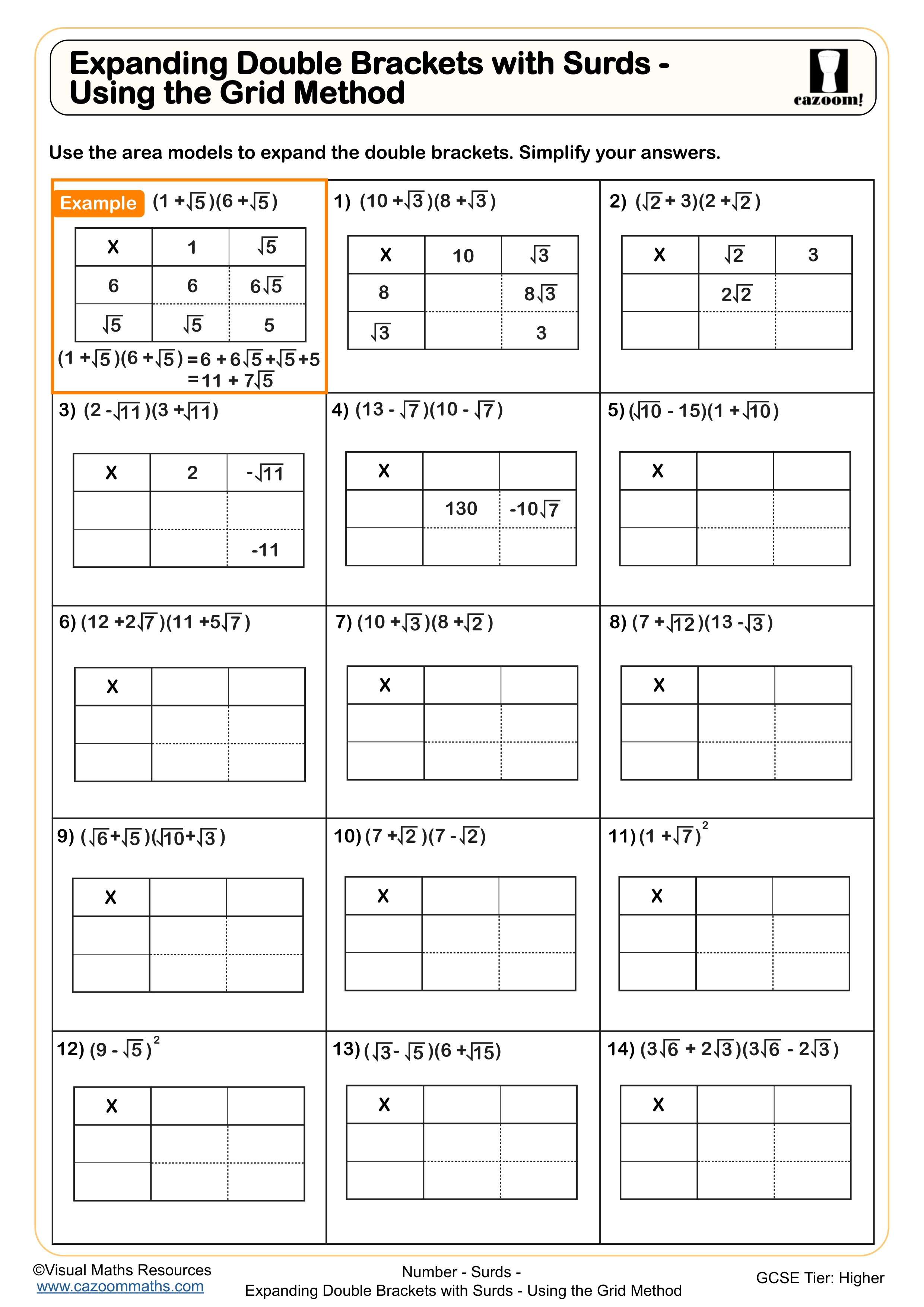
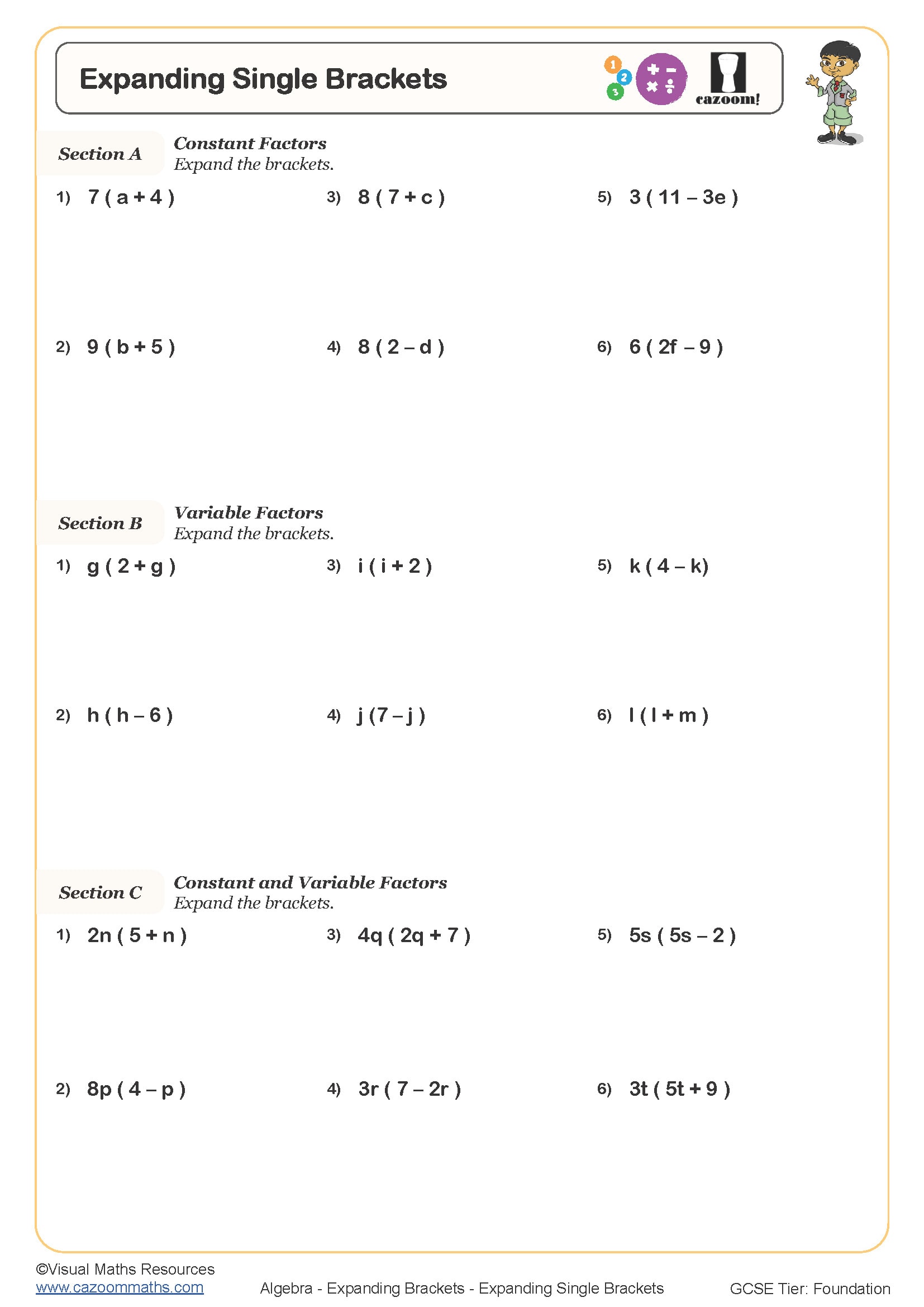
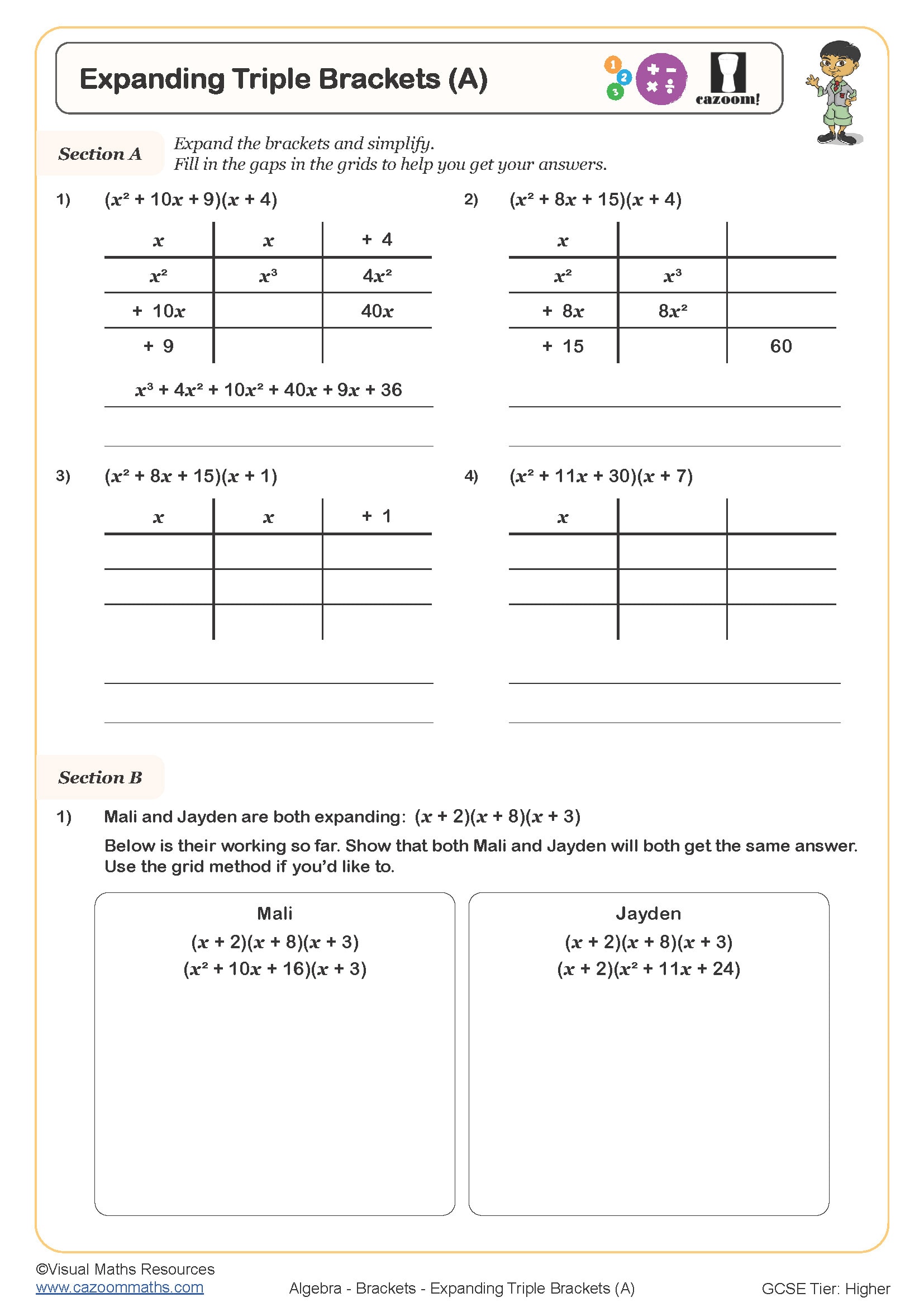
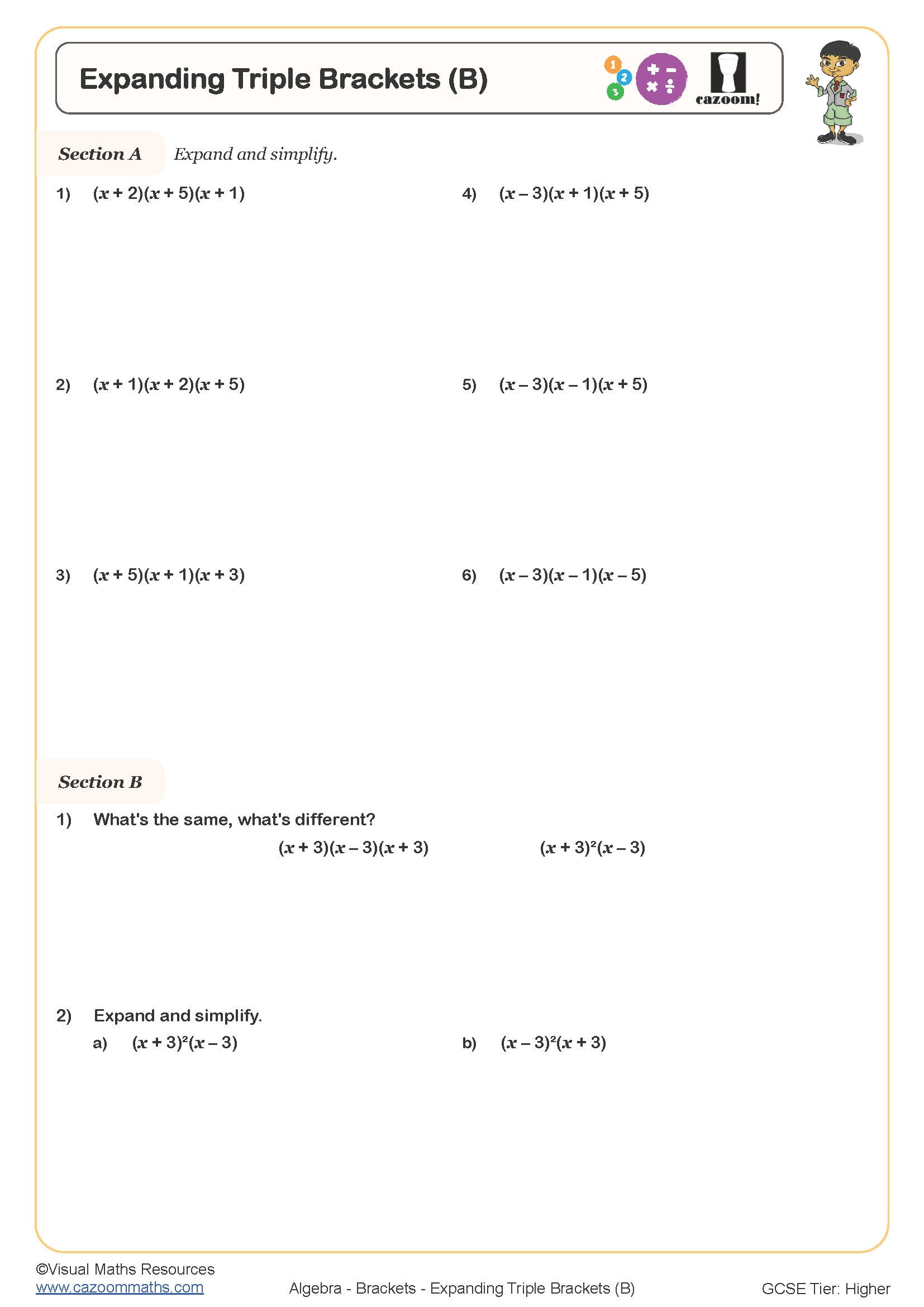
All worksheets are created by the team of experienced teachers at Cazoom Maths.
What are the common mistakes when expanding brackets?
The most frequent error occurs when students multiply out brackets containing negative terms. Teachers notice that students correctly expand 3(x + 4) but then write -2(x - 5) as -2x - 10, forgetting that multiplying two negative values gives a positive result. This misconception persists because students focus on the subtraction sign rather than recognising -5 as a negative term being multiplied by -2.
Another widespread mistake happens when expanding double brackets where students miss terms entirely, calculating (x + 3)(x + 2) as x² + 6 by only multiplying the first and last terms. Exam mark schemes consistently penalise this error, which often stems from students not systematically using methods like FOIL or the grid method to account for all four products. Students also commonly lose marks by forgetting to simplify fully after expansion, leaving expressions like 2x + 3x rather than collecting like terms to get 5x.
Which year groups study expanding brackets?
Expanding brackets appears in the KS4 curriculum for Year 10 and Year 11 students, forming a critical component of the GCSE Foundation and Higher tier specifications. At Foundation tier, students must confidently expand single brackets and simple double brackets, whilst Higher tier extends to expressions with three or more brackets, algebraic fractions, and brackets within proof questions. This topic builds directly on simplifying algebraic expressions and substitution covered in KS3.
The progression across KS4 increases sophistication rather than introducing entirely new methods. Year 10 students typically begin with single brackets containing integers before moving to brackets with fractional or negative coefficients. By Year 11, the focus shifts to fluency with double brackets and recognising when expansion helps solve equations or rearrange formulae. Teachers find that regular retrieval practise throughout both years prevents students from forgetting the distributive law when pressure increases during exam season.
How does expanding brackets connect to quadratic expressions?
Expanding double brackets generates quadratic expressions, demonstrating why the standard form ax² + bx + c emerges naturally from (px + q)(rx + s). Students who understand this connection recognise that factorising quadratics essentially reverses the expansion process, which helps them check their factorisation answers and builds algebraic fluency. The relationship between expansion and factorisation underpins solving quadratic equations, sketching parabolas, and manipulating more complex expressions in A-level mathematics.
This skill has direct applications in physics and engineering contexts. When calculating the area of composite shapes with algebraic dimensions, students expand brackets to write expressions for total area. In physics, working with equations of motion often requires expanding (v + at)² or similar expressions to isolate variables. Computer scientists use the same distributive principle when optimising algorithms, whilst economists apply it when modelling revenue functions where price and quantity both vary, demonstrating that this algebraic technique underpins quantitative reasoning across STEM disciplines.
How can these expanding brackets worksheets be used in lessons?
The worksheets provide structured progression that allows teachers to address specific weaknesses without re-teaching entire concepts. Each sheet isolates particular aspects of expansion, such as handling negative multipliers or working with larger coefficients, making them valuable for targeted intervention with students who have grasped the basic method but struggle with particular question types. The answer sheets enable students to identify precisely which step in their working contains errors, whether that's the multiplication stage or collecting like terms afterwards.
Many teachers use these resources for retrieval practise starters, setting one section as a timed activity to maintain fluency between initial teaching and GCSE examinations. They work equally well for homework consolidation, allowing students to practise independently whilst having access to worked solutions for self-correction. For mixed-ability classes, teachers often assign different worksheets based on confidence levels, using the simplifying algebra sheets for students needing reinforcement whilst others tackle more demanding double bracket questions, ensuring all students develop competence at their own pace.