Year 10 Algebra Tiles Worksheets
All worksheets are created by the team of experienced teachers at Cazoom Maths.
What are algebra tiles and why are they used in Year 10 maths?
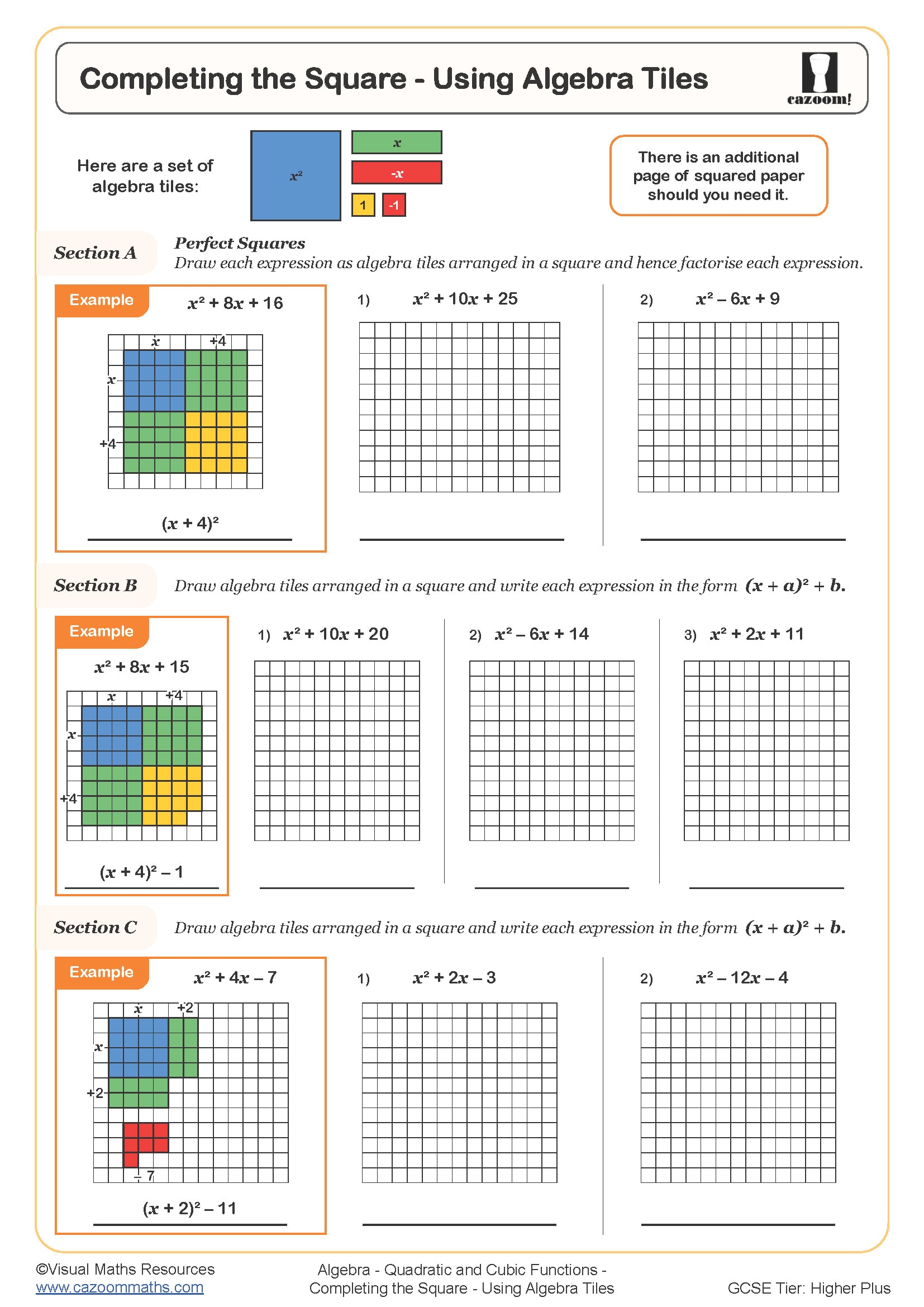
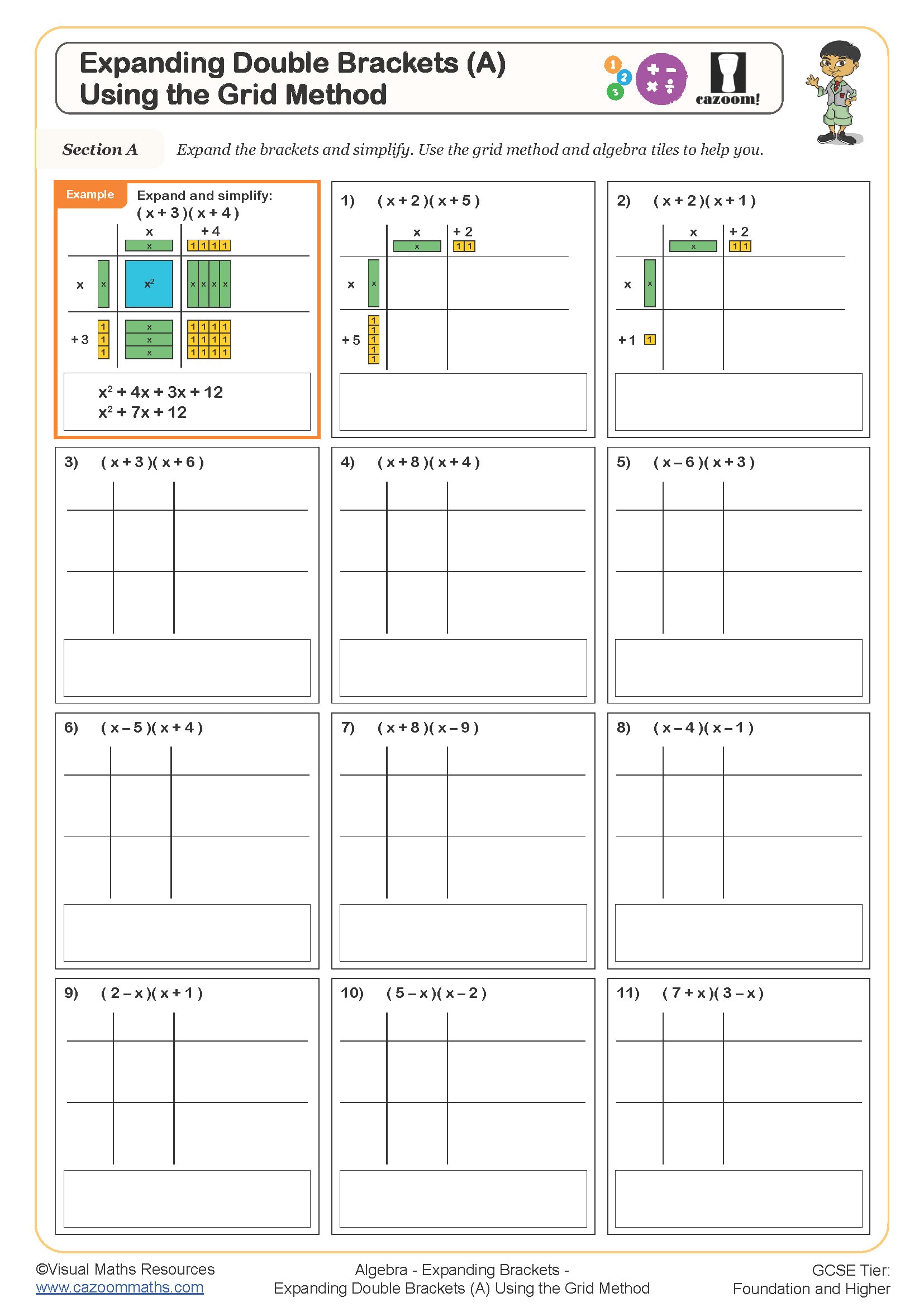
Algebra tiles are rectangular manipulatives that represent algebraic terms visually: large squares represent x², rectangles represent x, and small squares represent unit values. They allow students to model algebraic expressions and operations physically before working purely symbolically, which supports understanding at KS4 when algebraic complexity increases significantly.
Maths teachers frequently observe that students who have used algebra tiles develop stronger conceptual understanding of why like terms combine and why certain algebraic moves are valid. A common breakthrough occurs when students physically arrange tiles to see that 2x + 3x becomes 5x because they're counting five x-rectangles, not because they've memorised a rule. This concrete foundation helps prevent errors when students later work with more abstract expressions involving negative terms or binomial expansion.
Which year groups use algebra tiles worksheets?
These algebra tiles resources are designed for Year 10 students working within Key Stage 4 of the National Curriculum. At this stage, students encounter increasingly complex algebraic manipulation including expanding brackets, factorising, and solving equations with unknowns appearing on both sides, all of which benefit from visual modelling.
Whilst algebra tiles can be introduced earlier to support transition work, Year 10 represents the point where students must consolidate abstract algebraic thinking for GCSE. The worksheets progress from basic modelling of simple expressions through to representing and solving multi-step equations. Teachers often use tiles as an intervention tool for students who reached Year 10 without secure understanding of algebraic structure, providing the concrete experience that supports later symbolic fluency.
How do algebra tiles help with equations having unknowns on both sides?
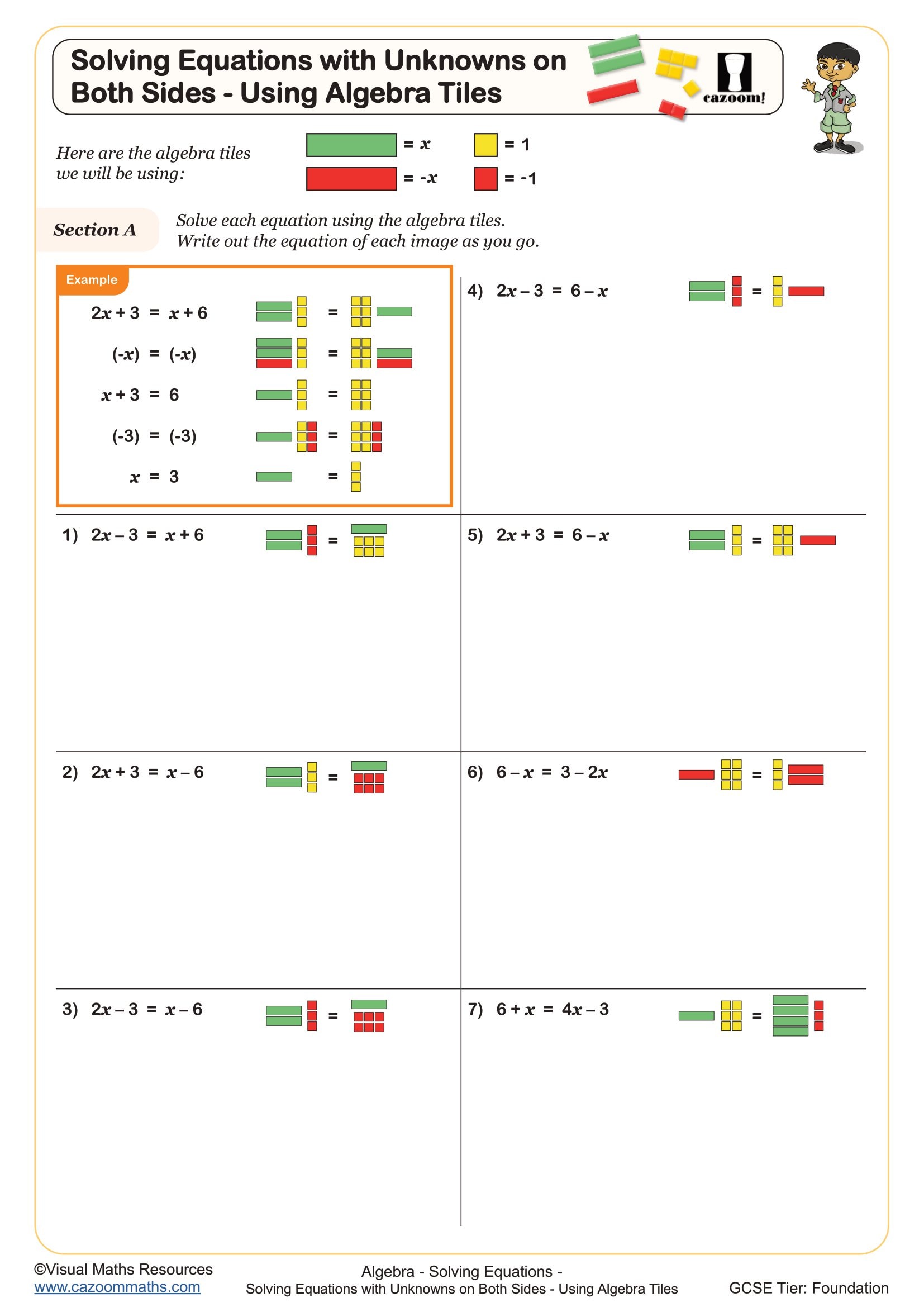
When solving equations with unknowns on both sides, students arrange tiles representing each side of the equation separately, then physically manipulate them to isolate the variable. For example, with 3x + 2 = x + 8, students create three x-rectangles plus two unit squares on one side, and one x-rectangle plus eight unit squares on the other, then remove matching tiles from both sides until x is isolated.
This visual approach connects directly to balancing chemical equations in science, where students must maintain equality whilst manipulating both sides. In engineering contexts, solving equations with variables on both sides determines break-even points or equilibrium conditions. The tile method makes these abstract procedures concrete, helping students understand why subtracting x from both sides is valid rather than memorising steps, which prevents errors when equations become more complex at GCSE Higher tier.
How can teachers use these algebra tiles worksheets in lessons?
The worksheets provide structured practice that moves from representing expressions with tiles through to simplifying and solving, with diagrams showing tile arrangements alongside symbolic notation. This dual representation helps students connect visual models to algebraic symbols, building the bridge between concrete and abstract thinking that many find challenging at KS4.
Teachers often use these resources during intervention sessions for students struggling with algebraic manipulation, as paired work where one student models with physical tiles whilst the other records symbolically, or as homework following practical tile work in class. The answer sheets allow students to self-check their tile arrangements and symbolic translations, which is particularly valuable when teachers are supporting multiple groups. Several teachers report using them as retrieval practice at the start of Year 11 for students who need to revisit foundational algebraic concepts before tackling GCSE content.