Year 9 Factorising Worksheets
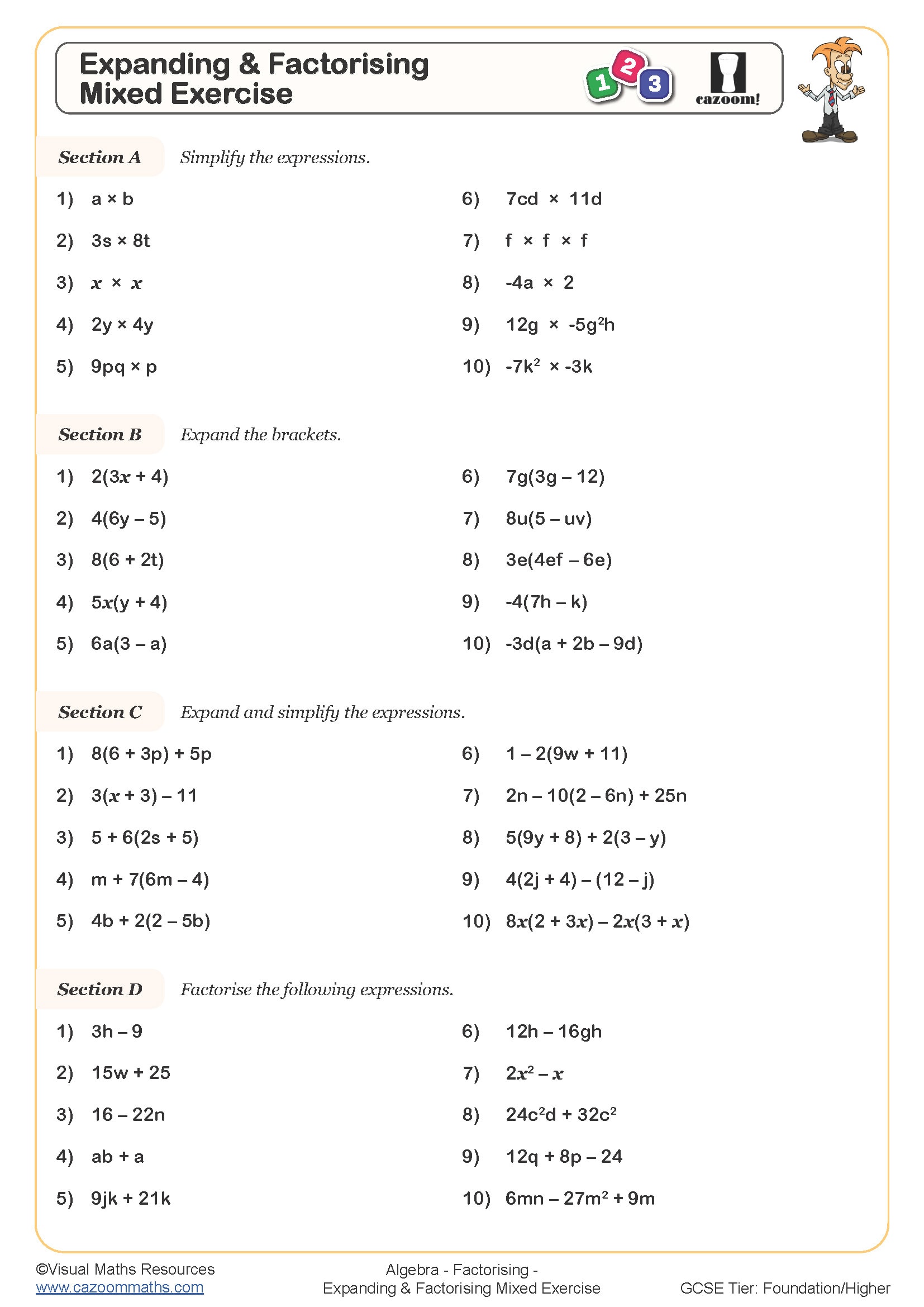
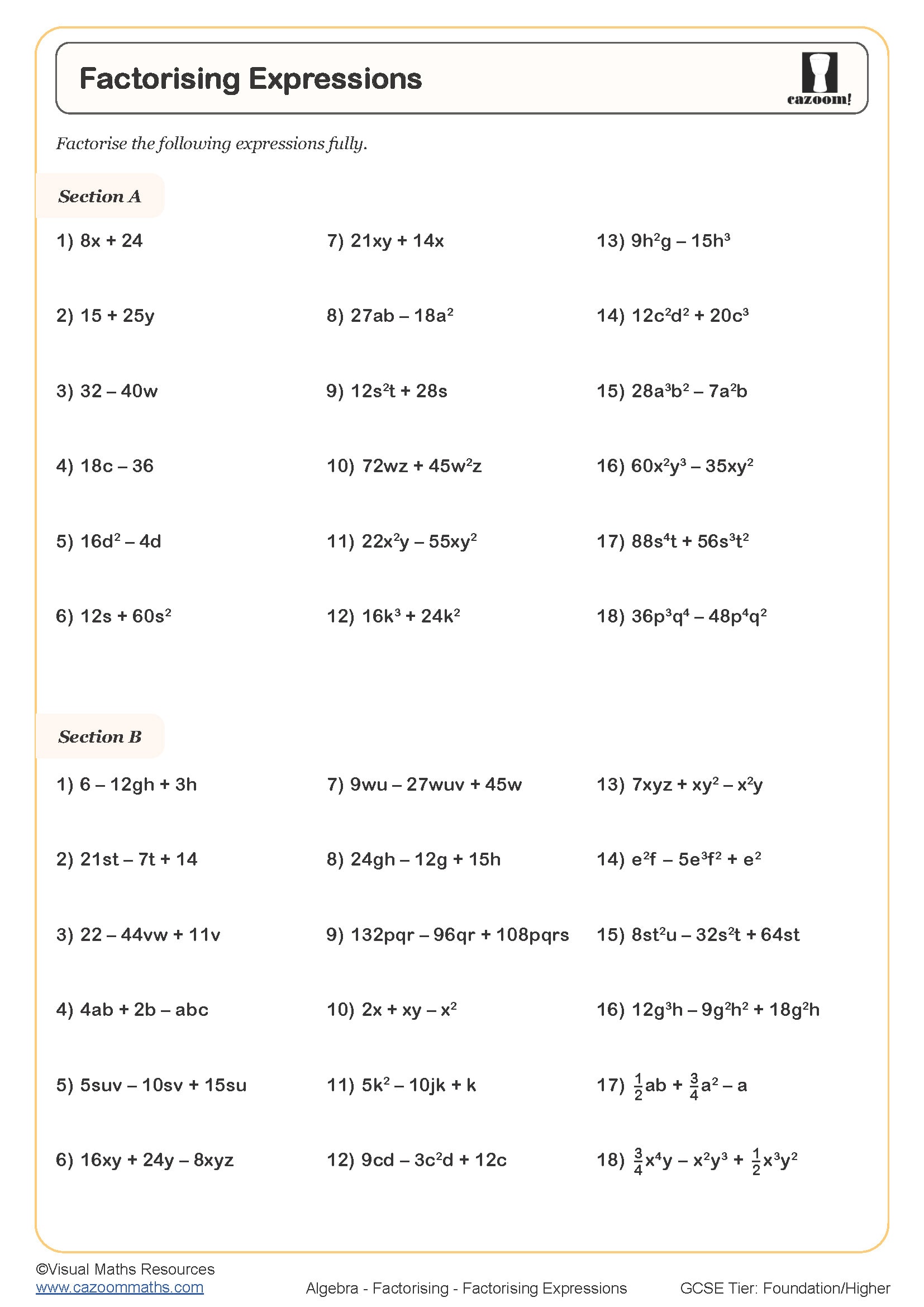
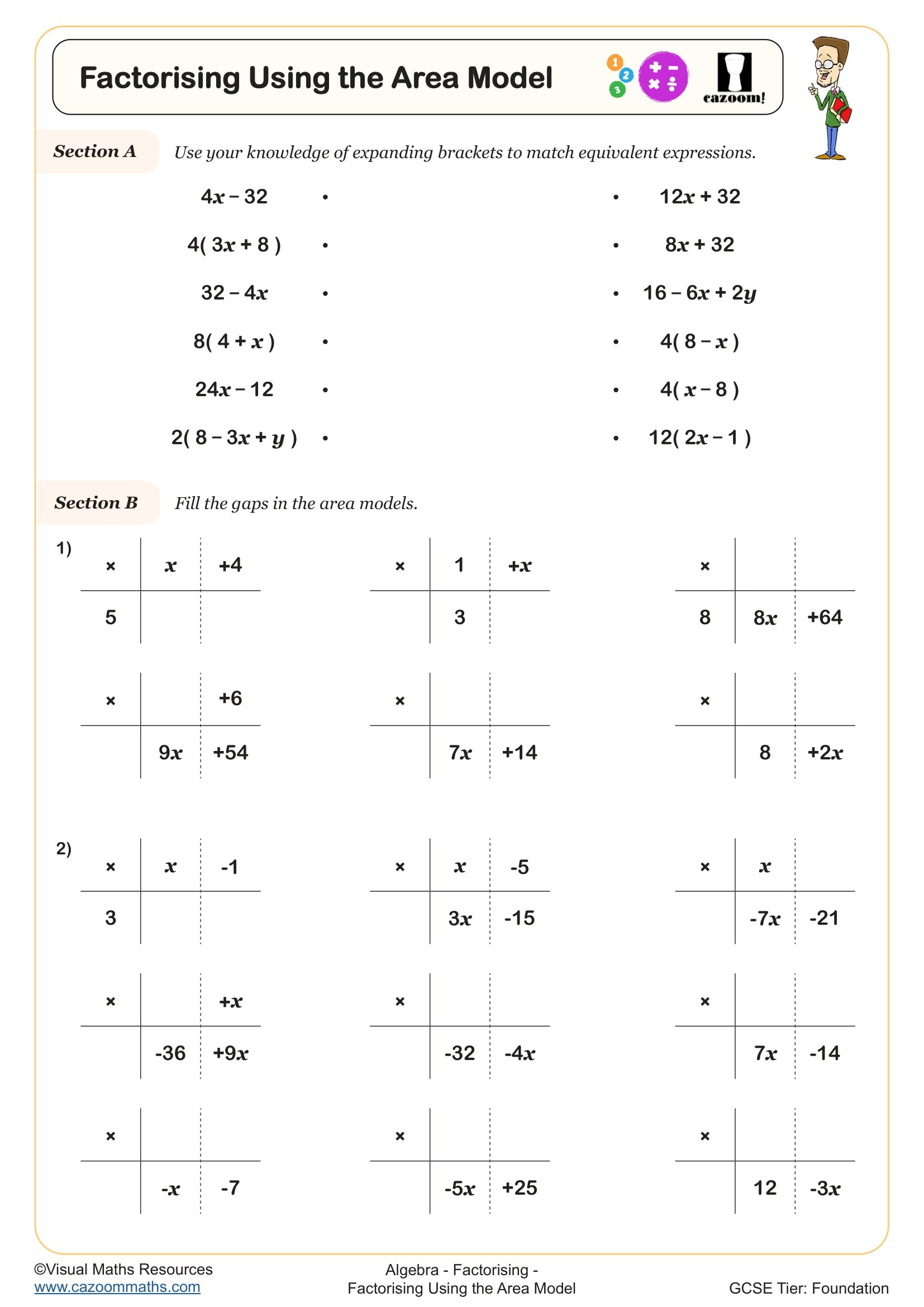
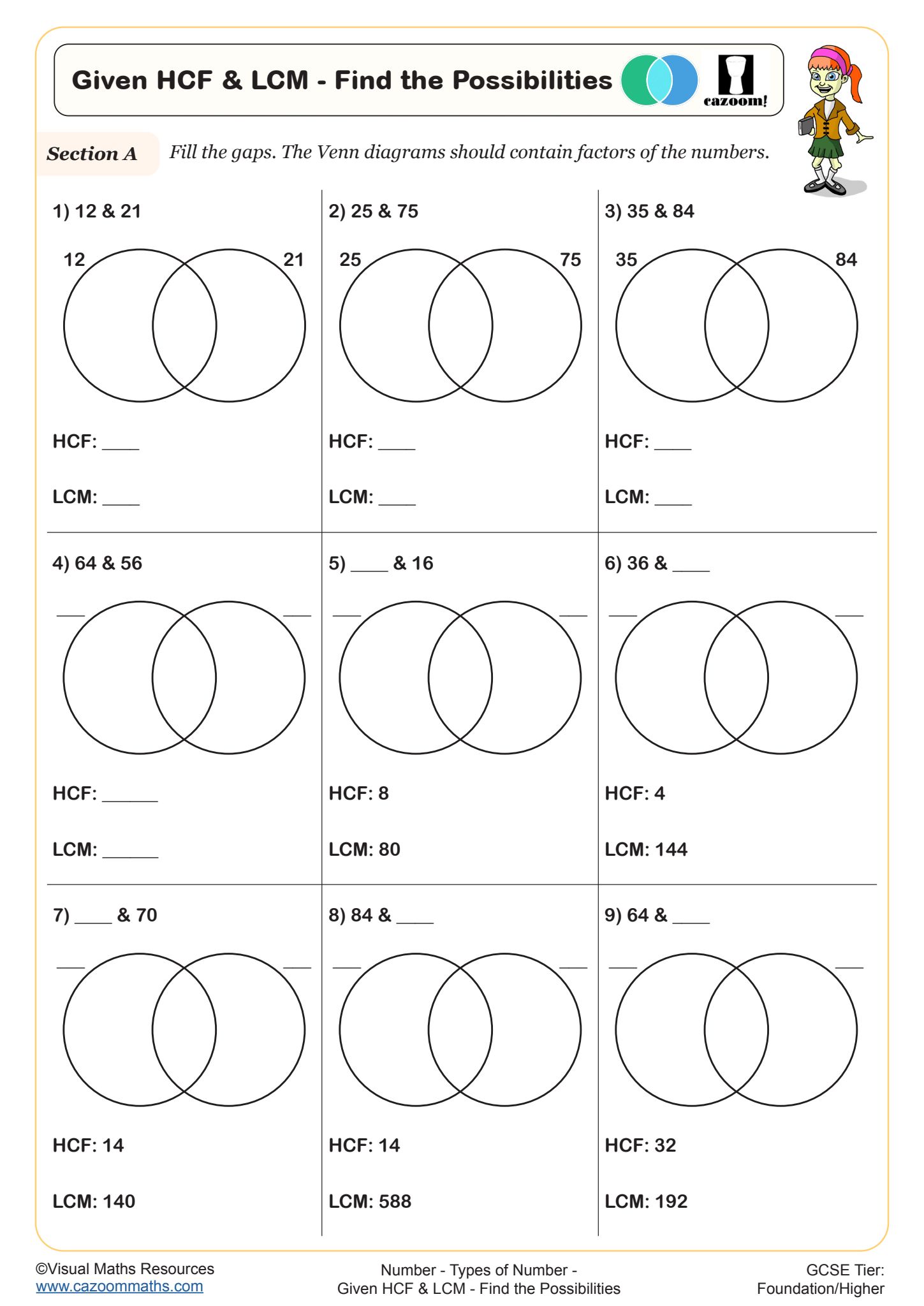
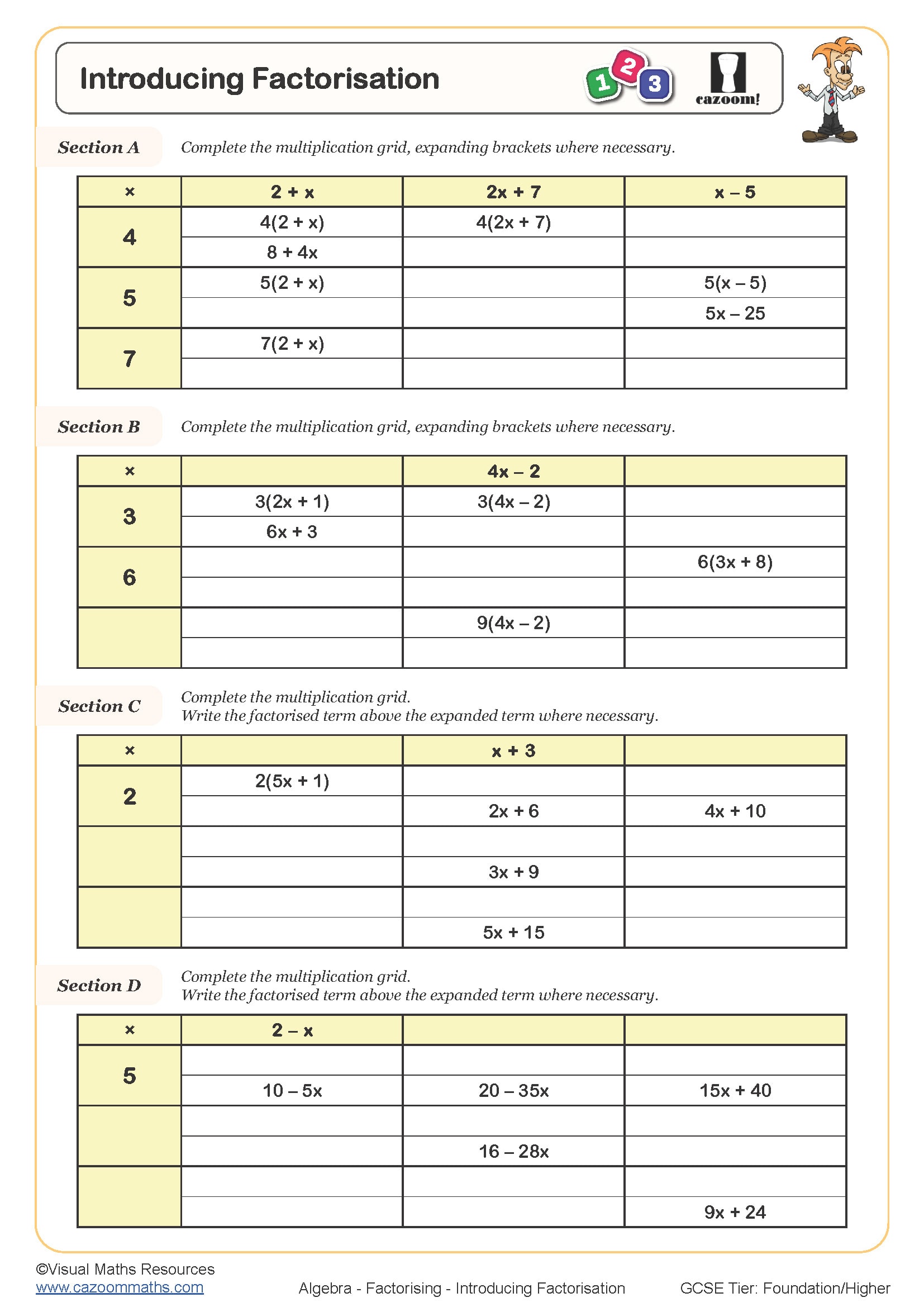
All worksheets are created by the team of experienced teachers at Cazoom Maths.
What makes a good Year 9 factorising worksheet?
Effective factorising worksheets at this level move beyond simple single bracket questions to include expressions where students must first identify the highest common factor, work with negative coefficients, and recognise when different techniques apply. The progression from straightforward examples like 6x + 9 to more demanding expressions such as 12x² - 8xy builds confidence whilst addressing the range of question types students encounter in end-of-topic assessments and GCSE papers.
Teachers often observe that students lose marks by rushing to factorise without checking whether they've extracted the full common factor. Questions that deliberately mix different difficulty levels within the same worksheet help students develop the habit of analysing each expression first, rather than applying a single method mechanically. Answer sheets become particularly valuable here, as they show the complete factorised form students should reach.
Which year groups study factorising?
Factorising appears in the Year 9 curriculum as part of the KS3 algebra programme of study, though students encounter the foundations earlier when working with factors and multiples in number work. At this stage, the National Curriculum expects students to manipulate algebraic expressions by taking out common factors, preparing them for the quadratic factorisation and algebraic fractions they'll meet in KS4.
The progression within Year 9 typically starts with single term common factors before introducing expressions with two or more terms in the bracket. Later in the year or in early GCSE work, students extend these skills to factorise quadratics, so establishing secure methods now prevents misconceptions developing. The techniques practised at KS3 form the foundation for solving equations and simplifying expressions throughout their GCSE course.
What does factorising mixed expressions involve?
Factorising mixed expressions requires students to work with terms that combine different variables and coefficients, such as 15ab + 10b or 6x²y - 9xy². Students must identify common factors across both the numerical coefficients and the algebraic terms, then write the expression as a product of the common factor and the remaining terms. This develops their understanding of how algebraic expressions can be rewritten in equivalent but more useful forms.
This skill connects directly to engineering and computer programming, where simplifying expressions reduces computational steps and makes formulae more efficient. When calculating forces in structures or optimising code, engineers routinely factorise expressions to reveal common components and reduce redundancy. Students who grasp factorisation understand why 3(5x + 2y) requires fewer operations than 15x + 6y when evaluating repeatedly, a principle that scales to complex real-world applications.
How can teachers use these factorising worksheets effectively?
The worksheets support structured learning through carefully sequenced questions that build from accessible starting points to more challenging problems. This scaffolding allows teachers to identify precisely where individual students' understanding breaks down, whether that's recognising common factors, dealing with negative terms, or writing expressions correctly with brackets. The variety across subtopics means teachers can select specific worksheets targeting gaps in understanding rather than revisiting all content.
Many teachers use these resources for targeted intervention with students who've missed earlier teaching or need additional consolidation before assessments. The complete answer sheets make them equally suitable for homework where students can self-check, or for paired work where students compare methods and discuss differences in their solutions. During revision periods, the worksheets provide focused practise on specific techniques without overwhelming students with mixed content.