Pythagoras’ Theorem and Trapezia WORKSHEET
Suitable for Year groups: Year 10, Year 11
GCSE Tier: Foundation/Higher
Targeting grades: 4-5
Prerequisite knowledge: Using Pythagoras’ Theorem. Formula for the area of a trapezium. Calculating perimeters. Rounding answers to a given degree of accuracy.
Learning Objective: Apply Pythagoras’ Theorem to find lengths in right-angled triangles in two-dimensional figures.
Pythagoras’ Theorem and Trapezia WORKSHEET DESCRIPTION
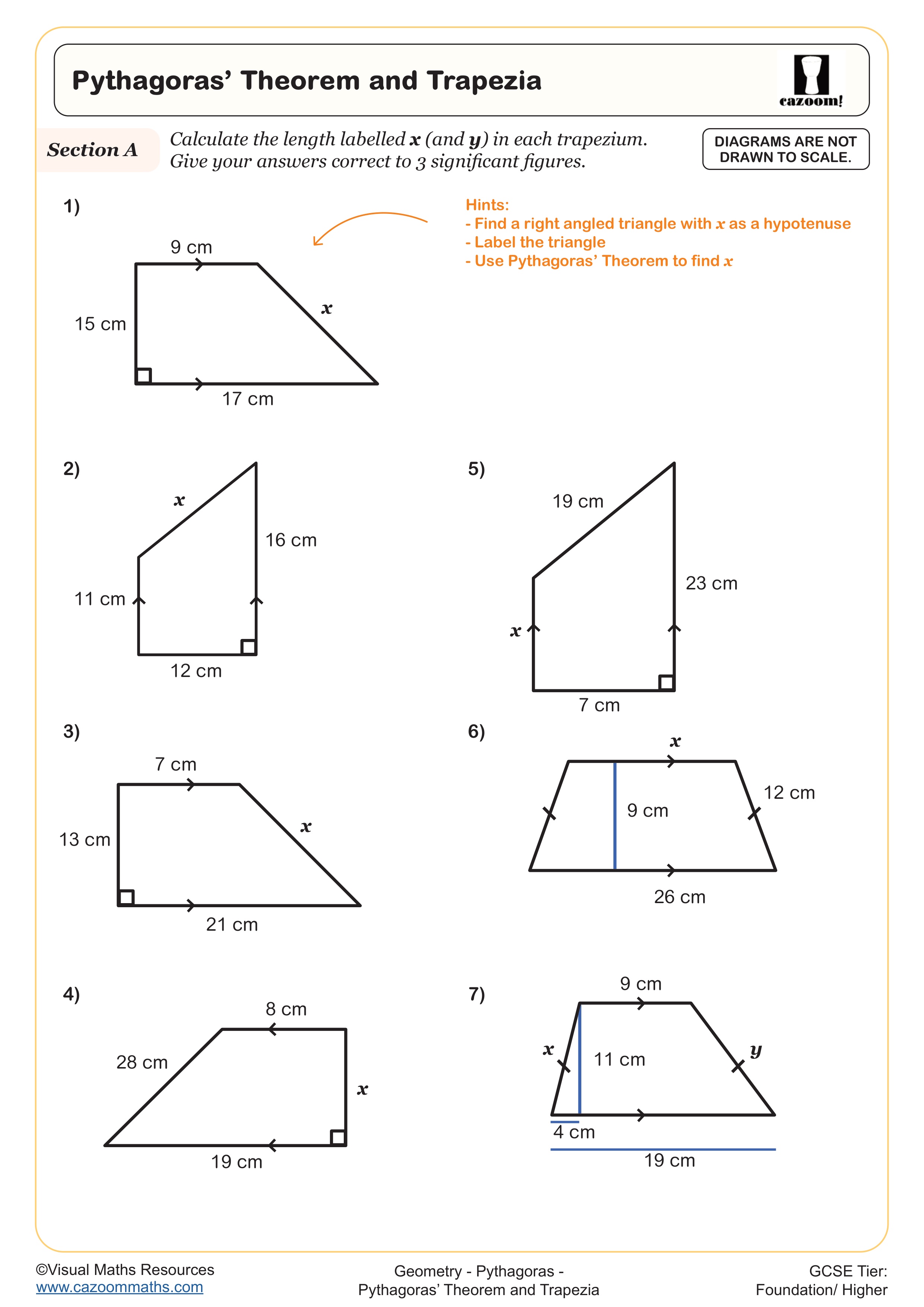
This worksheet helps students apply Pythagoras’ Theorem within trapezia to find missing side lengths and then use these results to calculate area and perimeter.
In Section A, pupils identify right-angled triangles hidden inside each trapezium, use given side lengths to calculate unknown slant sides, one of the parallel sides, perpendicular heights, or internal diagonals.
Section B builds on this by asking learners to find both the area and perimeter of trapezia, requiring them to combine Pythagoras with standard formulae and careful perimeter work.
This resource is ideal for consolidating right-angled triangle skills in a new context and for strengthening multi-step problem-solving.
In Section A, pupils identify right-angled triangles hidden inside each trapezium, use given side lengths to calculate unknown slant sides, one of the parallel sides, perpendicular heights, or internal diagonals.
Section B builds on this by asking learners to find both the area and perimeter of trapezia, requiring them to combine Pythagoras with standard formulae and careful perimeter work.
This resource is ideal for consolidating right-angled triangle skills in a new context and for strengthening multi-step problem-solving.
All worksheets are created by the team of experienced teachers at Cazoom Maths.
RELATED TO Pythagoras’ Theorem and Trapezia WORKSHEET
Frequently Asked Questions
Apply Pythagoras’ Theorem to find lengths in right-angled triangles in two-dimensional figures.