Solving Two-Way Table Problems with Algebra WORKSHEET
Suitable for Year groups: Year 8, Year 9
GCSE Tier: Foundation/Higher
Targeting grades: 4 - 5
Prerequisite knowledge: Forming and solving one-step and two-step linear equations. Interpreting algebraic expressions. Constructing and reading two-way tables.
Learning Objective: Solve linear equations to complete two-way tables.
Solving Two-Way Table Problems with Algebra WORKSHEET DESCRIPTION
This worksheet strengthens students’ understanding of how algebra can be used to complete two-way tables.
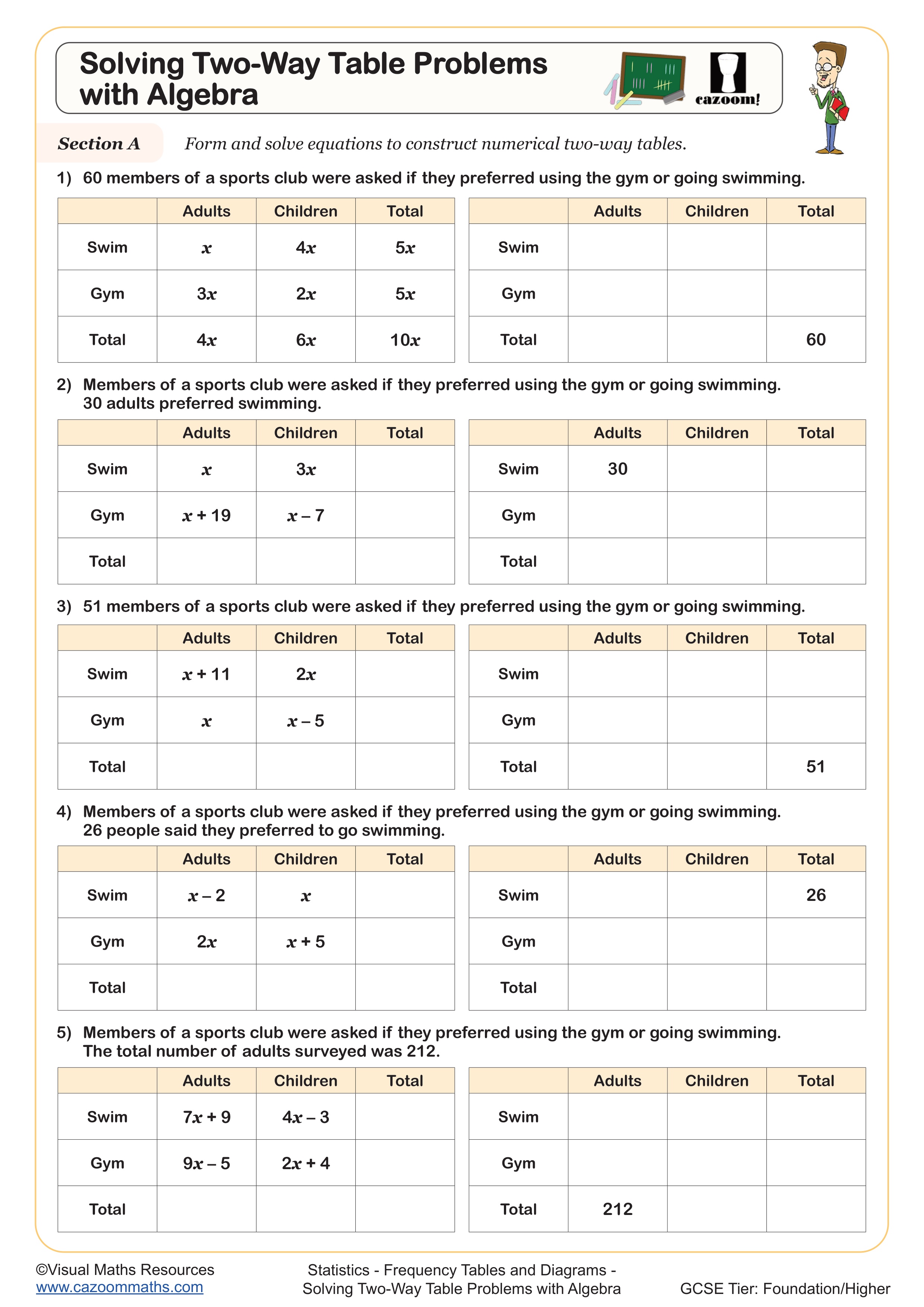
In Section A, each problem gives a partially filled table containing algebraic expressions alongside either a total or a key numerical value (e.g., 60 members in total, 30 adults preferred swimming) . Students must use the row and column totals to form equations, solve for 𝒳, and substitute back to complete the full set of frequencies.
Section B then moves into worded contexts where pupils build the algebraic table from scratch before solving, applying multi-step reasoning about proportional relationships.
The progression develops fluency in forming and solving equations, modelling two-way classifications, and interpreting real-world constraints.
In Section A, each problem gives a partially filled table containing algebraic expressions alongside either a total or a key numerical value (e.g., 60 members in total, 30 adults preferred swimming) . Students must use the row and column totals to form equations, solve for 𝒳, and substitute back to complete the full set of frequencies.
Section B then moves into worded contexts where pupils build the algebraic table from scratch before solving, applying multi-step reasoning about proportional relationships.
The progression develops fluency in forming and solving equations, modelling two-way classifications, and interpreting real-world constraints.
All worksheets are created by the team of experienced teachers at Cazoom Maths.
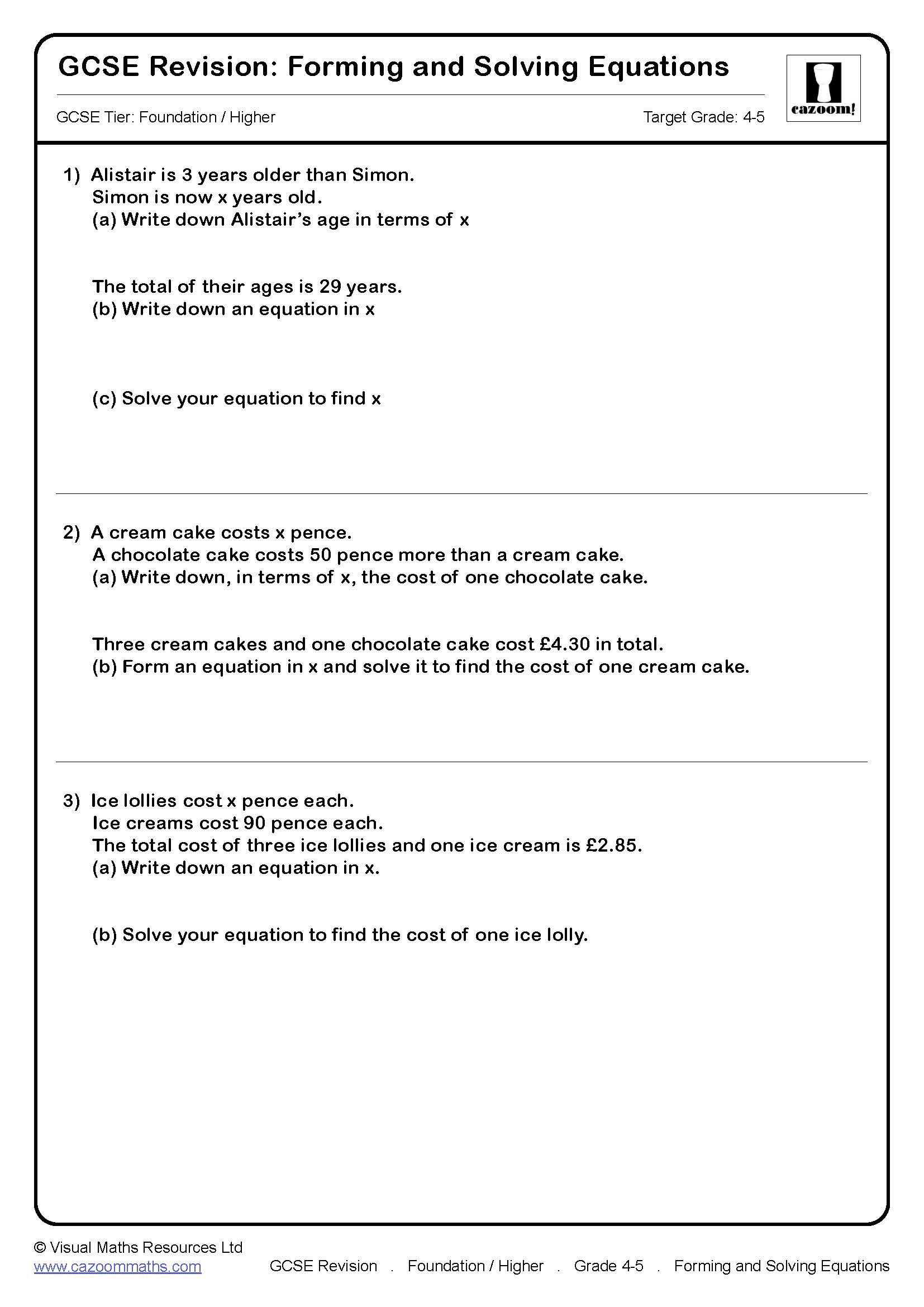
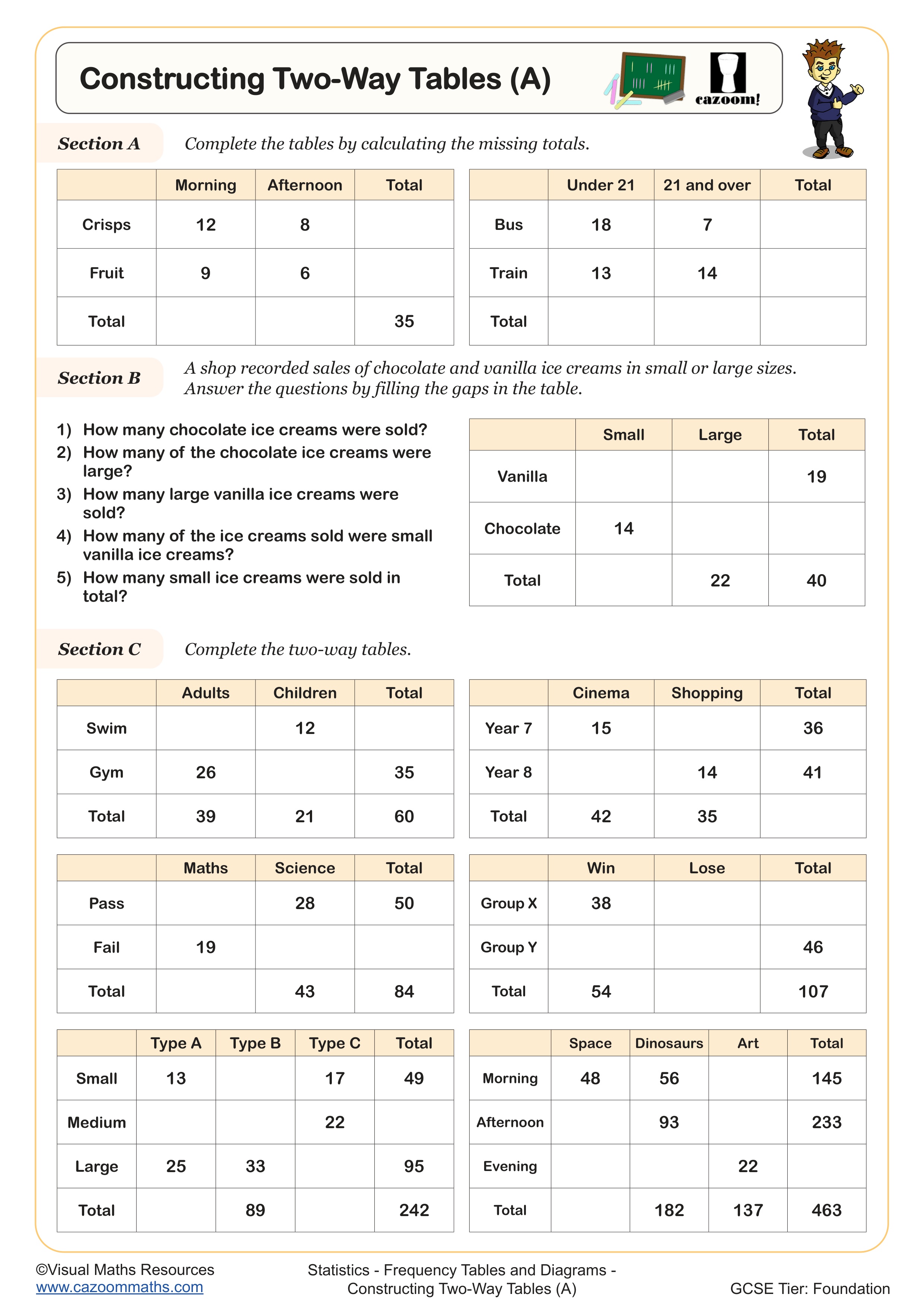
RELATED TO Solving Two-Way Table Problems with Algebra WORKSHEET
Frequently Asked Questions
Solve linear equations to complete two-way tables.