KS3 Order of Operations Worksheets
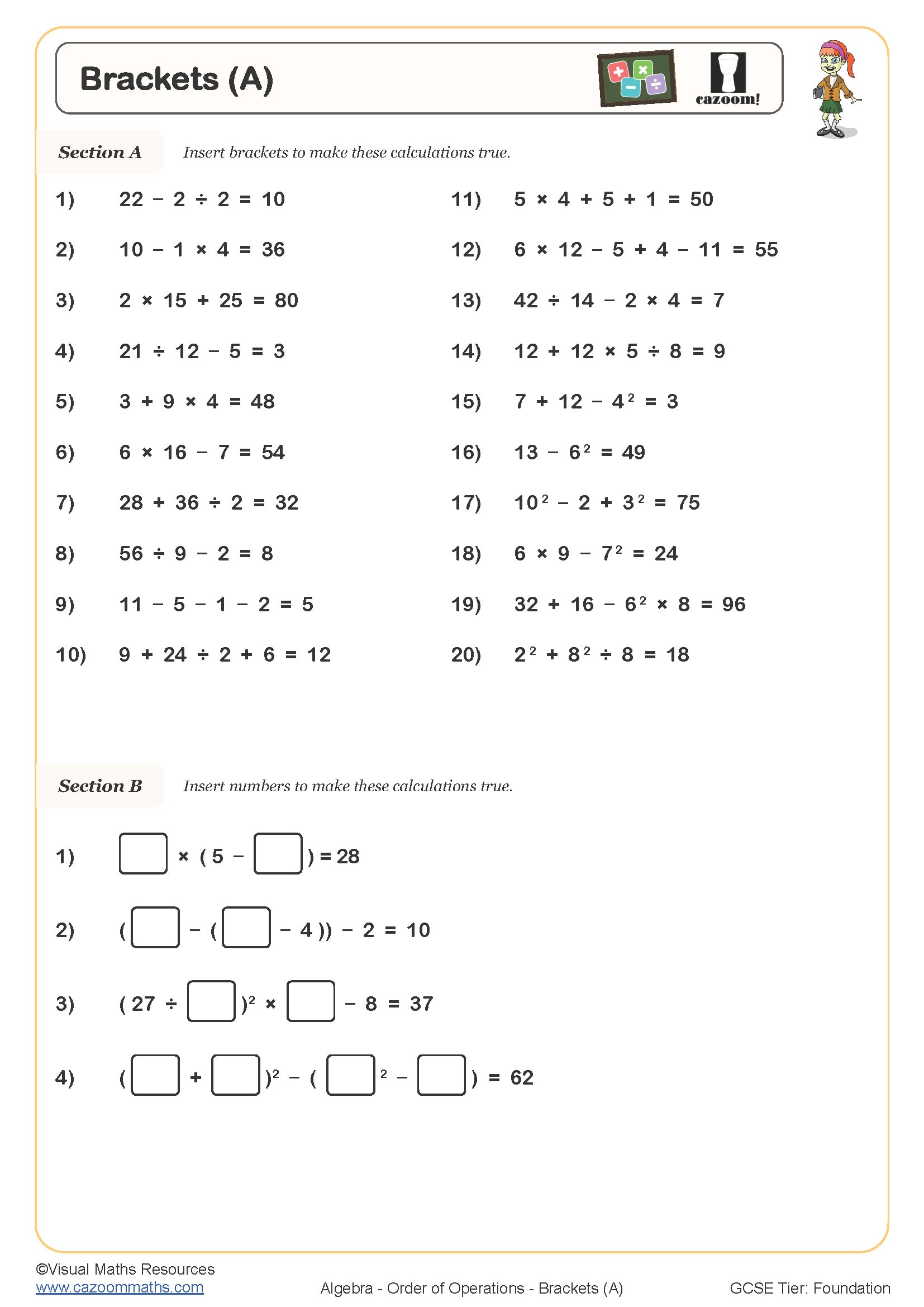
Brackets (A)
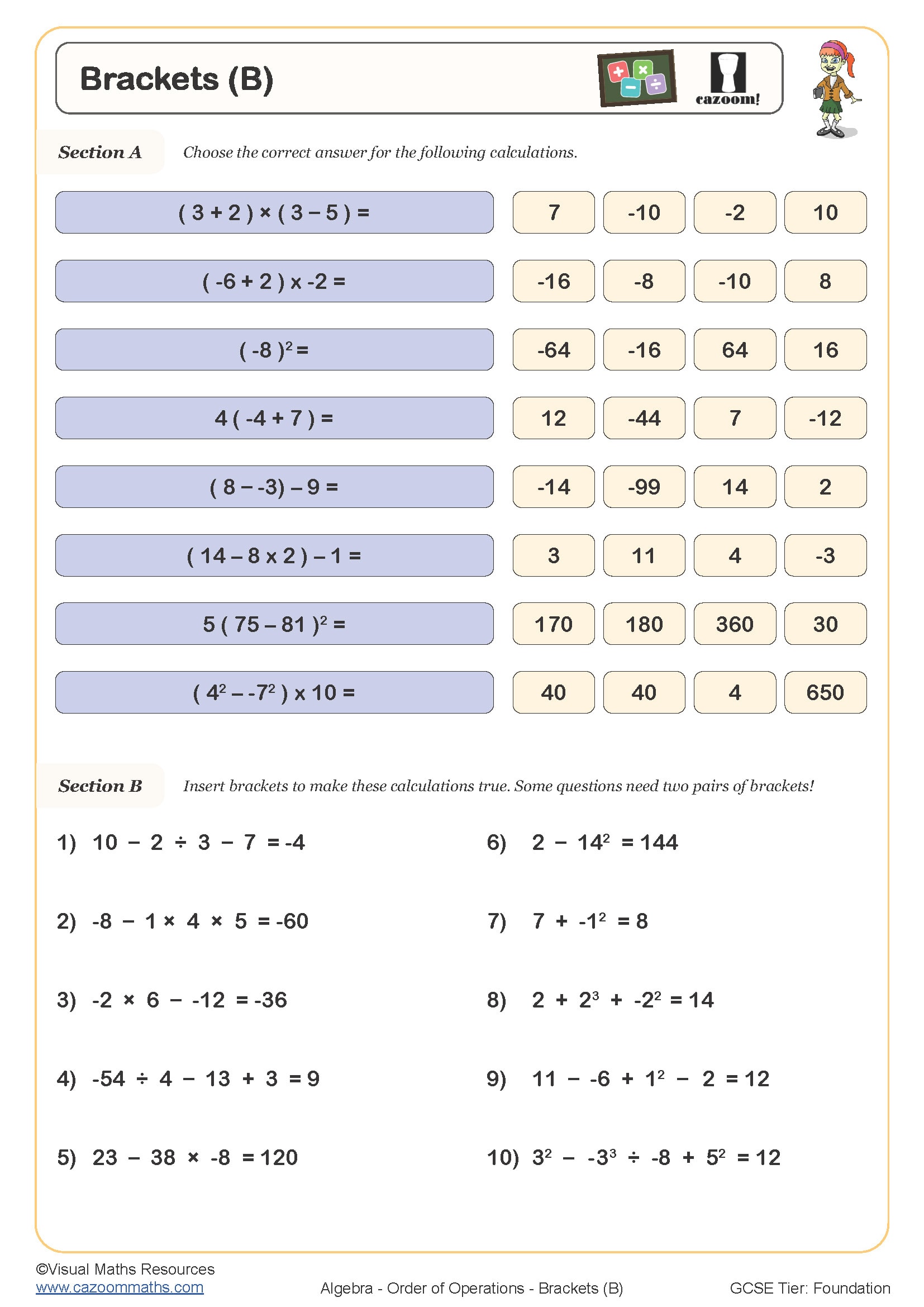
Brackets (B)
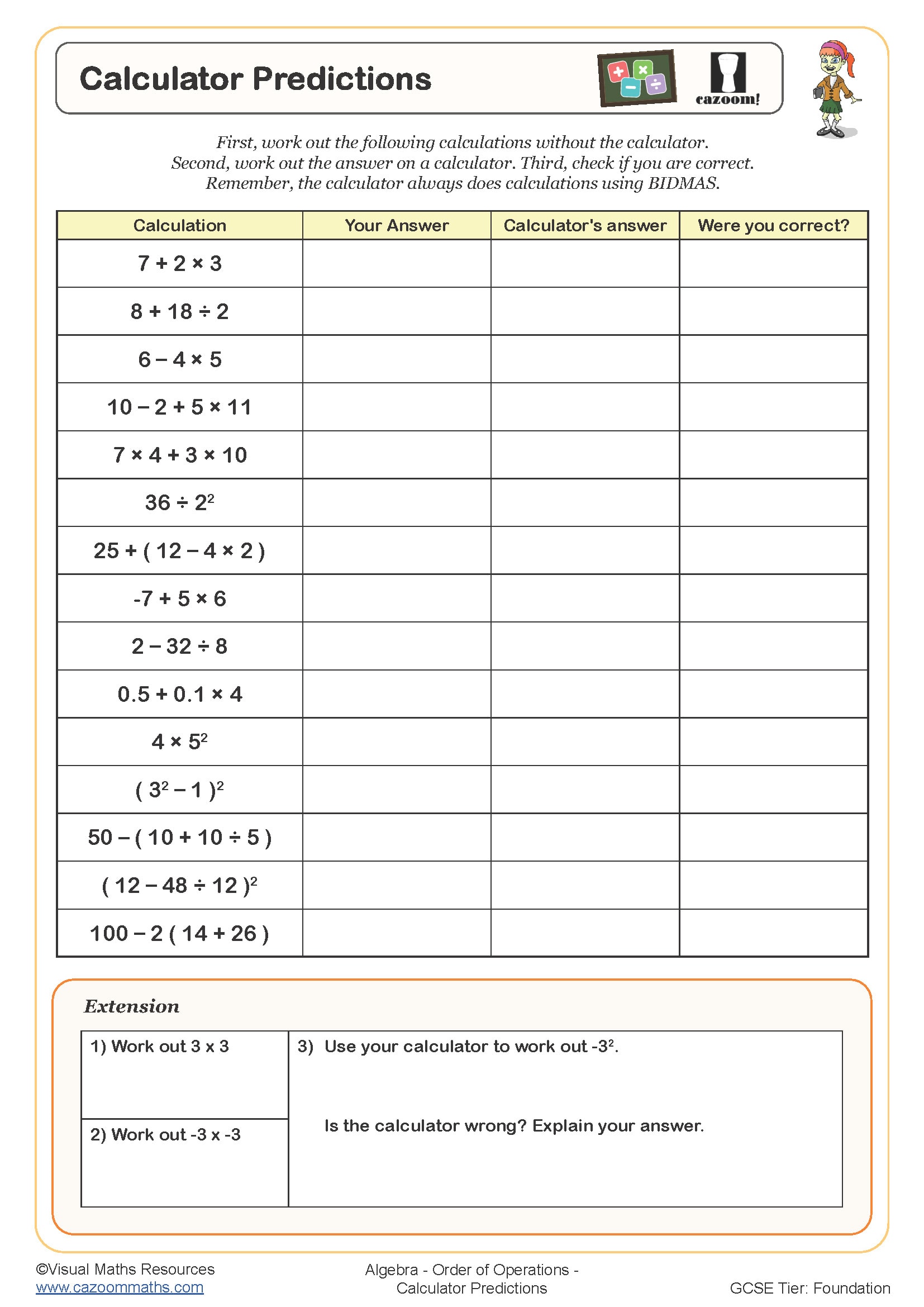
Calculator Predictions
Order of Operations - Calculating with Indices

Order of Operations - Addition and Subtraction

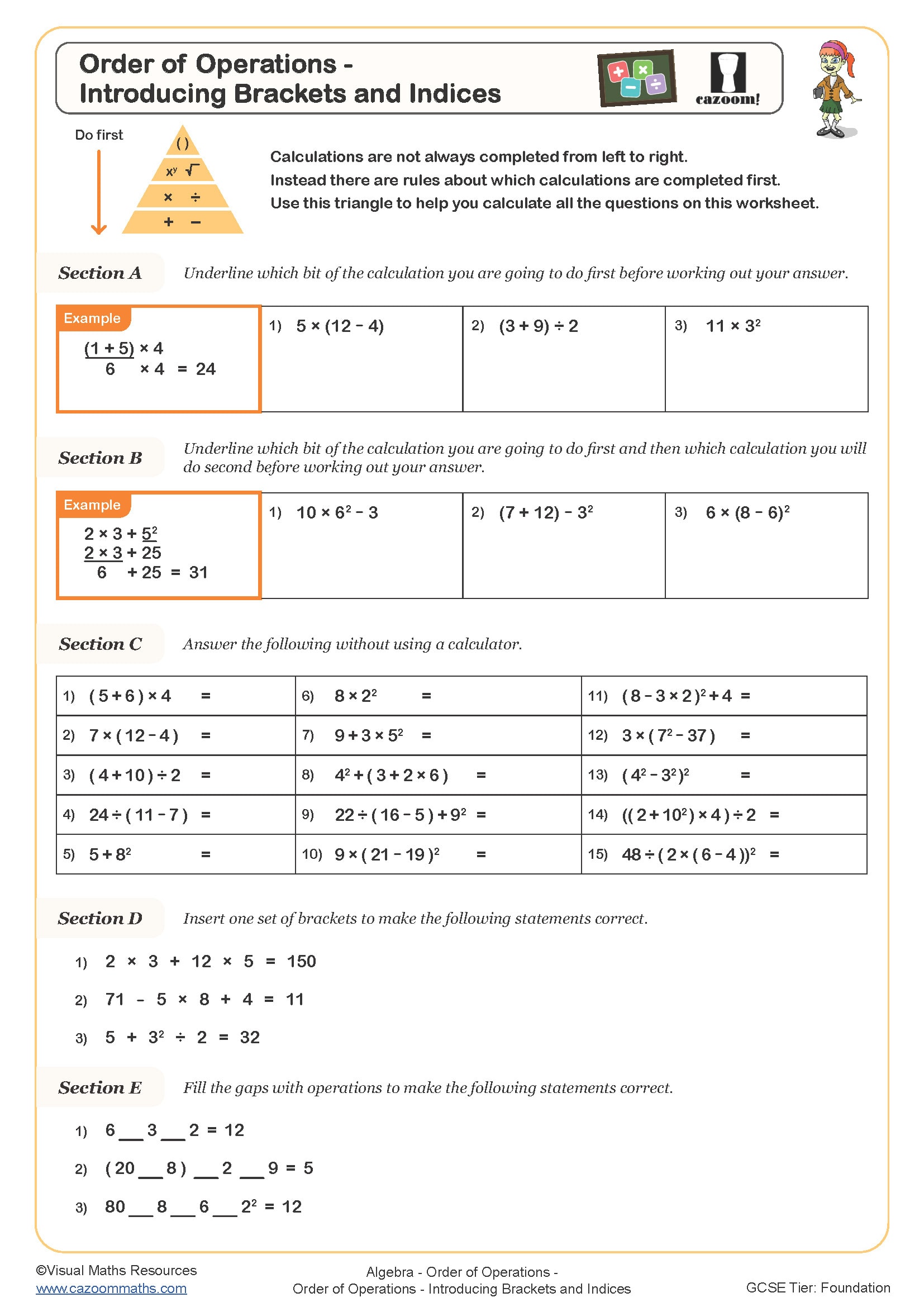
Order of Operations - Introducing Brackets and Indices
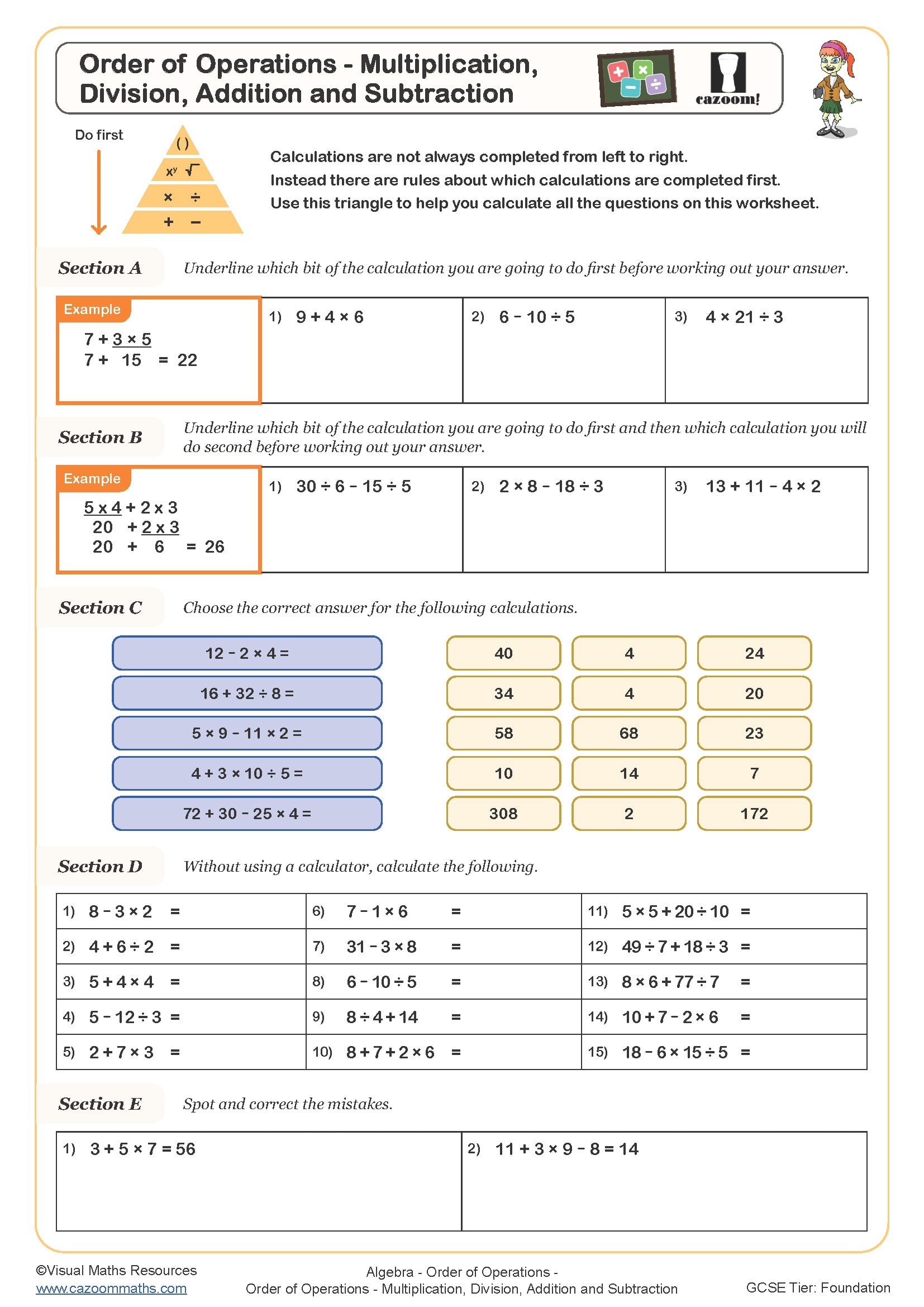
Order of Operations - Multiplication, Division, Addition and Subtraction
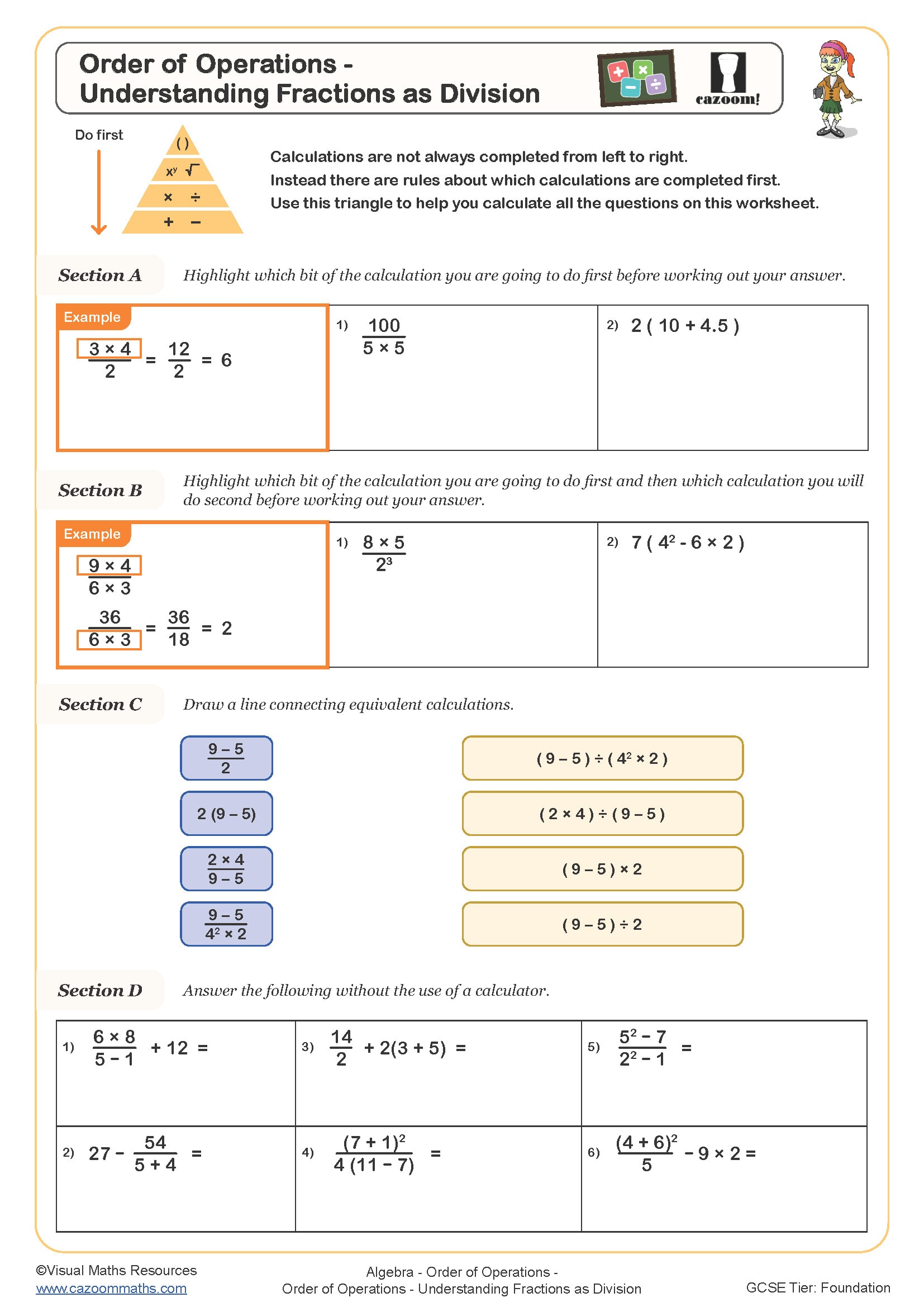
Order of Operations - Understanding Fractions as Division
Order of Operations – Expression Trails

All worksheets are created by the team of experienced teachers at Cazoom Maths.
What makes effective order of operations worksheets with answers?
Effective order of operations worksheets with answers provide graduated difficulty levels, starting with simple calculations involving two operations before progressing to complex expressions with nested brackets and powers. The National Curriculum expects Year 7 students to confidently apply BIDMAS rules, making structured practice important for building automaticity.
Teachers notice that worksheets work best when they include worked examples alongside practice questions. Students often make calculation errors when rushing through the steps, so having detailed solutions helps them identify exactly where mistakes occur and reinforces the systematic approach required for consistent accuracy.
Which year groups should use BIDMAS worksheet year 7 resources?
BIDMAS questions year 7 materials typically suit students in Years 7-9, though many teachers introduce basic order of operations concepts in Year 6 to prepare for secondary transition. The Key Stage 3 Programme of Study specifically requires students to use conventional notation for priority of operations, making Year 7 the critical point for consolidating these skills.
Some teachers find that lower-attaining Year 8 and 9 students benefit from revisiting Year 7 BIDMAS resources, particularly when preparing for GCSE topics involving algebraic manipulation. The foundational skills practised in these worksheets directly support success in factorising, expanding brackets, and solving equations at higher levels.
How do students handle brackets within order of operations calculations?
Students frequently struggle with nested brackets and calculations involving brackets raised to powers, often forgetting to complete all operations inside brackets before moving to the next step. Teachers observe that many students attempt to remove brackets too early, leading to systematic errors that compound throughout the calculation.
The most effective approach involves teaching students to work from the innermost brackets outward, using different coloured pens to track their progress through complex expressions. This visual method helps students maintain accuracy when dealing with expressions like 3(2 + 4)² - 5, where multiple operations must be carefully sequenced.
What's the best way to use order of operations maths worksheets in lessons?
Teachers find that starting lessons with a few worked examples on the board helps students internalise the BIDMAS sequence before attempting independent practice. Many successful teachers use a 'think aloud' approach, verbalising each decision about which operation to perform next, making the thought process explicit for students.
Regular mini-assessments using these worksheets help identify students who are applying rules mechanically without understanding. Teachers often pair weaker students with stronger ones during worksheet sessions, as peer explanation frequently clarifies misconceptions more effectively than teacher intervention alone.