KS4 Proportion Worksheets
All worksheets are created by the team of experienced teachers at Cazoom Maths.
What should students practise with proportion worksheets?
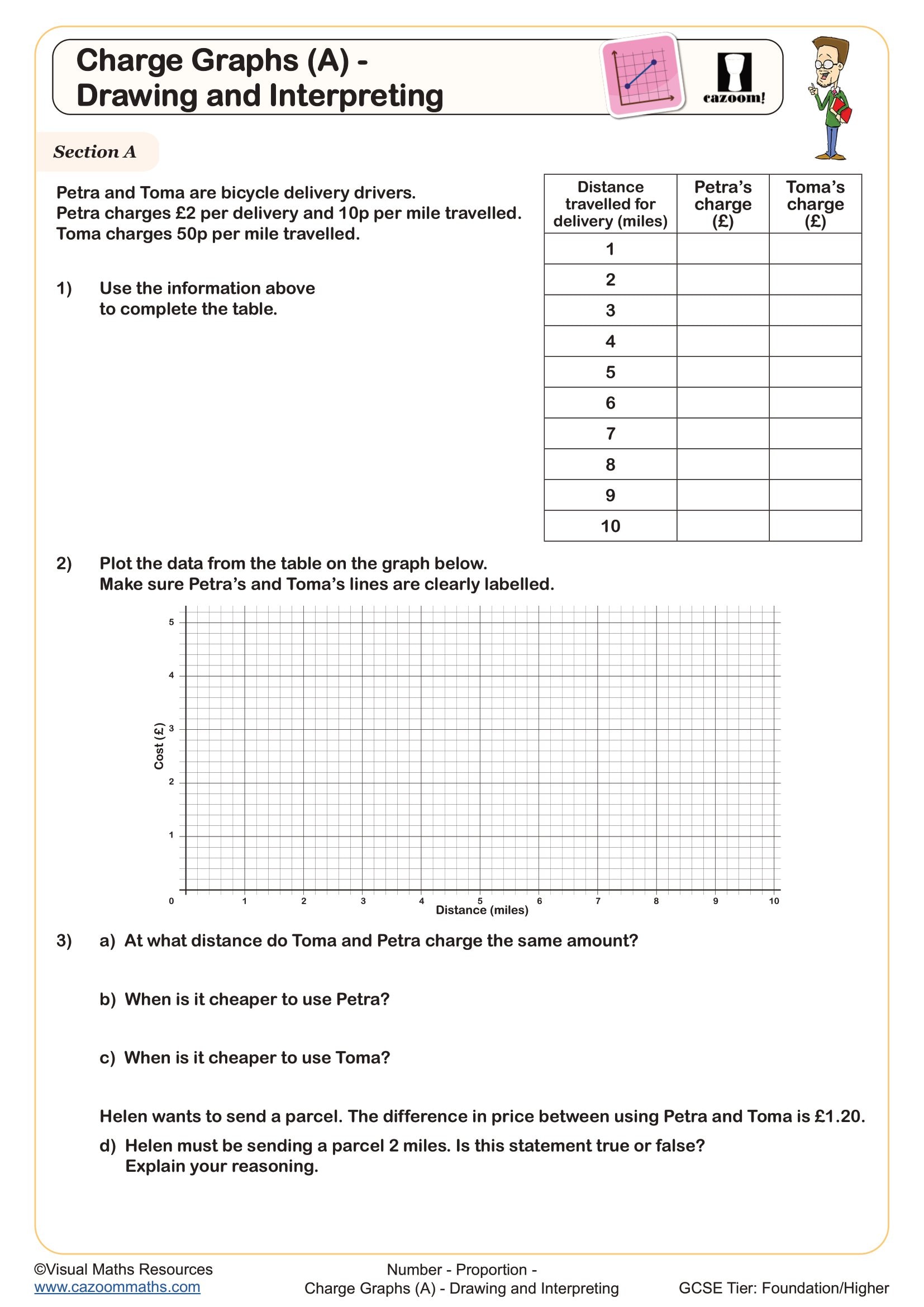
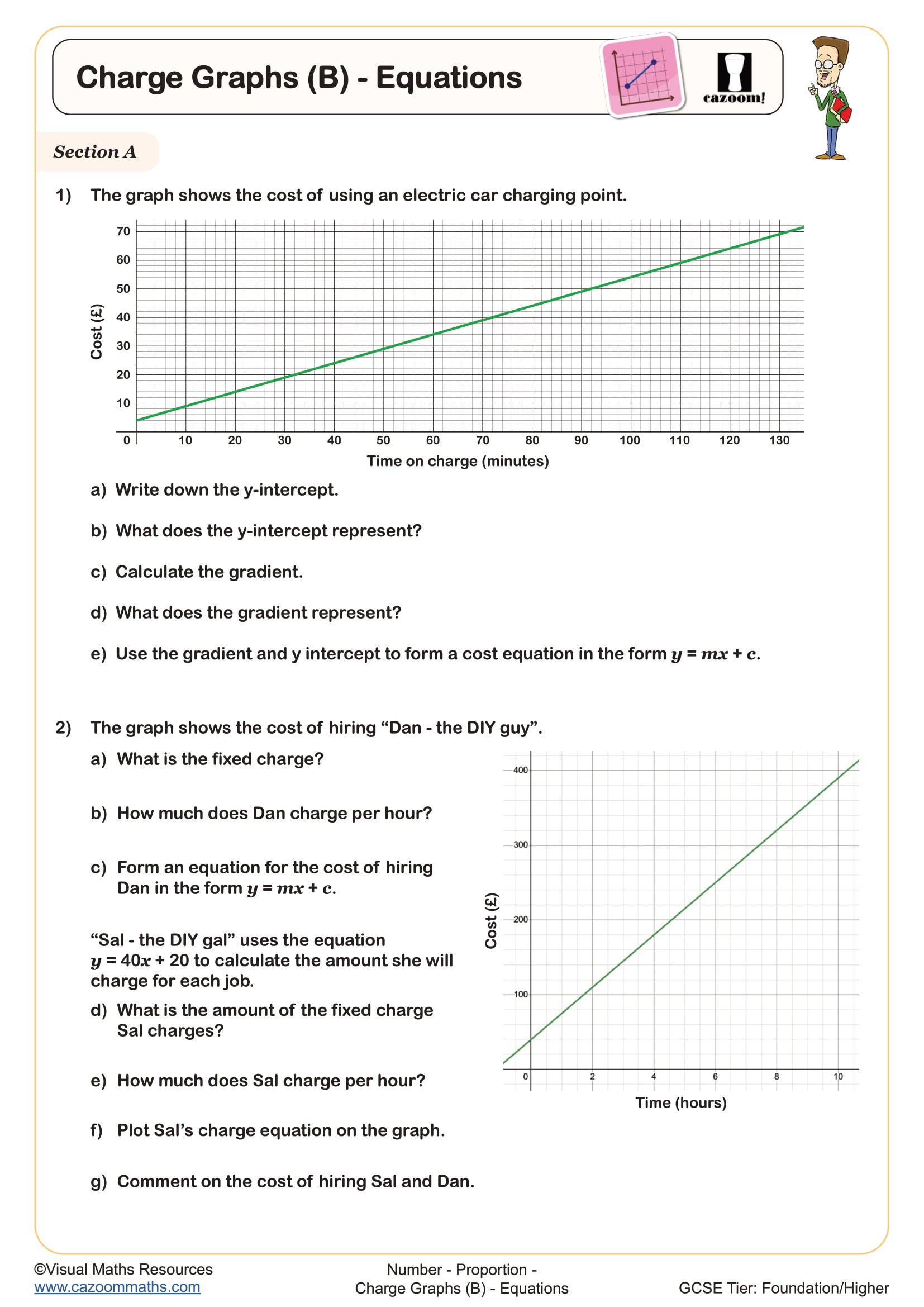
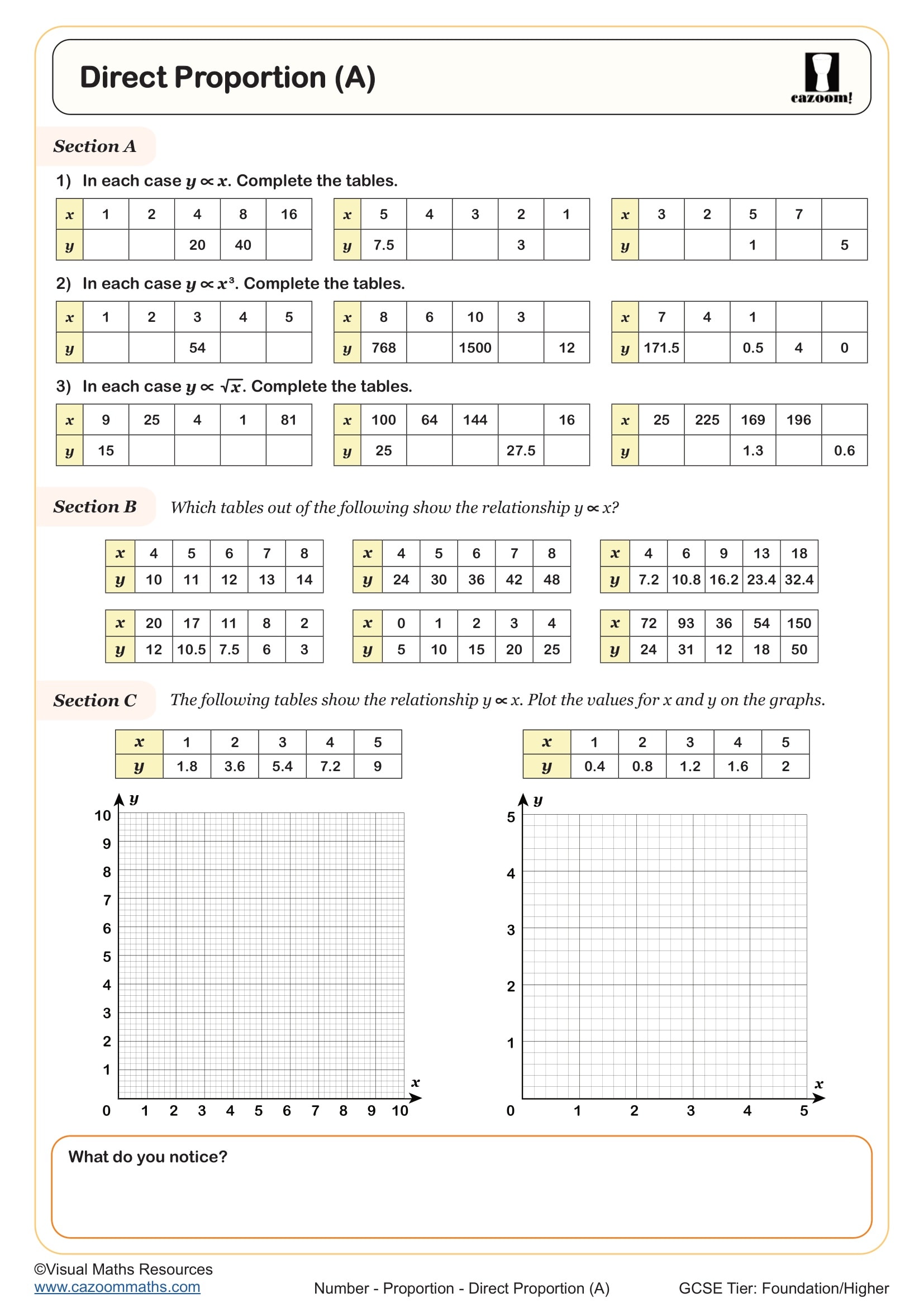
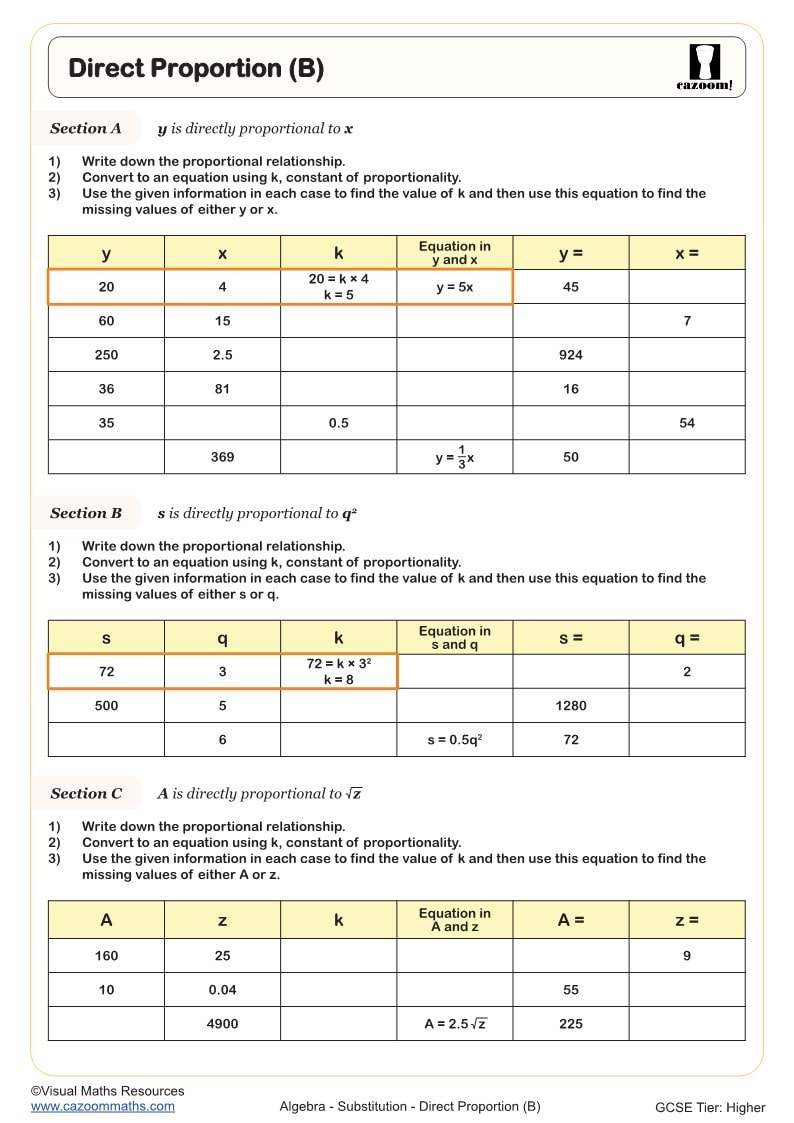
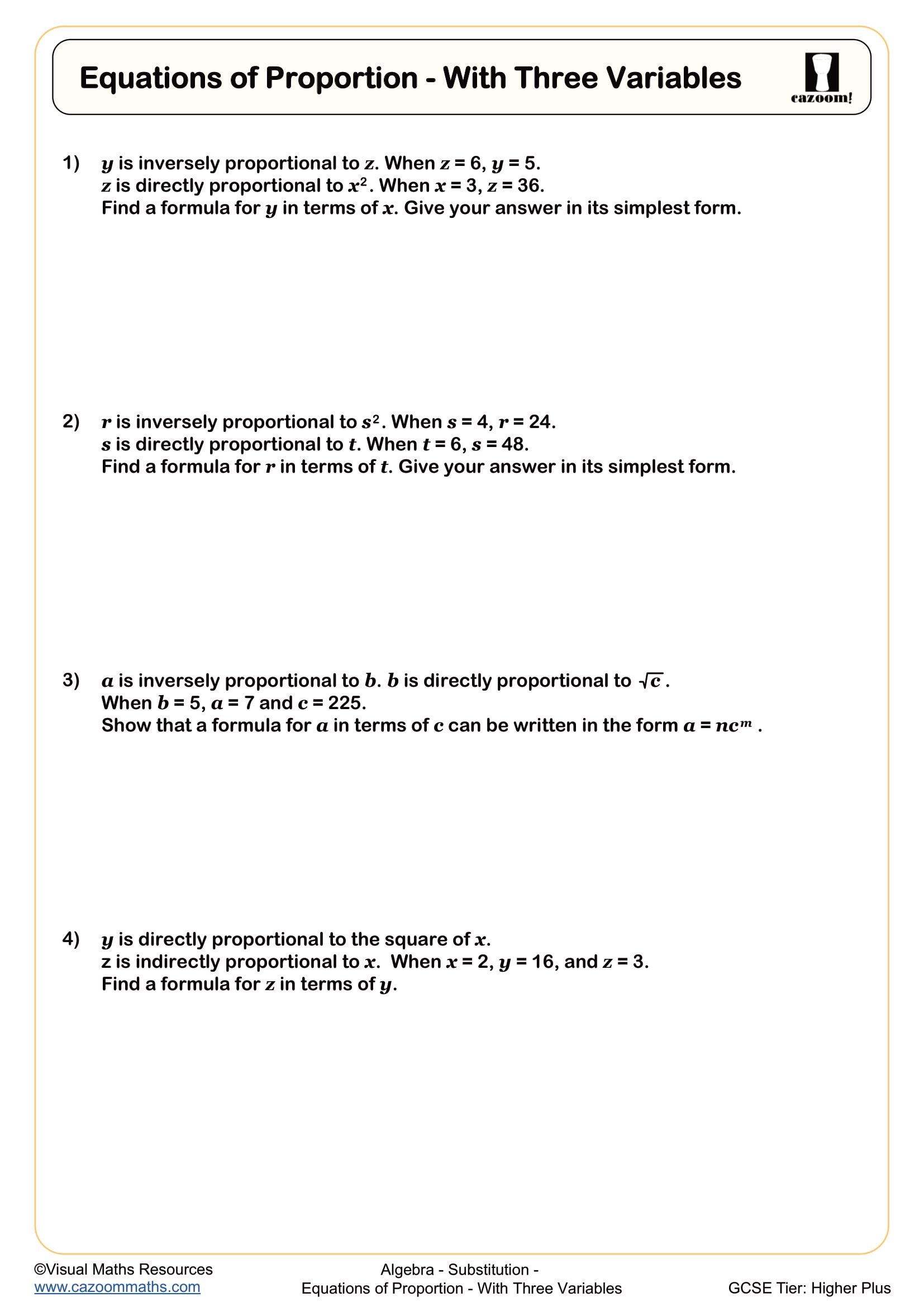
A proportion worksheet should build fluency in recognising and solving both direct and inverse proportion problems, moving from simple ratio-based questions to more complex algebraic and contextual applications. At KS4, this means working with proportion equations, the constant of proportionality (k), and understanding when quantities increase or decrease together. Students need exposure to proportion examples across different contexts including recipe scaling, currency conversion, speed-distance-time, and scientific relationships like Hooke's Law.
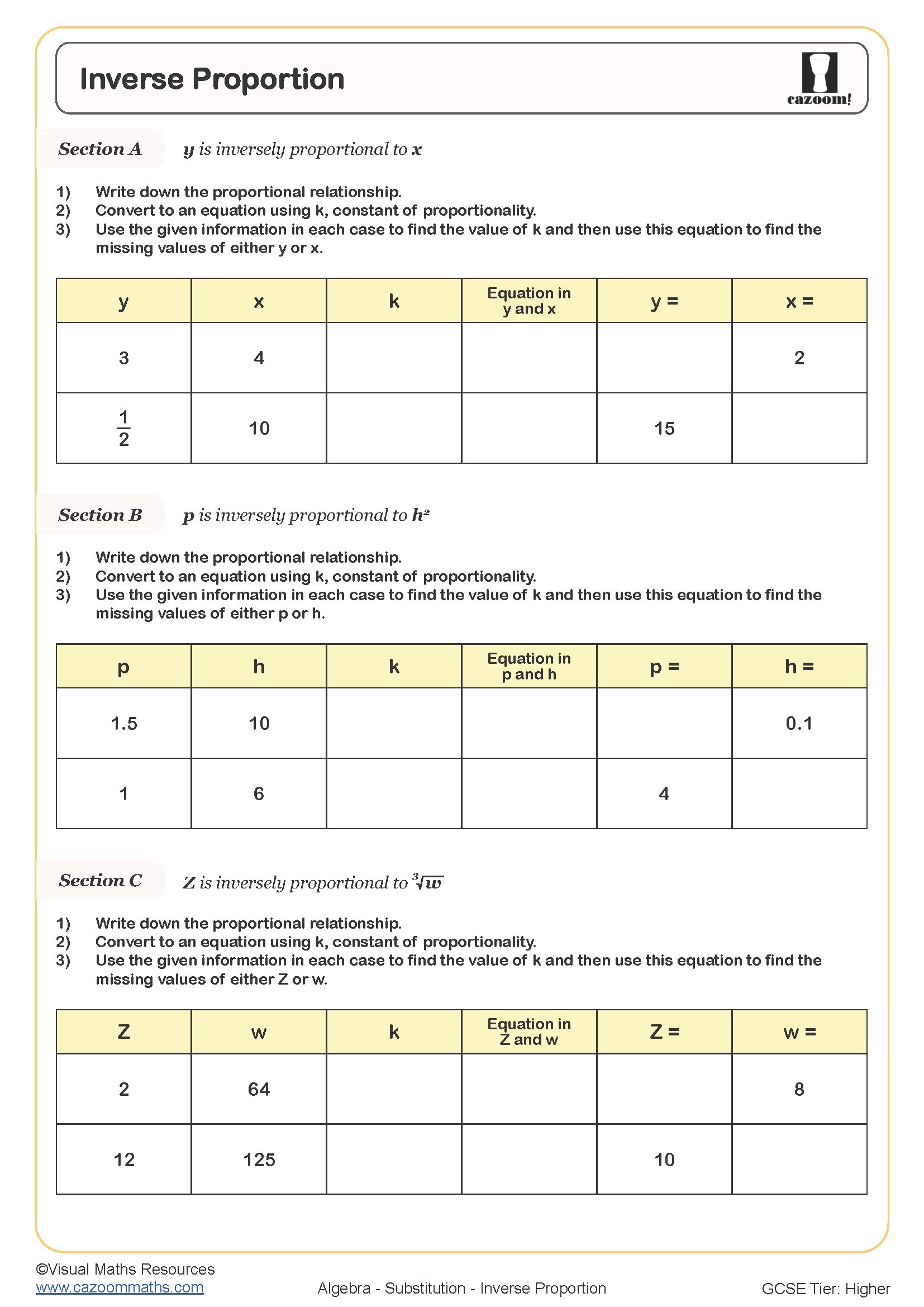
Teachers notice that many students can solve direct proportion mechanically but fail to explain why the method works. A common error appears when students see 'y is inversely proportional to x²' and write y = k/x instead of y = k/x², losing marks even when subsequent calculation steps are correct. Exam questions increasingly test conceptual understanding by asking students to sketch graphs or explain relationships in words, not just calculate values.
Which year groups study proportion at KS4?
Proportion appears across Year 10 and Year 11 as part of the GCSE ratio, proportion and rates of change strand. Year 10 typically introduces or consolidates inverse proportion after students have secured direct proportion from KS3, then extends to algebraic representations and problems involving squared or cubed relationships. Year 11 revisits proportion within exam preparation contexts, often through multi-step problems that combine proportion with other topics like percentages, graphs, or standard form.
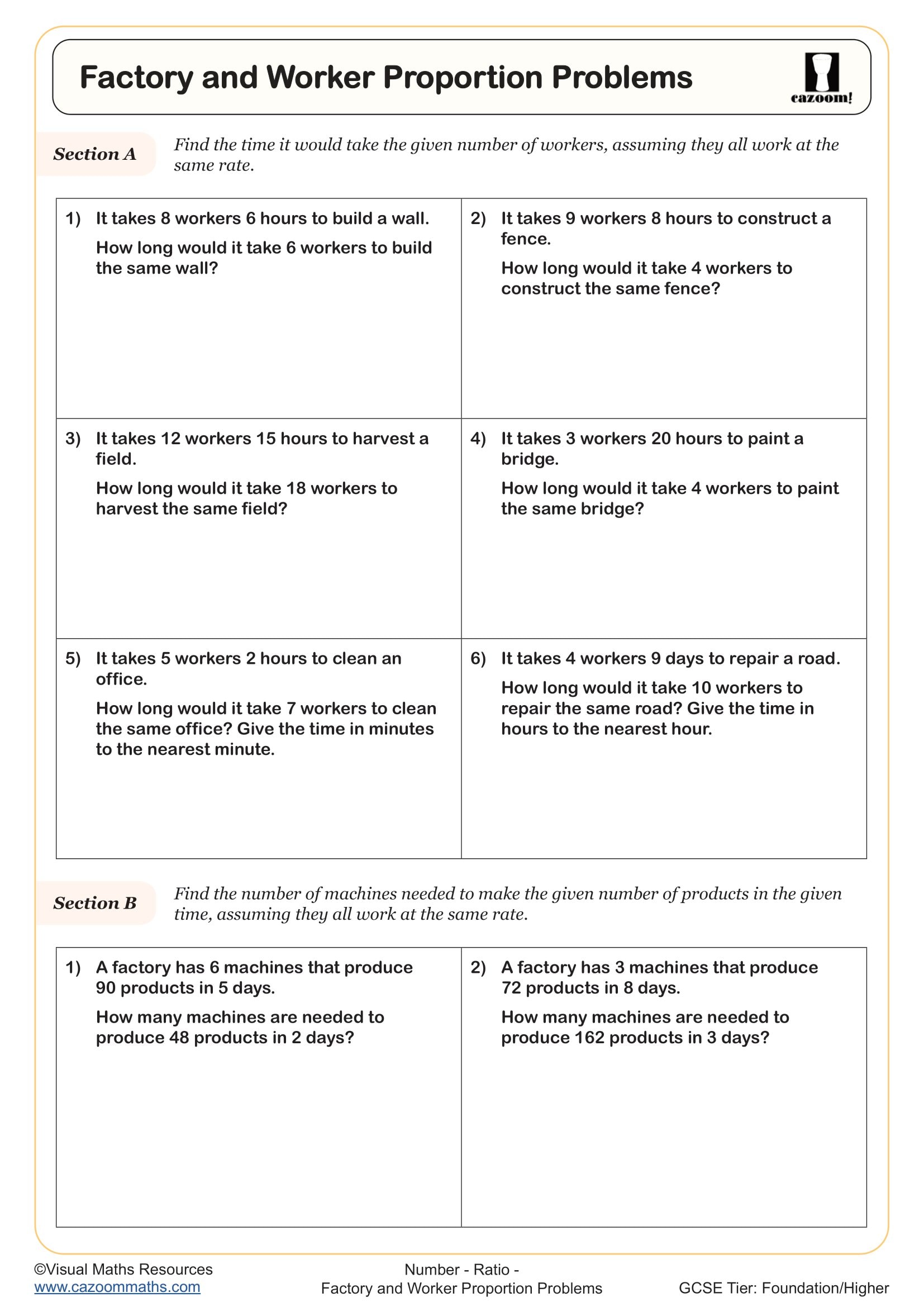
The progression from Year 10 to Year 11 involves increasing sophistication in problem complexity rather than entirely new content. Year 10 questions might isolate proportion within a single context, whilst Year 11 exam-style questions embed proportion within longer problems requiring students to extract relevant information, choose the appropriate method, and connect proportion to graphical or algebraic representations. Three-variable proportion problems and worker proportion scenarios typically appear in Year 11 as they demand stronger algebraic manipulation.
How does inverse proportion connect to real-world applications?
Inverse proportion describes relationships where one quantity increases as another decreases at a constant rate, expressed as y ∝ 1/x or xy = k. Students encounter this when calculating how journey time decreases as speed increases, how brightness diminishes with distance from a light source, or how pressure and volume relate in gas laws. Understanding that the product of inversely proportional quantities remains constant helps students recognise these relationships in unfamiliar contexts and choose appropriate solution methods.
In STEM careers, inverse proportion appears throughout physics and engineering. Electrical resistance calculations, gravitational field strength varying with distance squared, and gear ratios in mechanical systems all rely on inverse relationships. Medical professionals use inverse proportion when calculating drug dosages based on concentration, whilst architects apply it to structural load distribution. Students who grasp the conceptual difference between direct and inverse proportion can transfer this reasoning to authentic scientific problems rather than treating each question as an isolated calculation exercise.
How do these proportion worksheets support classroom teaching?
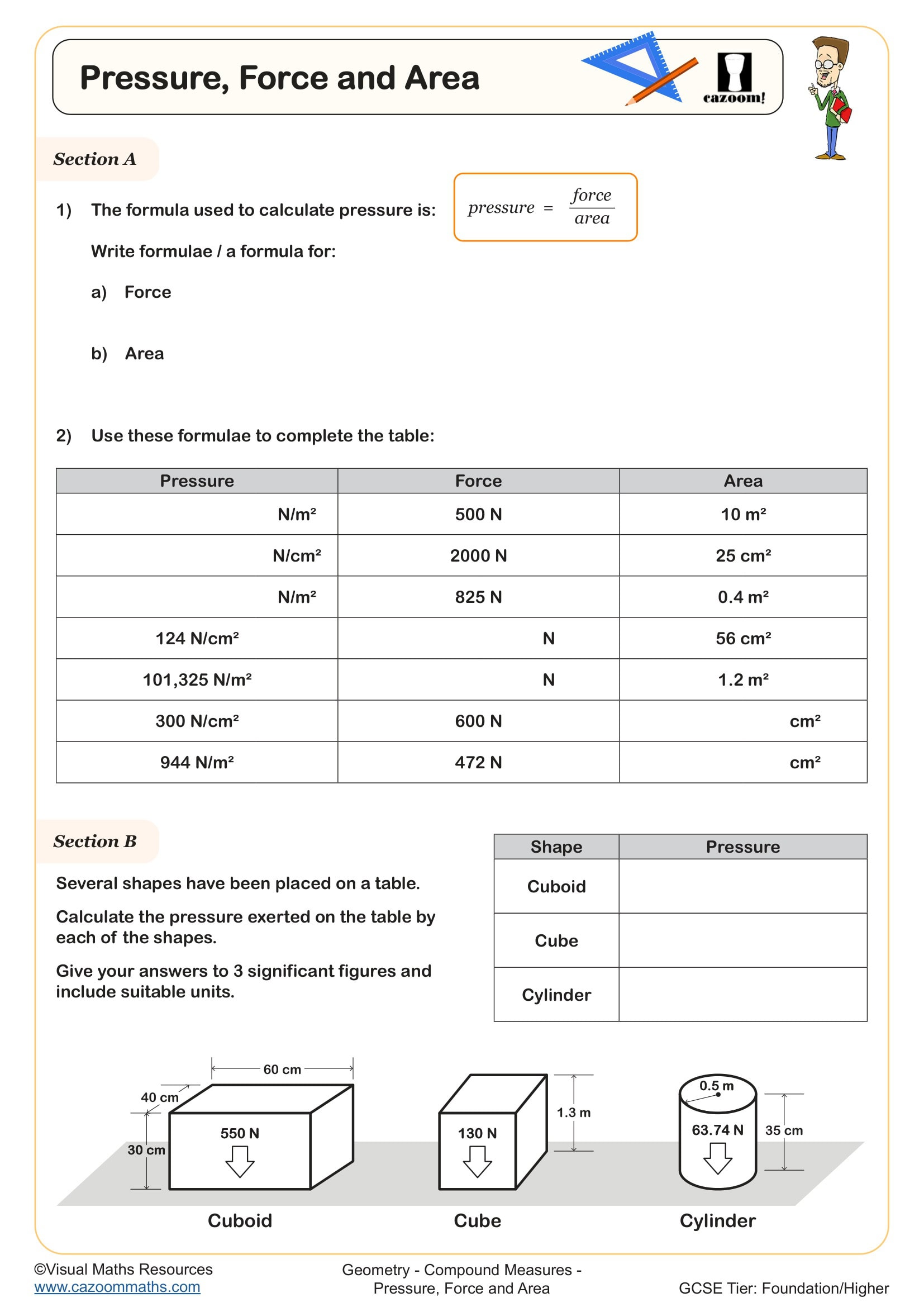
The worksheets provide structured practice that moves through recognising proportion relationships, setting up equations with the constant k, and solving multi-step problems. Questions progress from numerical work to algebraic representations, mirroring how GCSE exams test proportion within both calculator and non-calculator papers. Having answer sheets allows teachers to set worksheets for independent work whilst students self-check their methods, building the metacognitive skills needed to identify where their approach differs from the model solution.
Many teachers use proportion worksheets during intervention sessions when students have confused direct and inverse methods, as focused practice with immediate feedback helps unpick these misconceptions before they become entrenched. The range of contexts across the worksheets makes them valuable for homework following initial teaching, whilst mixed-topic revision sessions benefit from selecting specific questions that combine proportion with graph work or algebraic manipulation. Paired work often proves effective for proportion problems, as students articulating their reasoning to a partner frequently catch their own errors before calculation.