Year 10 Substitution Worksheets
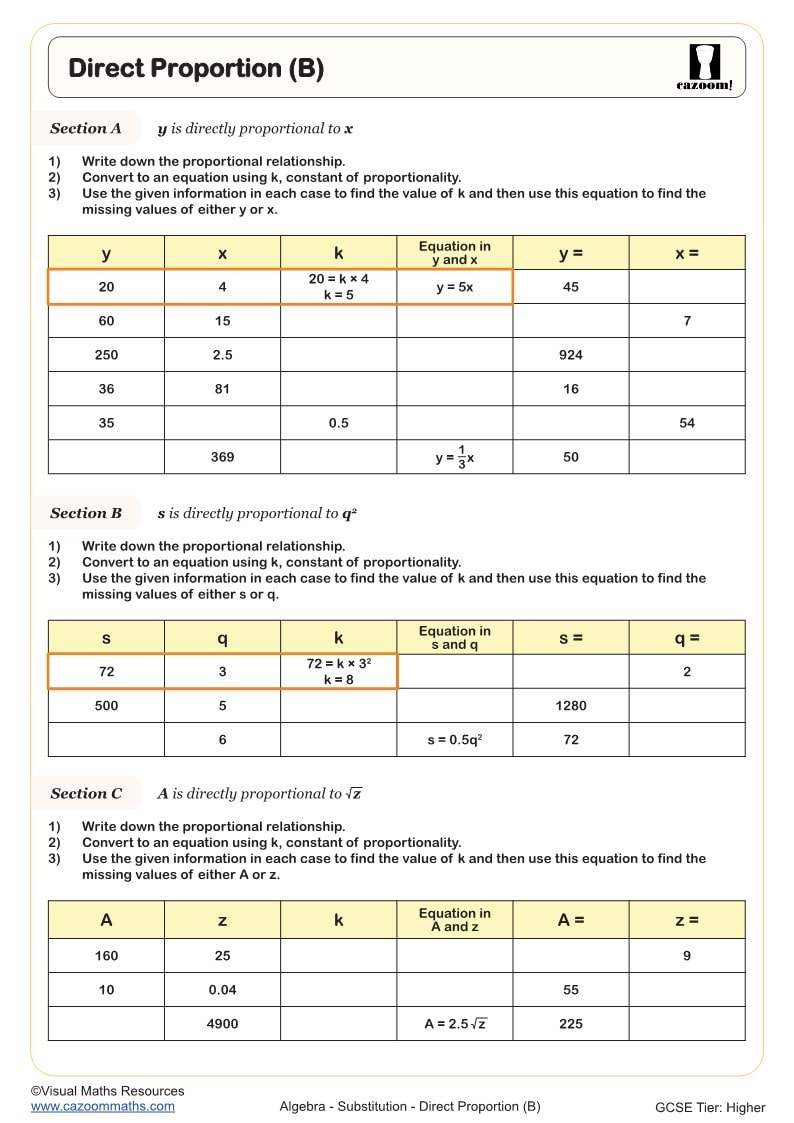
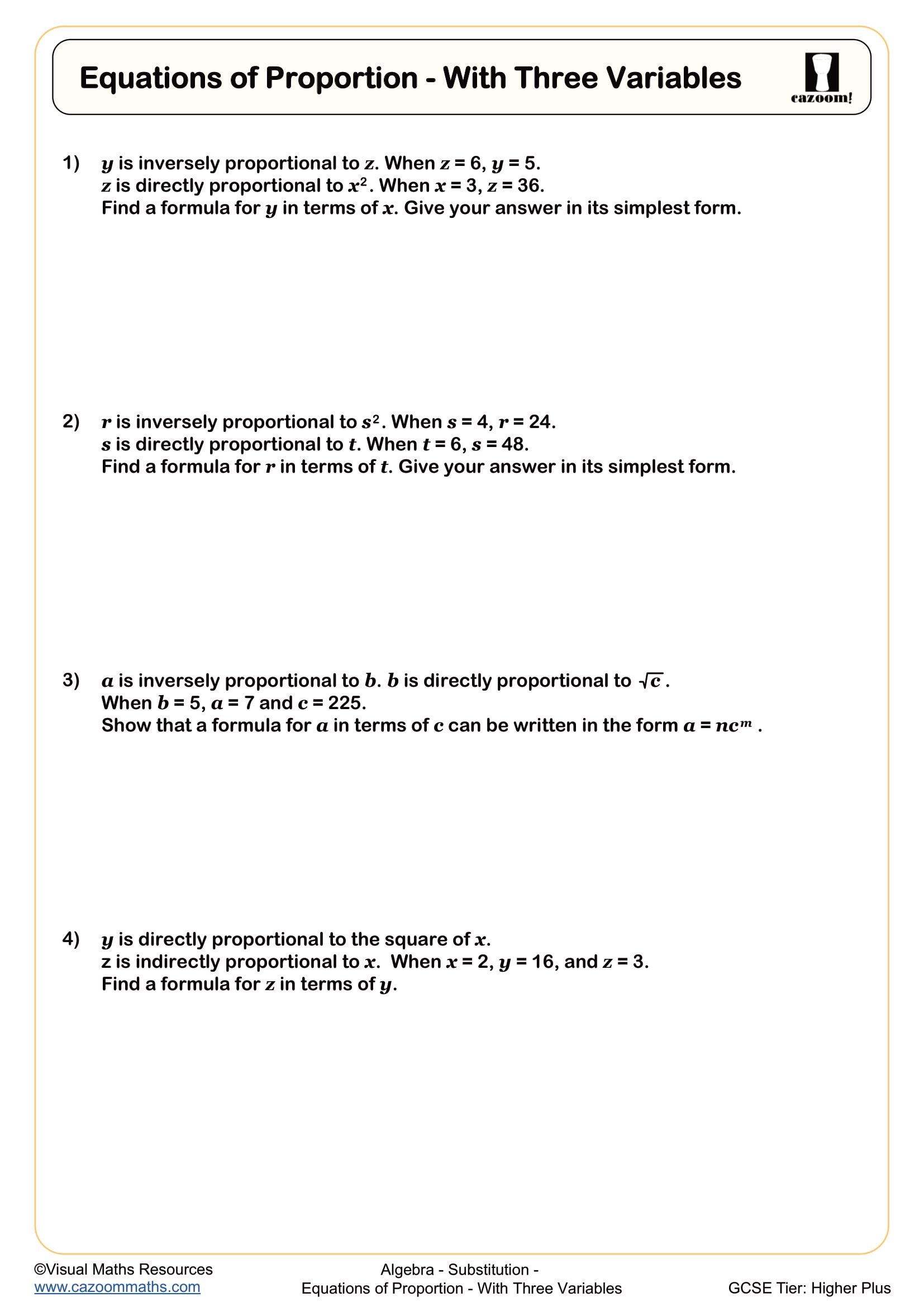
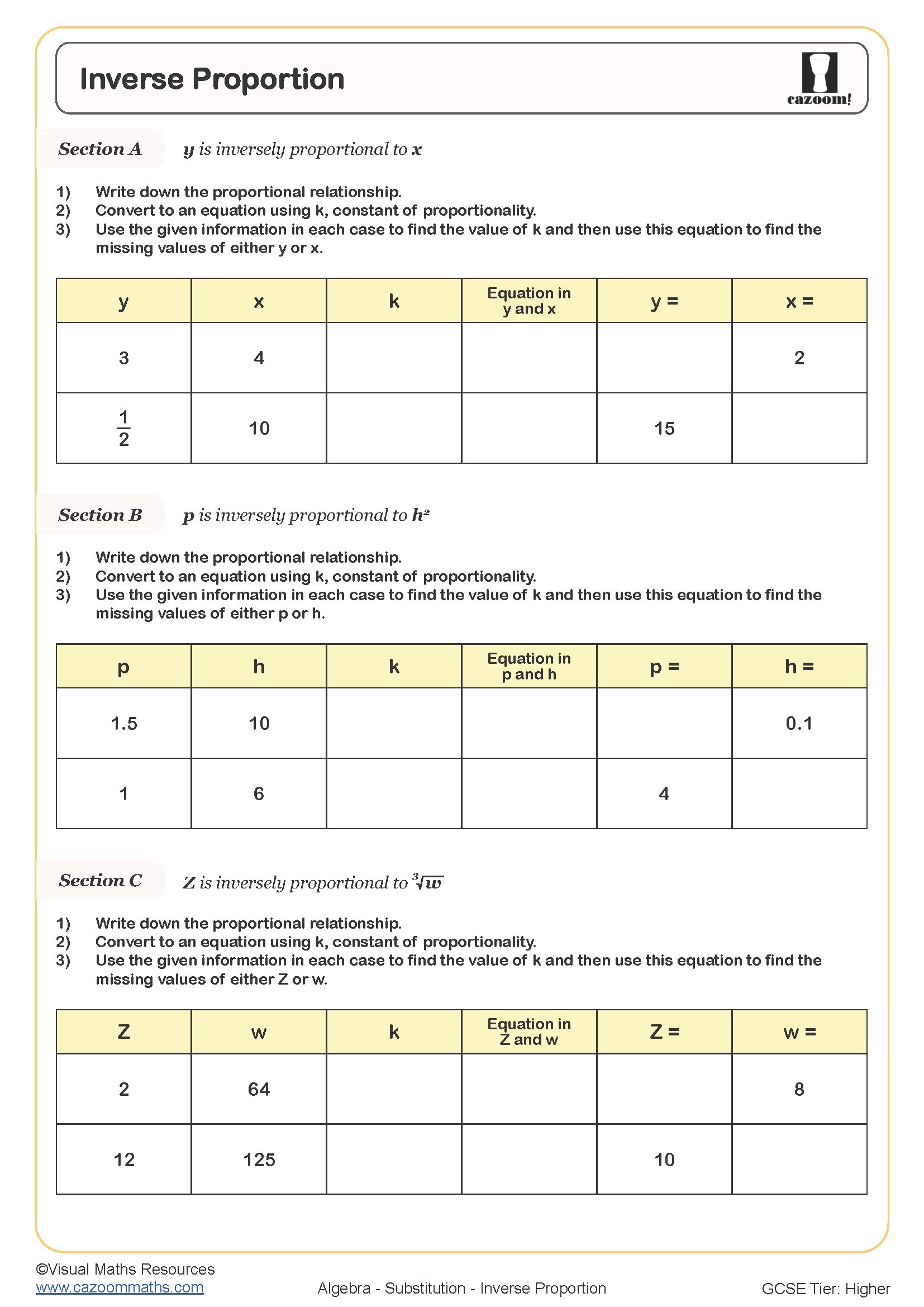
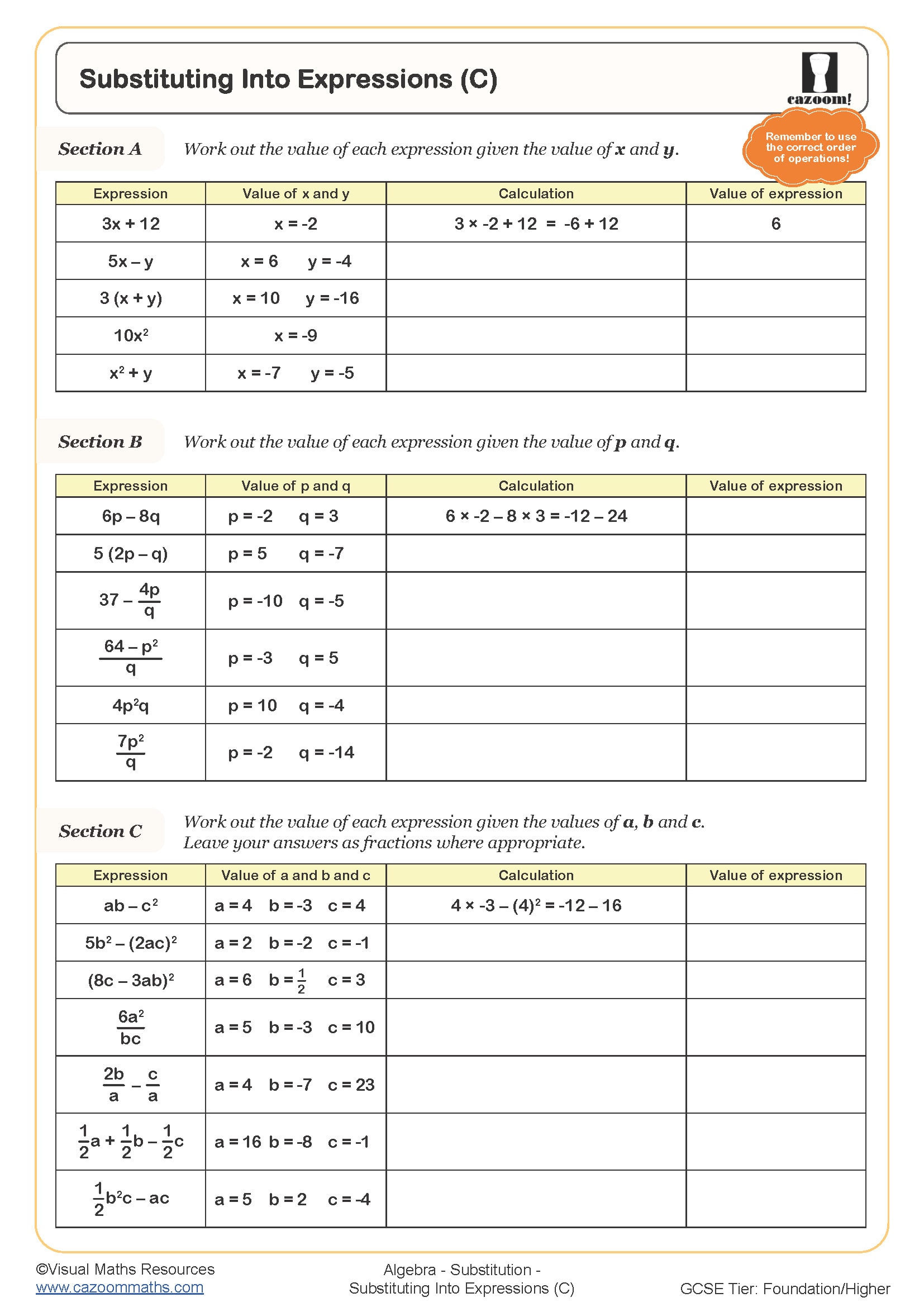
All worksheets are created by the team of experienced teachers at Cazoom Maths.
What is substitution in maths?
Substitution means replacing letters (variables) in an algebraic expression or formula with specific numerical values, then calculating the result. At Key Stage 4, students use this skill to evaluate expressions, check solutions to equations, and work with formulae across maths, science, and technology subjects. It's a fundamental technique that appears throughout GCSE assessments and requires confident handling of directed number and order of operations.
Students often struggle when negative values are substituted, particularly when they appear as indices or within brackets. A typical error involves substituting x = -3 into x² and writing (-3)² = -9 instead of 9, or incorrectly handling expressions like 2x when x is negative. Exam mark schemes consistently penalise missing brackets around negative substituted values, so emphasising this notation from the outset helps students avoid preventable mistakes.
Which year groups use substitution worksheets?
These substitution worksheets are designed for Year 10 students working within the Key Stage 4 curriculum. Substitution first appears formally in Key Stage 3, where students learn to substitute positive integers into simple expressions. By Year 10, the expectation is that students can handle more demanding substitutions involving negative numbers, fractions, decimals, and expressions with multiple variables or nested operations.
The difficulty progression across KS4 builds from straightforward single-variable expressions towards GCSE-level problems involving formulae, function notation, and substitution into quadratic or trigonometric expressions. Year 10 represents a consolidation phase where students must become fluent enough with the mechanical process to apply it reliably in problem-solving contexts, equation verification, and across science subjects where formulae substitution is routine.
How does using substitution apply to real-world problems?
Using substitution allows students to apply formulae and mathematical models to practical situations by inserting real measurements or values. The process teaches systematic working that translates directly to STEM contexts where formulae are essential tools. At GCSE level, students substitute into area and volume formulae, use the quadratic formula by substituting coefficients, and evaluate trigonometric expressions with angle measures.
Engineers use substitution constantly when applying standard formulae to design specifications, while programmers substitute variable values to test and debug code. In physics, substituting measured values into equations like s = ut + ½at² calculates real motion scenarios. This skill connects abstract algebra to quantifiable outcomes, helping students understand that formulae are practical tools rather than abstract exercises, which strengthens their appreciation of mathematics across scientific and technical disciplines.
How do these worksheets help students master substitution?
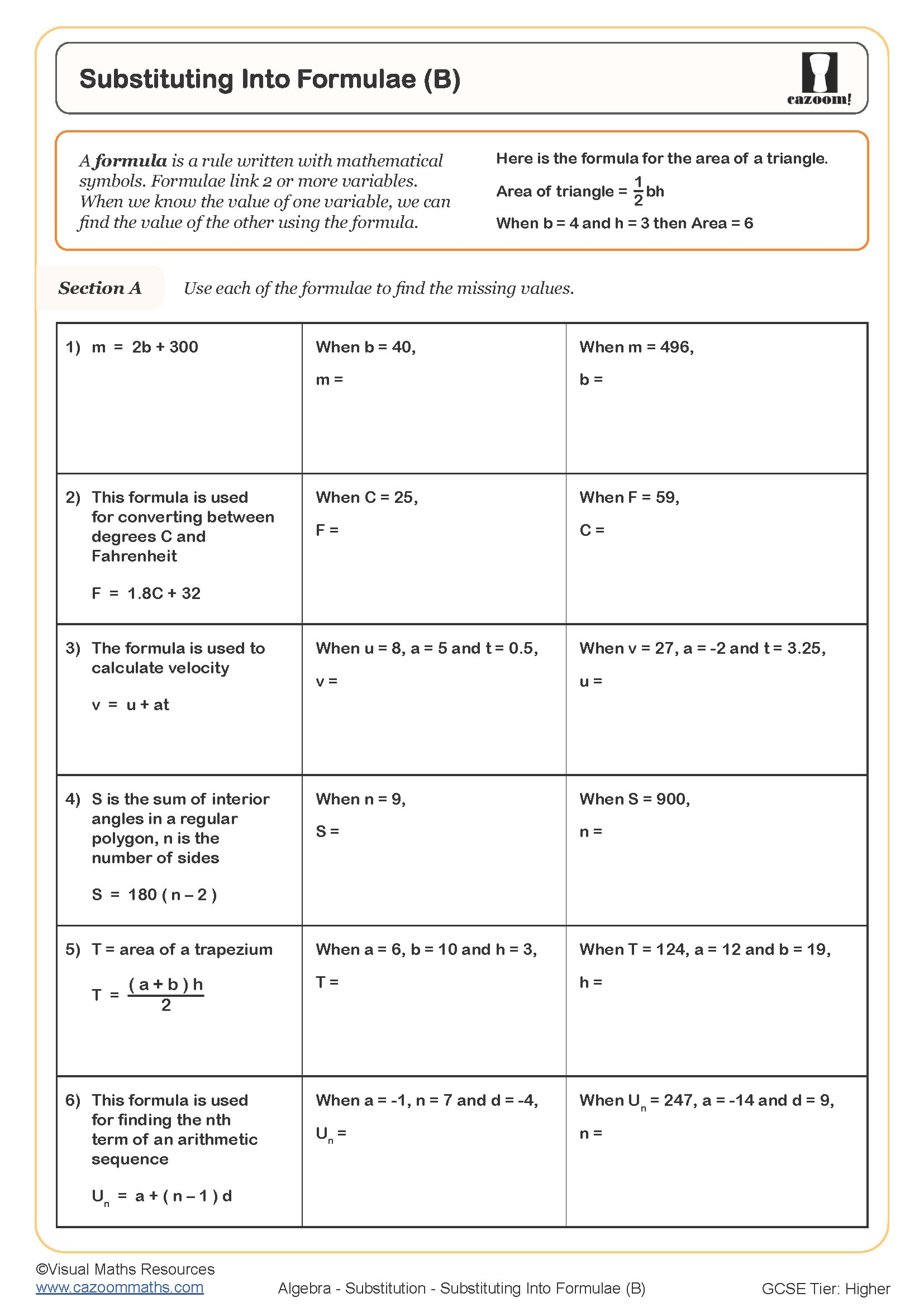
The worksheets provide structured practice that builds from straightforward substitutions towards problems requiring careful attention to notation and order of operations. Each sheet includes varied question types so students encounter different algebraic structures and value types, developing the flexibility needed for GCSE questions where substitution appears within larger problems. Answer sheets allow students to self-check their working, identifying error patterns before they become entrenched habits.
Many teachers use these resources for retrieval practice starters to maintain fluency, or set specific sheets as homework when students need additional consolidation after initial teaching. They work well in intervention groups where students may have gaps in directed number skills that become apparent through substitution errors. Paired work can be effective, with students checking each other's substitutions step-by-step, which encourages verbalisation of the method and catches the bracket omissions or sign errors that typically lose marks in assessments.